
14 / 18
Case file
Hospitality venue AV — banquet hall, ballroom and conference AV, restaurant and bar zone audio, and club-grade nightlife systems with JBL Professional, K-array and Kgear, engineered for hotels, resorts and standalone venues.
| Aspect | Separate-vendor fit-out | Zoned-system approach |
|---|---|---|
| Architecture | Each space wired in isolation | One zoned system on one managed network |
| Control | Independent boxes per room | Independent source and level per zone, one management surface |
| Provisioning | Rigging and power retrofitted late | Containment, power and rigging coordinated from drawing stage |
Educational comparison of delivery models — not a statement about any specific installer.
/ The discipline, in detail
How we approach hospitality venue av.
A hospitality property earns its reputation in its public spaces, and every one of them is an AV room. The banquet hall and ballroom need rigging points, floor boxes, dimmable house lighting and a PA that holds speech intelligibility for a wedding at full occupancy and a corporate town hall the next morning. The conference and meeting rooms need single-touch start and microphone coverage that survives a packed table. The all-day restaurant, the lobby, the spa and the corridors each need their own background-music zone with independent level and source — quiet enough at breakfast, alive by evening — and digital signage and display walls that the banquet sales team can re-skin per event. We engineer these as one zoned system on one network, commissioned space by space and handed over with documentation the property's own engineering team can run.
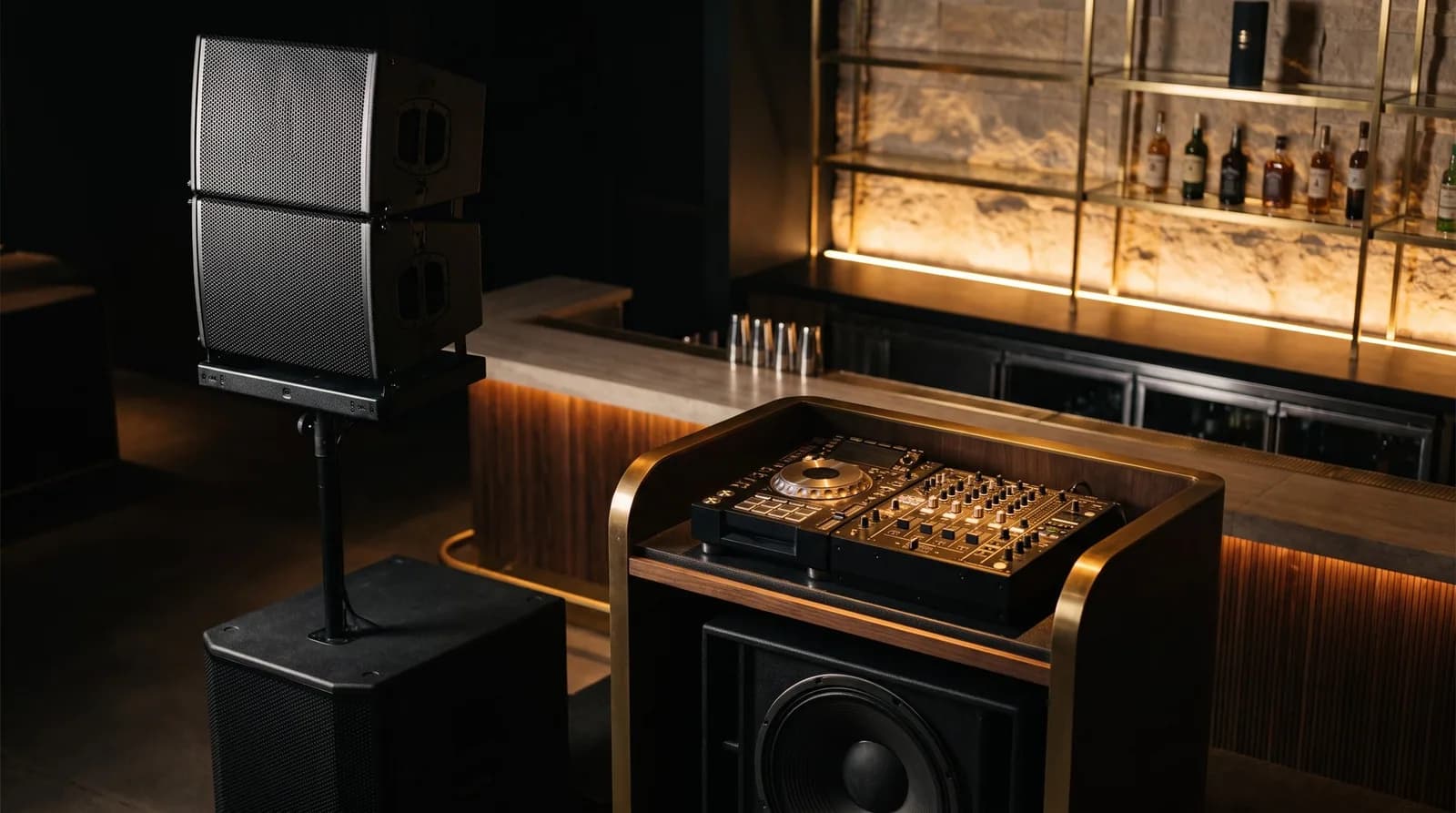
Standalone venues get the same discipline at higher energy. Speaker arrays at SPL the room can sustain without exhausting its guests; subwoofer cardioid arrays that aim into the dance-floor and away from the residences upstairs; DJ booth ergonomics that respect the rider; and an acoustic envelope that gets the venue past its sound-NOC inspection. Façade and interior lighting cycle through evening palettes on a calendar, stage lighting for live nights is rigged to the structural ceiling, and CCTV and access at the entrance integrate with the cover-charge or guestlist system rather than fighting it. For new hotel and resort projects we work alongside the architects, MEP consultants and interior designers from drawing stage, so containment, power and rigging provisions land before the finishes do.
On record
Every hospitality venue av engagement is documented end-to-end — design, programming, commissioning, calibration — and handed over with the files our successors would need if we were never to return.
/ Room control
Guest touch to room response
The guest-room control loop — one touch resolving lighting, climate, drapery and AV, with housekeeping and engineering states behind it.
Diagram · described
Hospitality room-control orchestration
A hospitality guest-room control system. Guest touch surfaces (bedside panel, wall keypad, TV remote, mobile app, voice assistant) feed a KNX or DALI bus through a room controller. The controller drives lighting scenes (welcome / sleep / wake), drape automation, HVAC setpoint, IPTV / smart-TV, multi-room audio and is gated by a property management system (PMS) check-in/out integration. Scene library is the operational contract — guest-touch always works; engineering complexity hides behind the bus.
Diagrammatic view — a system planning illustration for design discussion, not a project drawing or live interface.
/ Where we deploy this
Active across 2 sectors.
Hospitality Venue AV is rarely a standalone brief — it sits inside a wider sector practice with its own codes, expectations and operating rhythm.
/ Sister services
The rest of av.
A serious brief usually crosses two or three of these. Read across the discipline — we deliver them as one contract.
- 01
Home Theatre
Reference cinema, in your living room.
Custom-engineered private cinemas — projector, processor, screen, seating and acoustics designed to a single sweet-spot, following THX and Dolby Atmos reference layouts.0 - 02
Multi-Room Audio
One song. Every room. Or six different ones.
Whole-home audio on Yamaha, Sonance and BluOS — invisible in-ceiling speakers, hidden subs, room-corrected and zone-routed.1 - 03
Acoustic Solutions
Rooms that sound the way they look.
Acoustic design and treatment for cinemas, auditoriums, recording studios, places of worship and conference halls — engineered absorbers, diffusers, bass traps and ceiling clouds.2 - 04
Video Walls
Pixels at the scale of architecture.
Direct-view LED, fine-pitch LCD and rear-projection video walls for command centres, lobbies, broadcast studios, control rooms and event venues.3 - 05
Control Rooms & Command Centres
The room is the instrument.
Operator environments for security, utilities, transport and industrial monitoring — where the display wall, the operator position and the infrastructure behind them are engineered as one system that runs continuously.4 - 06
Smart Classrooms
Every student. Every word. Every time.
Interactive flat-panels, lecture-capture, voice-lift and learning-management integrations — engineered to NCERT, NEP-2020 and university lab specifications.5 - 07
LED Panels & Projectors
The right pixels for the room.
Direct-view LED, OLED, microLED and laser projection — selected to the room's lux, throw, sightline and content.6 - 08
Professional Audio & PA Systems
Intelligible, every seat in the house.
Public address, voice-evacuation and concert-grade audio for auditoriums, places of worship, stadia, transit hubs and event venues.7 - 09
Auditoriums & Boardrooms
Rooms that begin on time.
Turnkey auditorium, boardroom, training-room and conference-room AV — display, audio, control, video-conferencing and lighting integrated to a single touch.8 - 10
Digital Conferencing & Voting Systems
Sittings, voting, interpretation — one system, every seat.
Parliamentary-grade digital conferencing for legislative chambers, council halls and corporate boardrooms — mic management, electronic voting, 8-channel interpretation, camera control and chamber recording, integrated through Bosch DCN, Dicentis and Integrus.9 - 11
Recording Studios & Nightlife
Rooms tuned to the recording.
Recording studio design, post-production suites, broadcast booths and nightlife audio — acoustic isolation, monitoring, console integration and DJ infrastructure.10 - 12
Stage Lighting
Light that performs.
Theatre, concert, event, nightclub and place-of-worship stage lighting — moving heads, washes, profiles, pixel-mapped LED, effect lighting and MADRIX or ProtoPixel show control on DMX / Art-Net / sACN.11 - 13
Conference Room AV
Single-touch join. Every meeting.
Microsoft Teams Rooms, Zoom Rooms and Cisco Webex meeting rooms on platform-certified hardware, with auto-tracking cameras, ceiling-array microphones and one-touch room controllers.12 - 15
Digital Signage & Wayfinding
The right message, in the right place, on schedule.
Commercial indoor and outdoor display panels, signage video walls, menu boards, wayfinding and queue or information screens — driven by content-management software with scheduling and remote management for retail, hospitality, corporate, transport and institutional spaces.13 - 16
IPTV & Hospitality TV
Live channels, your channel, on every screen in the building.
Head-end reception and IP distribution of live television, in-house channels and content to commercial-grade and hotel TVs — with interactive welcome screens, an electronic programme guide, casting and integration into the property's network and guest-room systems.14 - 17
Queue Management System
Take a token, watch the counter, walk up.
Token and queue management — ticket dispensers, counter and main calling displays, audio call-forward, multi-counter routing and wait-time analytics — for healthcare, banks, government and retail counters.15 - 18
IP Paging & Announcement
Page the right zone, over the network.
IP network paging and announcement — zoned paging over the data network, SIP/telephone and desktop paging, scheduled bells and announcements — integrated with the PA and telephony systems for offices, campuses, industrial and transit sites.16
/ Integration with
How hospitality venue av talks to the rest.
A serious deployment of this system rarely operates in isolation. The disciplines below most commonly share its cabling pathways, its controller logic, and its cause-and-effect matrix.
Professional Audio & PA Systems
Intelligible, every seat in the house.
Public address, voice-evacuation and concert-grade audio for auditoriums, places of worship, stadia, transit hubs and event venues.IPTV & Hospitality TV
Live channels, your channel, on every screen in the building.
Head-end reception and IP distribution of live television, in-house channels and content to commercial-grade and hotel TVs — with interactive welcome screens, an electronic programme guide, casting and integration into the property's network and guest-room systems.Acoustic Solutions
Rooms that sound the way they look.
Acoustic design and treatment for cinemas, auditoriums, recording studios, places of worship and conference halls — engineered absorbers, diffusers, bass traps and ceiling clouds.
/ Read deeper
The engineering, in long form.
Each article below goes deeper than this service page can — a full walk-through of the engineering decisions, written by the team that delivers this work.
- Smart Living · 7 min
Hospitality room control: PMS integration is the contract; KNX/DALI is the implementation
Premium hospitality room control is sold as KNX vs DALI vs Crestron. Operated as guest-touch surfaces against a scene library. Held together by the PMS (property management system) integration that gates check-in / check-out / housekeeping state. The protocol choice is the implementation detail; the PMS integration is the operational contract.
Read article - AV · 11 min
Public-address system design: STI targets, zoning, and the line-array hang nobody calculates
A public-address system is graded by speech intelligibility (STI) at every seat, not by the headline wattage. The discipline of designing for STI ≥ 0.55 across an 800-seat hall, the zoning that lets emergency announcements over-ride routine paging, and the line-array hang geometry that delivers flat coverage from row A to row Z.
Read article
Engineering toolkit
Tools to scope this work
Calculators and reference checkers we use ourselves to sense-check the engineering before any drawings change hands.
- AV · Audio · Coverage
Speaker Coverage Planner
Engineering-grade speaker coverage and SPL planner across a source-cited public model catalogue spanning pro touring, commercial audio and architectural speakers. Predicts SPL at listener distance, the horizontal coverage width at that distance on the -6 dB dispersion axis, and the quantity needed for the room.
45 brands · SPL predictionOpen - Hospitality · Systems
Hotel Technology Planner
Pick the property archetype — boutique, 4-star, 5-star, resort — and the planner maps each space (guest floor, lobby, banquet, F&B, spa, BoH) to systems, AP density, AV grade and lifecycle cost.
property × space × systemsOpen - BMS · Energy
Energy & Efficiency Estimator
Adjust building variables and see indicative energy and CO₂ savings (kWh) for a BMS-driven energy upgrade plus daylight-harvesting LED retrofit. Conservative; defensible in a first conversation.
kWh · CO₂ savedOpen
/ Engineering concepts
Related engineering concepts
Concept
Scene Orchestration Pattern
Engraved-keypad-driven scene programming where lighting, shades, climate, audio and AV move together to a named room state (Welcome, Dinner, Film, Goodnight) — programmed once and triggered as one.
Concept
Harman Pro Ecosystem (JBL · Crown · BSS · Soundcraft · AKG)
Harman Professional brand family used across our cinema, auditorium and PA deployments — JBL loudspeakers, Crown amplification, BSS DSP, Soundcraft consoles, AKG microphones.
Concept
K-array & KGEAR — Premium Italian Architectural Audio
Premium Italian architectural-audio ecosystem — K-array's slim, discreet loudspeakers and the KGEAR everyday professional line — specified for design-led residences, hospitality and premium interiors across North-East India.
Concept
National Building Code 2016 (India)
India's umbrella building-services code. Sets fire and life-safety, structural, building-services and accessibility requirements that every ELV, fire, PA and BMS scope must cite line-by-line.
/ Used alongside
Commonly deployed alongside
Sector
Hospitality
Guest experience, engineered.
Sector
Restaurants, Bars & Clubs
The room. The night. The sound.
Service
Professional Audio & PA Systems
Intelligible, every seat in the house.
Service
Multi-Room Audio
One song. Every room. Or six different ones.
Service
CCTV & Surveillance
Coverage. Storage. Evidence.
Service
Building Management System (BMS)
The building, on a single dashboard.
/ Plan it right
Hospitality Venue AV — getting the brief right.
Common mistakes to avoid
- Provisioning banquet AV power, rigging and floor boxes after finishes, so every event needs surface cabling across a finished ballroom.
- Treating background music as a per-outlet purchase instead of one zoned, centrally managed system across lobby, F&B and corridors.
- Designing SPL for the empty room, not the occupied one — and forgetting the neighbours that decide the sound NOC.
- Skipping acoustic isolation between the banquet hall and guest floors, discovered on the first wedding night.
- No operator handover: a venue system the duty manager cannot run becomes a service call every weekend.
- Booking a wedding or conference stream and recording after the AV is designed, so there is no clean multi-camera image-magnification feed, audio embed or streaming path left to add.
- Ignoring a divisible ballroom's air-walls, so a single un-zoned system cannot combine and divide with the partitions for two events at once.
What to share before a quotation
- Floor plans for the banquet, F&B and public spaces (shared privately, not published).
- Banquet capacity, stage position and the event mix the venue expects to host.
- Zone list for background music with rough operating hours per zone.
- Whether DJ / live-performance use is in scope, and the neighbouring occupancies.
- Whether live streaming, multi-camera image-magnification or recording is expected, and whether the ballroom divides into separate halls with their own sound.
- Operator brand standards where the property is flagged.
Equipment categories
See the equipment behind the solution.
Explore equipment we supply and the services around it. The final specification follows your space, operating needs and agreed scope.
Equipment illustration
POS machines & systems
Point-of-sale equipment for retail and food-service counters. Billing software, payment interfaces and compatibility need project-specific confirmation.
Explore related service
Equipment illustration
KOT printers
Kitchen order ticket printers for restaurant, café and hospitality workflows. The ordering system and connection method are confirmed before supply.
Explore related service
/ Frequently asked
Hospitality Venue AV — what buyers ask first.
What AV systems should a new hotel or banquet property plan before construction?
Banquet and ballroom AV provisioning — rigging points, stage power, floor boxes, projection or LED-wall positions — must land at structure stage; retrofitting them onto a finished ballroom costs multiples and shows. Background-music zoning for the restaurant, lobby and corridors, conference-room AV containment, and the equipment-rack position should all be on the drawings before the false ceiling closes. Share the architectural drawings, the banquet capacity and the operator's brand standards (where one exists) and TechnoGuru will return a coordinated AV scope alongside the fire, CCTV and networking systems it usually accompanies.
Can one system cover the banquet hall, restaurant and bar with different moods?
Yes — that is exactly what zoned audio over a managed network is for. Each space runs as its own zone with independent source, level and schedule: instrumental at breakfast in the all-day dining, energy in the bar by evening, and the banquet hall isolated on its own system for events. The zones share amplification racks, the network backbone and one management surface, so the property's engineering team operates the whole building from one place.
Can you stream and record a wedding or conference held in the banquet hall?
Yes — for weddings, conferences and hybrid events we design multi-camera image-magnification (IMAG) to the LED wall or projection so the back of the hall sees the stage, plus a clean streaming feed to the platform the event chooses and a synchronised recording for the record. The camera, switching and audio-embed layer is planned alongside the room's PA and display so the stream carries the same intelligible mix the room hears. Share the room, the run-of-show and whether the stream is public or private and TechnoGuru will return a coordinated scope.
Can the ballroom be split into separate halls with their own sound?
Yes — where a ballroom is divisible on air-walls, the audio is designed to combine and divide with the partitions. Each salon runs as its own DSP zone with independent microphone, source and level when the walls are closed, and the zones recombine to one system when the room is opened out. Partition-position awareness keeps the sound matched to the physical layout so an event in one salon never bleeds into the meeting next door.
Can you cover a live singer, duo or small band as well as a DJ?
Yes — alongside the DJ booth we plan a live-performance package: vocal wired and wireless microphones with coordinated frequencies, instrument DI inputs, performer stage-monitor wedges or in-ear monitoring, and a compact digital mixer sized to the act. The lounge or bar can run a background-music evening, a solo singer, a duo or a small band on the same room system without re-patching between sets. Tell us the largest act you expect to host and we size the inputs and monitoring for it.
What's the cost of a club-grade PA system in India?
Cost scales with venue size, target SPL and rider expectations. A rooftop bar PA — main array, two subs, monitors and processing — is the entry scale; a dedicated dance-floor club at SPL 110 dBA with cardioid sub array, full coverage and DJ booth is a larger one. TechnoGuru does not publish tentative prices or budget bands because every project depends on site conditions, drawings, system scope, brands, integration depth, commissioning and support requirements. Please email info@technoguru.in or WhatsApp/call +91 88110 34444 with your drawings, BOQ or project brief for a written estimate after review.
What makes a rooftop bar's audio different from a restaurant's?
Rooftop bars need full-spectrum SPL output that is intelligible at 90+ dB and copes with monsoon weather; restaurants need restrained zone-audio at 70–75 dB with crisp speech intelligibility. Different fixture families: JBL Professional or K-array outdoor cardioid for rooftops, Sonance or Bose distributed in-ceiling for restaurants.
How do you zone audio in a multi-area venue?
Each named area (bar, dining, lounge, deck, bathroom) gets independent source selection, volume and equalisation through a DSP matrix (BSS Soundweb, Q-SYS Core). The bar can be playing one DJ set while the dining area runs ambient jazz, with the bathrooms on the same source as the lounge but at lower volume.
What's the right way to handle monsoon at a rooftop venue?
IP-rated speakers (IP55+ for cardioid, IP65 for fully exposed positions), removable canopies over the most-exposed cabinets, a documented monsoon-shutdown sequence operated from the audio booth, and elevated cable trays. We design the audio with the worst-case rain in mind.
Do hospitality venues need DJ-grade mixing positions?
If the venue programmes live DJ sets — yes, with proper booth monitors, isolated mains supply, RF coordination for radio mics, and a feed that lets the DJ hear the floor sound. We engineer DJ booths in close coordination with the venue's resident or visiting acts.
What's the lifecycle of a hospitality AV install?
Speakers and amplifiers last 12–15 years with AMC. DSP and routing matrices on a 7-year refresh. Cabling is a 25-year asset if installed correctly. We design hospitality systems for the venue's planned 10-year operating life with budgeted refresh windows for the active components.
· Begin
Begin a
hospitality venue av
brief.
Tell us about the building, the timeline, and what success looks like a year after handover. We will reply within two working days with a written response, not a sales pitch.