
16 / 18
Case file
IPTV & Hospitality TV.
Live channels, your channel, on every screen in the building.
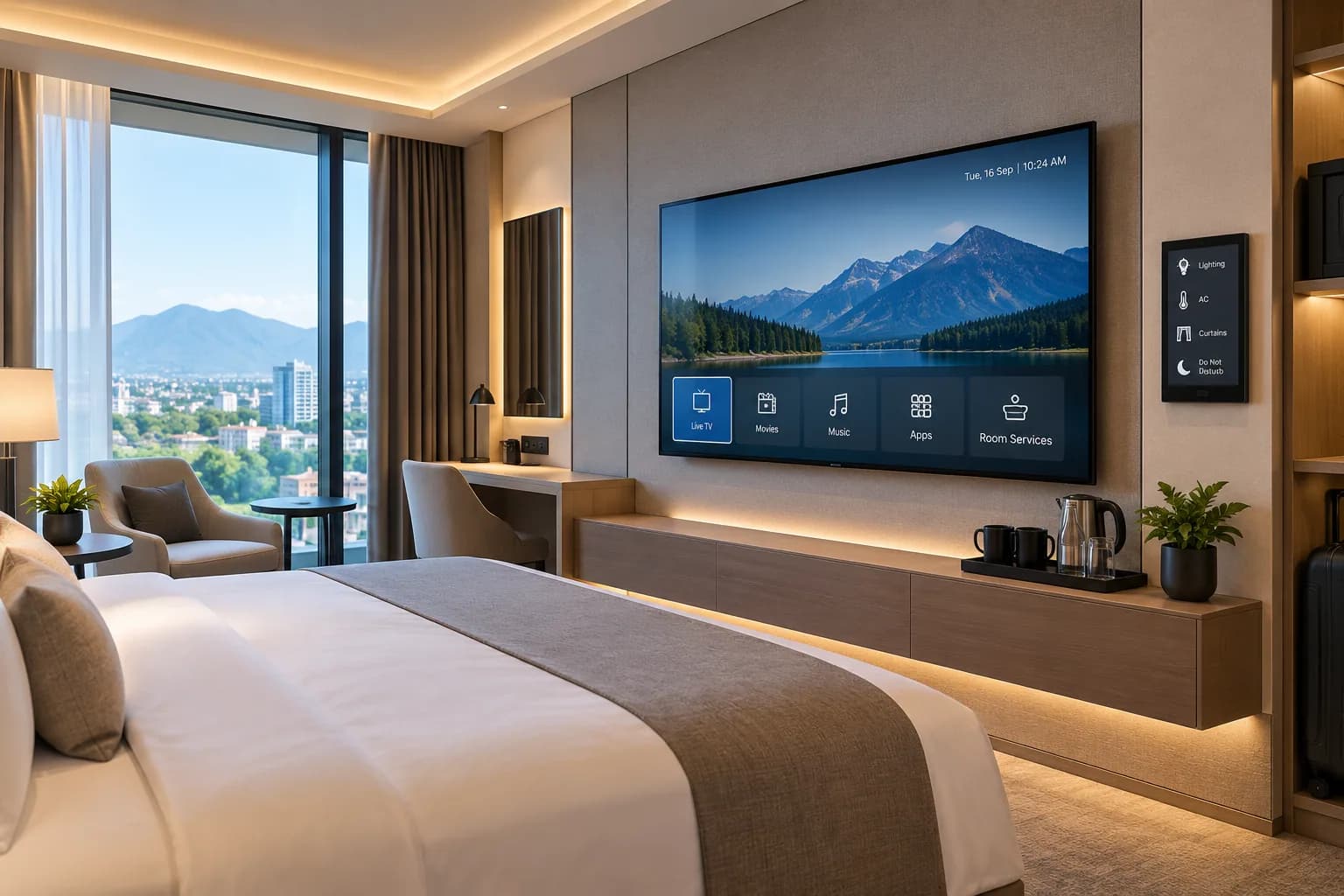
Head-end reception and IP distribution of live television, in-house channels and content to commercial-grade and hotel TVs — with interactive welcome screens, an electronic programme guide, casting and integration into the property's network and guest-room systems.
| Aspect | Off-the-shelf | Engineered approach |
|---|---|---|
| Distribution | Coaxial feed and a set-top box per room | Head-end, middleware and a managed network deliver IP streams to every screen without rewiring |
| Guest experience | Fixed channel list | Interactive welcome screen, electronic programme guide, multi-language line-ups and casting from a guest device |
| Network | Shares one flat network | Television traffic segmented so it never competes with guest internet, integrated with guest-room systems |
Educational comparison of design rigour — not a statement about any specific installer.
/ The discipline, in detail
How we approach iptv & hospitality tv.
Hospitality television is a distribution problem before it is a screen problem. We build the head-end that receives broadcast, DTH and over-the-top sources, the encoding and middleware layer that turns them into clean IP streams, and the managed network that carries those streams to every commercial-grade or hotel television in the building without a set-top box on each desk. The guest sees live channels in their language, an electronic programme guide, an interactive welcome screen that greets them by room, and the ability to cast from their own phone to the in-room display; the property sees one platform it can re-skin for an event, a season or a brand standard. We engineer channel line-ups, language packs and the in-house information channel as a managed service the front-office team can edit.
We design IPTV to live inside the property's wider systems, not beside them. The platform shares the structured-cabling and networking backbone we coordinate, integrates the in-room display with guest-room controls and welcome messaging where the room system supports it, and segments television traffic so it never competes with guest internet or operational networks. Commissioning covers a documented channel map, a tested welcome and EPG flow per room type, and a handover the property's own engineering and front-office teams can run. Where a new hotel or resort is still on the drawing board, we provision the head-end position, containment and network capacity alongside the AV, CCTV and fire systems before the finishes close in.
On record
Every iptv & hospitality tv engagement is documented end-to-end — design, programming, commissioning, calibration — and handed over with the files our successors would need if we were never to return.
/ AV-over-IP
Headend to room
How a hospitality TV headend distributes live channels, casting and property information to every room over the converged network.
Diagram · described
Enterprise AV-over-IP orchestration
Five horizontal lanes show how sources, encoders, an orchestrated switch fabric, decoders and rooms compose an enterprise AV-over-IP deployment. The fabric carries VLAN segmentation, QoS, time-sync and the control plane; decoders sit per room with display-side downstream.
Diagrammatic view — a system planning illustration for design discussion, not a project drawing or live interface.
/ Where we deploy this
Active across 4 sectors.
IPTV & Hospitality TV is rarely a standalone brief — it sits inside a wider sector practice with its own codes, expectations and operating rhythm.
/ Sister services
The rest of av.
A serious brief usually crosses two or three of these. Read across the discipline — we deliver them as one contract.
- 01
Home Theatre
Reference cinema, in your living room.
Custom-engineered private cinemas — projector, processor, screen, seating and acoustics designed to a single sweet-spot, following THX and Dolby Atmos reference layouts.0 - 02
Multi-Room Audio
One song. Every room. Or six different ones.
Whole-home audio on Yamaha, Sonance and BluOS — invisible in-ceiling speakers, hidden subs, room-corrected and zone-routed.1 - 03
Acoustic Solutions
Rooms that sound the way they look.
Acoustic design and treatment for cinemas, auditoriums, recording studios, places of worship and conference halls — engineered absorbers, diffusers, bass traps and ceiling clouds.2 - 04
Video Walls
Pixels at the scale of architecture.
Direct-view LED, fine-pitch LCD and rear-projection video walls for command centres, lobbies, broadcast studios, control rooms and event venues.3 - 05
Control Rooms & Command Centres
The room is the instrument.
Operator environments for security, utilities, transport and industrial monitoring — where the display wall, the operator position and the infrastructure behind them are engineered as one system that runs continuously.4 - 06
Smart Classrooms
Every student. Every word. Every time.
Interactive flat-panels, lecture-capture, voice-lift and learning-management integrations — engineered to NCERT, NEP-2020 and university lab specifications.5 - 07
LED Panels & Projectors
The right pixels for the room.
Direct-view LED, OLED, microLED and laser projection — selected to the room's lux, throw, sightline and content.6 - 08
Professional Audio & PA Systems
Intelligible, every seat in the house.
Public address, voice-evacuation and concert-grade audio for auditoriums, places of worship, stadia, transit hubs and event venues.7 - 09
Auditoriums & Boardrooms
Rooms that begin on time.
Turnkey auditorium, boardroom, training-room and conference-room AV — display, audio, control, video-conferencing and lighting integrated to a single touch.8 - 10
Digital Conferencing & Voting Systems
Sittings, voting, interpretation — one system, every seat.
Parliamentary-grade digital conferencing for legislative chambers, council halls and corporate boardrooms — mic management, electronic voting, 8-channel interpretation, camera control and chamber recording, integrated through Bosch DCN, Dicentis and Integrus.9 - 11
Recording Studios & Nightlife
Rooms tuned to the recording.
Recording studio design, post-production suites, broadcast booths and nightlife audio — acoustic isolation, monitoring, console integration and DJ infrastructure.10 - 12
Stage Lighting
Light that performs.
Theatre, concert, event, nightclub and place-of-worship stage lighting — moving heads, washes, profiles, pixel-mapped LED, effect lighting and MADRIX or ProtoPixel show control on DMX / Art-Net / sACN.11 - 13
Conference Room AV
Single-touch join. Every meeting.
Microsoft Teams Rooms, Zoom Rooms and Cisco Webex meeting rooms on platform-certified hardware, with auto-tracking cameras, ceiling-array microphones and one-touch room controllers.12 - 14
Hospitality Venue AV
From the banquet stage to the last bar stool.
Hospitality venue AV — banquet hall, ballroom and conference AV, restaurant and bar zone audio, and club-grade nightlife systems with JBL Professional, K-array and Kgear, engineered for hotels, resorts and standalone venues.13 - 15
Digital Signage & Wayfinding
The right message, in the right place, on schedule.
Commercial indoor and outdoor display panels, signage video walls, menu boards, wayfinding and queue or information screens — driven by content-management software with scheduling and remote management for retail, hospitality, corporate, transport and institutional spaces.14 - 17
Queue Management System
Take a token, watch the counter, walk up.
Token and queue management — ticket dispensers, counter and main calling displays, audio call-forward, multi-counter routing and wait-time analytics — for healthcare, banks, government and retail counters.15 - 18
IP Paging & Announcement
Page the right zone, over the network.
IP network paging and announcement — zoned paging over the data network, SIP/telephone and desktop paging, scheduled bells and announcements — integrated with the PA and telephony systems for offices, campuses, industrial and transit sites.16
/ Integration with
How iptv & hospitality tv talks to the rest.
A serious deployment of this system rarely operates in isolation. The disciplines below most commonly share its cabling pathways, its controller logic, and its cause-and-effect matrix.
Enterprise Network Design & Installation
Wires the building's nervous system.
Structured cabling, Wi-Fi 7, switching, SD-WAN and data-centre networking — Cisco, HPE Aruba, Juniper, Netgear, CommScope.Structured Cabling
Backbones rated for the next quarter-century.
Cat6A, OS2 and OM4/OM5 structured cabling — designed to TIA-568, terminated to manufacturer warranty and labelled to a documented patch schedule.Hospitality Venue AV
From the banquet stage to the last bar stool.
Hospitality venue AV — banquet hall, ballroom and conference AV, restaurant and bar zone audio, and club-grade nightlife systems with JBL Professional, K-array and Kgear, engineered for hotels, resorts and standalone venues.
Engineering toolkit
Tools to scope this work
Calculators and reference checkers we use ourselves to sense-check the engineering before any drawings change hands.
- IT · Networking
Network & PoE Calculator
Sized to year-three load — switches, Wi-Fi 7 access points, PoE budget (watts), Cat6A run count, port/AP sizing. Cisco / HPE Aruba / Juniper-class enterprise gear.
Switches · APs · PoE WOpen - Hospitality · Systems
Hotel Technology Planner
Pick the property archetype — boutique, 4-star, 5-star, resort — and the planner maps each space (guest floor, lobby, banquet, F&B, spa, BoH) to systems, AP density, AV grade and lifecycle cost.
property × space × systemsOpen - Hospitality · Readiness
Pre-Opening Hotel Technology Checklist
A pre-opening readiness self-check across a hotel's technology systems — fire alarm + PA commissioning, CCTV and access handover, guest Wi-Fi, GRMS, TV, BMS and back-of-house comms — with the close-out list for the time remaining. Banded statuses only; no room counts, layouts or pricing.
Advisory · readinessOpen
/ Engineering concepts
Related engineering concepts
Concept
Cat6A Structured Cabling
Augmented Category 6 structured cabling — 10 Gbps over the full 100 m channel, rated for 25 years of service. The default for any new commercial or premium-residential cabling layer.
Concept
Wi-Fi 7 (IEEE 802.11be)
Current generation of Wi-Fi. Adds 6 GHz band, MLO multi-link operation and 320 MHz channels. Default for new premium deployments where dense-room capacity is the binding constraint.
Concept
Power over Ethernet (IEEE 802.3)
IEEE-standard delivery of low-voltage DC power over the same Cat-class cable as data. PoE+ delivers up to 30 W; PoE++ Type 3/4 up to 90 W — sufficient for IP cameras, APs, VOIP phones and small displays.
Concept
Scene Orchestration Pattern
Engraved-keypad-driven scene programming where lighting, shades, climate, audio and AV move together to a named room state (Welcome, Dinner, Film, Goodnight) — programmed once and triggered as one.
/ Used alongside
Commonly deployed alongside
Sector
Hospitality
Guest experience, engineered.
Service
Building Management System (BMS)
The building, on a single dashboard.
Service
Professional Audio & PA Systems
Intelligible, every seat in the house.
Service
CCTV & Surveillance
Coverage. Storage. Evidence.
Service
Enterprise Wi-Fi
Coverage you can measure, not just claim.
Service
Fire Alarm System
Detection that pinpoints. Response that is coordinated.
/ Plan it right
IPTV & Hospitality TV — getting the brief right.
Common mistakes to avoid
- Buying the televisions before the distribution architecture — the head-end, network and TV capabilities must be designed together.
- Running IPTV over an unmanaged guest network with no multicast plan, so channels stutter exactly when the property is full.
- Ignoring content-source legitimacy when redistributing broadcast and OTT feeds through the head-end.
- Treating welcome screens and the programme guide as an afterthought the property team cannot edit later.
- Leaving PMS and guest-room integration unplanned, so the interactive layer never actually materialises.
What to share before a quotation
- Room count and TV positions, plus the public-area screens in scope.
- The source line-up — broadcast, DTH, in-house channels — and the language mix.
- The network design — managed switches, multicast support, VLAN structure.
- The PMS and guest-room systems in use and the integration intent.
- Whether casting and interactive welcome screens are in scope.
/ Frequently asked
IPTV & Hospitality TV — what buyers ask first.
What's the difference between IPTV and regular hotel television?
Regular hotel television feeds a coaxial signal to each room with a set-top box and limited control; IPTV distributes channels and content as IP streams over the property's data network, so every screen is a managed endpoint. That lets the property run its own welcome screen, in-house information channel, electronic programme guide and casting, re-skin the experience for an event or brand standard, and update line-ups centrally — without rewiring the building. We design the head-end, the middleware and the network segment together so television traffic stays separate from guest internet.
Can IPTV integrate with the guest-room and network systems we already have?
That is how we design it. The IPTV platform runs on the structured-cabling and networking backbone, on its own segment so it does not compete with guest or operational traffic, and the in-room display integrates with guest-room controls and welcome messaging where the room system supports it. Share the property's network design and room-control platform and TechnoGuru will return a coordinated IPTV scope alongside the AV, CCTV and networking systems it usually accompanies.
Can we keep the televisions we already have?
Sometimes — we audit them honestly. Existing sets can often receive the channel line-up through set-top devices, but hospitality-grade TVs are what unlock the interactive layer: welcome screens, the programme guide and casting integrated per room. The audit tells you which rooms need what before anything is priced in writing.
Does IPTV need its own cable network through the hotel?
No — that is its advantage. Television rides the property's managed data network alongside everything else, which is why the network design (managed switches, multicast support, VLAN separation from guest traffic) is the real engineering. One structured cabling plant serves TV, Wi-Fi and the guest-room systems together.
Can guests cast their own content to the room TV?
Yes — casting is scoped per room, with the guest's device paired only to their own display and kept isolated on the guest network. It has become a baseline expectation in new properties, and it changes the network design, so we ask whether casting is in scope at the start rather than bolting it on later.
· Begin
Begin a
iptv & hospitality tv
brief.
Tell us about the building, the timeline, and what success looks like a year after handover. We will reply within two working days with a written response, not a sales pitch.