
Residential.
The premium home, made quiet.
Private apartments, villas, farmhouses and palatial residences across the North-East, West Bengal and the neighbouring countries. Rako, Fibaro, KNX, Sonance, JBL Professional — engineered to disappear into the architecture.
| Aspect | Retrofit afterthought | TechnoGuru — coordinated |
|---|---|---|
| Timing | Added after plaster, chased into walls | Cable routes and scenes planned before plaster with the architect |
| Scenes | Generic numbered buttons | Keypads engraved in the family's own words for each room |
| Future zones | New additions break walls | Spare capacity pulled so later zones are a commissioning job |
Educational comparison of delivery models — not a statement about any specific installer.
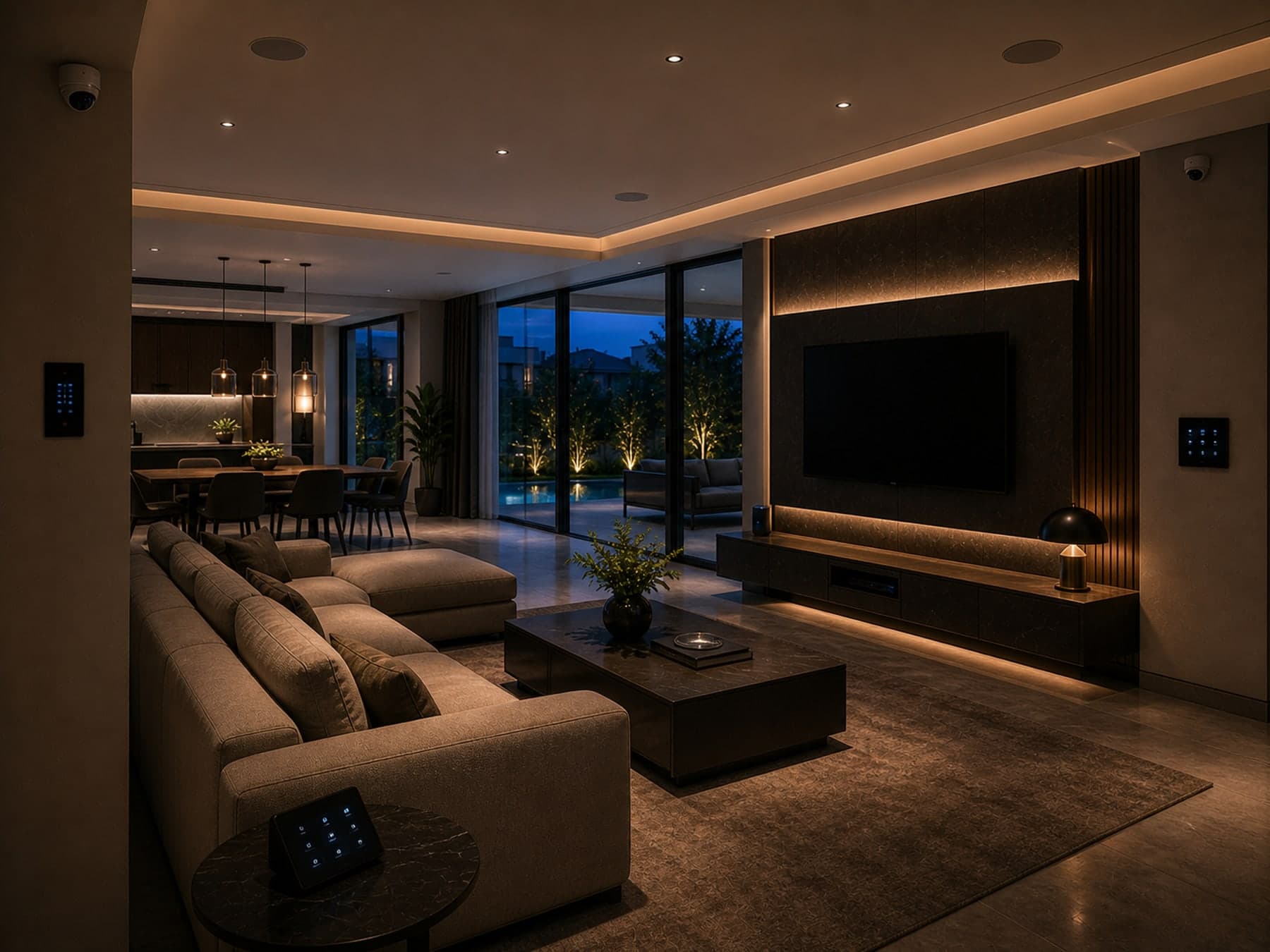
Our residential practice begins at the architectural drawing stage. Lighting layouts, audio coverage, cinema sightlines and security cabling are plotted before plaster — never retrofit. Every keypad is engraved with the room's actual scenes; every speaker is hidden where the eye cannot search; every server rack is acoustically isolated from the bedroom above it.
We work with established architects and interior designers as a discreet sub-consultant. The homeowner sees a single point of accountability, the architect sees an integrator who respects the design intent, and the contractor sees a coordinated cable schedule.
· What we coordinate at home
Smart living, entertainment, security and infrastructure — under one coordination layer.
From mood scenes to the network rack, these are the residential systems TechnoGuru can plan and integrate for flats, villas, penthouses and private homes. What each home needs is decided with your architect, interior and electrical teams — scope depends on project fit, the final devices and site conditions.
Comfort and control
The everyday layer — light, climate and entry that respond as one.
- Smart-home automation
- Lighting control and mood scenes
- Curtain and blind automation
- AC and climate-control integration, where compatible
- Smart locks and entrance automation
Entertainment and lifestyle
Music and media that follow the family through the house.
- Multi-room audio
- Home theatre and media-room systems
- TV, projector, screen and display solutions
- Balcony, bathroom, bar, lounge and dining-area audio
- Gaming-room and kids'-room AV and controls
Network, cabling and infrastructure
The quiet backbone everything else depends on.
- Wi-Fi coverage and networking
- IT infrastructure and structured cabling
- Concealed low-voltage wiring coordination
- Work-from-home connectivity planning
- Network-rack and AV-rack planning
- UPS backup for Wi-Fi, automation, CCTV and AV
Security and access
Knowing who is at the door, and what is happening at home.
- Video door phone systems
- CCTV and basic residential security
- Door and motion sensors
- Intrusion alerts
- Smart-entrance integration
Future readiness
Built so tomorrow's additions are a commissioning job, not a wall-breaking one.
- Provisions for future smart devices
- Upgrade-ready cabling and rack planning
- Coordination with architects, interior designers, electricians and civil teams
Planned during the wiring and interior stages, with future-ready provisions pulled for upgrades later. We agree the detail privately against your drawings — this page never publishes device counts, quantities or layouts.
Planning a residence
What shapes a home that runs quietly
The best residential systems are decided at the drawing stage, not retro-fitted later. These are the choices we work through with you and the architect before anything is wired.
- Involved at drawing stage
- Conduit, control points and equipment locations are agreed against the architectural drawings, so the technology disappears into the home rather than being bolted on afterwards.
- Lighting and scene zoning
- Circuits, dimming and shade groups are planned around how each room is actually lived in, so a single scene can settle the whole space.
- Whole-home audio and AV
- Sources, zones and the cinema are distributed over one backbone, so music and media follow the family through the house.
- Network and a single control idea
- A coverage-planned network underpins it all, and one consistent control philosophy keeps the home approachable for everyone who lives in it.
· Core services
10 services
delivered to this sector.
Grouped by the engineering layer each system belongs to — the way the scope is actually coordinated on site.
Indicative coordination scope. Not every project engages every layer; the working scope is agreed against the drawings before anything is specified.
Equipment categories
See the equipment behind the solution.
Explore equipment we supply and the services around it. The final specification follows your space, operating needs and agreed scope.
· Frequently asked
Residential —
what buyers ask first.
What can TechnoGuru do for a premium home, villa or penthouse?
For a premium home, villa or penthouse, TechnoGuru can coordinate smart-home automation, lighting and mood scenes, curtains and blinds, multi-room audio, a home theatre, Wi-Fi and networking, structured cabling, CCTV and residential security, video door phone and smart-lock entry, and UPS backup for the systems that should stay on — planned as one coordinated low-voltage layer. We work across Rako, Fibaro, KNX and AMX platforms and bring it together with the network and AV racks, concealed cabling and future-ready provisions, planned during the wiring and interior stages alongside your architect, interior and electrical teams. What each home needs depends on project fit, the final devices and the site, so the exact scope is agreed before anything is wired.
How early in the home-build process should I bring in a smart-home integrator?
Bring a smart-home integrator in at the architectural drawing stage, before any wiring is pulled — typically 6–12 weeks before construction begins. Ideally at the architectural drawing stage, before any wiring is pulled. Cable pathways, panel locations, lighting schedules and acoustic envelopes are dramatically more effective and visually integrated when designed alongside the architecture. Our first meeting is best with the architect and interior designer in the room.
What are the typical scenes you programme for a residence?
Typical residential scenes are Welcome, Day, Dinner, Film and Goodnight — engraved on keypads in the family's actual words rather than generic numbers. Welcome (foyer warms, entry music, security disarms), Day (daylight harvesting, drapery on sun-load), Dinner (dining warms to 2200 K, kitchen task-lit, dining audio), Film (cinema bias only, drapery closed, AV routes), Goodnight (path lighting, perimeter armed, climate eco). The scenes are engraved on the keypads in the words your family actually uses, not generic numbers.
Can a smart home survive a power outage or internet drop?
Yes — keypads and scenes operate fully through power outages and internet drops; with battery-backed circuits, scene memory is preserved through outages. Every keypad, scene and local control function continues to operate without internet. With battery-backed circuits, scene memory is preserved through power outages. Internet is only required for remote app access, voice control, and software updates — not for daily use of the home.
Do you work with our interior designer and architect or independently?
Always with the architect and interior designer — never independently — delivering shop drawings to their standards and respecting design intent end-to-end. We deliver shop drawings to the architect's standards, attend design coordination meetings, and respect interior intent. Engraved keypads, fabric speaker grilles, hidden subwoofers and recessed projector lifts are details we agree with the design team rather than imposing on them.
What's the realistic budget range for a premium villa?
The budget is driven by floor area, the controlled-fixture count, the number of audio zones, and the cinema specification. A 4,000–6,000 sq ft villa with full Rako, climate, audio and basic cinema sits at one scale; a reference 9.1.6 cinema with Trinnov Altitude processing, JBL Synthesis or Focal speakers, Rako lighting, invisible architectural audio and full Fibaro Home programming sits well above it. TechnoGuru does not publish tentative prices or budget bands because every project depends on site conditions, drawings, system scope, brands, integration depth, commissioning and support requirements. Please email info@technoguru.in or WhatsApp/call +91 88110 34444 with your drawings, BOQ or project brief for a written estimate after review.
How is a residential project coordinated when the family is living through the build?
Through phased commissioning, dust-isolation hoarding and zone-by-zone scene activation, with our site supervisor as the household's single point of contact. Phased commissioning and visible discipline on site. We sequence noisy and dust-heavy work to predictable windows, isolate occupied rooms with proper protection, and commission scenes one zone at a time so the family always has working lighting and audio in the rooms they are using. Our site supervisor is the single point of contact for the household — we do not let the project bleed into family life by accident.
Can the system grow as the family does — guest wing, future cinema, outdoor entertainment?
Yes — we pull spare cabling capacity to obvious future zones (rooftop, basement, guest wing, garden) at first build, so future expansions are commissioning exercises rather than wall-breaking ones. The time to plan for it is now, before plaster. We typically pull a small reserve of cabling capacity to the obvious future zones (rooftop, basement, guest wing, garden), terminate them in the central rack, and document the spare runs in the as-built pack. Years later, adding the new cinema or the outdoor audio zone is a commissioning exercise rather than a wall-breaking one.
What does the post-handover relationship look like for a residential client?
Most residential clients enrol in a residential AMC after handover — quarterly health checks, scheduled firmware updates, a named engineer and a small spares pool. Most of our residential clients move onto a residential AMC after handover — quarterly health checks, scheduled firmware updates, a named engineer for any service request, and a small spares pool held against the home's specific deployment. The aim is that the family never has to remember our number; we are the ones tracking the calendar. Some clients prefer a pay-per-visit relationship, which we also support.
Can an existing home be upgraded, or is this only for new construction?
Existing homes can be upgraded — new construction simply gives more freedom, because conduit and cabling can be concealed before plaster. In a finished home we work with what the structure allows: retrofit-friendly automation, lighting and audio platforms, wireless where chasing walls is not practical, and a staged plan so the rooms that matter most are done first. We tell you honestly where a clean result needs a little building work and where it does not, rather than promising that everything can be hidden after the fact.
Can Wi-Fi, CCTV, automation and AV keep running during a power cut?
Yes — the core network, CCTV recorder, automation processor and key AV can sit on UPS backup so the essentials ride through a power cut rather than dropping every time the supply blinks. How long they stay up is a sizing decision we make with you — a short bridge to cover a generator changeover, or longer for the systems that matter most. Backup runtime depends on the final equipment and the load you choose to protect, so we size it to the home rather than quoting a fixed figure.
Engineering decisions
Decisions that shape residential projects
Decision · AV & Audio
Architectural audio vs conventional loudspeakers — the design approach
You are choosing a loudspeaker approach for a design-sensitive space and weighing concealment and even coverage against conventional flexibility and cost.
Decision · AV & Audio
Home theatre AVR vs separates — processing and amplification
You are specifying the processing and amplification for a home cinema and weighing a single receiver against separates.
Decision · Smart Building & Automation
KNX vs wireless smart-home automation — the control backbone
You are choosing the control backbone for a residence or building and weighing wired robustness against retrofit flexibility.
Decision · Networking & IT
Managed Wi-Fi vs consumer mesh — the right wireless for the building
You are deciding the wireless class for a home, office, retail or hospitality space and want it matched to the real client load and ownership model.
Engineering toolkit
Tools we use for residential work
Calculators and reference checkers our engineers reach for first on projects in this sector.
- AV · Projection
Projector Throw Distance Calculator
Engineering-grade throw distance calculator across a verified multi-brand projector catalogue — Sony, JVC, Epson, BenQ, LG, Optoma, ViewSonic, Panasonic, Barco, Christie, Canon, InFocus, Maxell, Casio, EIKI, Philips, Nebula, JMGO, Dangbei, Boxlight, ASUS, Leica, Xiaomi, WEMAX, Ricoh and more. Searchable picker, throw range, lens-shift envelope, viewing distance, pixel density, feasibility flags and a custom-throw fallback. Sources cited per model.
51 brands · sourcedOpen - AV · Cinema
Cinema Sizer
Room dimensions in, recommended screen size, seat layout, Atmos format and projector throw out. Reference / Premium / Media-room tiers.
Screen · seats · AtmosOpen - Smart Home
Smart Home Discovery Wizard
For villa and apartment owners — pick your home, the zones that matter and the experiences you want, and map a coordination scope and room checklist. Not a final design, device count or security layout.
Advisory · discoveryOpen
/ Engineering notes
Long-form reading for residential projects
Insight
Anatomy of a premium villa automation scope — an anonymised discipline breakdown
An anonymised, discipline-by-discipline breakdown of a real 2,800 sq-ft North-East India villa fit-out — lighting automation, shading, multi-room audio, AV, CCTV, access control, structured cabling, Wi-Fi, UPS and AMC. What each discipline actually contains, the brand bands and the trade-offs we made. Pricing is project-specific and follows a written estimate after review.
Insight
AMC scope transparency — what a serious AMC actually includes (and what thin ones omit)
An honest breakdown of what an Annual Maintenance Contract on a premium integrated system actually has to deliver — preventive visits, response-target capacity, parts pool and obsolescence reserve, configuration discipline, lifecycle planning — and what gets quietly excluded from a thin AMC. Pricing is scoped per project and shared in writing after review.
Insight
Government ELV procurement: GeM, EMD, BG, BOQ and the paperwork that decides who wins
How Central and State Government ELV tenders work in India — the role of GeM empanelment, EMD/BG instruments, BOQ formats and the technical specifications that decide a bid before commercial opening. A field guide for systems integrators bidding their first government contract and for departments writing their first tender.
Every calculator, checker and planner curated for residential projects lives on one directory page.
All residential tools →· Begin
Project in residential?
Begin a brief.
The first reply will come from a project lead, not a sales gateway, within two working days.