
Government & Public Safety.
Mission-grade integration.
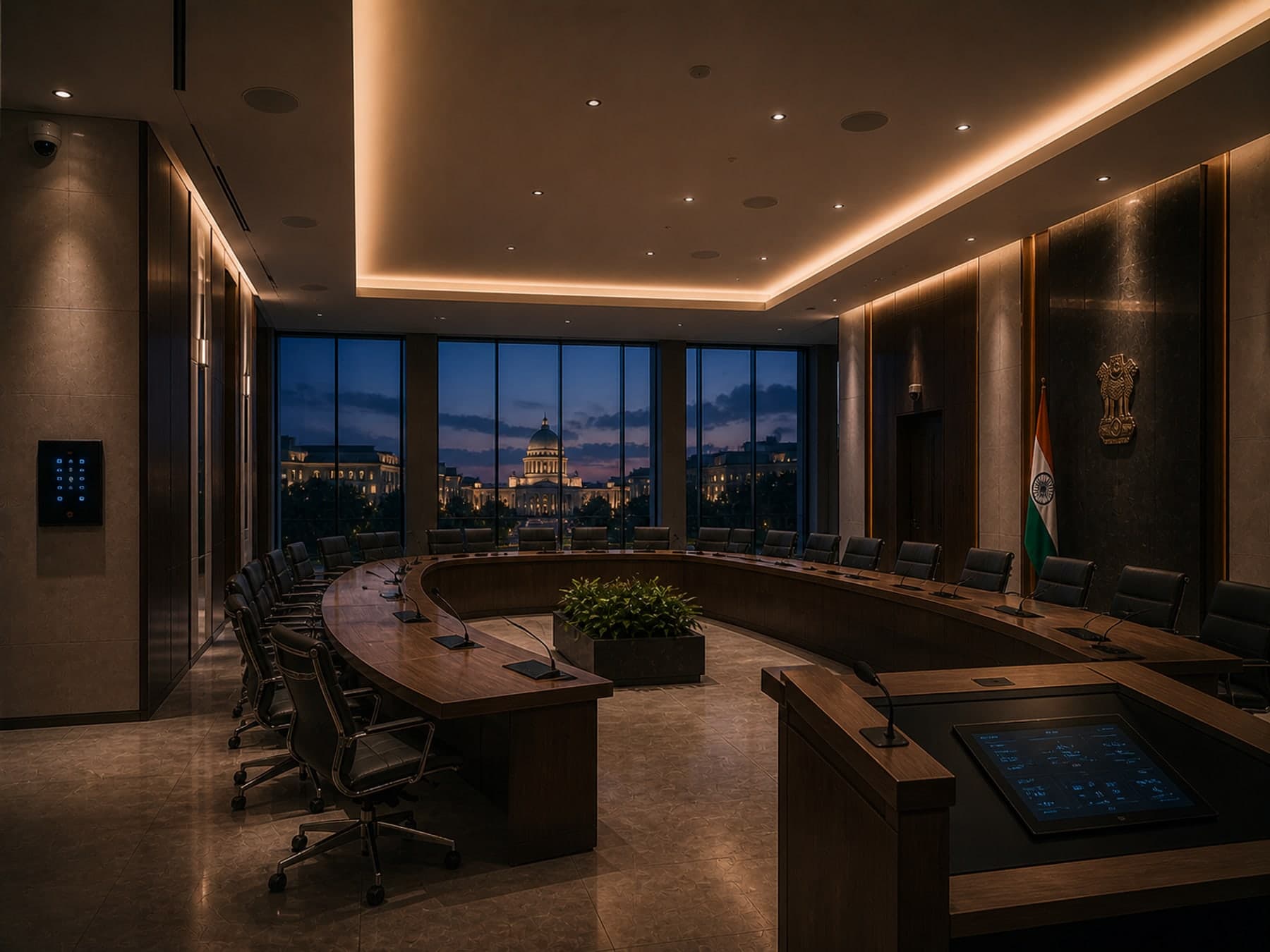
Defence establishments, paramilitary, embassies, secretariats, courts, police HQs — surveillance, access control, perimeter, vehicle screening and command-and-control.
| Aspect | Fragmented delivery | TechnoGuru — coordinated |
|---|---|---|
| Screening | Detectors and scanners bought piecemeal | UVSS, X-ray and DFMD sized to the site's actual threat profile |
| Command | Separate feeds across consoles | Surveillance, screening and access on one operator picture |
| Documentation | Records reconstructed from memory | Every drawing, test and device captured to a versioned baseline |
Educational comparison of delivery models — not a statement about any specific installer.
TechnoGuru has supplied and installed audio systems for Army requirements and supplied interactive panels through GeM bids for defence-related requirements. These are genuine delivered-work references. Public project examples elsewhere in this sector describe civic auditoria, legislative spaces and government conference rooms at their individually approved scope.
Government auditoriums, assembly halls and cultural venues are a distinct engineering discipline inside this sector, and one we have delivered publicly: the Capital Cultural Hall in Kohima and the Town Hall Auditorium in Dimapur both run speech-grade line-array PA engineered to measured intelligibility targets, with video, room acoustics, stage lighting and stage furnishing designed as one venue — and on the same contracts we delivered each hall's fire-alarm and fire-hydrant systems as their own life-safety scope. For a government auditorium the specification stage is where the project is won or lost — STI targets written into the tender, the fire consultant's requirement for that building settled before the tender closes rather than after, and any interface between the fire system and the PA decided at design stage rather than discovered at commissioning — so we support departments, PWD engineers and consultants at that stage through our specification-support and vendor-onboarding resources.
Alongside the venues sits the quieter volume of government-office ELV work across Assam and the North-East: surveillance, access control, fire detection, structured cabling, UPS and PA for secretariats, directorates, courts and district offices. Procurement typically runs through GeM, where TechnoGuru is an active seller, or through departmental tenders, and the documentation follows the tender's own format — signed drawings, witnessed commissioning logs and versioned as-builts, so an audit query years later is answered from records rather than memory. Empanelment and registration always remain subject to each department's own process; we state only the registrations we actually hold.
· Selected clients · Government
Systems delivered across government sites in the North-East.
- PWD — Assam Public Works Department
- Public Works Department, Arunachal Pradesh
- Reserve Bank of India
- BSNL
- TRIFED
- Assam Power Distribution Company Limited
- Arunachal Pradesh Legislative Assembly, Itanagar
- Government of Arunachal Pradesh
Organisations across whose sites and facilities we have delivered systems — directly or as a specialist sub-contractor. Most engagements stay under contractual confidentiality; listing implies no endorsement or exclusivity, and trademarks remain the property of their owners. The full roster.
· What we coordinate for public-safety sites
Screening, command, public halls and infrastructure — engineered for public safety.
Government buildings, command centres, public halls and civic infrastructure. These are the systems TechnoGuru can plan, integrate and support — described in broad, public-safe terms. Operational and security specifics are handled privately, never published.
Security screening
Entry-point screening, planned discreetly.
- Door-frame metal detectors
- X-ray baggage scanners
- Under-vehicle surveillance
- Access control and boom barriers
- Bollards
Command and control
A single picture for the people on duty.
- CCTV surveillance systems
- Command-centre display systems
- Video walls
- PA and emergency announcement
Public halls and conference spaces
Halls and chambers that carry the room.
- Conference-room AV
- Auditorium AV
- Stage lighting and stage systems
- Public address and paging
IT and infrastructure
The backbone behind the operation.
- Networking and IT infrastructure
- Structured cabling
- Server and rack planning
- UPS and online-UPS systems
Life safety and support
Code compliance, integration and long-term care.
- Fire alarm systems
- Fire hydrant and safety systems
- BMS integration where required
- Digital signage
- AMC and long-term support
Scope is indicative and public-safe; we do not publish security layouts, operational detail, device counts or quantities. Engagement and procurement follow the site's own processes.
Illustrative cause-and-effect sequence: when the trigger event fires — Perimeter alarm · Gate 3 (Intrusion sensor triggered · armed.) — the integrated systems respond in order: CCTV pre-position: PTZ slewed to Gate 3, neighbours frame the approach corridor.; Inner door lockdown: Soft-lock applied to corridor doors B1–B4 pending duty-officer release.; PA pre-announcement: Code message broadcast to staff zones; public zones unaffected.; Duty officer page: Pager + IP phone + Teams alert · acknowledgement clock running.; Tamper-evident log: Event hashed and counter-signed; CCTV clip bookmarked.. The animation steps through each response with the same information; use the Run and Reset controls to replay it. This is a demonstration of how the systems are wired together, not a recording from a live site.
— Cause & effect · Government & defence
Intrusion alarm. Perimeter answers as one.
A breach at the perimeter triggers CCTV pre-position, access lockdown on inner doors, PA pre-announcement and the duty-officer page — written into the cause-and-effect matrix and audited per event.
Perimeter alarm · Gate 3
Intrusion sensor triggered · armed.
- 01
CCTV pre-position
PTZ slewed to Gate 3, neighbours frame the approach corridor.
CCTV - 02
Inner door lockdown
Soft-lock applied to corridor doors B1–B4 pending duty-officer release.
Access - 03
PA pre-announcement
Code message broadcast to staff zones; public zones unaffected.
PA - 04
Duty officer page
Pager + IP phone + Teams alert · acknowledgement clock running.
Comms - 05
Tamper-evident log
Event hashed and counter-signed; CCTV clip bookmarked.
Compliance
· Core services
10 services
delivered to this sector.
Grouped by the engineering layer each system belongs to — the way the scope is actually coordinated on site.
- CCTV & SurveillanceCoverage. Storage. Evidence.
- Access ControlRight person. Right door. Right time.
- X-Ray Baggage ScannersOperator confidence, in seconds.
- Under Vehicle Surveillance (UVSS)Full-chassis scan, the moment a vehicle arrives.
- Door-Frame Metal DetectorsQuick, unobtrusive, accurate.
- Boom Barriers & Motorised GatesControlled flow, every gate.
- Fire Alarm SystemDetection that pinpoints. Response that is coordinated.
- Fire Hydrant SystemHigh-volume water, precisely where it's needed.
Indicative coordination scope. Not every project engages every layer; the working scope is agreed against the drawings before anything is specified.
· Delivered as turnkey
Cultural and institutional builds, delivered end to end
On turnkey auditorium and cultural-infrastructure work — such as Town Hall Dimapur and the Cultural Capital Complex, Kohima — our scope is not limited to supply or installation. It can span audio, video, IT, acoustics, fire hydrant, fire alarm and fire extinguisher works where applicable to project scope, HVAC, stage furnishing, stage lighting, auditorium seating, step lighting and controlled / dimmable indoor lighting, alongside BOQ / design coordination and interior planning / design coordination where required by the auditorium scope — coordinated as one accountable hand from requirement to handover, subject to drawings, AHJ / consultant review and project scope.
· Selected proof
Reference work in
government.
Owner-approved projects, shown with project-safe public scope. Each links to a written case study.
- 01
Arunachal Pradesh Legislative Assembly
Itanagar, Arunachal Pradesh
Completed · 2017
- 02
Multi-Purpose Hall, Arunachal Pradesh Assembly Complex
Itanagar, Arunachal Pradesh
Completed · 2018
- 03
Cabinet Conference Room, Arunachal Pradesh Secretariat
Itanagar, Arunachal Pradesh
Completed · 2018
- 04
Conference Room, Chief Minister's Residential Complex, Kohima
Kohima, Nagaland
Completed · 2022
- 05
Capital Cultural Hall, Kohima
Kohima, Nagaland
Completed · 2022
- 06
Town Hall Auditorium, Dimapur
Dimapur, Nagaland
Completed · 2024
- 07
Multipurpose Cultural Hall, Namsai
Namsai, Arunachal Pradesh
Completed · 2018
- 08
Taraghar — State Guest House
Shillong, Meghalaya
Completed · 2025
- 09
Assam State Guest House, Koinadhara
Guwahati, Assam
Completed · 2021
Public project summaries describe systems and outcomes only — BOQ values, quantities, device counts and security layouts are kept off public surfaces.
Equipment categories
See the equipment behind the solution.
Explore equipment we supply and the services around it. The final specification follows your space, operating needs and agreed scope.
Equipment illustration
Interactive flat panels
Touch flat panels for classrooms, training rooms and boardrooms — supplied directly and through GeM. Panel size, mounting and the room's source and control arrangement are confirmed for each order.
Explore related service
Illustrative — generated visual, not a real project photograph. Illustrative category scene
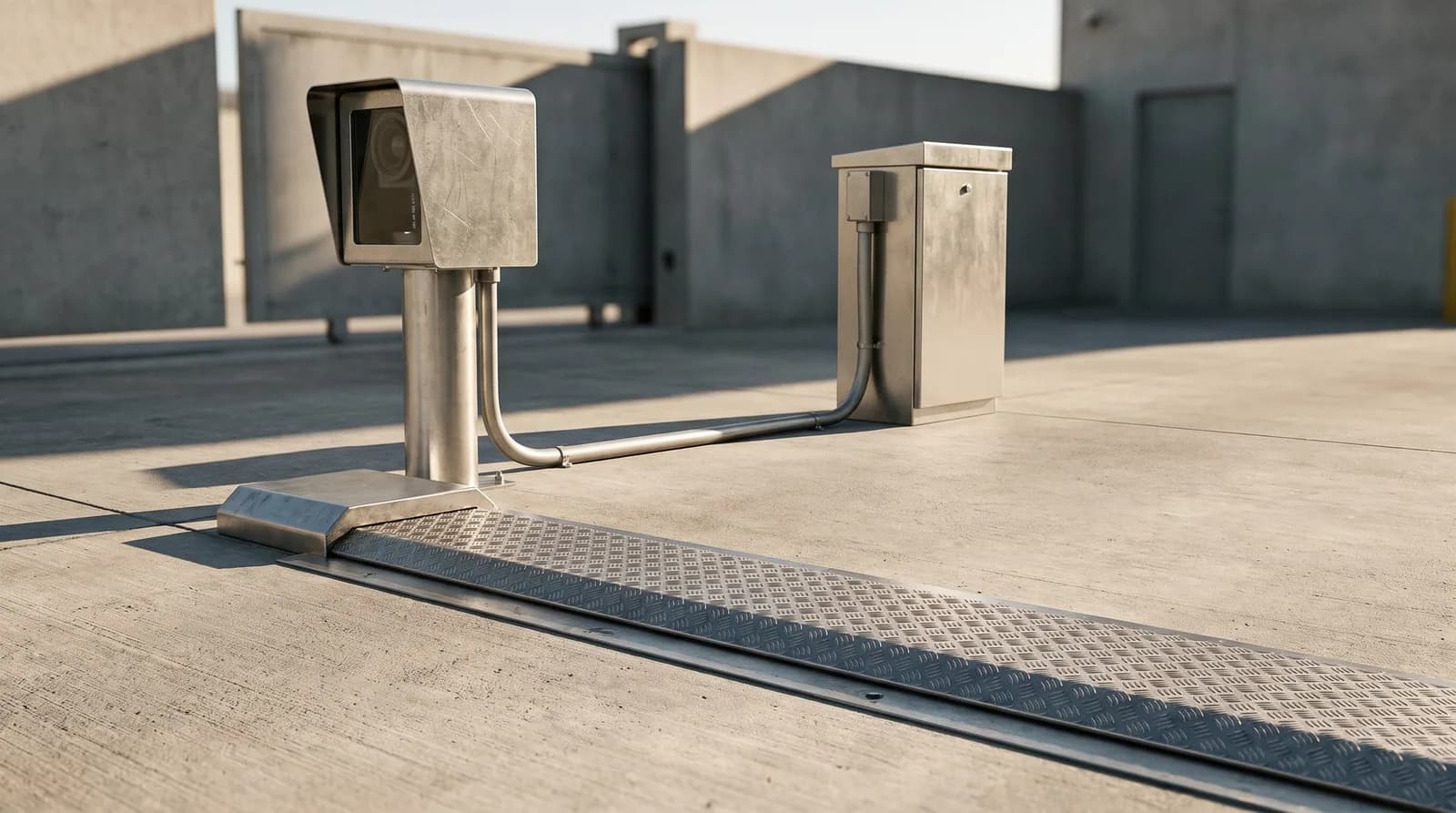
Under-vehicle surveillance
Vehicle inspection equipment for an agreed security-screening workflow at controlled entry points.
Explore related service
· Frequently asked
Government —
what buyers ask first.
What systems can TechnoGuru support for a government or public-safety site?
For government buildings, command centres, public halls and civic infrastructure, TechnoGuru can plan and integrate CCTV surveillance, command-centre display systems and video walls, PA and emergency announcement, fire alarm and fire-hydrant safety systems, access control and boom barriers, security-screening equipment (door-frame metal detectors, X-ray baggage scanners and under-vehicle surveillance), conference and auditorium AV with stage systems, networking and structured cabling, server-rack planning, online UPS and digital signage — coordinated to the site's requirements and supported under long-term AMC. Scope is described in broad terms only; operational and security details are handled privately.
Do you procure through GeM and follow government tendering processes?
Yes — we are GeM-registered, deliver to GFR-compliant procurement and routinely respond to government tenders, with reference deliveries via formal procurement processes. We are registered on GeM and routinely respond to government tenders across our service spectrum. We deliver to GFR-compliant procurement, accept the appropriate tender bonds, and provide every certificate the tender documents require. Our Capital Cultural Hall, Kohima project was delivered through a formal government procurement process.
What's the right combination of UVSS, X-ray and DFMD at a state-government site?
Combine UVSS at vehicle entries, X-ray for parcel screening at high-occupancy lobbies and DFMD for visitor frisk-screening — sized to the actual threat envelope, not blanket procurement. It depends on threat envelope, not blanket procurement. UVSS at vehicle entries where chassis search matters, X-ray for parcel and bag inflow at high-occupancy public lobbies, DFMD for visitor frisk-screening. A high-security campus typically needs all three; a routine government building may only need DFMD plus CCTV. We size to the actual threat profile after a written risk assessment.
How do you handle the security clearance and personnel vetting needs?
Project teams on sensitive deployments are vetted to the client's protocols, with cleared personnel handling encryption, video-wall and ANPR layers. Our project teams for sensitive deployments are vetted against the client's protocols. We submit personnel rosters in advance, accept the client's screening procedures, and design our project supervision so identity-cleared personnel handle the sensitive layers (encryption keys, video-wall content systems, ANPR databases) while general electrical work uses standard contractor labour.
Can you build an integrated command-and-control desk?
Yes — we have delivered integrated command-and-control desks running unified VMS (Honeywell Pro-Watch, Bosch BVMS), ANPR, AI analytics, PA, screening and access on a single multi-screen console. Video-wall command centres with unified VMS (Honeywell Pro-Watch, Bosch BVMS) running ANPR, face-search, AI analytics, integrated PA voice-evacuation, X-ray screening dashboards and access-control plane on a single multi-screen operator console. The desk is engineered for 24/7 operation with shift-handover and audit-trail logging.
How long does a typical state-government secretariat or campus deployment take?
A government campus programme depends on the confirmed systems, procurement, approvals, site readiness and operational coordination. Perimeter work, interior systems and integration are sequenced into agreed access and testing windows. The written programme identifies dependencies and acceptance milestones for each scope.
What's the right approach to data residency and cyber-discipline on a sensitive deployment?
All video, audit-log and access-data storage stays on-prem on client-controlled infrastructure, with cloud analytics restricted to anonymised metadata and segmented VLANs across surveillance, access and ops. Video, audit-log and access-data storage stays on-prem on the client's controlled infrastructure unless there is an explicit policy decision otherwise. Cloud analytics, where used, is restricted to anonymised metadata. Our network architecture follows segmentation to the cause-and-effect plane: surveillance VLANs, access-control VLANs and operations VLANs are firewalled from the broader IT network. The architecture is documented per site for the client's IT-security audit.
How do you handle the documentation and audit-trail requirements government clients expect?
Documentation discipline matches the tender's clauses — every drawing signed and stamped, commissioning tests in witnessed logs, every device captured to a versioned baseline. A documentation discipline matched to the tender's clauses. Every drawing is signed and stamped to the format specified. Every commissioning test is recorded in a witnessed log. Every controller, camera and panel has its serial number, firmware version and configuration captured to a versioned baseline. Audit requests months or years later are answered from records, not memory.
Can you operate within the security clearance and vetting protocols defence projects require?
Yes — we operate within the client's specified clearance and vetting protocols, with cleared personnel handling sensitive layers while general work uses standard contractor labour. Within the protocols the client specifies. We submit personnel rosters in advance, accept the client's screening procedures, and structure project supervision so cleared personnel handle the sensitive layers (encryption keys, video-wall content, ANPR databases) while general electrical work uses standard contractor labour. Our practice has delivered through this discipline routinely for North-East government deployments.
Engineering decisions
Decisions that shape government projects
Decision · Fire & Life Safety
Addressable vs conventional fire alarm — panel architecture under NBC 2016
You are settling the fire-alarm panel architecture for a building and want the decision framed by scale, evacuation logic and integration, not brand.
Decision · Security & Surveillance
DVR vs NVR — which CCTV recorder architecture to specify
You are choosing the recording architecture for a CCTV system and want it matched to the cabling that exists, the resolution required and how the system will grow.
Decision · Security & Surveillance
IP vs analogue camera — which surveillance camera type to specify
You are setting the camera and transmission technology for a surveillance system and want it matched to existing cabling, resolution requirements and the site's network policy.
Decision · Security & Surveillance
NVR vs enterprise VMS — surveillance recording architecture
You are choosing the recording and management architecture for a surveillance system and want it matched to the camera count, site spread and integration needs.
Engineering toolkit
Tools we use for government work
Calculators and reference checkers our engineers reach for first on projects in this sector.
- AV · LED
LED Wall Size Calculator
Direct-view LED wall sizing across a source-cited model catalogue including Samsung, LG MAGNIT, Sony, Philips, Leyard, Absen, Unilumin, ROE Visual, AOTO, INFiLED, Daktronics, Planar, Nanolumens and more. Cabinet count, native resolution, brightness adequacy, power and weight — with pitch-vs-distance honesty and camera-refresh flags. Sources cited per model.
50 brands · pitch-awareOpen - AV · Audio · Coverage
Speaker Coverage Planner
Engineering-grade speaker coverage and SPL planner across a source-cited public model catalogue spanning pro touring, commercial audio and architectural speakers. Predicts SPL at listener distance, the horizontal coverage width at that distance on the -6 dB dispersion axis, and the quantity needed for the room.
45 brands · SPL predictionOpen - Coordination
Architect Brief Builder
For architects, consultants and project teams — assemble a plain-language coordination brief. A draft input, not a statutory submission.
Advisory · copyableOpen
/ Engineering notes
Long-form reading for government projects
Insight
CCTV design for hospitals: privacy zoning, retention windows and the camera count nobody calculates
Hospital surveillance is not a commercial brief with a medical sticker. Patient privacy, infection-control zoning, NABH audit retention and clinical-engineering veto rights mean the camera plan, the storage sizing and the analytics rules all read differently. The design discipline we have built around it.
Insight
Addressable vs conventional fire alarm: which one your building actually needs
Code thresholds, forensic localisation, integration with cause-and-effect logic — the practical differences that decide the right specification for a mid-rise commercial building under NBC, IS 2189 and NFPA 72.
Insight
Command-and-control room engineering: three envelopes, per-envelope power, hand-off boundaries
Command-and-control rooms (gov perimeter ops, transit ops, power-plant SCADA, broadcast master control) are not large boardrooms with extra screens — they are three-envelope facilities with per-envelope power, dedicated earthing, hand-off boundaries between perimeter / surveillance / command, and operator-correlation surfaces that bind them. The engineering discipline that holds across 15 years of operation.
Every calculator, checker and planner curated for government projects lives on one directory page.
All government tools →· Begin
Project in government?
Begin a brief.
The first reply will come from a project lead, not a sales gateway, within two working days.