
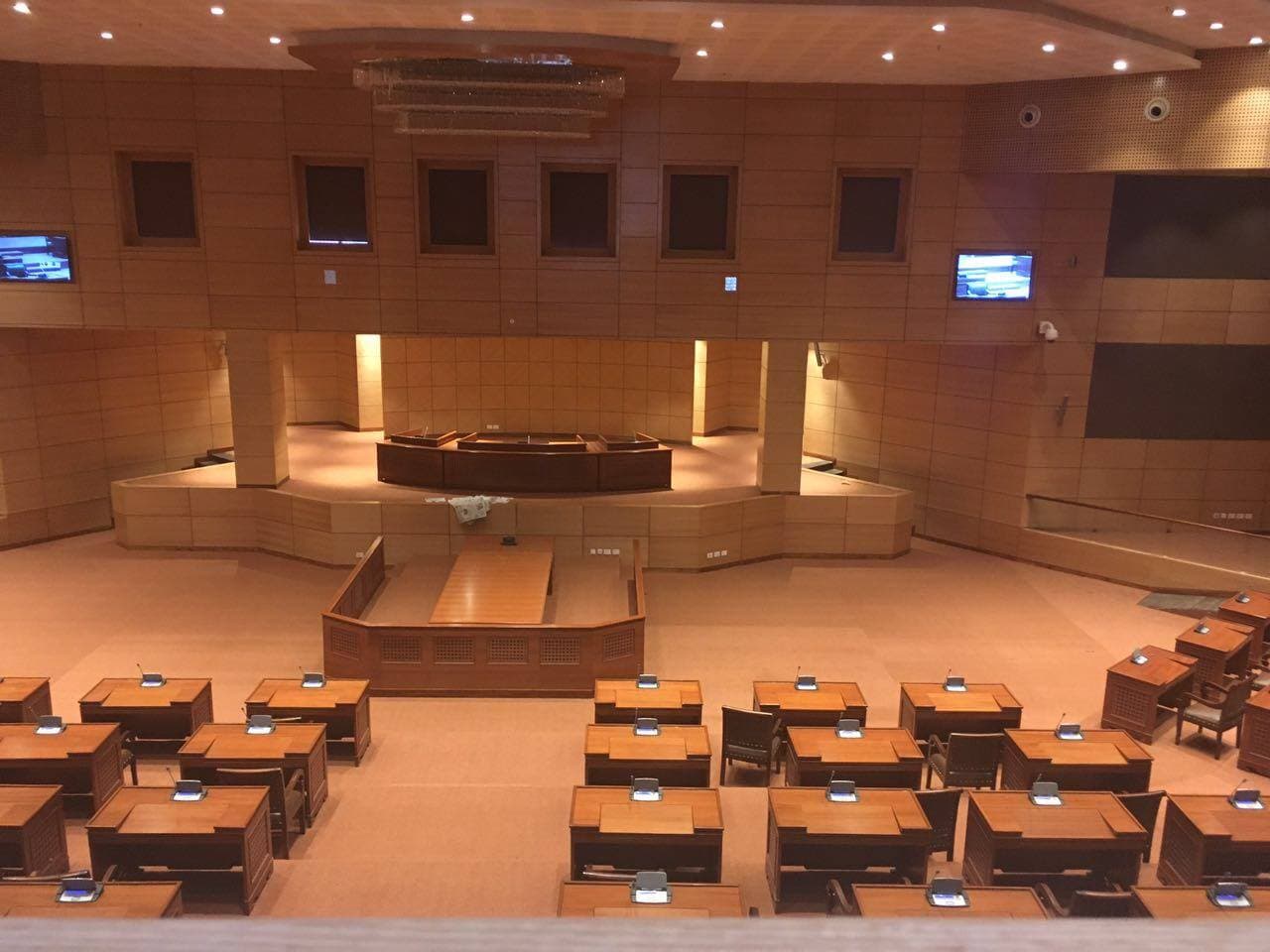
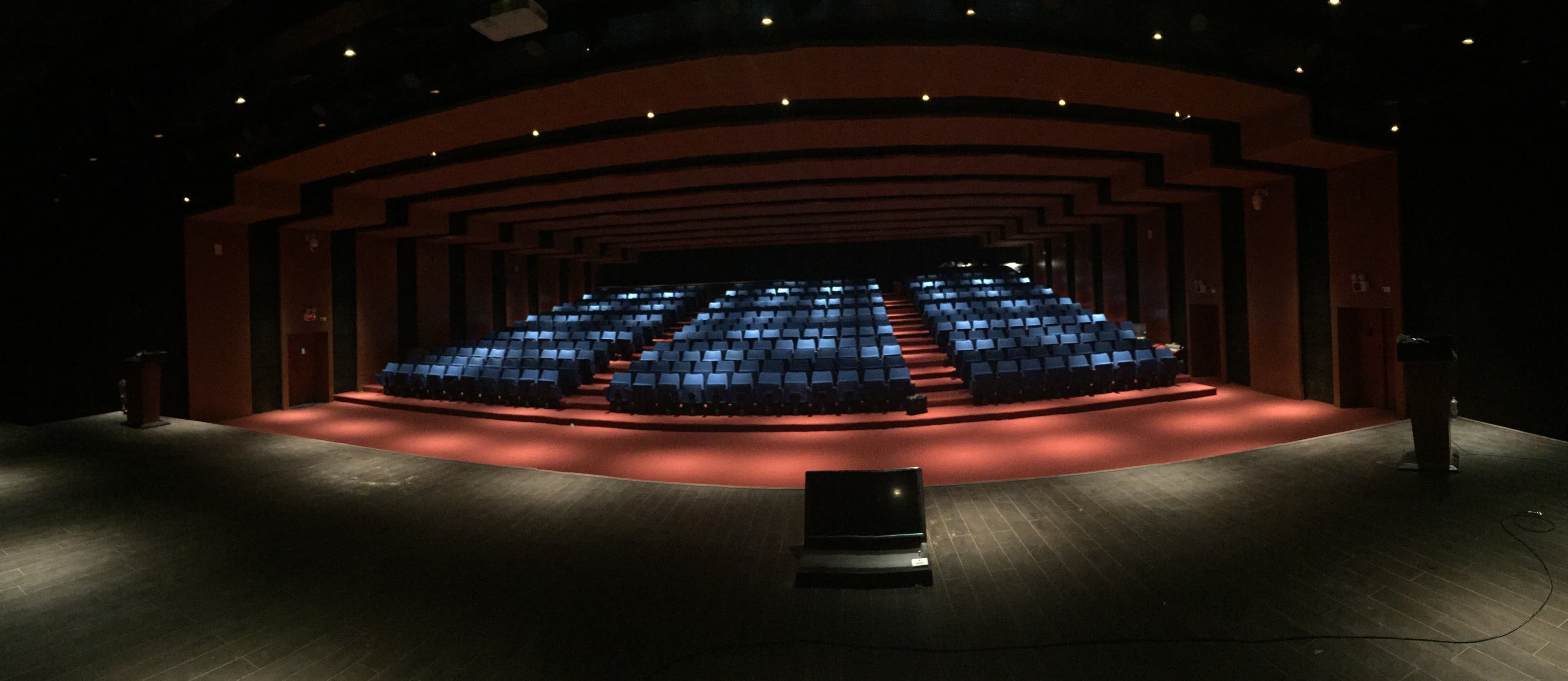
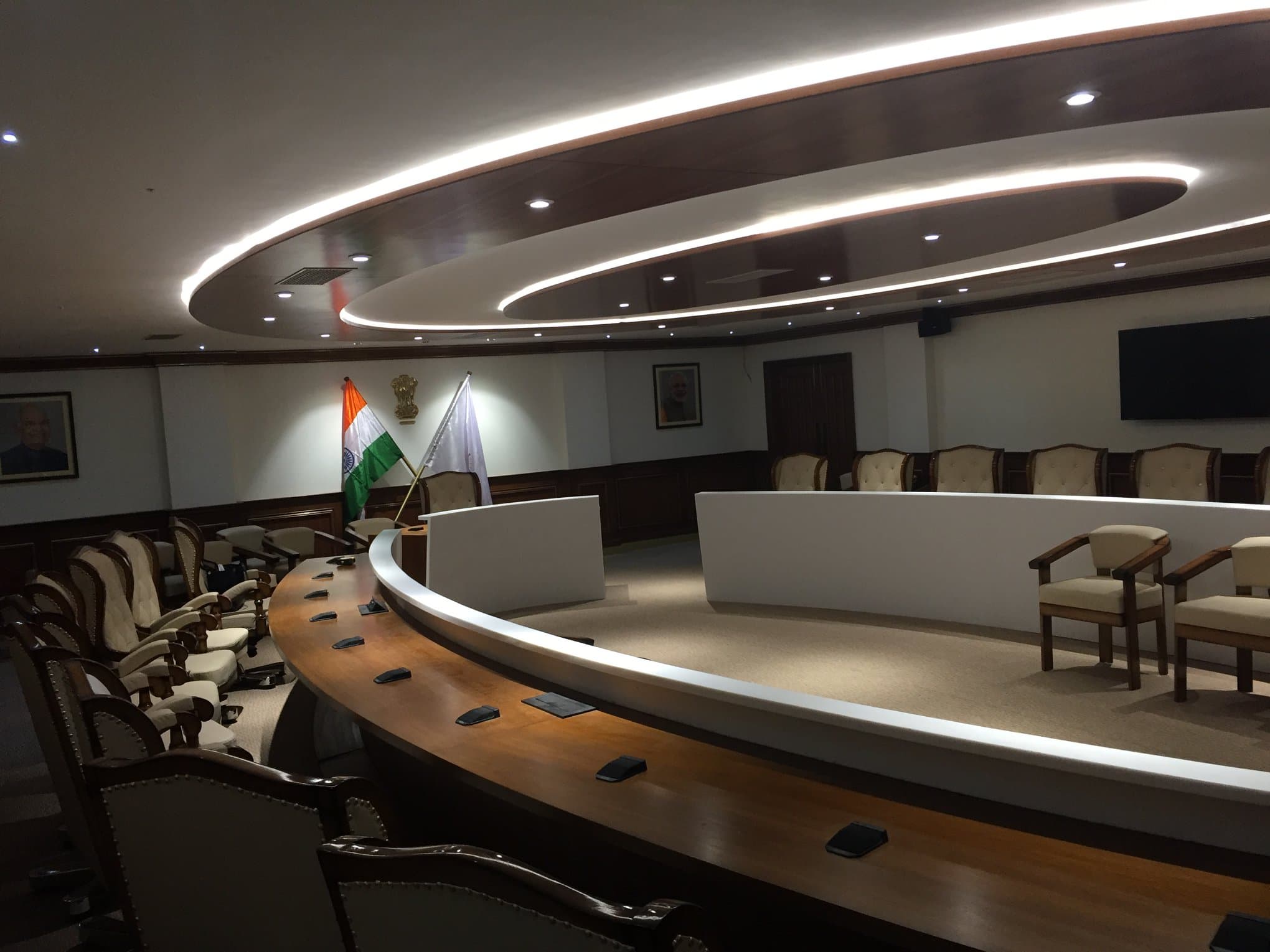
Town Hall Auditorium, Dimapur.
The shape of the deployment.
Structured engineering tagging — deployment archetype, infrastructure complexity, operational class and the named protocols the integration runs on.
- Infrastructure complexity
- Single Room
- Operational class
- Civic Cultural
- Deployment archetypes
- civic auditoriummixed mode avpanel cloud treatment
- Protocols referenced
- DMX-512 (entertainment lighting)BSS BLU-link DSPAES3 / AES50 digital audio (Soundcraft Si)HDMI 2.0 over WyreStorm / Aten extension
What we were asked to deliver.
A civic auditorium engineered for council meetings, official functions and community performance. TechnoGuru delivered audio, video, acoustics, stage furnishing, stage lighting, active LED, DALI lighting automation, fire alarm, fire hydrant, HVAC, CCTV and auditorium chairs / seating.
Below 800 seats, panel-and-cloud acoustic treatment is the right tool — properly specified, with calculated coverage and material discrimination. The Town Hall was engineered to that thesis: panel coverage tuned per audience zone, cloud diffusion at the rear, line-array DSP shading set against the measured RT60, and the LED cluster brightness profile set against the actual illuminance the room sees during civic and community use. The room was signed off to civic-speech standard on the first commissioning attempt.
Signal & system architecture.
Systems integrated: 10 disciplines, one contract.
Auditoriums & Boardrooms
Professional Audio & PA Systems
Video Walls
Lighting Automation
CCTV & Surveillance
Stage Lighting
Acoustic Solutions
Fire Alarm System
Fire Hydrant System
Multi-System Project Delivery
- ↳Holding civic-speech intelligibility across a multi-mode hall — civic-speech, official-function and community-performance — without locking the room into one acoustic identity. Panel-and-cloud treatment was specified rather than a fluid scheme: at this venue scale it is the right tool.
- ↳Designing the LED centre cluster's brightness and colour temperature against the auditorium's mixed-use lighting — civic functions need a cooler register, community performance prefers a warmer one. Two preset profiles were programmed against measured ambient illuminance.
- ↳Compact line-array placement that delivers even coverage across the auditorium without dominating the architectural sightline — the hang geometry was set against the room before specification, not adjusted on site.
- ↳Tuning the DSP feedback-suppression for live council meetings, where multiple lavalier microphones operate simultaneously — the DSP profile was set against the actual lectern and presidium microphone count, not a generic civic preset.
- ·STI 0.61 mean and 0.57 minimum measured across the auditorium — speech intelligibility delivered for council meetings and official functions to civic-grade standard.
- ·Two-mode preset on the LED cluster — civic and community — operable by the auditorium staff without DSP knowledge.
- ·Single coordinated commissioning report — audio, video, lighting, drapery and seating signed off together against a measured test plan.
What the floor told us when work started.
Mixed-use civic auditoria refuse a single acoustic identity.
Council meetings need speech intelligibility; official functions need ceremonial reverberance; community performance needs concert-grade envelope. The Town Hall was engineered against panel-and-cloud treatment with two DSP presets — civic and community — so the room is operable by the in-house staff without re-tuning the DSP between modes.
Below 800 seats, fluid acoustic treatment is the wrong tool.
Capital Cultural Hall (1,800 seats) needed fluid treatment because panel-only fails at that scale. Town Hall Dimapur is 374 seats — panel-and-cloud is the right tool, properly specified with calculated coverage and material discrimination. Picking the right tool for the seat count is the architectural decision; the intelligibility result followed from it.
Council-meeting DSP profile is microphone-count-driven, not preset-driven.
Council meetings run multiple lavalier microphones simultaneously — the DSP feedback-suppression profile was set against the actual lectern and presidium microphone count, not a generic civic preset. Without that, feedback during the second hour of a session is operationally visible.
What the engagement had to work around.
- MIXED-MODE USE
- Constraint —Civic-speech, official-function and community-performance modes — one room, three acoustic identities.
- Design response —Two BSS BLU 50 DSP presets — civic and community — operable by in-house staff; panel-and-cloud treatment calibrated against each mode's reverberance brief.
- SIGHTLINE INTEGRITY
- Constraint —Compact line-array placement that delivers even coverage across the auditorium without dominating the architectural sightline.
- Design response —JBL SRX910LA hang geometry set against the room before specification — placement worked out on the coverage map, not adjusted on site after install.
- LIGHTING REGISTER
- Constraint —LED centre cluster brightness and colour temperature must serve both civic (cooler register) and community-performance (warmer register) modes.
- Design response —Two preset profiles programmed against measured ambient illuminance — operable from a single auditorium-staff console.
- COUNCIL-SESSION FEEDBACK MARGIN
- Constraint —Multiple simultaneous lavalier microphones — generic civic feedback-suppression profile drives audible feedback by the second hour of a session.
- Design response —DSP feedback-suppression profile set against the actual lectern and presidium microphone count from the council's typical sitting profile.
What needed careful handover.
Witnessed intelligibility commissioning pass — 374 seats.
Speech intelligibility checked with the line-array under the measured house-noise floor and confirmed before sign-off, with the commissioning record handed over.
EFFORT — One full witnessed measurement session
DSP preset library — civic vs community modes.
BSS BLU 50 DSP carries two named presets — Civic and Community — recallable from a single auditorium-staff console. Each preset was tested against the room's full reverberance envelope and the lectern microphone count before sign-off.
LED-cluster brightness profile against measured ambient illuminance.
Two LED-cluster presets — civic (cooler) and community (warmer) — calibrated against the auditorium's measured ambient illuminance during a council-mode session and a community-event mode rehearsal.
EFFORT — Two evening calibration sessions
DMX-512 stage-lighting scene library hand-over.
DMX scene library handed across to the auditorium staff with a printed cheat-sheet — each scene named (Council Open, Council Recess, Press Conference, Cultural Performance, Stage Set-up, House Lights Up) and verified against the council's published sitting protocol.
Seams that required cross-trade engineering.
SEAM 01
Council protocol × DSP preset × DMX lighting scene
Civic Open, Civic Recess, Press Conference, Cultural Performance and House Lights Up are named scenes that coordinate the BSS DSP preset, the JBL line-array gain profile, the LED-cluster brightness preset and the DMX stage-lighting scene — one scene call from the auditorium-staff console moves all four layers.
SEAM 02
374-chair seating layout × row/seat labelling × council protocol
General and VIP seating was installed with row and seat labelling against the council's protocol seating chart — every chair has a printed label and a documented chair-replacement spare-inventory record. The seating chart drives the labelling, not vice versa.
What the design refuses to let take the whole system down.
DSP feedback-suppression collapses during a council session.
MEDIUMIsolated by —Civic and community presets are exported offline after every firmware update; the AMC schedule holds a per-session pre-flight check for the lectern and presidium microphone count.
Single LED-panel failure in the 23 ft × 13 ft centre cluster.
MEDIUMIsolated by —Panel-by-panel replacement on the active LED service-access profile; the spare-panel inventory holds against the panel catalogue, not a generic spares pool.
Crown / JBL amplifier failure during a civic event.
MEDIUMIsolated by —Per-zone amplification — audience and stage zones on separate amplifier chains — limits a single amplifier event to its zone; the AMC inventory holds a named hot-spare amplifier on-site.
What the team will live with.
- JBL SRX line-array elementsSRX910LA driver assemblies carry an 8–10 year service life under daily civic-and-community load; replacement is like-for-like with a coverage-map re-verification before re-deployment.
- BSS BLU 50 DSP firmware presetsDSP feedback-suppression and EQ profiles drift with firmware updates — civic and community presets are exported offline after every firmware refresh and re-loaded after the room's microphone count is verified.
- 23 ft × 13 ft P2.5 LED video wallFine-pitch LED panels show colour-uniformity drift over a 7–9 year horizon; panel-by-panel re-calibration is on the AMC schedule, with the panel-spare inventory held against the active LED catalogue.
- Acoustic panel + cloud diffusionPanel-and-cloud treatment holds a 12–15 year envelope; re-fabric on the panel faces is the leading maintenance signal under high-event occupancy.
- 374-seat audience-chair upholsteryCivic-auditorium chair upholstery carries a 6–8 year refresh cycle under heavy use; spare-chair inventory was handed over for routine replacement without contractor re-engagement.
Where the design holds capacity for growth.
+ Wireless microphone fleet expansion for community-performance use.
Soundcraft Si Expression mixer has spare input channels; the BSS DSP can hold a third 'community-wireless' preset; the Mini Stage Box accommodates additional wireless receivers without head-end rack re-arrangement.
+ Live-streaming feed for council sessions.
Soundcraft Mini Stage Box has spare AES output capacity; WyreStorm HDMI distribution can carry a livestream encoder feed without re-cabling — a dedicated streaming-encoder bay in the head-end rack is the minimum incremental scope.
+ Stage drapery automation for council vs cultural mode.
DMX-512 headroom on the existing controller; DLMC stage-lighting rig supports motorised drape integration on the same DMX bus — automation control would surface on the existing auditorium-staff console.
What this engagement taught us, on the record.
- 01
Pick the acoustic-treatment tool against the seat count, not the marketing.
Every civic-auditorium engagement starts with the seat-count question — panel-and-cloud below ~800 seats, fluid treatment above. Mis-tooling the treatment is the leading silent failure mode in civic-auditoria.
- 02
Mixed-mode auditoria need named DSP presets, not generic civic presets.
Every mixed-use civic auditorium since this handover carries two or more named DSP presets keyed to the operating mode — civic, community, ceremonial — operable from a single in-house staff console.
- 03
Line-array hang geometry worked out before specification beats site-adjusted hangs.
Every line-array hang is worked out before specification — placement, gain shading and audience-coverage map are set on paper, not adjusted on site after install.
· Where to go next
Related engineering, insights and tools.
Read further
Engineering pages
- ISO 3382-1 — room acoustic measurement
- AES-15id — speech-intelligibility sound system design
- DMX-512 — entertainment lighting control



The systems and sectors behind Town Hall Auditorium, Dimapur.
Every discipline on this project is engineered as part of one integrated stack. Open the system practice, or the sector it sits inside — each page is a live brief you can start a similar project from.
This project was delivered in Dimapur, Nagaland. See how we work in Dimapur — the disciplines we cover there, and how a project is planned and supported from the Guwahati office.
Public project summaries describe systems and outcomes only. BOQ values, quantities, device counts, security and network layouts and private drawings are kept off public surfaces.
Specifying a government room for a real building?
Send the floor plates, the operating context and the documented brief. We return a sized scope and a written estimate after drawings and site review — typically within two working days.
Talk to the studio