
/ AV
Auditorium acoustics in the Northeast: hill-air, hall geometry and seasonal RT60 drift
Quick answer
Auditorium acoustics in the Northeast see seasonal RT60 drift of 0.3–0.6 seconds across winter and monsoon. Three regional factors dominate: (1) hill-climate humidity swings of 30–80% RH which detune fibre-based absorbers; (2) exposed-timber and stone interiors common in regional architecture which behave very differently from gypsum-board references; (3) altitude effects on air absorption at frequencies above 4 kHz. Designing auditoriums for the NE requires polyester / mineral-wool absorbers (not fibreglass), explicit per-season absorption coefficients in the RT60 model, and an annual re-tune as part of AMC.
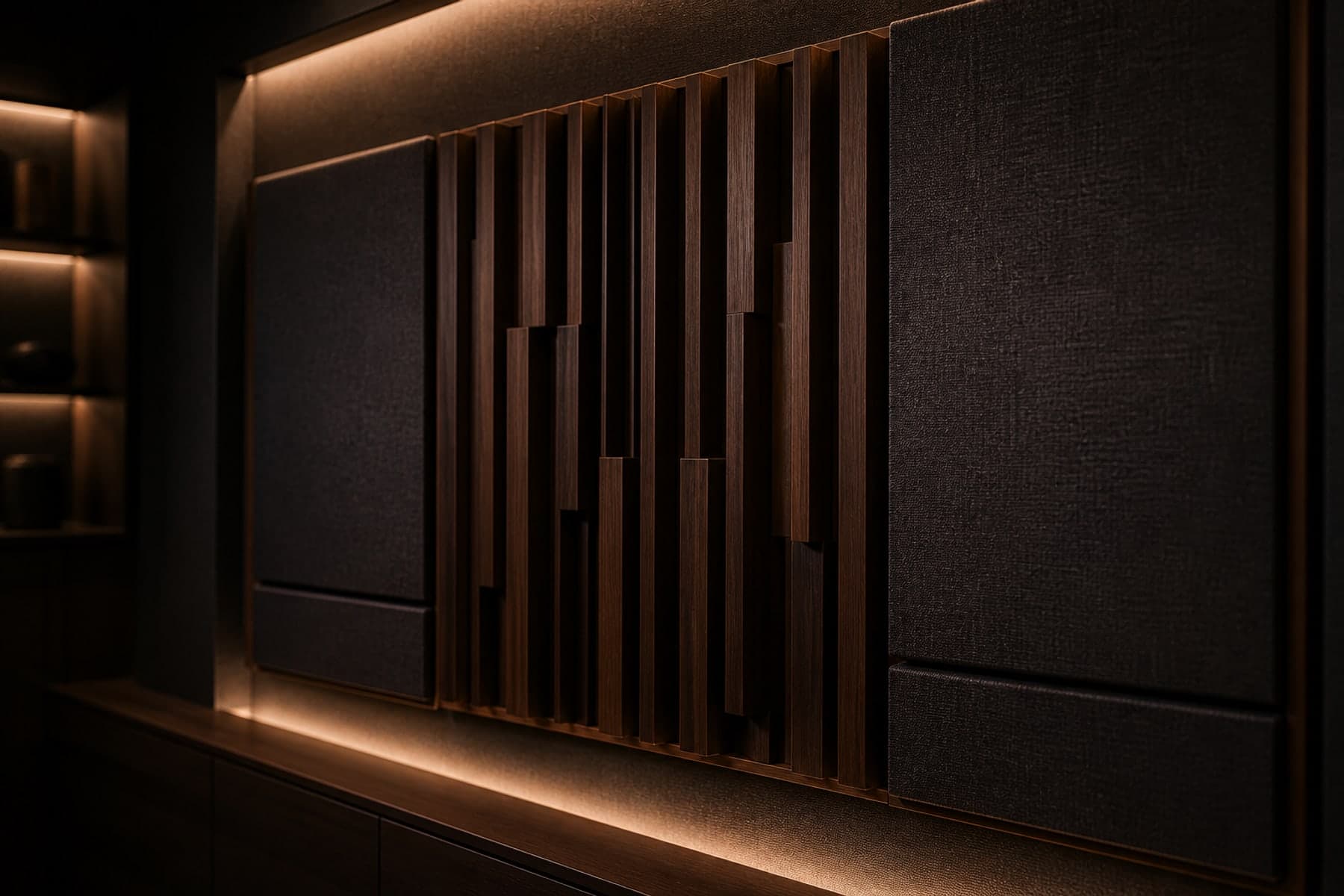
Auditorium acoustic design templates in India are predominantly built around steel-frame, gypsum-board interiors at sea-level humidity. Apply that template to an auditorium in Shillong, Aizawl or Tawang — high-altitude, monsoon-humid, often built with exposed timber, stone or bamboo — and the RT60 model that worked perfectly in Mumbai over-predicts by 0.2 seconds in winter and under-predicts by 0.3 seconds in monsoon. The result is a hall that sounds 'right' for two months a year and 'wrong' for ten.
The discipline for the region is three-fold: choose absorption materials that are stable across humidity swings, model the room with seasonal absorption coefficients (not a single annual average), and build annual re-tune into the AMC.
Reality 1 — Absorber chemistry matters
Standard fibreglass absorbers (Owens Corning 703, ROCKWOOL) have well-published absorption coefficients at 50% RH. Drop RH to 30% (winter highland) and the coefficients shift upward by 5–8% (drier fibres are more absorbent). Raise RH to 80% (monsoon) and they shift downward by 8–12% (moisture loads fibres, reduces absorption). The seasonal swing is roughly 0.15-0.25 RT60-seconds at 1 kHz in a 600-seat hall — enough to push a hall from 'lecture-clear' (RT60 1.1s target) to 'congregational-warm' (RT60 1.4s).
Polyester acoustic panels (acoustic-grade PET felt, 100% recycled PET) and high-density mineral wool (RW3, ≥ 80 kg/m³) show much smaller humidity swings — typically 2–4% coefficient change across the same RH range. They are the right choice for NE auditoriums. The cost premium over fibreglass is 15–25% at the absorber line, recovered comfortably against the avoided re-tune labour every year and the avoided client dissatisfaction with seasonal sound drift.
Reality 2 — Architecture-led absorption
Regional architecture in the NE often features exposed timber (Khasi-influenced halls in Meghalaya), stone (in Sikkim and Arunachal), and bamboo or thatched roof structures (Tripura and Mizoram). Each material has a published absorption coefficient that differs significantly from gypsum-board: exposed timber at 0.05–0.10 (similar to plaster); stone walls at 0.02–0.04 (much more reflective than gypsum); thatched ceilings at 0.15–0.25 (much more absorbent than gypsum).
An RT60 model that assumes 0.05 plaster walls and a 0.07 ceiling will be wildly wrong if the actual hall has 0.02 stone walls and a 0.20 thatched ceiling. The hall will be brighter at high frequencies than predicted (under-absorption from walls) and warmer at low frequencies than predicted (over-absorption at ceiling). We model NE auditoriums with material-specific absorption coefficients drawn from the actual specification, not from a generic template.
Reality 3 — Altitude and air absorption
Above ~1,200 m altitude, air absorption at frequencies above 4 kHz becomes acoustically significant — high frequencies attenuate faster than at sea level due to lower air density. The effect is small per metre but accumulates in deep halls (15+ m source-to-listener distance) and matters for speech-intelligibility design.
The brief-stage response is to specify line-array systems with explicit high-frequency compensation (Meyer Sound's Galileo Galaxy and L-Acoustics's L-ISA both handle this natively) and to validate with on-site SPL measurements at the longest throw distance. For halls below 1,200 m altitude, the effect is small enough to ignore. Above 1,500 m, it is a design consideration that affects speaker-system selection.
Annual re-tune as standard AMC scope
Every premium NE auditorium we commission includes an annual acoustic re-tune in the AMC scope. The re-tune is a single visit in the shoulder season (October or April), takes 1-2 engineering days, and consists of: (1) calibrated SPL + RT60 measurement at seven listening positions; (2) DSP loudspeaker preset adjustment if measurements drift outside the target band; (3) verification listening tests with a known reference track; (4) documentation update to the as-tuned record.
The annual re-tune costs ~0.3-0.5% of installed AV value. It is the difference between an auditorium that performs through fifteen years and one that drifts steadily into mediocrity. Halls without annual re-tune typically need a full re-commissioning (which costs 10-20× the annual re-tune) every five to seven years.
What this means for architects and project sponsors
Auditorium acoustic design in the NE benefits from three explicit asks: (1) ask the acoustic consultant for the seasonal RT60 model — they should be willing to show humidity-band absorption coefficients, not a single annual average; (2) confirm the absorber specification is polyester / mineral-wool, not fibreglass; (3) require the AMC contract to include annual re-tune labour as a published line item.
An auditorium specified, built and commissioned without these disciplines will sound good for two months. With them, it sounds right for fifteen years.
/ Reference table
Standard auditorium spec vs NE-adjusted spec
| Design axis | Standard spec | NE-adjusted spec | Why |
|---|---|---|---|
| Absorber chemistry | Owens Corning 703 fibreglass | Polyester PET felt or RW3 mineral wool | Stable across RH 30–80% |
| RT60 model | Single annual coefficient | Per-season coefficient bands | Seasonal swing 0.15–0.25 s |
| Speaker DSP | Default preset | HF-compensated preset above 1,200 m | Air absorption above 4 kHz |
| AMC scope | On-call only | Annual re-tune included | Drift correction at design SPL |
| Material absorption | Generic gypsum template | Specific to actual interior | Timber / stone / thatch coefficients |
Adjustments are typical for premium auditorium and event-hall commissioning in NE India. Detailed coefficient bands are published in ISO 354 and AVIXA's A102.01 guidance.
/ Frequently asked
Quick answers from the practice.
- Is the absorber-chemistry adjustment also relevant for boardrooms or home cinemas?
- Yes, but the seasonal RT60 swing in smaller rooms (under 150 m³) is smaller in absolute terms — typically 0.10–0.15 s rather than 0.20–0.30 s. Premium home cinemas in NE locations still benefit from polyester felt or mineral wool over fibreglass; the premium is small and the calibration stability is real.
- What's the lead time impact of specifying polyester felt?
- Polyester acoustic felt (AutexAcoustics, Décor Aero, Soundbox) is now reasonably available through Indian importers with 4–6 week lead times. Premium-tier polyester (Autex Composition, Décor Aero Premier) needs 8–10 week lead time for custom-cut panels. Project schedules should plan accordingly; the procurement runway is a known quantity.
- Does the altitude / HF-compensation discussion apply below 1,200 m?
- Below 1,200 m, the air-absorption effect at 4 kHz+ is small enough to ignore for most halls. Above 1,500 m, it is a design consideration that affects speaker preset selection — typically a 1–2 dB lift at 6–8 kHz to compensate for the lost high-frequency reach over throw distance.
- What does the annual re-tune visit actually look like?
- Two engineers, one day on site. SPL+RT60 measurement at seven positions, DSP preset adjustment if needed, verification listening, documentation update. The customer's auditorium loses 4 hours of bookable time; the calibration stability is restored to within 0.5 dB and 0.1 s of the as-commissioned baseline.
- Will TechnoGuru take on auditorium acoustic re-tune for a hall we did not build?
- Yes, after a takeover audit. The audit measures the existing baseline (RT60, SPL distribution, IR coverage) against the original commissioning data if available, identifies drift drivers, and proposes a re-tune plan. Pricing for the re-tune visit is the same as our standard AMC re-tune line; the audit is a one-off engagement.
/ What to do next
Three next steps for auditorium sponsors and acoustic consultants
- Run the RT60 calculator with NE-specific coefficients →Test the seasonal swing by toggling absorber chemistry and surface materials.
- Read the auditorium AV service page →Engineering scope, brand bands, AMC re-tune discipline.
- Send the auditorium drawings to the studio →We mark up acoustic targets and absorber positions within two working days.
Engineering toolkit
Tools that go with this read
If this article gave you a question worth pricing, these calculators give a defensible first number.
- Auditorium AV · Readiness
Auditorium AV Scope & Readiness Planner
A scope-level self-check for an auditorium, convention or multipurpose hall — the AV signal chain (sources, mixing & DSP, amplification & loudspeaker zones, projection, stage-lighting, assistive listening, recording, control), plus acoustics, infrastructure and operations — with the gap list and who owes what. Statuses and bands only; no seat counts, SPL targets or model choices.
Advisory · readinessOpen - Automation · Lighting
Lighting Scenes Interactive
Tap a scene — Welcome, Dinner, Film, Rest, Away, Goodnight — and watch every circuit, shade, AC zone and AV source shift at once across a reference 4 BHK plan. KNX + Rako + DALI.
6 scenes · photorealOpen - Lead intake
Project Brief Wizard
Six structured questions, a written response within two working days. The fastest path to engaging the practice on a real project.
6 questions · 2-day replyOpen
/ Reference work
Projects where this engineering shows up.
Multi-Purpose Hall, Arunachal Pradesh Assembly Complex
Government · Multi-Purpose Auditorium
Itanagar, Arunachal Pradesh · Handover 2018Capital Cultural Hall, Kohima
Government · Cultural Auditorium
Kohima, Nagaland · Handover 2022Town Hall Auditorium, Dimapur
Government · Civic Auditorium
Dimapur, Nagaland · Handover 2024Multipurpose Cultural Hall, Namsai
Government · Cultural Auditorium
Namsai, Arunachal Pradesh · Handover 2018
Editorial — about this surface
TechnoGuru AV Systems Practice
The AV systems practice engineers residential reference cinema and commercial audio-visual systems against the AVIXA CTS, CEDIA, HAA Level 1 and K-Array Certified Designer reference frames. Every installation pairs measurable acoustic and visual targets with the field calibration that proves the room actually meets them.
Reviewed against calibrated measurement realities — room performance is verified against reference targets before sign-off.
Last reviewed
17 May 2026
Engineering domains
Residential cinema and reference audio · Commercial audio-visual systems · Acoustic engineering and room treatment · Loudspeaker and line-array design
Operating environments
Residential reference cinema · Hospitality lounges and venues · Corporate AV and boardrooms · Auditoria and assembly halls
/ Discuss your project
If this article matches a brief you are working on, the next step is a short brief — a project lead replies to it directly.
We do not run sales pipelines. The first reply comes from a project lead, within two working days, and it goes straight to the engineering question rather than a brochure.