04 / 06
Case file
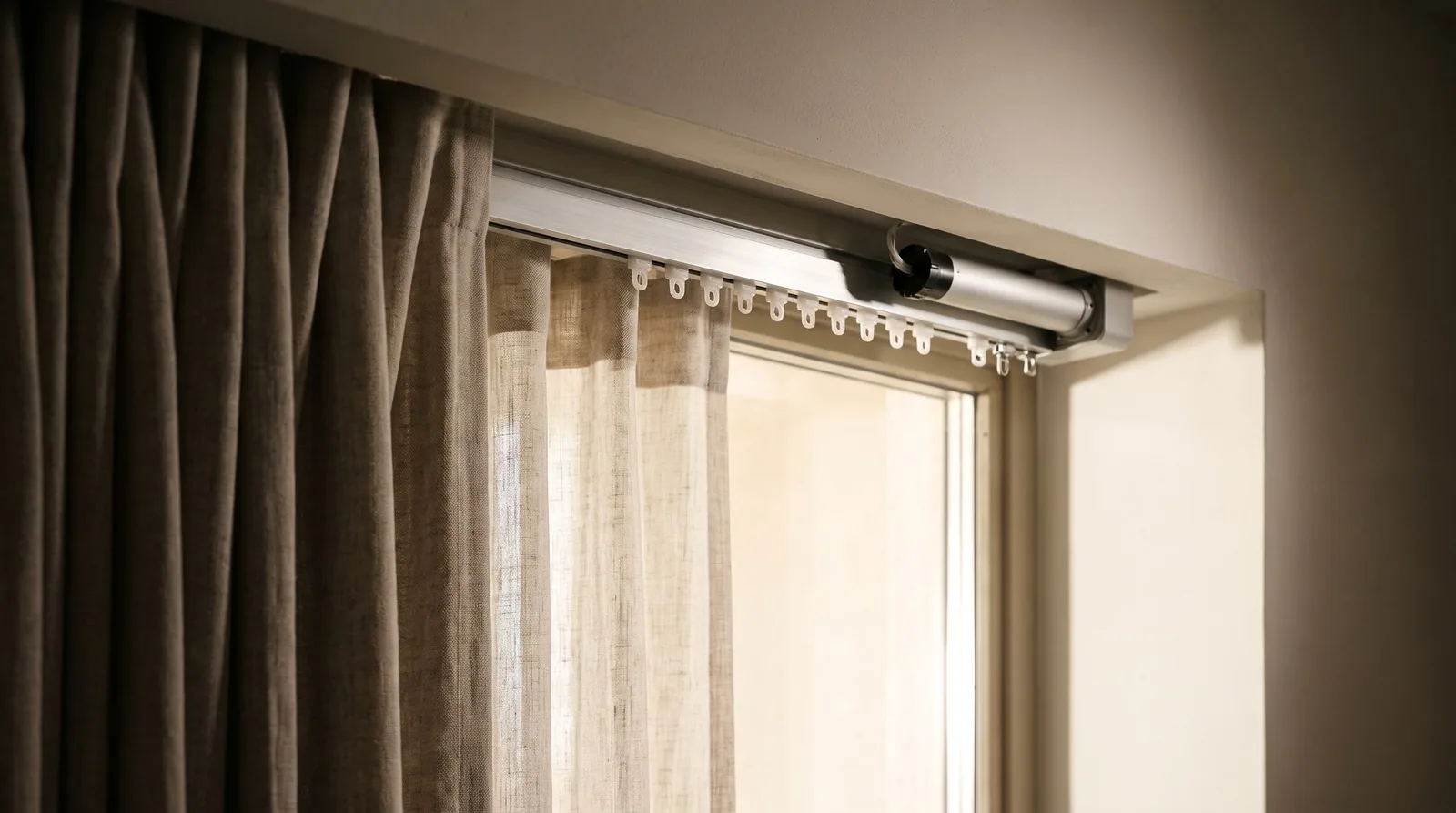
Motorised curtain tracks, roller and roman blinds, sheer-and-blackout double-rolls, and external louvres — silent, scheduled, scene-aware and integrated with the rest of the home or building.
| Aspect | Manual / standalone blinds | Integrated approach |
|---|---|---|
| Operation | Adjusted by hand, room by room | Scene-driven and astronomically scheduled |
| Integration | Separate from lighting and AV | Shares the same scenes as lighting and climate |
| Install | Surface-mounted retrofit | Tracks designed into the cornice and joinery |
Educational comparison of approaches — not a statement about any specific installer.
/ The discipline, in detail
How we approach drapery & shading control.
Drapery is the second-largest variable in a room's mood after lighting, and the one most often left manual long after every other system has gone smart. We specify motors that hold their position rather than re-zeroing on every press, fabric weights matched to the architecture's reveal depth, and tracks that disappear into the cornice. The system answers to the same scenes as the lighting — Welcome opens the sheers, Film closes the blackout, Goodnight steps everything to a known state — and to the same astronomical schedule, so the morning room rises with the sun.
On larger projects we coordinate with the architect on pelmet construction, motor service-access and acoustic decoupling so the install reads as joinery, not retrofit. External louvres, pergolas and skylights extend the same logic to the building envelope, where the shade strategy is also a thermal strategy.
On record
Every drapery & shading control engagement is documented end-to-end — design, programming, commissioning, calibration — and handed over with the files our successors would need if we were never to return.
/ Orchestration
Shading on the scene graph
Motorised drapery and blinds ride the same bus as lighting — with every wall plate keeping a manual override.
Diagram · described
DALI plus KNX orchestration topology
A single orchestration server bonded to DALI-2 lighting, KNX shading and HVAC, and an audio-zone matrix. Every wall plate retains a manual fallback path.
Diagrammatic view — a system planning illustration for design discussion, not a project drawing or live interface.
/ Where we deploy this
Active across 3 sectors.
Drapery & Shading Control is rarely a standalone brief — it sits inside a wider sector practice with its own codes, expectations and operating rhythm.
/ Sister services
The rest of automation.
A serious brief usually crosses two or three of these. Read across the discipline — we deliver them as one contract.
- 01
Home & Office Automation
One press. The whole space responds.
Lights, climate, blinds, audio, cinema and security — orchestrated by a single Rako, Fibaro or KNX backbone and controlled from a touch panel, voice or a discreet keypad on the wall.0 - 02
Lighting Automation
Light, tuned to the hour.
Dimmable, scene-based, daylight-aware lighting on Rako, Fibaro, KNX or DALI — programmed to the rhythm of the room rather than the switch on the wall.1 - 03
Smart Control
One panel. The whole building.
Touch panels, keypads, voice and mobile control surfaces — Rako, Fibaro Home Center and KNX — engineered as the single, learnable interface to everything else we install.2 - 05
Architectural & Façade Lighting
The building and the grounds, after dark.
Façade graze, in-grade uplights, linear coves, water-feature lighting, drive and pathway detailing, tree uplights and perimeter flood — engineered, programmed and night-commissioned on one Rako control surface.3 - 06
Motorised Shutters & Skylights
The building envelope, on a quiet motor.
Motorised building-envelope openings — automatic rolling shutters, motorised skylights and retractable roof glass, and façade and ventilation openings — scheduled, scene-aware and integrated with the wider automation system.4
/ Integration with
How drapery & shading control talks to the rest.
A serious deployment of this system rarely operates in isolation. The disciplines below most commonly share its cabling pathways, its controller logic, and its cause-and-effect matrix.
Home & Office Automation
One press. The whole space responds.
Lights, climate, blinds, audio, cinema and security — orchestrated by a single Rako, Fibaro or KNX backbone and controlled from a touch panel, voice or a discreet keypad on the wall.Lighting Automation
Light, tuned to the hour.
Dimmable, scene-based, daylight-aware lighting on Rako, Fibaro, KNX or DALI — programmed to the rhythm of the room rather than the switch on the wall.Motorised Shutters & Skylights
The building envelope, on a quiet motor.
Motorised building-envelope openings — automatic rolling shutters, motorised skylights and retractable roof glass, and façade and ventilation openings — scheduled, scene-aware and integrated with the wider automation system.
Engineering toolkit
Tools to scope this work
Calculators and reference checkers we use ourselves to sense-check the engineering before any drawings change hands.
- Smart Home
Smart Home Discovery Wizard
For villa and apartment owners — pick your home, the zones that matter and the experiences you want, and map a coordination scope and room checklist. Not a final design, device count or security layout.
Advisory · discoveryOpen - AV · Projection
Projector Throw Distance Calculator
Engineering-grade throw distance calculator across a verified multi-brand projector catalogue — Sony, JVC, Epson, BenQ, LG, Optoma, ViewSonic, Panasonic, Barco, Christie, Canon, InFocus, Maxell, Casio, EIKI, Philips, Nebula, JMGO, Dangbei, Boxlight, ASUS, Leica, Xiaomi, WEMAX, Ricoh and more. Searchable picker, throw range, lens-shift envelope, viewing distance, pixel density, feasibility flags and a custom-throw fallback. Sources cited per model.
51 brands · sourcedOpen - BMS · Energy
Energy & Efficiency Estimator
Adjust building variables and see indicative energy and CO₂ savings (kWh) for a BMS-driven energy upgrade plus daylight-harvesting LED retrofit. Conservative; defensible in a first conversation.
kWh · CO₂ savedOpen
/ Used alongside
Commonly deployed alongside
Service
Home & Office Automation
One press. The whole space responds.
Service
Home Theatre
Reference cinema, in your living room.
Service
Lighting Automation
Light, tuned to the hour.
Service
Multi-Room Audio
One song. Every room. Or six different ones.
Service
Intercom & Video Door Phone
See who's there before you open the door.
Service
Motorised Shutters & Skylights
The building envelope, on a quiet motor.
/ Plan it right
Drapery & Shading Control — getting the brief right.
Common mistakes to avoid
- Deciding on motorisation after the pelmet and cornice details are built, so tracks and service access never fit.
- Choosing motors without matching them to fabric weight and stack width — an undersized motor fails early.
- Pulling cable through finished walls where battery tracks were the honest retrofit answer — or fitting battery tracks in a new build where wired motors would outlast them.
- Leaving shading out of the scene logic, so the blinds live on a separate remote nobody can find.
- Ignoring sun path and thermal load — shading is an energy strategy, not only a privacy one.
What to share before a quotation
- A window schedule — sizes and the treatment intended per opening (curtain, roller, sheer-plus-blackout).
- The interiors intent — pelmet details, fabric direction, reveal depths.
- New-build or retrofit, and whether cabling is still possible.
- The automation platform in use or planned, and the scene intent.
- The orientation of the main façades and any glare or heat problem being solved.
/ Frequently asked
Drapery & Shading Control — what buyers ask first.
Can shading be retrofit into an existing villa without breaking ceilings?
Yes in most cases — battery-powered Rako or Somfy tracks hold a 12–18 month charge for retrofit, while wired motors are recommended for new builds. We use battery-powered tracks for retrofit where pulling cable is invasive, and lithium tracks now hold a charge for 12–18 months on typical residential use. For new builds we always recommend wired motors for longevity.
Do motorised curtains make noise?
Modern Rako and Somfy motorised curtains run at 38–44 dBA — audible only in a silent bedroom; premium Silent Gliss tracks run quieter still. We specify motor class to the room — bedroom motors are quieter and more expensive than living-room motors.
How quiet are motorised drapery tracks really?
Premium tracks (Silent Gliss, Forest, Somfy Sonesse 50) run under 25 dB at 1 m — quieter than a refrigerator. Cheaper tracks at 35–40 dB are noticeable in a bedroom and become a complaint at month three. We specify the track to the room's noise floor.
Sheer + blackout double-roll — is it worth it?
In bedrooms and master suites, almost always. The sheer manages glare during the day; the blackout takes the room to absolute darkness for sleep. Both run on independent motors so the morning routine is sheer-only. The double-roll adds 30–50% to the drapery line item and is the upgrade we recommend most often.
Can existing curtains be motorised, or do I need new tracks?
Existing tracks rarely accept motors cleanly — most curtains use rod-and-ring systems that need full track replacement. Existing roller blinds with chain operation can sometimes be retrofitted with chain-drive motors. We audit each window before quoting.
Will motorised drapery work during a power cut?
Most premium motors hold position automatically — they only need power to move, not to stay open or closed. We can specify battery-backed circuits or rechargeable motors (Somfy WireFree) for cycling needs during outages. Local manual override is always available as a fail-safe.
· Begin
Begin a
drapery & shading control
brief.
Tell us about the building, the timeline, and what success looks like a year after handover. We will reply within two working days with a written response, not a sales pitch.