
Healthcare.
Hospitals where systems serve the patient.
Hospitals, nursing homes, diagnostic centres — nurse-call, PA, life-safety, BMS, surveillance and IT engineered to NABH and HTM standards.
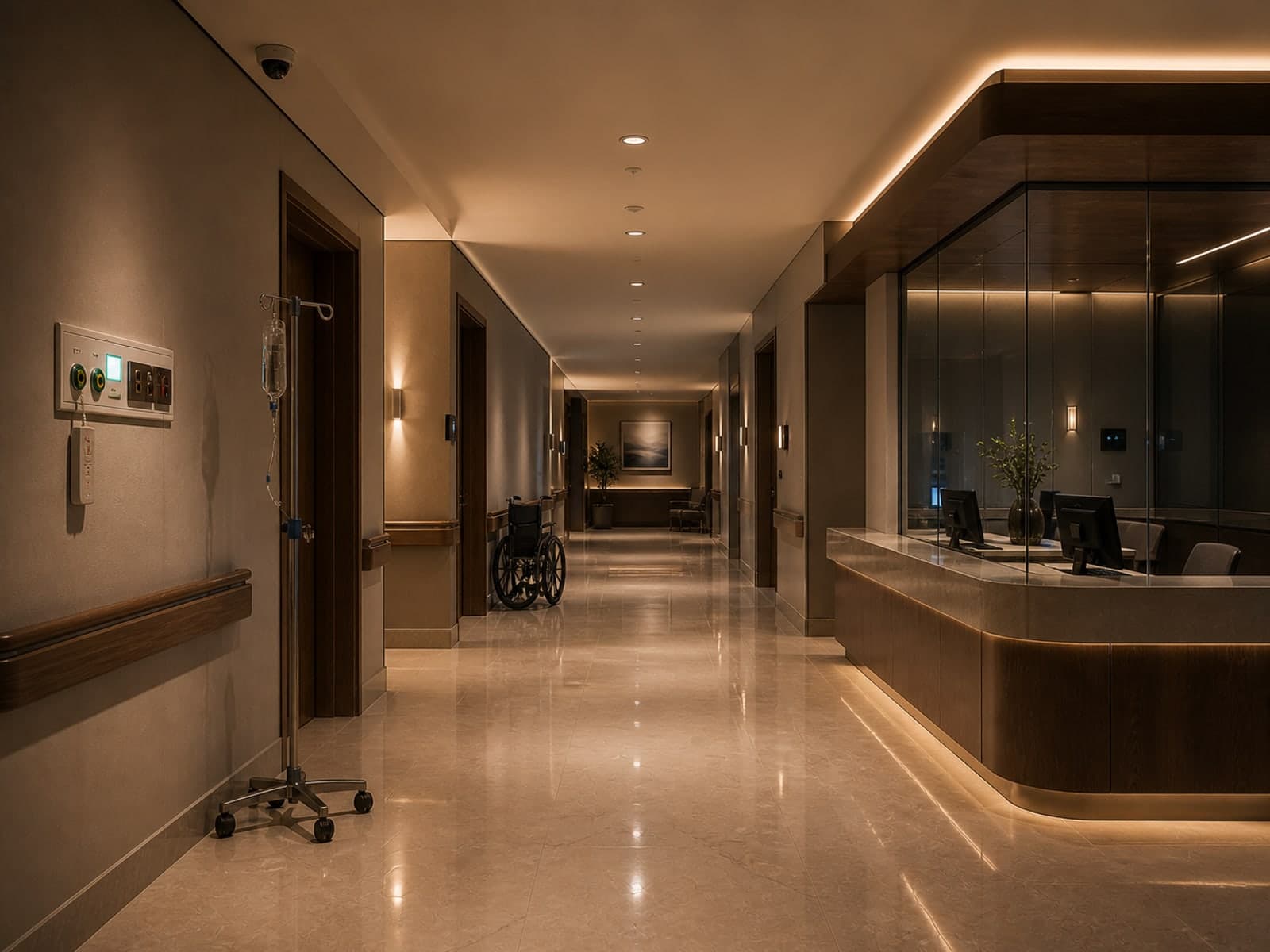
| Aspect | Fragmented delivery | TechnoGuru — coordinated |
|---|---|---|
| Life safety | Fire and PA wired as separate trades | Fire alarm and emergency announcement engineered to the brief together |
| Privacy | CCTV placed without dignity zoning | Surveillance zoned so wards and toilets are excluded by design |
| Continuity | Backup sized by catalogue default | UPS sized for the critical loads that cannot drop |
Educational comparison of delivery models — not a statement about any specific installer.
Healthcare is the most demanding sector we serve. Code-blue must reach every nursing station, mobile pager and corridor dome within seconds. Fire alarms must coordinate with smoke compartmentation, AHU shutdown and lift recall. UPS must hold every theatre lamp through the longest grid outage. We engineer to NABH, HTM 08-03 and IS 13039 simultaneously.
Hospital commissioning is zone-by-zone by necessity: wards, theatres and departments go live independently, each with its fire, PA and access cause-and-effect verified before patients arrive, while active clinical areas stay on segmented networks as construction continues elsewhere. Privacy is a design input, not an afterthought — camera placement excludes wards and toilets at the drawing stage, and retention policies follow NABH and applicable data-protection guidance.
Tinsukia Medical College & Hospital, delivered for NCC Limited, is the reference profile for this work in the North-East — surveillance, access control, fire systems, telephony, UPS and networking commissioned across a phased clinical campus and supported since under an active AMC. Diagnostic centres and nursing homes receive the same engineering standard sized to smaller premises, because smaller clinical sites are where compromise causes the most operational damage.
· Selected clients · Healthcare / Hospitals
Systems delivered across healthcare sites in the North-East.
- LGB Regional Institute of Mental Health (Tezpur)
- Swagat Hospitals
- Shree Marwari Hospital & Aushadhalaya (Guwahati)
- Tinsukia Medical College & Hospital
- Agartala Medical College & GBP Hospital
- RichFeel Trichology Centre
Organisations across whose sites and facilities we have delivered systems — directly or as a specialist sub-contractor. Most engagements stay under contractual confidentiality; listing implies no endorsement or exclusivity, and trademarks remain the property of their owners. The full roster.
· What we coordinate in healthcare
Communication, security, life-safety and IT — coordinated across the facility.
Hospitals, clinics, diagnostic centres, labs and nursing homes. These are the systems TechnoGuru can plan, integrate and support across patient-facing, security, life-safety and IT layers — coordinated with the facility's consultants and sized to the brief. We engineer to design intent and do not make medical-compliance or approval claims.
Patient-facing communication
Clear information from reception to consultation.
- Reception and waiting-area display systems
- Queue-management displays
- Digital signage
- OPD / consultation-room display support
- Video door phone and intercom
- Nurse-call system through suitable solution partners, where required
Security and restricted areas
Access where it matters, dignity where it counts.
- CCTV and surveillance
- Access control for restricted areas
- Access control for lab, pharmacy, store and server areas
Fire and emergency systems
Life-safety, engineered to the brief.
- Fire alarm system
- Fire safety systems
- PA and emergency-announcement system
- Fire-rated safety coordination where applicable
Network and IT
The backbone clinical and back-office systems share.
- Wi-Fi and networking
- IT infrastructure and structured cabling
- Server and network-rack setup
- IP-PBX and telephony
Operations support
Backed up, integrated and maintained.
- UPS backup for IT, networking and security systems
- BMS integration where required
- AMC and service support
Specialist clinical systems such as nurse call are delivered through suitable solution partners where required. We agree the detail privately against the drawings — no device counts, quantities or layouts are published here.
Illustrative cause-and-effect sequence: when the trigger event fires — Bed-12 nurse call · ICU North (Patient pull-cord activated · priority routing engaged.) — the integrated systems respond in order: Corridor lamp: Red dome lit outside ICU-N door for line-of-sight triage.; Nurse station console: Bed-12 highlighted with priority tone, escalation timer started.; Duty nurse paging: On-shift duty nurse paged via IP-PBX with location and priority.; Lift dispatch: Service lift held at ICU floor for clinical response team if needed.; Audit log: Event sealed with bed-id, timestamp, response latency for clinical audit.. The animation steps through each response with the same information; use the Run and Reset controls to replay it. This is a demonstration of how the systems are wired together, not a recording from a live site.
— Cause & effect · Healthcare
Nurse call. Hospital-grade chain reaction.
A bedside pull triggers a coordinated sequence across nurse station, corridor lamp, paging, lift dispatch and audit trail — engineered to the NABH-readable cause-and-effect matrix the hospital signs off.
Bed-12 nurse call · ICU North
Patient pull-cord activated · priority routing engaged.
- 01
Corridor lamp
Red dome lit outside ICU-N door for line-of-sight triage.
Nurse call - 02
Nurse station console
Bed-12 highlighted with priority tone, escalation timer started.
Nurse call - 03
Duty nurse paging
On-shift duty nurse paged via IP-PBX with location and priority.
Comms - 04
Lift dispatch
Service lift held at ICU floor for clinical response team if needed.
BMS - 05
Audit log
Event sealed with bed-id, timestamp, response latency for clinical audit.
Compliance
· Core services
10 services
delivered to this sector.
Grouped by the engineering layer each system belongs to — the way the scope is actually coordinated on site.
- Nurse Calling SystemPatient request to nurse response. Documented.
- CCTV & SurveillanceCoverage. Storage. Evidence.
- Access ControlRight person. Right door. Right time.
- Fire Alarm SystemDetection that pinpoints. Response that is coordinated.
- Fire Hydrant SystemHigh-volume water, precisely where it's needed.
Indicative coordination scope. Not every project engages every layer; the working scope is agreed against the drawings before anything is specified.
· Delivered and maintained
Delivered turnkey, then supported across its life
· Selected proof
Reference work in
healthcare.
Owner-approved projects, shown with project-safe public scope. Each links to a written case study.
- 01
Tinsukia Medical College & Hospital
Tinsukia, Assam
Completed · 2024
- 02
Agartala Medical College & GBP Hospital
Agartala, Tripura
Completed · 2022
Public project summaries describe systems and outcomes only — BOQ values, quantities, device counts and security layouts are kept off public surfaces.
Equipment categories
See the equipment behind the solution.
Explore equipment we supply and the services around it. The final specification follows your space, operating needs and agreed scope.
Equipment illustration
Interactive kiosks
Interactive kiosk equipment for visitor information and service-counter applications. The software and workflow are agreed for each project.
Explore related service
Illustrative — generated visual, not a real project photograph. Illustrative category scene
Fire alarm equipment
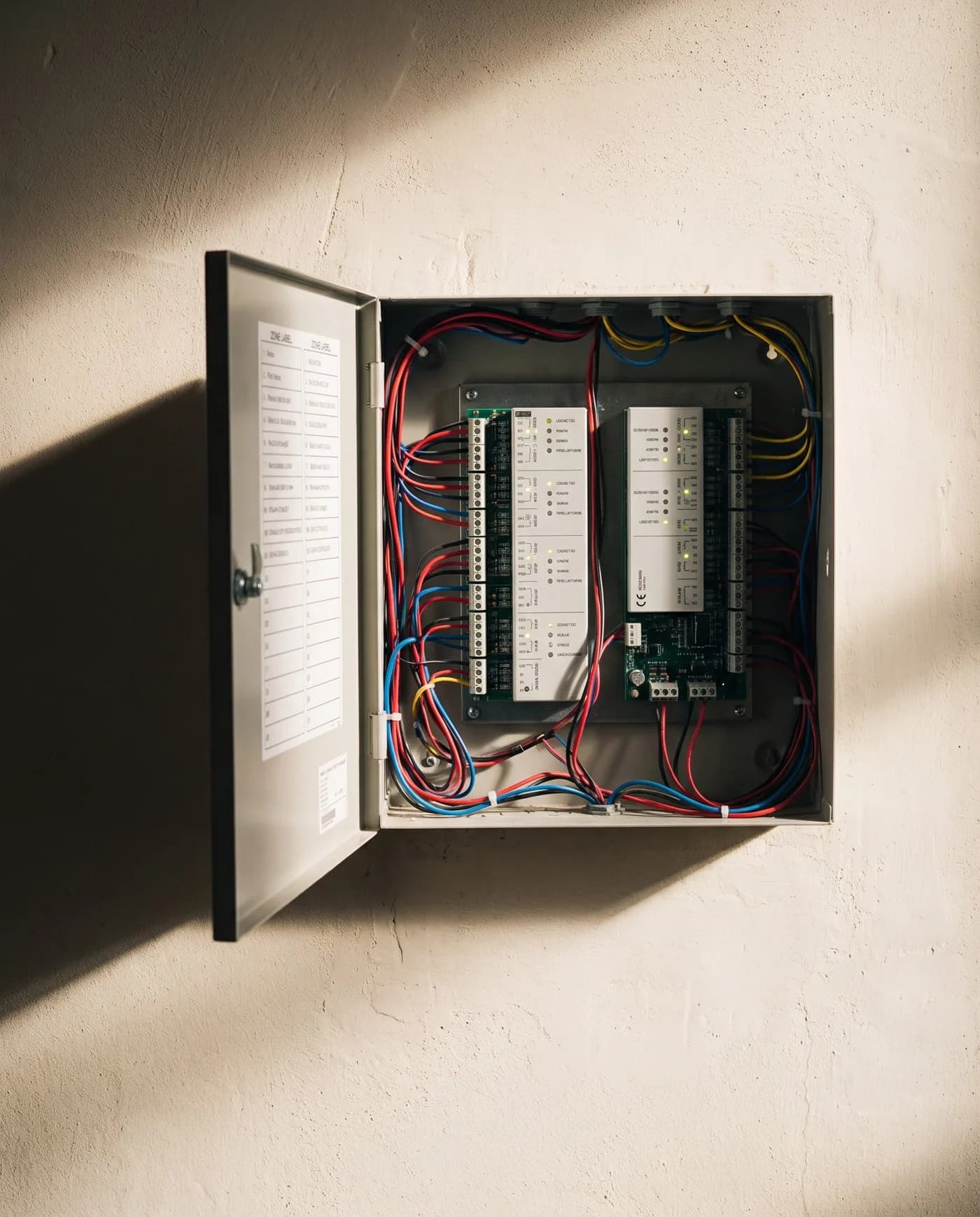
Detection and alarm equipment for the fire consultant's agreed design and applicable project requirements.
Explore related service
Illustrative — generated visual, not a real project photograph. Illustrative category scene
Fire hydrant equipment
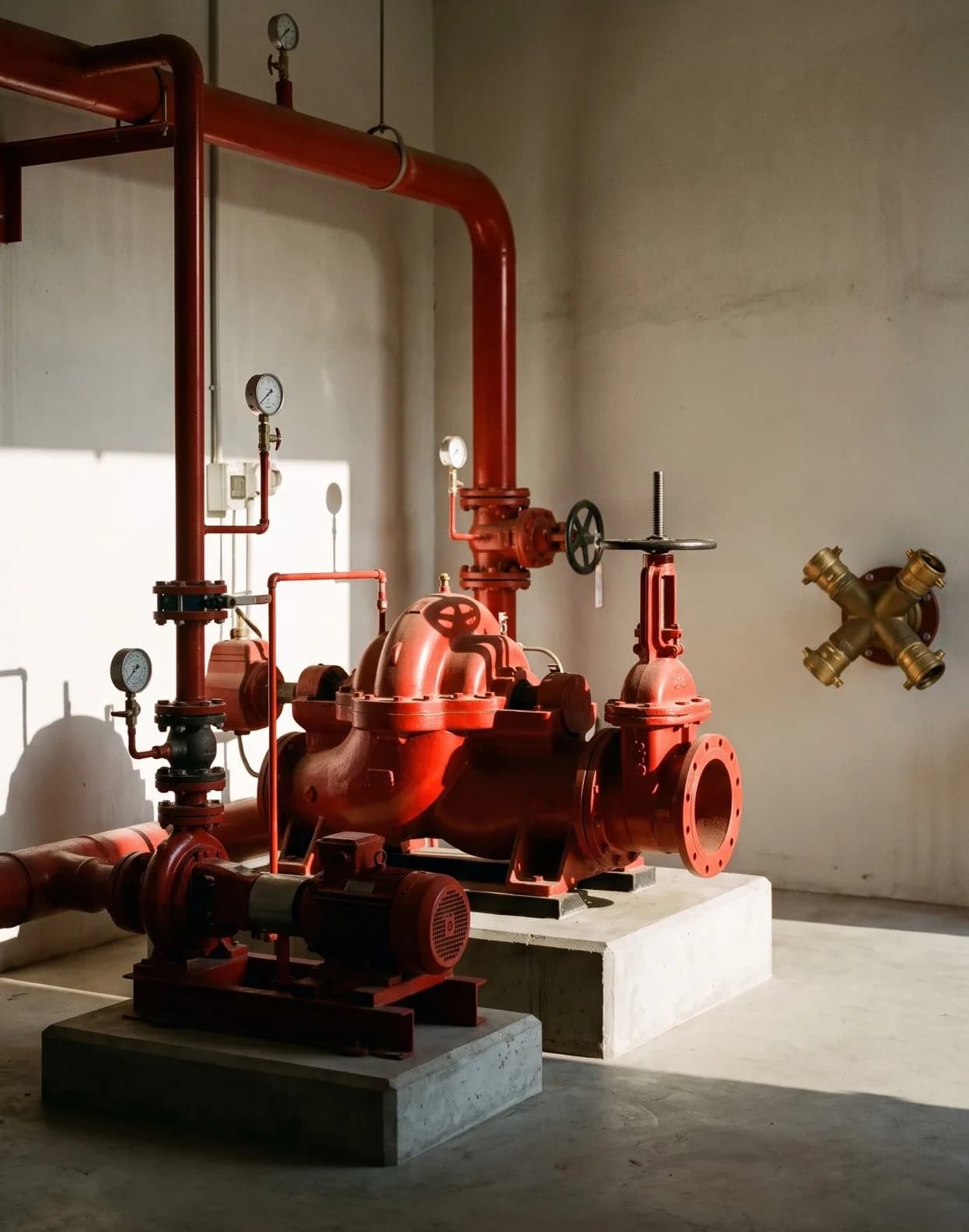
Hydrant equipment coordinated with the approved fire-protection design, water supply and commissioning scope.
Explore related service
Illustrative category scene
Fire-protection goods
Extinguishers, hose reels, fire blankets, egress signage and cabinet hardware, supplied against the building's agreed fire-protection schedule with refill and inspection dates recorded.
Explore related service
Illustrative — generated visual, not a real project photograph. Illustrative category scene
Online UPS equipment
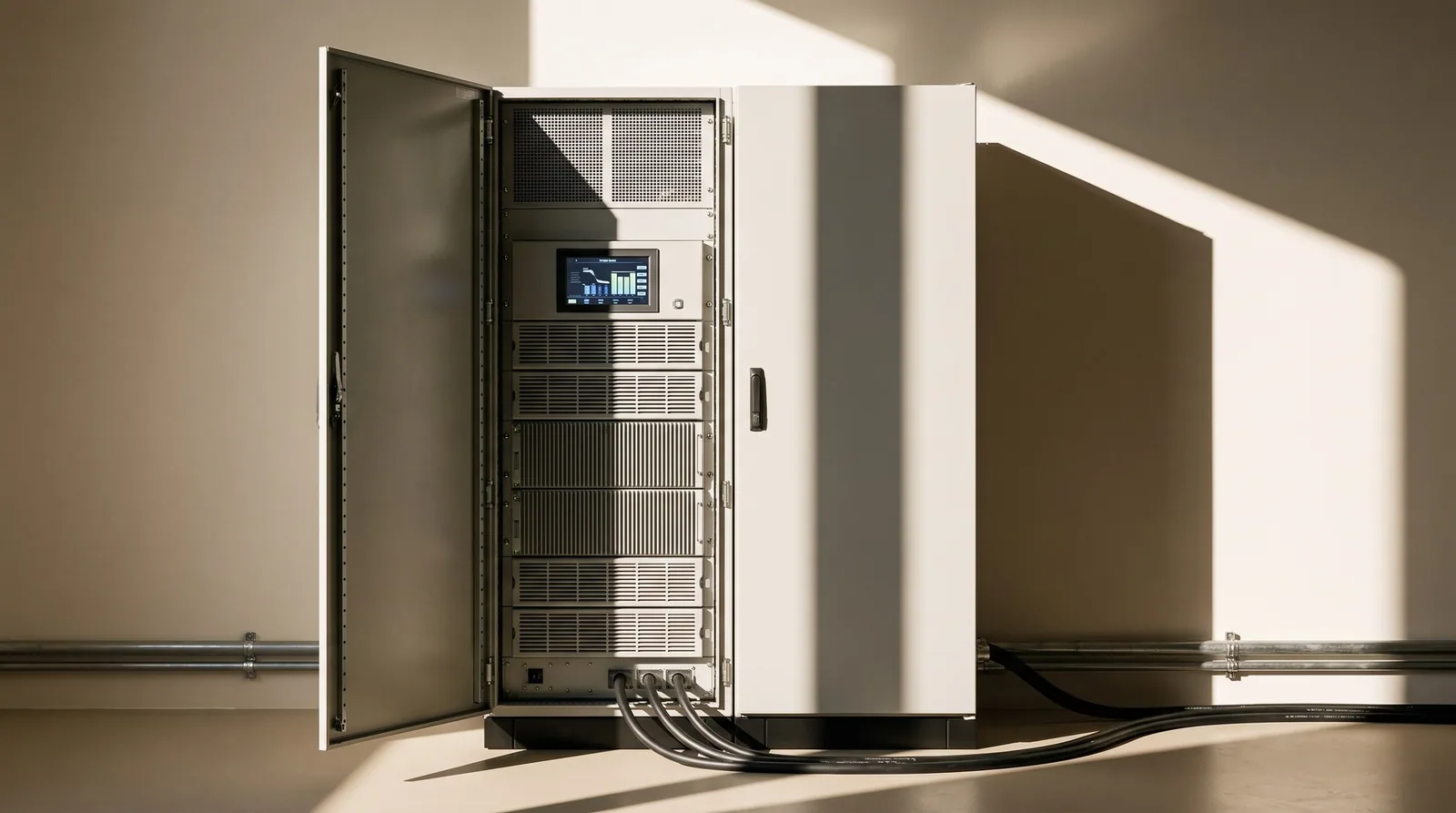
UPS equipment selected against the connected load and a confirmed backup requirement.
Explore related service
· Frequently asked
Healthcare —
what buyers ask first.
What systems can TechnoGuru support for a hospital, clinic or diagnostic centre?
For hospitals, clinics, diagnostic centres, labs and nursing homes, TechnoGuru can plan and integrate CCTV and access control for restricted areas, fire alarm and safety systems, PA and emergency announcement, reception, waiting-area and queue-management displays, digital signage, video door phone and IP-PBX telephony, Wi-Fi and structured cabling, server-rack setup, and UPS backup for IT, networking and security — coordinated as one estate. A nurse-call system can be provided through suitable solution partners where required, and BMS integration is added where required. We engineer to the facility's brief and design intent; we do not make medical-compliance or approval claims.
What standards do you engineer hospital systems to?
We engineer hospital systems to NABH, HTM 08-03 (nurse-call), IS 13039 (hydrant) and IS 2189 (fire alarm), with voice-evacuation PA following NBC 2016 Part 4's voice-evacuation provisions. NABH for clinical operating standards, HTM 08-03 best-practice for nurse-call (originally NHS, now widely adopted internationally), IS 13039 for fire hydrant networks, IS 2189 for fire alarm, IEC 60849 as the international equipment benchmark a voice-evacuation PA specification is written against rather than an instrument Indian code puts in force, and the relevant Indian and international codes for radiation safety where imaging departments are scoped. Our drawings carry signed compliance to the applicable standards.
Why does a hospital need a separate UPS-with-BESS architecture?
Because hospital surgical theatres and ICU equipment cannot tolerate even a 50 ms transfer interruption, online UPS with lithium-ion BESS is life-safety equipment. Surgical theatres, ICU equipment, ventilators, dialysis machines and MRI cooling cannot tolerate even a 50 ms transfer interruption. Online UPS with double-conversion topology and lithium-ion BESS isolates the load from grid reality completely, with zero transfer time and ride-through that outlasts any grid event. This is life-safety equipment, not just operational continuity.
How do nurse-call response-time targets work?
Nurse-call escalates from bedside to nurse mobile after 30 seconds, floor supervisor after 90 seconds and duty doctor after 3 minutes — code-blue broadcasts simultaneously. Escalation timers with mobile-device follow-through. A bedside call is presented to the nursing station immediately, escalates to a designated nurse's mobile device after 30 seconds, escalates to the floor supervisor after 90 seconds, and to the duty doctor after 3 minutes if not acknowledged. Code-blue is broadcast to every relevant station and pager simultaneously. Every event is logged for service-quality analytics.
Can you do CCTV that respects patient dignity and complies with hospital privacy norms?
Yes — hospital CCTV is zoned strictly: wards and toilets excluded, corridor coverage privacy-respecting, ICU and theatre CCTV restricted to authorised clinical staff. Hospital CCTV is designed with strict zoning: wards and toilets are explicitly excluded, corridor and entry coverage is privacy-respecting, ICU and theatre CCTV requires written authorisation and is restricted to clinical staff. We design retention policies to NABH and applicable data-protection guidance.
What's the typical scope and timeline for a 200-bed hospital?
A hospital programme depends on scope, procurement, approvals, site readiness and clinical coordination. The systems can include nurse-call, PA, addressable fire alarm, IP CCTV, access control, IP-PBX, BMS, online UPS-with-BESS and structured cabling. Scope: nurse-call across all beds, PA with departmental zoning (engineered as a voice-alarm system where the occupancy and the fire authority require one), addressable fire alarm, IP CCTV (typically 90+ cameras), access control across restricted zones, IP-PBX with hospital extensions, BMS, online UPS-with-BESS for theatres and ICUs, structured cabling and medical-grade Wi-Fi. The schedule is agreed after reviewing construction readiness and the clinical opening plan. Tinsukia Medical College & Hospital, delivered for NCC Limited, is a project at this scale: our scope there covered nurse calling, PA with microphone announcement and departmental zoning, addressable fire alarm, IP CCTV, access control, EPABX, data points and Wi-Fi.
How do you handle commissioning in a phased hospital that is opening wards while still being built?
Phased hospital commissioning runs zone-by-zone — each ward, theatre or department tested and handed over independently with verified cause-and-effect before patients arrive. Zone-by-zone cutover. Each ward, theatre or department is commissioned, tested and handed over independently, with the nurse-call, fire and PA cause-and-effect verified per zone before patients arrive. The active hospital and the construction zone are kept on separately segmented networks during the build, with documented hand-off points as each new zone goes live. This is the discipline NABH expects and we engineer to it.
Can you serve a smaller diagnostic centre or nursing home, not just full hospitals?
Yes — we serve diagnostic centres and nursing homes to the same engineering standards as full hospitals, with scale and budget sized accordingly. Standards are the same — code-compliant fire and PA, addressable alarm, hardened CCTV, online UPS for critical loads, structured cabling for HMIS. The scale is smaller and the budget is sized accordingly, but the engineering discipline does not relax for smaller premises. Smaller clinical sites are often where compromise causes the most operational damage; we hold the standard.
What's the AMC profile for a hospital — and why is response time so critical?
Hospital AMC is premium tier with contracted critical-hours support and documented mobilisation targets for critical fault classes — written into the contract because clinical operation cannot tolerate ambiguity. Critical-system support for nurse-call, fire, PA, UPS and theatre AV is scoped in the AMC, with escalation paths documented for critical fault classes. Spares for these systems are held in our Lachit Nagar office against the specific hospital's deployment. Response targets are written into the contract because clinical operation cannot tolerate the ambiguity that comes with verbal commitments.
Engineering decisions
Decisions that shape healthcare projects
Decision · Networking & IT
On-premises IP PBX vs cloud telephony
You are deciding where the call platform should live for a site whose voice has an operational job, not just a desk-phone job.
Decision · Networking & IT
Single-mode vs multimode fibre backbone
You are specifying the backbone fibre grade for a new build or a re-cable and want it sized for the building's life rather than the current switch generation.
Decision · Fire & Life Safety
Addressable vs conventional fire alarm — panel architecture under NBC 2016
You are settling the fire-alarm panel architecture for a building and want the decision framed by scale, evacuation logic and integration, not brand.
Decision · Power & UPS
Online UPS vs BESS-backed backup — the right ride-through
You are deciding how to protect a critical load and are weighing instantaneous ride-through against longer-duration backup or an energy strategy.
Engineering toolkit
Tools we use for healthcare work
Calculators and reference checkers our engineers reach for first on projects in this sector.
- Life-safety
NBC Compliance Checker
Building height, type and occupancy in — the life-safety and ELV systems NBC 2016 indicates for that building, citing NBC 2016 and the relevant IS codes.
NBC 2016 · IS codesOpen - Life-safety · 28 states + 8 UTs
NBC Fire-Safety by State
State or union territory, building height and occupancy in — list of sprinkler, voice-evac PA, wet-riser and Fire-NOC triggers out, with explicit source-status tiering across all 28 Indian states and 8 union territories.
NBC 2016 · state ruleOpen - Power · BESS · Solar
DG → Solar+BESS Crossover
DG capacity and monthly run-hours in — the kWp solar + kWh LFP BESS that displaces the genset's run-hours out, plus annual diesel litres displaced and CO₂ avoided.
kWp · kWh · yearsOpen
/ Engineering notes
Long-form reading for healthcare projects
Insight
Redundancy & failover engineering: N+1, 2N, hot-standby and the discipline of designing for the day something fails
Cross-discipline redundancy philosophy — when N+1 is enough, when 2N is the only honest answer, how cold/warm/hot-standby actually behave at switchover, and the failover patterns that separate a building from a critical-infrastructure asset.
Insight
UPS runtime: the misconceptions that turn a 30-minute spec into a 12-minute reality
UPS holdover on the catalogue is a nameplate kVA at unity power-factor and a fresh battery bank at 25°C. UPS holdover in the building is the actual load at the actual power-factor on a 30-month-old battery bank at the actual operating temperature. The gap is where the runtime spec breaks down.
Insight
Addressable vs conventional fire alarm: which one your building actually needs
Code thresholds, forensic localisation, integration with cause-and-effect logic — the practical differences that decide the right specification for a mid-rise commercial building under NBC, IS 2189 and NFPA 72.
Every calculator, checker and planner curated for healthcare projects lives on one directory page.
All healthcare tools →· Begin
Project in healthcare?
Begin a brief.
The first reply will come from a project lead, not a sales gateway, within two working days.