
03 / 22
Case file
Addressable and conventional fire detection and alarm — one of the three fire families (fire alarm, fire hydrant, fire extinguishers) — Honeywell, Bosch, Notifier and Siemens panels — integrated with PA, BMS, access control and emergency lighting to readiness per NBC, IS 2189 and NFPA 72, for consultant and AHJ review.
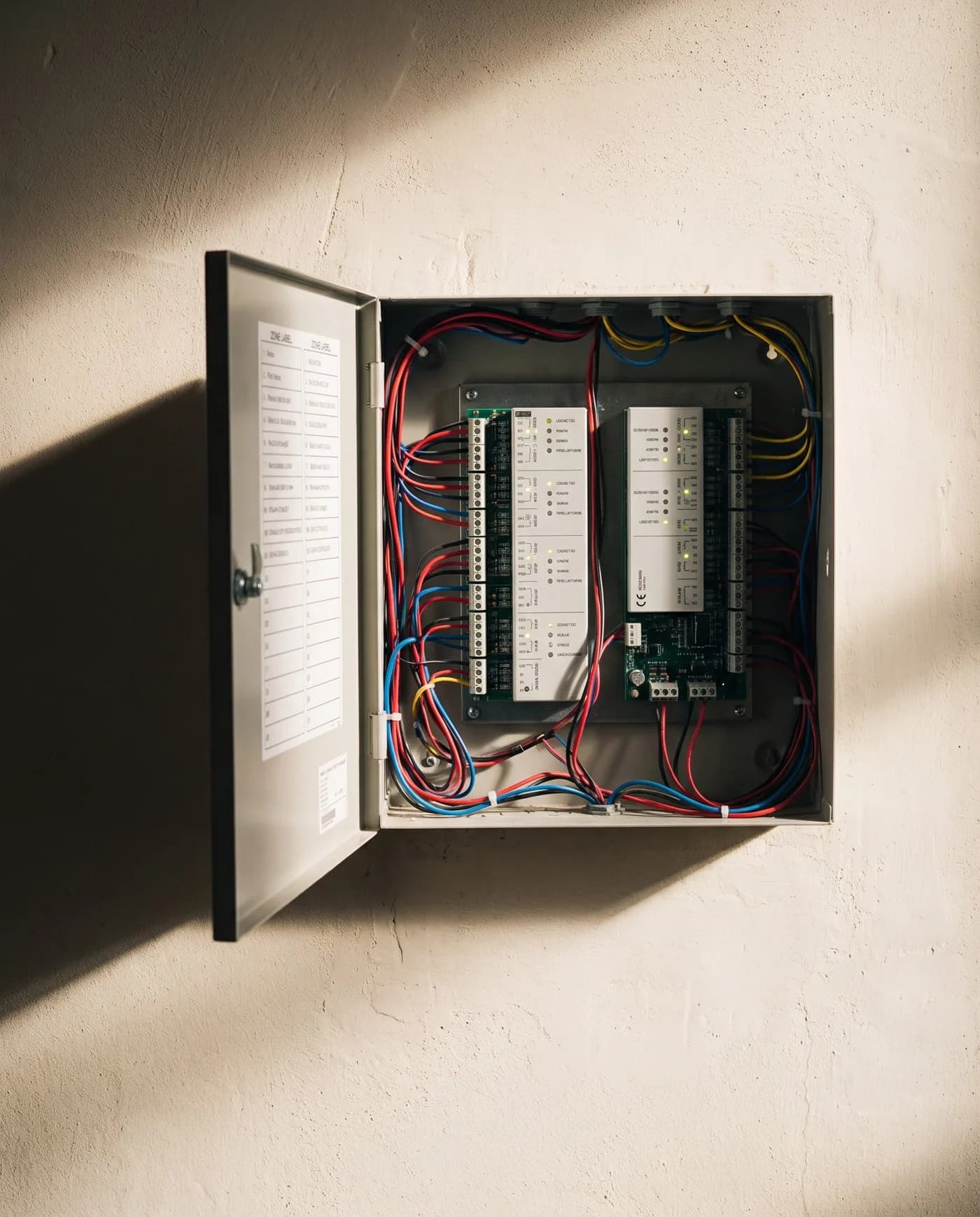
| Requirement | Code-minimum approach | Engineered approach |
|---|---|---|
| Panel type | Conventional, chosen on cost | Addressable where NBC requires, by building class |
| Cause-and-effect | Detection only | Detection mapped to sounders, dampers, lifts, doors, PA and BMS |
| Standby power | Battery sized by rule of thumb | Standby sized to the real load and required duration |
| Approvals | NOC chased at the end | NOC engineered toward from the design stage |
Educational comparison of design rigour — not a statement about any specific installer.
— Fire Alarm · Cause-and-Effect
Twenty seconds. Choreographed.
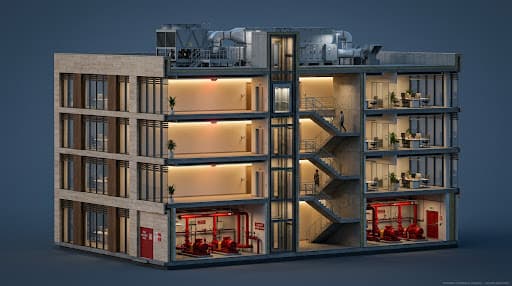
Trigger a detector. Lifts, doors, PA, BMS dampers, smoke extract, brigade dashboard and pumps respond in the order written into the cause-and-effect matrix.
/ Standby
Hit Play to trigger the Floor 3 detector and watch the 20-second cascade run through the building.
Fire alarm cause-and-effect cascade
- +0s Smoke detector: Smoke detected on Floor 3 corridor.
- +1s Fire panel: Panel confirms the alarm and logs it.
- +3s Lifts: Lifts return to ground floor and hold open.
- +5s Fire doors: Held-open doors release — fire compartments seal.
- +6s PA system: Floor 3 hears the evacuation voice message.
- +8s Air handling: Floor 3 air-handling shuts to slow smoke spread.
- +10s Stair pressurisation: Stair fans start — stairs stay smoke-free.
- +12s Brigade dashboard: Address and zone pushed to the brigade panel.
- +15s Hydrant pumps: Pumps confirm pressure — mains primed.
- +18s Sprinklers: Sprinklers stand by — waiting on heat.
/ The discipline, in detail
How we approach fire alarm system.
Most fire alarm panels are mute until the moment they aren't. The good ones already know which corridor, which beam pocket, which return-air plenum the smoke has just entered. We design to that standard — addressable loops with documented zone maps, cause-and-effect logic written for the specific building rather than copied from a template, and a graphical front-end the night-shift security guard can read at 3 a.m. without training. The fire alarm sits within the wider fire-safety scope alongside fire hydrant and fire extinguisher works where applicable to project scope.
The integration matters as much as the detection. When the panel triggers, lifts homing to the ground floor, magnetic door-holders releasing, the PA chain announcing the affected floor, AHU dampers closing — these handovers are programmed and tested against a written cause-and-effect matrix, not assumed. Loop sizing, detector spacing and survivability are engineered to readiness per NBC, IS 2189 and NFPA 72; drawings are prepared for the local fire NOC and the AMC includes quarterly inspection, hot-work watch and biannual mock drills. Readiness is our deliverable; final approval rests with the AHJ/consultant, so verify with the AHJ/consultant.
We deal in both conventional and addressable systems, and the honest owner-level question is which one the building actually calls for. A conventional panel groups detectors into hardwired zones and reports at zone level — the right engineering answer for small, simply-zoned standalone buildings where knowing the floor or wing is enough and the device count is low. An addressable loop identifies each individual device, cuts cable runs on larger footprints, and self-reports detector health point by point — which is why its cost of ownership falls as the building grows. We design, supply, install and maintain both, and we state in writing which one the building's size, zoning and code position justify.
On record
Every fire alarm system engagement is documented end-to-end — design, programming, commissioning, calibration — and handed over with the files our successors would need if we were never to return.
/ Cause and effect
Detection to action
The addressable cause-and-effect matrix — how a detector event cascades into sounders, dampers, access release and BMS actions, by design rather than by accident.
Diagram · described
Fire-alarm cause-and-effect matrix
The addressable fire-alarm cause-and-effect matrix is the contract for life-safety integration. Six representative input zones (OT smoke, MICU heat, lobby call-point, atrium beam, sprinkler flow, server pre-action) feed a per-zone cause matrix with explicit acknowledgement-delay rules. The matrix gates nine output classes — sounders, strobes, PA voice messages, AHU dampers, lift homing, magnetic door-hold release, access-control evacuation mode, CCTV bookmark and BMS event log. Witnessed at commissioning, signed off per zone, audited at every inspection cycle.
Diagrammatic view — a system planning illustration for design discussion, not a project drawing or live interface.
/ Three lenses on the same system
Read it the way you actually need it.
Three short readings of fire alarm system — for a non-engineer who needs the picture, an engineer who needs the spec, and a buyer who needs to see the system in operation.
/ In simple terms
A fire-alarm system is the safety net that detects fire early and triggers a coordinated response — sounders go off, doors release, lifts return to ground, the air-handling system seals the affected area, and the public-address system tells everyone where to evacuate from. Modern systems are 'addressable', meaning the panel knows exactly which detector triggered, not just which floor.
/ Technical explanation
An addressable fire-alarm system supervises every detector, manual call-point, sounder and beacon on a class A or class B loop individually. The panel evaluates inputs against a written cause-and-effect matrix and triggers outputs across lifts, doors, dampers, PA and BMS. Compliance is to NBC 2016, IS 2189 and (for international cross-reference) NFPA 72; voice-alarm overlay is to IEC 60849 / EN 54-16.
/ Real project usage
On the Tinsukia Medical College & Hospital deployment, the fire-alarm cause-and-effect matrix coordinates the addressable detection zones against the building's physical response — lift homing, magnetic door-holder release, AHU damper closure, CCTV pre-record and access-control evacuation mode — with a surgical-anaesthesia override captured explicitly on the theatre-serving air-handling zones so the OT team can acknowledge before those dampers close on a fire alarm. The hospital's public address is a departmental announcement and paging system, independent of the fire panel. The matrix is signed by the hospital's clinical engineering lead, the fire-safety officer and the AHJ, and re-tested on every quarterly AMC visit. Matrix dimensions, zone schedules and plant identifiers stay in the project record.
/ System architecture
The layers, named.
Every layer below is engineered as one piece of the integrated stack. Each carries its own commissioning artefact and its own AMC inclusion.
- 01
Addressable fire-alarm panel at the building's central control point, sized against the loop count required by IS 2189 and the building's actual zone partition. Modern panels carry 2–8 loops, with each loop supporting up to 240 addressable devices (detectors, manual call-points, sounders, beacons, interface modules).
- 02
Loop cabling is fire-rated FRLS or MICC, depending on the building's compartmentation, with isolators every 25–32 devices so a short on one segment does not bring down the whole loop. Each loop is supervised end-to-end — the panel reports loop integrity continuously and raises a fault on any open or short.
- 03
Field devices — addressable smoke and heat detectors, manual call-points, sounders, voice-alarm strobes, interface modules to AHU dampers, lift-homing relays, magnetic door-holders, BMS gateways. Every device has a unique address on its loop, programmed against the building's zone partition.
- 04
Back-up power — dual-source supply (utility + battery) sized to maintain the panel and loop in alarm state for 30 minutes minimum (24 hours in stand-by + 30 minutes in alarm, per IS 2189). Battery capacity is calculated against the panel's actual loop and field-device load.
- 05
Cause-and-effect logic resides in the panel's programming layer, written against the building's zone partition. The panel evaluates inputs (zone alarm, manual call-point, sprinkler flow-switch) and triggers outputs (sounder zones, door-holder release relays, AHU damper actuators, lift-homing circuits, PA voice-evac, BMS interlocks).
/ Design considerations
The decisions we take early.
- Zone partition is the first decision and the hardest to revisit — it must be agreed against the building's compartmentation and occupancy character before the panel is procured, because the panel's loop and address budget has to fit the partition.
- Cause-and-effect matrix is written in tabular form before the panel is programmed — every input row, every output column, every cell explicit. The matrix is signed by the AHJ, the operations team and the integrator before any field installation begins.
- Loop topology — class A (fault-tolerant ring) versus class B (radial) — driven by the building's criticality. Hospital, hospitality and high-occupancy assembly buildings get class A; small commercial buildings can accept class B.
- Voice-alarm overlay is required where NBC 2016 Part 4 and the local AHJ mandate it — typically large auditoria, hospitals, larger hotels and malls. The PA system must be designed as a voice-alarm system to IEC 60849 / EN 54-16, with supervised cabling and battery-backed power.
- Detector sensitivity tuning is per-zone, not per-detector — kitchens, plant rooms and workshop areas get higher-threshold detectors or different detector types (heat-only, CO-only) to avoid nuisance alarms.
/ Integration logic
How it talks to the rest.
- Lift-homing — on a fire-alarm trigger from any zone serving the lift shaft, the lifts home to the ground floor and lock open. Implementation is a normally-energised relay output from the panel that the lift controller monitors; on relay drop-out, the lift homes.
- Magnetic door-holder release — on a fire-alarm trigger, the door-holders on the affected zone release, allowing fire doors to close under their automatic-closer mechanism. The release is via a normally-energised relay that drops out on alarm.
- AHU damper closure — on a fire-alarm trigger, the AHU dampers in the affected zone close to limit smoke spread. Hospital deployments carry a clinical-engineering acknowledgement window before the OT-zone dampers close, captured in the matrix.
- PA voice-evacuation, where the building carries a voice-alarm system — on a fire-alarm trigger, the PA pre-empts routine paging on a hardware-enforced priority input and broadcasts the affected zone's evacuation message. Implementation is the fire-alarm voice-evac module wired to the highest-priority input on every zone amplifier. Where a building's PA is an announcement and paging system only, it is not wired this way and the matrix carries no PA output.
- Access-control evacuation mode — on a fire-alarm trigger, the access-control system switches to evacuation mode. Doors on egress paths must be fail-safe in hardware so the access-control system cannot keep them locked.
- BMS gateway — the fire-alarm panel exposes its status to the BMS via a BACnet or Modbus gateway, so the facilities team's dashboard surfaces fire events and the BMS can interlock dependent plant.
/ Failure scenarios
What goes wrong, in practice.
- Battery degradation — the back-up battery loses capacity over 3–5 years; without scheduled load-testing, the battery may not deliver the full 30-minute alarm state when actually needed. AMC includes quarterly battery load-testing and 5-year proactive replacement.
- Detector drift — addressable detectors drift in sensitivity over 5–8 years; without sensitivity testing, drift produces either false alarms (drifted-low) or missed alarms (drifted-high). AMC includes 5-year sensitivity testing per IS 2189.
- Lift-homing-circuit disabled by lift maintenance — the lift maintenance contractor disables the homing circuit during a service visit and forgets to re-enable it. The fire-alarm matrix says the lifts home on alarm; the lifts in service do not. Caught only by quarterly cause-and-effect re-testing.
- Cause-and-effect drift after system change — a new detector added to a zone, an output relay re-wired, a panel firmware update — and the matrix is no longer accurate. Caught only by re-testing on every system change.
- Voice-alarm priority bypassed — software-only priority configuration that a routine paging operation can over-ride. The fire-alarm voice-evac broadcasts but a higher-priority routine page interrupts. Mitigated by hardware-enforced priority on every zone amplifier.
/ Maintenance expectations
What the AMC actually delivers.
- Quarterly preventive visit — panel battery load-test, detector sensitivity sample-check (10% of the loop population), manual call-point function-test on every zone, sounder/strobe activation on every zone, cause-and-effect verification on a rotating sub-set of the matrix.
- Annual full cause-and-effect re-test — every input row in the matrix triggered, every output column verified, signed-off test record handed to the operations team.
- 5-year detector sensitivity test on the full loop population per IS 2189, with documented sensitivity readings and replacement of any out-of-spec detector.
- Configuration baseline stored offline — the panel's complete programming captured to versioned encrypted storage, so a panel firmware corruption is recoverable in hours not days.
- Spares-on-hand — the AMC carries a deployment-specific spares pool: panel motherboards, loop drivers, detectors, manual call-points, sounders, batteries, sized against the manufacturer's MTBF data.
/ Where we deploy this
Active across 7 sectors.
Fire Alarm System is rarely a standalone brief — it sits inside a wider sector practice with its own codes, expectations and operating rhythm.
Hospitality
Guest experience, engineered.
Commercial & Corporate
Workplaces that begin meetings on time.
Education & Institutions
Schools, colleges and universities.
Healthcare
Hospitals where systems serve the patient.
Government & Public Safety
Mission-grade integration.
Retail & Malls
Footfall, loyalty, footprint.
Industrial & Warehousing
Operations that don't take a day off.
/ Sister services
The rest of elv.
A serious brief usually crosses two or three of these. Read across the discipline — we deliver them as one contract.
- 01
CCTV & Surveillance
Coverage. Storage. Evidence.
IP video surveillance — Hikvision, Dahua, Axis, Bosch — designed to coverage, recording-bandwidth and retention specifications, with VMS and AI-analytics overlays.0 - 02
Access Control
Right person. Right door. Right time.
Card, biometric, mobile-credential and visitor-management — Honeywell, HID, Matrix and Suprema — integrated with CCTV, intrusion and HR systems.1 - 04
Fire Hydrant System
High-volume water, precisely where it's needed.
Wet- and dry-riser hydrant systems — one of the three fire families (fire alarm, fire hydrant, fire extinguishers) — jockey-and-main pump rooms, yard hydrants and four-way fire-brigade inlets, engineered to readiness per NBC, IS 13039 and NFPA 14 for consultant and AHJ review.2 - 05
X-Ray Baggage Scanners
Operator confidence, in seconds.
Dual-energy X-ray baggage and parcel scanners for airports, hotels, government buildings, courts, malls and corporate lobbies.3 - 06
Under Vehicle Surveillance (UVSS)
Full-chassis scan, the moment a vehicle arrives.
Embedded high-resolution UVSS with ANPR and driver-occupant cameras — a critical first line of defence at every vehicle entry point.4 - 07
Door-Frame Metal Detectors
Quick, unobtrusive, accurate.
Multi-zone DFMDs with adjustable sensitivity, pinpoint LED indicators and networked logging — for hotels, courts, places of worship, malls and government buildings.5 - 08
Boom Barriers & Motorised Gates
Controlled flow, every gate.
Boom barriers, sliding and swing gates, road blockers, bollards and turnstiles — integrated with ANPR, RFID and access control.6 - 09
Nurse Calling System
Patient request to nurse response. Documented.
IP-based nurse call systems with bedside, bathroom, code-blue and staff-presence stations, integrated with mobile and PA.7 - 10
Gas Suppression System
Fire put out without water touching the equipment.
Clean-agent and inert-gas fire suppression — the clean agent flooding system of consultant schedules — FM-200/HFC-227ea, fluoroketone-class NOVEC 1230, CO2 and inert-gas systems — for server rooms, data centres, archives, electrical and panel rooms and other spaces where water would do as much damage as the fire, engineered to readiness per NBC, relevant IS codes and NFPA 2001/12 for consultant and AHJ review.8 - 11
Fire Sprinkler System
Automatic water, only where the heat is.
Automatic water sprinkler systems — wet, dry, pre-action and deluge — engineered to readiness per NBC, relevant IS codes and NFPA 13, and coordinated with the fire-hydrant and fire-alarm systems for consultant and AHJ review.9 - 12
Emergency Lighting & Egress Signage
A lit, legible path out when the mains go dark.
Emergency and egress lighting with photoluminescent exit and wayfinding signage — self-test luminaires, central-battery systems and IS-compliant signage — designed so occupants can find and follow a marked route to a final exit when normal power fails, engineered to readiness per NBC and relevant IS codes for consultant and AHJ review.10 - 13
Fire Doors & Fire-Rated Shutters
The fire held at the doorway.
Fire-rated doorsets and rolling shutters — passive fire protection at compartment lines, staircases and service openings — with frames, closers, panic hardware and magnetic hold-open release coordinated with the fire alarm and the escape plan, supplied and installed where project-fit.11 - 14
Fire Extinguishers & Fire-Protection Goods
First response, within arm's reach.
Portable fire extinguishers — one of the three fire families (fire alarm, fire hydrant, fire extinguishers) — ABC dry powder, CO2, clean-agent, foam and water classes, with site-assessed placement, mounting, signage, refilling and AMC, along with related fire-protection goods and accessories.12 - 15
Automatic Tube Fire Detection & Suppression
Suppression born inside the cabinet.
Automatic Linear Pneumatic Tube Detection systems — enclosure-level fire detection and suppression for electrical panels, server and network racks, battery enclosures and machine cabinets — operating standalone without external power, in direct- and indirect-discharge configurations.13 - 16
Intrusion Detection & Alarm
Know the moment a boundary is crossed.
Intrusion and perimeter detection — door/window contacts, dual-tech motion sensors, glass-break, vibration and fence sensors, panic and alarm panels with app and central-station-ready monitoring — integrated with CCTV and access control.14 - 17
Intercom & Video Door Phone
See who's there before you open the door.
Intercom and video door phone (VDP) door-entry — audio and video door stations, indoor monitors, IP and 2-wire systems, lift and lobby intercom, apartment and villa door-entry — integrated with access control and mobile answer.15 - 18
Facial Recognition System
Recognised at the door. Logged, with consent.
AI face-recognition for access, attendance and surveillance — face-based entry, watchlist and VIP/denied-entry alerts — integrated with CCTV and access control on a consent-aware, privacy-respecting deployment.16 - 19
ANPR & Number-Plate Recognition
The plate decides the barrier.
Automatic number-plate recognition for gate automation, parking and visitor logging — plate-read cameras with watchlist alerts, integrated with boom barriers and access control.17 - 20
AI Video Analytics
What your cameras can actually carry.
Video analytics is a layer, not a product — it runs on whatever streams the cameras already on site can genuinely deliver.18 - 21
Centralised CCTV Monitoring
Many sites. One monitoring picture. Stated limits.
Head-office monitoring across branch sites commissioned years apart on different recorders — surveyed site by site, then built on what each recorder actually exposes.19 - 22
Fireman Talk-Back & Emergency Communication
Two-way communication that is supervised, not assumed.
Supervised fireman's telephone circuits and talk-back field stations — fixed jack points and handset outlets distributed through the building, calling a master console at the fire command point over dedicated two-wire circuits that are monitored, so a cut or a short shows up as a fault rather than as a surprise during an incident.20
/ Where this system has been deployed
Fire Alarm System on the ground.
The reference projects below carry a fire alarm system layer engineered as part of an integrated stack. Each case study walks through the engineering challenges that were solved, the standards the work was held to, and the operational outcome on the day-two team.
- Completed · Handover 2024
Tinsukia Medical College & Hospital
Healthcare · Government · Tinsukia, Assam
- Completed · Handover 2022
Capital Cultural Hall, Kohima
Government · Cultural Auditorium · Kohima, Nagaland
- Completed · Handover 2024
Town Hall Auditorium, Dimapur
Government · Civic Auditorium · Dimapur, Nagaland
- Completed · Handover 2025
Taraghar — State Guest House
Government · State Guest House · Shillong, Meghalaya
- Completed · Handover 2021
Assam State Guest House, Koinadhara
Government · Protocol Residence · Guwahati, Assam
Public project summaries describe systems and outcomes only — BOQ values, quantities, device counts and security layouts are kept off public surfaces.
Request a feasibility review/ Integration with
How fire alarm system talks to the rest.
A serious deployment of this system rarely operates in isolation. The disciplines below most commonly share its cabling pathways, its controller logic, and its cause-and-effect matrix.
Professional Audio & PA Systems
Intelligible, every seat in the house.
Public address, voice-evacuation and concert-grade audio for auditoriums, places of worship, stadia, transit hubs and event venues.Access Control
Right person. Right door. Right time.
Card, biometric, mobile-credential and visitor-management — Honeywell, HID, Matrix and Suprema — integrated with CCTV, intrusion and HR systems.CCTV & Surveillance
Coverage. Storage. Evidence.
IP video surveillance — Hikvision, Dahua, Axis, Bosch — designed to coverage, recording-bandwidth and retention specifications, with VMS and AI-analytics overlays.Building Management System (BMS)
The building, on a single dashboard.
Open-protocol BMS frameworks — HVAC, lighting, fire and access integrated to a single graphical front-end with operator analytics and alarm escalation.Fire Doors & Fire-Rated Shutters
The fire held at the doorway.
Fire-rated doorsets and rolling shutters — passive fire protection at compartment lines, staircases and service openings — with frames, closers, panic hardware and magnetic hold-open release coordinated with the fire alarm and the escape plan, supplied and installed where project-fit.Fireman Talk-Back & Emergency Communication
Two-way communication that is supervised, not assumed.
Supervised fireman's telephone circuits and talk-back field stations — fixed jack points and handset outlets distributed through the building, calling a master console at the fire command point over dedicated two-wire circuits that are monitored, so a cut or a short shows up as a fault rather than as a surprise during an incident.
/ Read deeper
The engineering, in long form.
Each article below goes deeper than this service page can — a full walk-through of the engineering decisions, written by the team that delivers this work.
- ELV · 7 min
Addressable vs conventional fire alarm: which one your building actually needs
Code thresholds, forensic localisation, integration with cause-and-effect logic — the practical differences that decide the right specification for a mid-rise commercial building under NBC, IS 2189 and NFPA 72.
Read article - ELV · 10 min
Fire-alarm zoning and cause-and-effect: writing the matrix the building actually obeys
An addressable fire-alarm panel is only as useful as the cause-and-effect matrix it is programmed to execute. The matrix is a written contract between the building and its safety system — it ties every zone, every detector, every sounder, every door and every AHU damper into a coordinated response. The discipline of writing one that the AHJ will sign and the building will obey.
Read article - ELV · 11 min
Eight ELV integration mistakes that survive into commissioning — and how to catch them earlier
ELV integration faults rarely surface in design review or installation — they survive into commissioning because the seam-level coordination is nobody's contractual responsibility. The eight failure modes we see most often, and the design-stage discipline that catches each one before it becomes a snag list at handover.
Read article
Engineering toolkit
Tools to scope this work
Calculators and reference checkers we use ourselves to sense-check the engineering before any drawings change hands.
- Life-safety · 28 states + 8 UTs
NBC Fire-Safety by State
State or union territory, building height and occupancy in — list of sprinkler, voice-evac PA, wet-riser and Fire-NOC triggers out, with explicit source-status tiering across all 28 Indian states and 8 union territories.
NBC 2016 · state ruleOpen - Life-safety
NBC Compliance Checker
Building height, type and occupancy in — the life-safety and ELV systems NBC 2016 indicates for that building, citing NBC 2016 and the relevant IS codes.
NBC 2016 · IS codesOpen - Drawing readiness
Drawing & BOQ Readiness Checker
Check whether your drawings, schedules, BOQ/spec status, site access and project team are ready for a systems conversation. Advisory; no pricing, quantities or final scope.
Advisory · copyableOpen
/ Engineering concepts
Related engineering concepts
Concept
National Building Code 2016 (India)
India's umbrella building-services code. Sets fire and life-safety, structural, building-services and accessibility requirements that every ELV, fire, PA and BMS scope must cite line-by-line.
Concept
Fire Cause-and-Effect Matrix
A written specification that documents what each life-safety event triggers across the connected systems — lift recall, magnetic door release, PA announcement, AHU damper close, CCTV pre-record, access evacuation mode.
Concept
ELV Cabling Backbone
The unified low-voltage cable plant carrying fire, CCTV, access, PA, IP-PBX, BMS and structured data across a building — coordinated as one cause-and-effect pathway rather than per-discipline runs.
Concept
IS 2189 — Fire Detection
Indian Standard for the selection, installation and maintenance of automatic fire-detection and alarm systems. Cited line-by-line in every TechnoGuru fire-alarm engineering pack.
/ Used alongside
Commonly deployed alongside
Service
CCTV & Surveillance
Coverage. Storage. Evidence.
Sector
Healthcare
Hospitals where systems serve the patient.
Service
Building Management System (BMS)
The building, on a single dashboard.
Service
Professional Audio & PA Systems
Intelligible, every seat in the house.
Sector
Hospitality
Guest experience, engineered.
Service
Access Control
Right person. Right door. Right time.
/ Plan it right
Fire Alarm System — getting the brief right.
Common mistakes to avoid
- Choosing conventional panels on zone geometry the building will outgrow — a conventional panel reports at zone level only, so a large or complex floor plate loses device-level localisation.
- Designing detection without the matching cause-and-effect: which zone drives which sounders, dampers, lifts, doors and PA message.
- Leaving fire integration with PA, BMS and access control until after the panels are bought, so the interfaces never get wired.
- Sizing battery standby without the real load, so the panel fails its required standby duration on test.
- Treating the fire NOC as a document to chase at the end rather than a design constraint to engineer toward from the start.
What to share before a quotation
- Floor plans with built-up area, floor count and overall building height.
- Occupancy type (hospital, mall, hotel, office, industrial) and any local fire-authority requirement already issued.
- Whether voice evacuation / PA and BMS interfacing are in scope.
- Phasing — single handover or staged floors and blocks.
- Any existing panels or detection that must be retained or migrated.
Equipment categories
See the equipment behind the solution.
Explore equipment we supply and the services around it. The final specification follows your space, operating needs and agreed scope.
/ Frequently asked
Fire Alarm System — what buyers ask first.
Addressable vs conventional fire alarm — which do I need?
NBC 2016 Part 4 requires an automatic detection and alarm system by occupancy and height but does not specify addressable or conventional — that choice is an engineering decision, not a code mandate. The practical driver is IS 2189, which limits a conventional detection zone to 2,000 sq m and a 30 m search distance; large floor plates exhaust that quickly, which is why addressable is usually right for multi-storey and phased-evacuation buildings. Conventional remains acceptable for small standalone buildings and warehouses, where zone-level rather than device-level localisation is adequate. The authority having jurisdiction approves the final scheme.
What is VESDA?
VESDA is aspirating smoke detection: the panel actively samples air through a pipe network and detects smoke at concentrations 100 to 1,000 times lower than spot detectors. We specify it for data centres, server rooms, museums, archives and high-value control rooms where early detection is essential.
Do you supply and install conventional fire alarm panels as well as addressable?
Yes — we deal in both conventional and addressable fire alarm systems. Conventional panels remain the right engineering answer for small, simply-zoned buildings — a standalone school block, a small office, a compact warehouse — where zone-level reporting is sufficient and the device count is low. Addressable is specified where NBC height and area thresholds require it, or where per-device identification and health reporting earn their keep across a larger footprint. The recommendation follows the building, not the catalogue, and we put it in writing.
Can a conventional fire alarm be upgraded to addressable later?
Yes, but plan it as a migration rather than a panel swap — addressable loops are wired and supervised differently from conventional zone circuits, so the panel, the loop wiring plan and usually the devices change together. On occupied buildings we stage the migration zone by zone so detection cover is never lost mid-works. Where a building is likely to outgrow conventional limits, we say so at design stage so the first installation is not a dead end.
Honeywell, Bosch, Notifier or Morley fire panel?
Honeywell Notifier (Honeywell-owned) is our broad-coverage default — the most extensive addressable product range and the strongest service support across India. Morley-IAS is the Honeywell-owned mid-tier addressable line for hospitality and commercial projects where the Notifier head-end is over-specified. Bosch is excellent for healthcare and government where single-vendor coordination with their CCTV and PA matters. Edwards-EST and Siemens Cerberus are specified on specific government and high-rise estates. Choice follows the building's life-safety code map, not the brand catalogue.
What's a cause-and-effect matrix and why do we need one written in advance?
A documented table that says: when detector X activates, system Y, Z and W must perform actions A, B and C. The matrix programmes the building's behaviour during a fire event — lifts home, doors release, PA announces, BMS shuts dampers, CCTV pre-records. Writing it before commissioning forces the design team to think through every interlock; programming it later, after the building is occupied, is slow and error-prone.
How often should the fire alarm be tested?
Monthly functional tests on detectors (battery-supervised, no smoke needed); quarterly full-zone tests; annual end-to-end commissioning re-test with the AHJ. Our AMC programme schedules each, documents the test, and files the report — the document the local fire department audit will ask for.
How is the cost of a fire alarm system scoped?
Cost for a fully addressable system in a commercial or hospitality building is driven by detector density and the integration scope (PA, BMS, lifts, dampers). Hospital and clinical environments run materially higher because of the additional life-safety integration. TechnoGuru does not publish tentative prices or budget bands because every project depends on site conditions, drawings, system scope, brands, integration depth, commissioning and support requirements. Please email info@technoguru.in or WhatsApp/call +91 88110 34444 with your drawings, BOQ or project brief for a written estimate after review.
Who integrates fire safety systems in Assam, and what does the state rule add to NBC 2016?
TechnoGuru engineers addressable fire alarm, detection-to-plant cause-and-effect and hydrant coordination across Assam from its Guwahati headquarters, with the Assam Fire & Emergency Services rule layered onto the NBC 2016 baseline and the cause-and-effect documentation prepared for NOC inspection. The state overlay changes trigger thresholds against building height and occupancy — resolve your building's specific profile with the Assam fire-safety quick-check at /tools/nbc-fire-check/assam, then share drawings for a written scope. Published institutional proof under Assam jurisdiction is the addressable fire-detection and signed cause-and-effect matrix scope at Tinsukia Medical College & Hospital.
Addressable or conventional fire alarm — which suits my building?
Conventional panels report by zone and suit small, simple buildings; addressable panels identify the individual device and carry the loop, cause-and-effect and interface capacity that larger and mixed-occupancy buildings need. The choice follows the building's size, layout and the interfaces required — PA/EVAC, lifts, BMS, dampers — rather than a fixed preference. It is confirmed against the drawings, the occupancy and the local fire authority's requirements.
Where do Ravel, Agni and GST panels fit alongside Honeywell, Notifier and Bosch?
Ravel, Agni and GST are addressable lines we work with on projects where their product range and service model suit the building, while Honeywell, Notifier, Morley and Bosch cover the wider commercial, hospitality and healthcare range. We specify by the building's life-safety design and serviceability rather than by a fixed brand. Final selection is subject to the drawings, the consultant's approval and the local fire authority.
How does the fire alarm interface with the voice-evacuation PA?
The fire-alarm cause-and-effect drives the voice-evacuation PA so a confirmed alarm triggers the correct zoned announcements, with the interface between the two documented before commissioning. Detector type and zoning are chosen for the occupancy and its escape strategy rather than by rule of thumb. The complete design is subject to the occupancy, the consultant's approval and the local fire authority's inspection.
· Begin
Begin a
fire alarm system
brief.
Tell us about the building, the timeline, and what success looks like a year after handover. We will reply within two working days with a written response, not a sales pitch.