
/ ELV
Fire-alarm zoning and cause-and-effect: writing the matrix the building actually obeys
Quick answer
A cause-and-effect matrix is a written table that ties every zone-and-event input on the fire-alarm system to every output it must trigger — AHU dampers, lift-homing, magnetic door-holder release, PA broadcast, BMS interlocks, access-control evacuation mode, sprinkler-pump start. We write it before the panel is procured, walk it through with the AHJ and the operations team, signal-test it at commissioning, and re-test after every system change. Without a written matrix, the building's coordinated response lives in someone's head — and disappears when they leave.
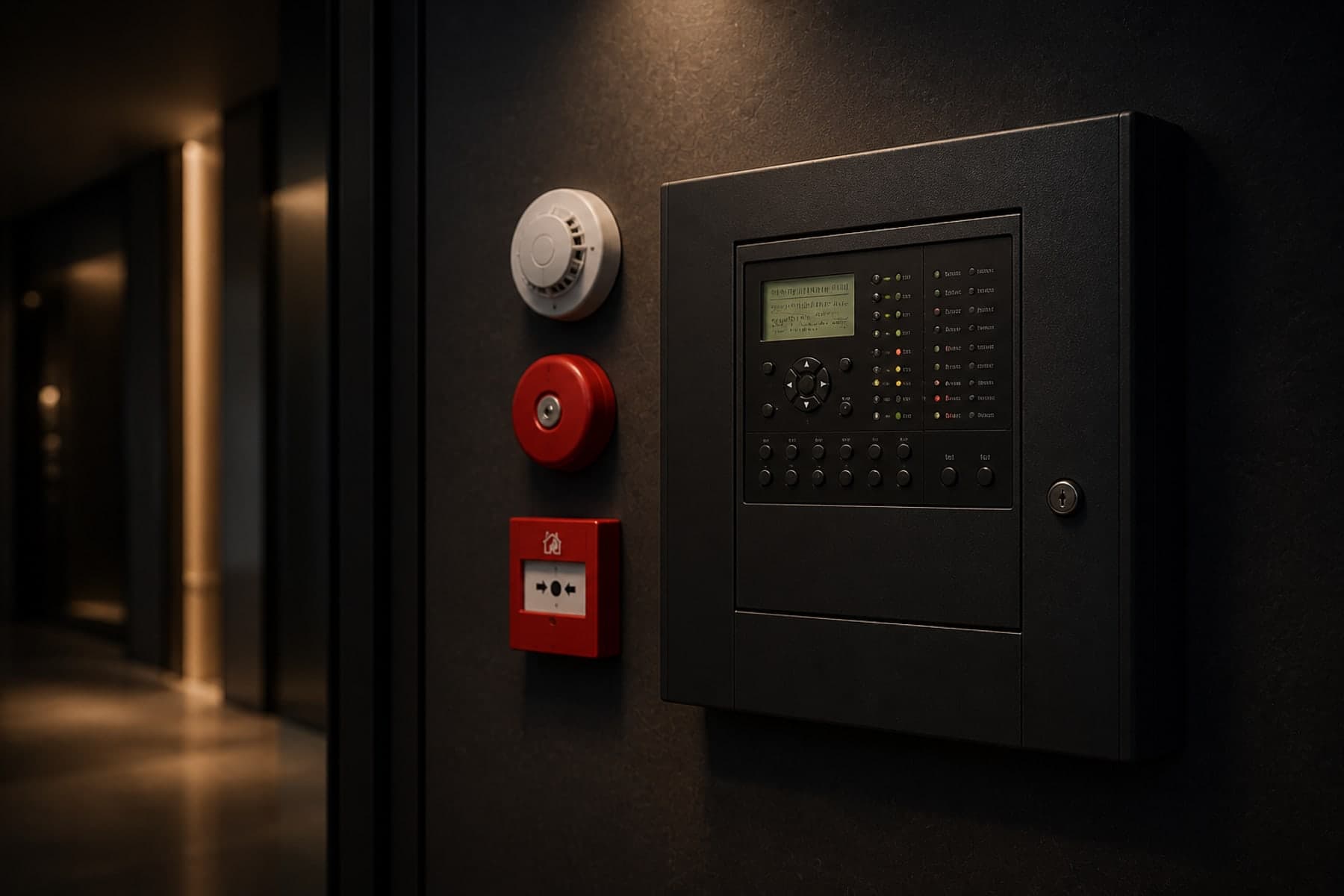
A fire-alarm panel is a small piece of hardware that controls a very large coordinated response. On a single trigger from a single detector in a single zone, the panel may need to home four lifts to ground, release fourteen magnetic door-holders, close eighteen AHU dampers, broadcast a zone-specific evacuation announcement, hand the access-control system into evacuation mode, signal the BMS to pre-start the sprinkler pumps, and pre-record on twenty-three CCTV cameras pointed at the affected corridor. None of this is automatic. All of it is programmed against a written cause-and-effect matrix that someone wrote, someone reviewed, someone signal-tested, and someone signed. If that matrix does not exist in writing, the response does not exist in practice — it lives in someone's head, and it disappears the day they leave.
What the matrix actually is
A cause-and-effect matrix is a table. Rows are inputs — every detector zone, every manual call-point, every sprinkler flow-switch, every duct detector. Columns are outputs — every sounder zone, every door-holder relay, every AHU damper, every lift-homing circuit, every PA broadcast, every BMS interlock. The cells are the actions: 'on alarm input from Zone 3, sound Zone 3 + Zone 4, release Zone 3 door-holders, home Lifts 1 and 2 to ground, close the affected zone's AHU damper, broadcast voice-evacuation message E-3 to Zones 3 and 4, switch Access-Group A to evacuation, pre-record CCTV cameras 12-18 for 60 seconds before alarm'. Every cell is reviewable, testable and revisable.
Most fire-alarm panels we audit pre-retrofit have a matrix that exists implicitly in the panel programming but has never been extracted into a written document. The site engineers can describe the response in conversation but cannot produce a table. That gap is the operational risk the matrix exists to close. We extract the as-is matrix from the panel's programming on every audit, walk it through with the operations team to confirm it matches their understanding, identify the gaps and the contradictions, and produce a written document that becomes the spec for any subsequent change.
Zoning is the first decision and the hardest to revisit
Fire-alarm zoning decides what 'Zone 3' means in the matrix. It is the partition of the building into discrete addressable groups that the panel reports against, and it is what the AHJ signs against. Zoning that is too coarse loses forensic localisation (a 5,000 sq m floor reported as one zone is a single haystack the security desk has to search). Zoning that is too fine produces a matrix with so many rows the operations team cannot mentally hold it.
We zone by occupancy and by compartmentation: each fire compartment is at minimum its own zone, and within a compartment we zone by occupancy character (a ward zone is separate from the nurse station, even if they share a compartment, because the response is different). The IS 2189 conventional-zone ceiling — 2,000 sq m per zone with a 30 m search distance, sub-zoned further where compartmentation requires it (NBC 2016 sets no zone-area figure of its own) — is the floor; we frequently zone tighter for clinical, civic and educational occupancies. The zoning decision is made before the panel is procured, because the panel's loop and address budget has to fit it.
The seam-level integrations are where matrices fail
Most matrices we audit pass the in-system tests cleanly — the fire-alarm panel reads the input, the sounders sound, the door-holders release. They fail at the seams: the AHU damper does not close because the BMS controller went into a maintenance mode three months ago and nobody noticed; the lift-homing circuit was disabled during a service visit and nobody re-enabled it; the PA broadcast plays the wrong message because the message library was reorganised and the matrix references the old message ID.
We mitigate this with two disciplines. First, the matrix carries a per-output 'verification source' — the controller, the relay address and the test method that proves the output is in service. Second, we cause-and-effect test at every system change, not just at original commissioning, with a written test record signed by the system owner. The matrix is a living document, not a commissioning artefact.
The AHJ signs the matrix, not the wiring diagram
On every project, the matrix is what the Authority Having Jurisdiction (the local fire department, in most Indian contexts) signs. The wiring diagram is the implementation; the matrix is the spec. We prepare the matrix in the format the local AHJ recognises — usually a tabular form with the building's actual zone names, the actual device addresses and the actual output relays — and we walk the AHJ through it before any field installation begins. The AHJ's sign-off is on the matrix; we then implement the matrix and demonstrate it on commissioning.
Callout — what buyers most miss
The matrix is the deliverable, not the panel. Most fire-alarm tenders are written around the panel specification — addressable, the loop count, the device count, the brand. The matrix is the actual deliverable. A panel without a written matrix is a piece of hardware looking for a programme. Tender for the matrix discipline as well as the panel; the difference is what separates a system that responds correctly to its first real event from one that does not.
Reference deployment context
The Tinsukia Medical College & Hospital fire-alarm matrix coordinates the addressable detection zones against the building's physical response — lift homing, magnetic door-holder release, AHU damper closure, CCTV pre-record and access-control evacuation mode — with a surgical-anaesthesia override captured explicitly on the theatre-serving air-handling zones, so the OT team can acknowledge before those dampers close on a fire alarm. The matrix was agreed with the fire consultant before commissioning and is signed by the hospital's clinical engineering lead, the fire-safety officer, and the AHJ. We re-test the cause-and-effect on every quarterly AMC visit; the test record is in the AMC log. Matrix dimensions, zone schedules and plant identifiers stay in the project record.
References
1. IS 2189-2008 — Code of practice for installation of automatic fire detection and alarm system.
2. National Building Code of India 2016, Volume 2, Chapter 1 — fire and life-safety provisions.
3. NFPA 72 (2022 edition) — National Fire Alarm and Signaling Code.
4. IEC 60849 — Sound systems for emergency purposes.
Cause-and-effect matrix · the contract for life-safety integration
fire-alarm-cause-effectDiagram · described
Fire-alarm cause-and-effect matrix
The addressable fire-alarm cause-and-effect matrix is the contract for life-safety integration. Six representative input zones (OT smoke, MICU heat, lobby call-point, atrium beam, sprinkler flow, server pre-action) feed a per-zone cause matrix with explicit acknowledgement-delay rules. The matrix gates nine output classes — sounders, strobes, PA voice messages, AHU dampers, lift homing, magnetic door-hold release, access-control evacuation mode, CCTV bookmark and BMS event log. Witnessed at commissioning, signed off per zone, audited at every inspection cycle.
Witness pass discipline
Per-zone witnessed test, signed off in writing.
Every zone is tested with a witnessed input event against every gated output; signatures from the integrator, the AHJ, the facilities or clinical-engineering lead, and the fire-safety officer. The matrix is the document the building is operated against — the wiring diagram is the implementation.
Effort — Full-building: 1–2 days; per-zone re-test: 4–6 hours
/ Frequently asked
Quick answers from the practice.
- Who signs the cause-and-effect matrix?
- Three parties: the integrator (who wrote it), the building's facilities or clinical-engineering lead (who will operate it), and the AHJ (who will inspect it). On hospital and government work, a fourth signature from the fire-safety officer is standard. Without these signatures, the matrix is a draft — it isn't the document the building is being operated against.
- Should the matrix live in the panel or in a separate document?
- Both. The matrix is programmed into the addressable panel as cause-and-effect rules; the same matrix is also published as a signed PDF that the operations team can read without panel access. Mismatches between the two are the most common source of fire-safety surprises during incidents. We diff the two at every quarterly AMC visit.
- How often does the matrix need to be re-tested?
- At commissioning, at every quarterly AMC visit, and after every system change (lift maintenance, AHU controller swap, access-control firmware update, BMS schedule change). The discipline is per-zone testing, not whole-building — full-building tests are reserved for annual sign-off. Per-zone tests are 4–6 hours each, scheduled outside peak clinical or operational windows.
- Can a single AHJ rejection void the entire NOC?
- Yes. Most AHJ inspectors will sign-off the matrix line-by-line; a rejection at line 47 typically requires re-test of the whole matrix after the fix. The discipline is to walk the matrix through with the AHJ informally before the formal inspection so surprises land at draft stage, not at NOC stage.
- Will TechnoGuru maintain the matrix across the building's life?
- Yes. Cause-and-effect verification is included at every AMC tier; the tier sets the cadence, not whether it happens — annual at Bronze, half-yearly at Silver, quarterly at Gold, and a monthly rehearsal at Mission-Critical. The matrix is versioned, baselines retained offline, diff'd at each verification visit, and re-signed by all four parties after material changes. Reference deliveries: Tinsukia Medical College (signed multi-block cause-and-effect matrix), AP Legislative Assembly, Capital Cultural Hall Kohima (fire-alarm and fire-hydrant scope).
/ What to do next
Three next steps for fire-alarm scope
- Try the NBC fire-safety state quick-check →State-resolved trigger heights for sprinkler, voice-evac PA and wet-riser scope.
- Read the fire-alarm service page →Engineering scope, brand bands, cause-and-effect discipline.
- Send the project drawings →We open with a matrix draft against the architectural drawings; signed version within 5 working days.
Engineering toolkit
Tools that go with this read
If this article gave you a question worth pricing, these calculators give a defensible first number.
- Life-safety
NBC Compliance Checker
Building height, type and occupancy in — the life-safety and ELV systems NBC 2016 indicates for that building, citing NBC 2016 and the relevant IS codes.
NBC 2016 · IS codesOpen - Life-safety · 28 states + 8 UTs
NBC Fire-Safety by State
State or union territory, building height and occupancy in — list of sprinkler, voice-evac PA, wet-riser and Fire-NOC triggers out, with explicit source-status tiering across all 28 Indian states and 8 union territories.
NBC 2016 · state ruleOpen - Site planning
Industrial & Tea-Estate Technology Planner
Site type, zones and what's ready in — which systems to coordinate (CCTV, PA, access, networking, UPS, fire/ELV), what to prepare and a readiness view out. Advisory; no counts, layouts or pricing.
Advisory · readiness · copyableOpen
/ Services this article informs
Read the discipline pages.
/ Reference work
Projects where this engineering shows up.
Tinsukia Medical College & Hospital
Healthcare · Government
Tinsukia, Assam · Handover 2024Capital Cultural Hall, Kohima
Government · Cultural Auditorium
Kohima, Nagaland · Handover 2022Town Hall Auditorium, Dimapur
Government · Civic Auditorium
Dimapur, Nagaland · Handover 2024Taraghar — State Guest House
Government · State Guest House
Shillong, Meghalaya · Handover 2025Assam State Guest House, Koinadhara
Government · Protocol Residence
Guwahati, Assam · Handover 2021
Editorial — about this surface
TechnoGuru Fire & Life-Safety Practice
The fire and life-safety practice runs the discipline that the state fire service signs against. Addressable detection design, cause-and-effect logic, PAVE voice-evac and emergency lighting — engineered against the National Building Code, the relevant state amendments and the field realities of how a building actually evacuates.
Reviewed against NBC, IS 2189 and the relevant state fire-service requirements — every recommendation is held to what passes NOC and field cause-and-effect verification.
Last reviewed
19 May 2026
Engineering domains
Addressable fire detection · Cause-and-effect logic engineering · Public-address voice evacuation (PAVE) · Emergency lighting design
Operating environments
Mid-rise and high-rise commercial · Hospitality and healthcare buildings · Government and institutional facilities · Assembly and gathering venues
/ Discuss your project
If this article matches a brief you are working on, the next step is a short brief — a project lead replies to it directly.
We do not run sales pipelines. The first reply comes from a project lead, within two working days, and it goes straight to the engineering question rather than a brochure.