Integrated Systems Delivery. Many building systems, one accountable team.
1 sub-services · 0 brands
Turnkey delivery of multi-system projects — design and BOQ coordination, supply, installation, integration, commissioning and handover — one accountable team.
· Quick answer
What is turnkey systems delivery, and how does TechnoGuru deliver it?
TechnoGuru delivers turnkey multi-system projects as a single accountable team across the full lifecycle: planning, design and scope coordination, supply, installation, integration, testing, commissioning and handover. A single Guwahati practice coordinates AV, IT, fire-safety, HVAC, lighting and more across North-East India, so the seams between disciplines become its problem rather than the client's, with handover documentation the operations team can actually use.
When to use it
A project that crosses three or more disciplines and needs single-point accountability from requirement to handover.
When it’s not the right fit
If one discipline covers the whole scope and an appointed consultant is already coordinating the trades, single-point delivery adds a layer nobody needs.
Delivery: item-by-item procurement vs turnkey
Delivery: item-by-item procurement vs turnkey
Aspect
Item-by-item procurement
TechnoGuru — turnkey
Accountability
Separate vendors, scope gaps between them
One contractor owns the whole integrated stack
Coordination
The client manages the seams
Cross-discipline coordination is the contractor's problem
Handover
Documentation written for the auditor
An operations manual written for the people who run the building
Educational comparison of delivery models — not a statement about any specific contractor.
/ Engineering rail
Concept through commissioning
Seven engineering stages with explicit deliverables and sign-offs. Indicative cadence; project-specific timing varies.
Diagram · described
Engineering lifecycle flow
A seven-stage rail visualising the engineering lifecycle: concept brief, site survey, design and BOQ, inter-trade coordination, on-site execution, commissioning with cause-and-effect verification, and handover into long-term AMC support. Each stage has a single sub-label to clarify the load-bearing activity.
When a project crosses many building systems at once — audio, video, IT and networking, fire-safety, HVAC, lighting and more — coordination is no longer a meeting agenda; it is the work itself. We deliver turnkey as a single accountable team across the full lifecycle: Plan, Design Coordinate, BOQ / Scope Align, Supply, Install, Integrate, Test, Commission and Handover — design and shop-drawing coordination with the architect and consultant, central procurement, sequenced installation, commissioning to a written test plan, and handover with documentation the operations team can actually use.
On auditorium and cultural-infrastructure projects, the scope is not limited to supply or installation. It can span audio, video, IT, acoustics, fire hydrant, fire alarm and fire extinguisher works where applicable to project scope, HVAC, stage furnishing, stage and step lighting, controlled/dimmable indoor lighting and auditorium seating — together with BOQ/design coordination and scope alignment, and interior planning/design coordination where required by the auditorium scope. The value is multi-system coordination with single-point accountability from requirement to handover, subject to drawings, AHJ/consultant review and project scope.
/ Capability stack
1 services in Turnkey.
Click or hover any service in the index to see its capabilities, brand stack and a representative installation context.
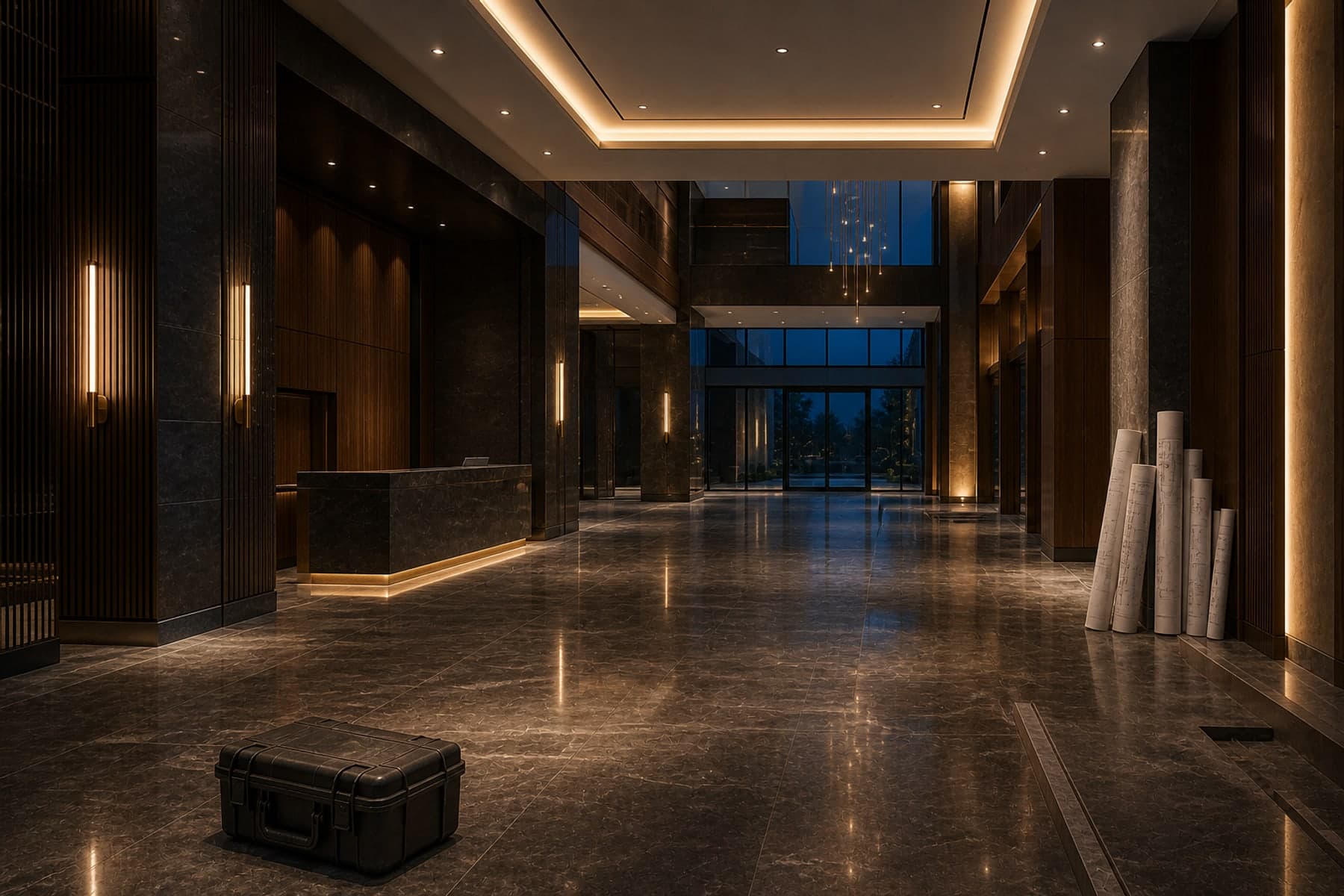
Illustrative — generated visual, not a real project photograph.
Many building systems, one accountable team.
Multi-System Project Delivery
End-to-end project delivery across the full lifecycle — Plan, Design Coordinate, BOQ / Scope Align, Supply, Install, Integrate, Test, Commission and Handover — coordinated by a single accountable team across many building systems at once.
/ Capabilities
Planning and schematic design
Design coordination, detailed engineering and shop drawings
BOQ/scope alignment and procurement
Interior planning/design coordination where required by the auditorium scope
Turnkey delivery of multi-system projects — design and BOQ coordination, supply, installation, integration, commissioning and handover — one accountable team.
Multi-System Project Delivery
End-to-end project delivery across the full lifecycle — Plan, Design Coordinate, BOQ / Scope Align, Supply, Install, Integrate, Test, Commission and Handover — coordinated by a single accountable team across many building systems at once.
Capabilities
Planning and schematic design
Design coordination, detailed engineering and shop drawings
BOQ/scope alignment and procurement
Interior planning/design coordination where required by the auditorium scope
User training, handover and operations documentation
Turnkey delivery
One team, from requirement to handover
Turnkey work means we own the whole arc of delivery — planning, design and BOQ / scope coordination, supply, installation, multi-system integration, testing, commissioning, documentation and handover — so the systems arrive as one coordinated outcome with single-point accountability. For turnkey auditorium and cultural-infrastructure projects that scope is genuinely broad: not just supply or installation, but the systems and finishes that make the room work together.
01Plan
02Design coordinate
03BOQ / scope align
04Supply
05Install
06Integrate
07Test
08Commission
09Handover
10Maintain
What we align before execution
We start from the requirement and the consultant's drawings, then settle BOQ / design coordination, system boundaries and responsibilities — and interior planning / design coordination where the auditorium scope requires it — so execution runs against an agreed scope rather than assumptions.
Systems that must coordinate
On a turnkey auditorium that can span audio, video, IT, acoustics, fire hydrant, fire alarm and fire extinguisher works, HVAC, stage furnishing, stage lighting, auditorium seating, step lighting and controlled / dimmable indoor lighting — plus the BOQ and interior planning coordination that ties them together. We hold these as one programme, not separate contracts.
What gets documented before handover
Before we hand over, integration is tested and commissioned and the project is documented — as-delivered scope, system records and operating handover — so the facility team inherits something they can run and maintain, with fire works always subject to AHJ / consultant review.
Single-point accountability
Through every stage there is one team answerable for the result, which is what keeps multi-system coordination from falling into the gaps between trades.
What does 'turnkey' actually mean — and how is it different from item-by-item procurement?
Turnkey is a single contract with a single accountable contractor for design, procurement, installation, commissioning and handover across the integrated stack. A single contract with a single accountable contractor for the entire integrated stack. Instead of separate vendors for AV, security, fire, BMS and IT — each with their own scope gaps and finger-pointing — one party owns design, procurement, installation, commissioning and handover. The seams between disciplines become our problem, not yours.
What's the smallest project where turnkey makes economic sense?
Turnkey makes sense when a project crosses three or more disciplines (e.g. AV + security + BMS) or needs single-point accountability across a whole building — below that, single-discipline contracts are usually more efficient. Where the disciplines genuinely interlock, turnkey almost always pays back through reduced coordination friction, fewer change orders, and a clean handover.
Do you handle import procurement and customs clearance?
Yes — we handle import procurement, customs clearance, GST compliance and last-mile freight for our India projects. Many of our reference brands (Rako, Fibaro, JBL Professional, K-array, Yamaha) ship internationally; the same discipline carries forward into the planned GCC engagements.
How is handover documented?
Turnkey handover ships a documentation pack — as-built drawings, labelling schedules, configuration files, calibration reports, AMC enrolment and an operations manual — printed and digital. A documentation pack: as-built drawings, rack and patch labelling schedules, controller configuration files, calibration reports, software licence registers, AMC enrolment, escalation contact list, and an operations manual written for the people who will actually use the system — not the auditor. The pack is delivered both printed and digital.
What's your approach to coordinating with the architect, MEP and interior designer?
We coordinate with the architect, MEP and interior designer through a published shop-drawing release schedule and a written change-order process from project kickoff. We open every project with a coordination meeting and then work to a published shop-drawing release schedule. Cabling pathways, panel locations, riser routing and acoustic envelopes are agreed against the architect's drawings before anything is procured. We attend design and MEP coordination meetings throughout, and we route every change request through a written change-order process so the architect's intent is preserved.
How are commissioning and snagging actually documented?
Commissioning and snagging are documented through a written test plan signed off against measurable criteria (STI, RT60, channel cert, cause-and-effect), with handover following snag closure not a calendar date. A written test plan agreed before commissioning begins. Every system is signed off against measurable criteria — STI in AV rooms, RT60 in cinemas, channel certification on cabling, alarm cause-and-effect verification on fire and ELV, energy-baseline capture on BMS. Snags are logged in a single tracker visible to the architect and client, with target close-out dates and accountability. Handover follows snag closure, not a calendar date.
What happens when a turnkey project includes scope from another contractor — civil, MEP, interior?
We coordinate with civil, MEP and interior contractors but do not own their work — we publish requirements as schedules they build to, or partner with a main contractor under a JV where the client wants single-point accountability. We do not own work that sits outside our discipline. Where civil, MEP or interior contractors are appointed by the client, we publish our cabling and equipment requirements as schedules they can build to, and we attend coordination meetings to flag conflicts early. Where the client wants single-point accountability across all trades, we partner with a main contractor under a joint-venture or principal-sub structure agreed up front.
Will you train our operations team to run the building after handover?
Yes — every turnkey hands over with hands-on training tailored to facilities, security and AV operators, recorded for future hires, with 30- and 90-day post-handover check-ins. Every turnkey hands over with a hands-on training programme tailored to the people who will actually operate the building. Facilities staff learn the BMS dashboard. Security staff learn the VMS and access plane. AV operators learn the room-control presets. The training is recorded so future hires have the same induction, and we follow up with a remote check-in 30 and 90 days post-handover to clear questions that surface in real operation.
Engineering toolkit
Planning tools for turnkey
Advisory calculators and reference checkers that scope this discipline before drawings — planning references, not final designs.