/ Glossary · 40+ terms
The vocabulary
of the practice.
A plain-English glossary of the terms our practice uses most often. Designed for architects, developers, owners and operations teams who need a working understanding without becoming an engineer themselves. Updated continuously.
/ Why this exists
A glossary written for the people who specify the systems we install.
Systems integration is a discipline of acronyms — and most of them carry a specific engineering weight that gets lost when they drift through a brochure. RT60, PoE++, cause-and-effect matrix, cause-class IS code — these are the terms a procurement document, a tender or an architect's coordination meeting will turn on, and the difference between knowing them roughly and knowing them precisely tends to be measurable in money.
We wrote this reference for the people who sit on the other side of our table — architects shaping a brief, project managers triangulating a tender response, owners reading a BOQ in good faith and operations teams inheriting a freshly handed-over building. Each entry is short, plain and sourced in the way our engineering pack would source it. If a term is missing, write to us; the page is amended in the same week.
/ Automation
Automation · 9 terms
- Automation busAutomation
- A wired protocol — KNX, DALI, Modbus, BACnet — that allows devices on a building's controls layer to communicate with a controller and with each other. Wired buses are preferred for buildings of >30 zones and for systems expected to last 15+ years.
- DALIAutomation+ engineering
- Digital Addressable Lighting Interface. An IEC-standard protocol allowing each light fitting to be individually addressed and dimmed. Preferred for premium lighting where each circuit needs scene-level control and tunable-white capability.
- FibaroAutomation
- Polish Z-Wave home-automation platform. Fast to deploy, polished mobile app, well-suited to residential homes up to ~30 controllable zones. TechnoGuru specifies, supplies, installs and integrates Fibaro where the project fit is right.
- GRMSAutomation+ engineering
- Guest Room Management System. The hotel-specific automation layer controlling a guest room's lighting, HVAC setback, drapes and do-not-disturb / make-up-room states, typically integrated with door access and the property-management system — so the room welcomes an arriving guest and sheds energy when unsold.
- KNXAutomation+ engineering
- An ISO-standard wired open-protocol building bus. Multi-vendor, scalable to thousands of devices, designed to last 20+ years. TechnoGuru's preferred bus for buildings that need vendor independence and longevity.
- Occupancy sensorAutomation
- A sensor that reports whether a space is in use so lighting, HVAC and AV can respond. PIR types detect motion by infrared change, ultrasonic types by Doppler shift, and dual-technology sensors require both before switching in order to reject false triggers. Placement, sensitivity and time-out are what decide whether occupants experience it as intelligent or as lights going out mid-meeting.
- PIR sensorAutomation
- Passive Infrared. A sensor that detects movement by registering changes in infrared radiation across a segmented field of view; passive because it emits nothing itself. Used for lighting control, intruder detection and occupancy sensing. Its known blind spot is a person walking directly toward the sensor rather than across its segments.
- RakoAutomation+ engineering
- British wireless lighting and scene-control platform. Its wireless topology suits retrofit residential lighting and shade where wired runs are not possible. TechnoGuru specifies, installs and programs Rako systems where the brief calls for that ecosystem.
- Z-WaveAutomation
- A low-power wireless mesh-network protocol used in residential automation, particularly by Fibaro and several US-market platforms. Operating in sub-GHz band, less congested than 2.4 GHz Wi-Fi/Zigbee. Best suited to residential up to ~30 zones.
See also: KNX · Z-Wave · Rako ·
Why it matters · Premium lighting that delivers scene control and tunable-white needs an addressable layer — DALI is the IEC-standard answer.
Engineering depth
What an engineer means · DALI-2 IEC 62386 — broadcast and addressable commands over a low-voltage two-wire bus, with each fitting carrying an individual short address.
Day-two operations · The lighting layer that lets every fitting in a room be dimmed and colour-tuned independently — the basis of scene programming.
Shapes the project · Required for tunable-white and individual-fitting scene control; can ride alongside KNX or be the primary lighting bus.
Maintenance and refresh · Bus power supplies on a five-year inspection; commissioning baseline archived per circuit.
Typically used in · Residential, Hospitality, Commercial & Corporate
Commonly confused with · KNX
See also: Z-Wave · Rako · KNX ·
Why it matters · Energy per unsold room and the guest's first thirty seconds in the room are both decided by the GRMS specification.
Engineering depth
What an engineer means · Room controller per key or per floor integrating lighting, HVAC, drapes and door signalling — commonly KNX- or proprietary-bus based — with an interface to the property-management system.
Day-two operations · The room greets an arriving guest with a welcome scene, signals housekeeping through DND/MUR states, and sets HVAC back automatically when the room is unsold.
Shapes the project · Specified per key at fit-out; drives coordination between the interior designer's switch plates, the HVAC contractor's fan-coils and the front-office software.
Maintenance and refresh · Room-controller configuration baseline archived per room type; failures isolated to a single key rather than a riser.
Typically used in · Hospitality
Commonly confused with · BMS
See also: KNX · DALI ·
Why it matters · The ISO-standard answer when the building needs to survive twenty years of vendor and ownership changes.
Engineering depth
What an engineer means · KNX TP (twisted pair) bus carrying actuators, sensors, scene controllers and gateways with an open ETS-programmed configuration baseline.
Day-two operations · The building bus that connects every lighting, shade, climate and scene controller into one open ecosystem.
Shapes the project · Preferred for buildings needing vendor independence and 20-year lifecycle; pairs naturally with DALI at the lighting layer.
Maintenance and refresh · Bus-coupler heat-sink rating verified in commissioning; ETS configuration archived offline; touch-panel refresh every six years.
Typically used in · Residential, Hospitality, Commercial & Corporate
See also: Automation bus · DALI ·
See also: PIR sensor · DALI · BMS ·
See also: Occupancy sensor ·
Why it matters · The lighting backbone of choice for retrofit residential — the only premium answer where wired runs are not possible.
Engineering depth
What an engineer means · Rako WK wireless mesh or Rako Wired bus with scene controllers, engraved keypads and the Rako app — programmed via Rasoft Pro against a documented schedule.
Day-two operations · The lighting backbone that delivers Welcome, Dinner, Film, Goodnight scenes from a single keypad press.
Shapes the project · Default for retrofit homes where wired bus is impractical; pairs with KNX at the room or building boundary in larger projects.
Maintenance and refresh · Annual PM on the scene controllers; Rasoft Pro baseline archived offline; battery-backed scene memory.
Typically used in · Residential, Hospitality
See also: Fibaro · KNX · DALI ·
/ AV
AV · 17 terms
- AV-over-IPAV+ engineering
- Audio-visual signal distribution over a standard IP network rather than dedicated cabling. Reduces matrix-switcher cost, allows large-scale routing, and integrates cleanly with the building's IT layer. Most premium boardrooms, video walls and houses of worship are now AV-over-IP.
- CEDIAAV
- Custom Electronic Design and Installation Association. International body for residential AV and home-cinema integration. TechnoGuru is a CEDIA member and logs continuing-education hours annually.
- DanteAV
- Audinate's audio-over-IP networking technology — uncompressed multichannel audio over standard managed ethernet with sample-accurate synchronisation. The interoperability layer of modern professional audio: consoles, amplifiers and DSPs from different manufacturers exchange audio over one network instead of point-to-point analogue runs.
- Digital signageAV
- Networked displays driven by a scheduling and content-management platform rather than by a local media player. The engineering questions are display brightness against ambient light, mounting and serviceability, media-player class, network path and content governance — who is allowed to publish to which screen, and what happens when the network drops.
- DSPAV
- Digital Signal Processor. In AV systems, the configurable processing brain between microphones or sources and the amplifiers — routing, equalisation, delay, echo cancellation, speaker management and level logic all live here. Every serious conference room, auditorium and PA system has one; its configuration file is part of the commissioning baseline.
- EASEAV
- Enhanced Acoustic Simulator for Engineers. The industry-standard software for acoustic and electro-acoustic modelling of auditoria, concert halls and large rooms. Predicts SPL coverage, STI (Speech Transmission Index) and reverberation behaviour ahead of build.
- FOHAV
- Front of House. The mixing-console position in an auditorium or concert venue, typically located in the rear-centre of the audience area. The FOH engineer balances sound for the listening audience as opposed to monitor mixes for performers.
- HDBaseTAV+ engineering
- An AV signal-distribution standard sending uncompressed video, audio, ethernet, controls and PoE up to 100 m on a single Cat6 cable. Workhorse format for boardrooms, classrooms and most commercial AV.
- LED P0.9AV
- Direct-view LED display with 0.9 mm pixel pitch. Pixel pitch is the distance between adjacent LEDs; closer viewers need finer pitch. Premium boardrooms typically specify P0.9 to P1.5; large lobbies P1.5 to P2.5; outdoor signage P3 to P10.
- Lens shiftAV
- The projector's ability to move the projected image up, down, left or right of its optical axis optically, without geometric distortion — unlike keystone correction, which distorts pixels to fake the same result. The shift envelope is projector-specific and bounded, so a mount that needs more offset than the lens provides is a mount that has to move, not a setting that can be dialled in.
- Line-arrayAV
- A vertical array of speaker cabinets behaving as a single source. Provides smoother SPL coverage across distance compared to point-source clusters, and is the default topology for medium-and-large auditoria, concert halls and houses of worship.
- RT60AV+ engineering
- Reverberation Time at 60 dB decay. The time taken for sound energy in a room to decay by 60 dB after the source stops. Target RT60 is set by room VOLUME, not by the room’s name: 0.4–0.6 s for a boardroom under 50 m³, 0.7–1.0 s for a conference room of 150–400 m³, and 1.6–2.2 s for a concert hall over 1,000 m³ — rising to several seconds in large stone churches.
- Smart classroomAV
- A teaching space where display, audio, capture and control are integrated so a lecturer can start a session without technical help. The decisive details are sightlines from the back row, speech intelligibility, microphone strategy for hybrid teaching, and a control layer simple enough that it survives a substitute teacher.
- STIAV+ engineering
- Speech Transmission Index — a 0-1 scale measuring intelligibility of speech in a space. STI ≥ 0.5 is acceptable, ≥ 0.6 is good, ≥ 0.75 is excellent. Mandatory measurement for evacuation-PA systems under EN 54-16; designed-to target for boardrooms and lecture theatres.
- Throw distanceAV
- The distance from the projector's lens to the screen surface. It is the number a mount position is actually set from, and it follows from the throw ratio and the image width rather than being chosen freely: throw distance = throw ratio × image width. A zoom lens gives a usable range, so the room's constraints usually pick a point inside that band rather than a single answer.
- Throw ratioAV
- The projector's throw distance divided by the projected image WIDTH: throw ratio = throw distance ÷ image width. It is defined against width, never the diagonal, which is why a screen quoted by its diagonal has to be resolved to a width before the distance means anything. A zoom lens has a throw-ratio RANGE rather than a single figure, so the same projector and the same screen give a band of valid mounting distances.
- Video conferencingAV
- Two-way audio and video between rooms and remote participants. Room outcomes are decided by microphone coverage, acoustic echo cancellation, camera framing and display legibility at the far end — not by the codec brand. A room that sounds poor is judged as a bad meeting; a room that looks poor is usually forgiven.
Why it matters · Most premium boardrooms, video walls and houses of worship are now AV-over-IP; HDBaseT is the answer below 8 endpoints.
Engineering depth
What an engineer means · Encoder/decoder pair at each endpoint over 1 Gbps or 10 Gbps managed network — JPEG2000 or NDI compression with sub-frame latency.
Day-two operations · The single network the AV team and the IT team both share, with AV routing as a managed application layer.
Shapes the project · Reduces matrix-switcher cost, scales to large routing, integrates cleanly with the building IT layer; demands a mature managed network.
Maintenance and refresh · Network maturity is the key dependency; firmware refresh on the encoder/decoder pair during AMC.
Typically used in · Commercial & Corporate, Education & Institutions, Hospitality
Commonly confused with · HDBaseT
See also: AV-over-IP · DSP ·
See also: LED P0.9 · AV-over-IP ·
See also: STI · RT60 ·
Why it matters · Pre-AV-over-IP, this was the AV-distribution default; for small-to-medium deployments it remains the simpler, cheaper answer.
Engineering depth
What an engineer means · Point-to-point AV transport with bundled control and PoE — workhorse format for boardrooms, classrooms and most commercial AV under 100 m.
Day-two operations · The single Cat6 cable that runs from the AV closet to the display, carrying everything the display needs.
Shapes the project · Default for ≤ 8 endpoint deployments where AV-over-IP is over-engineered; transitions to AV-over-IP at larger scale.
Maintenance and refresh · Cable plant inspection on the standard structured-cabling rhythm; transmitter / receiver firmware in the AMC refresh.
Typically used in · Commercial & Corporate, Education & Institutions, Hospitality
Commonly confused with · AV-over-IP
See also: Throw ratio · Throw distance ·
Why it matters · The single number that decides whether a room sounds right; everything else in the AV chain is downstream.
Engineering depth
What an engineer means · Sabine equation T60 = 0.161 V / (S α) for a rectangular room; measured RT60 used for STI and electro-acoustic modelling.
Day-two operations · The acoustic character of the room — long RT60 makes speech unintelligible, short RT60 makes music feel dead.
Shapes the project · Target varies by room VOLUME rather than by room name — 0.4–0.6 s for a small boardroom under 50 m³, widening to about 0.8 s across larger meeting rooms, 1.6–2.2 s for a concert hall over 1,000 m³, several seconds in a large stone church. The calculator publishes the full volume-indexed table.
Maintenance and refresh · Acoustic treatment is largely static; soft-furnishing changes affect the result and trigger re-measurement.
Typically used in · Education & Institutions, Places of Worship, Hospitality, Residential
See also: STI · DSP ·
Why it matters · It is the acceptance criterion the specification is written against — EN 54-16 is the equipment benchmark, not an instrument Indian code mandates — and the AHJ requires the measurement record before voice-evac PA sign-off.
See also: Throw ratio · Lens shift ·
See also: Throw distance · Lens shift ·
See also: DSP · AV-over-IP ·
/ ELV
ELV · 33 terms
- Access controlELV
- Electronic control of who can pass through which door, gate or barrier, and when. Card, fob, PIN, mobile-credential or biometric readers feed door controllers that check a permissions database and drive electric locks. Fail-safe locks release on power loss (escape routes); fail-secure locks stay locked. Integrated with the fire alarm so evacuation routes release on alarm — a cause-and-effect line, not an afterthought.
- Addressable fire alarmELV+ engineering
- A fire-detection architecture where every detector and call point on a loop carries a unique address, so the panel reports the exact device in alarm — not just a zone. Enables per-device cause-and-effect programming, faster incident localisation and cleaner maintenance records.
- ANPRELV
- Automatic Number Plate Recognition. A camera-and-software pairing that captures a vehicle's registration plate, parses it via optical character recognition, and looks it up against an authorised-vehicle database in real time. Used at gates, parking entries and toll points; pairs naturally with UVSS for high-security vehicle screening.
- Aspirating smoke detectorELV
- An air-sampling detector that continuously draws room air through a pipe network to a central detection chamber, sensing smoke at concentrations far below what a point detector registers. Specified where the earliest possible warning matters or where point detectors are impractical: server rooms, atria, cold stores, heritage interiors and high-ceiling halls. Sampling-hole layout and pipe transport time are the design variables.
- Beam detectorELV
- An optical smoke detector that projects an infrared beam across an open space to a receiver or retro-reflector and alarms when smoke attenuates the beam. Covers long spans that point detectors cannot reach economically — atria, warehouses, auditoria, sports halls. Beam alignment stability and the building structural movement are the practical constraints.
- Boom barrierELV
- A high-speed motorised gate arm at vehicle entry points, typically interlocked with ANPR, UVSS and the access-control system. Speed targets (1.5-3.5 seconds full open) and MTBF (mean cycles between failure) are key procurement variables.
- Cause-and-effect matrixELV+ engineering
- A written specification — typically a table or matrix — that documents what each life-safety event triggers across all connected systems. On a fire-alarm event from detector AD-031: lifts home to ground, magnetic door-holders release, PA announces affected floor, BMS shuts AHU dampers, CCTV pre-records, access-control switches to evacuation. The matrix is programmed once and tested at commissioning.
- CCTV retentionELV
- How long surveillance footage is kept before automatic overwrite. Regulated by sector and risk: 30 days for most commercial, 60 days hospitality, 90 days healthcare and government, 180 days where regulated. Retention × bitrate × camera-count drives storage sizing.
- Command and control centreELV
- A staffed room where CCTV, access control, fire, PA, BMS and communications are brought onto one operator surface. Design drivers are sightlines to the video wall, operator ergonomics over long shifts, acoustic separation, redundant power and a documented escalation procedure. The technology is the straightforward part; the written operating procedure is what makes it work.
- Conventional fire alarmELV
- A fire-detection architecture where detectors are wired in zones and the panel can only report which zone is in alarm, not which device. Lower equipment cost for very small buildings; weaker for localisation, cause-and-effect programming and maintenance. The addressable-versus-conventional choice is one of the first decisions in any fire-alarm brief.
- DFMDELV
- Door-Frame Metal Detector. A walk-through scanner used at hospitality, government, and event venue entry points. Multi-zone DFMDs (typically 12–33 detection zones) localise the metallic object's height for faster handheld follow-up.
- DORIELV
- Detection, Observation, Recognition, Identification — the IEC 62676-4 scale of minimum horizontal pixel densities for each investigative outcome: Detect 25, Observe 62.5, Recognise 125 and Identify 250 pixels per metre, with Inspect at 1000 px/m as the forensic tier. It is a DENSITY scale, so widening the scene drops px/m linearly: the same camera covering more metres delivers a lower tier.
- DVRELV
- Digital Video Recorder. The recording platform for analogue and HDCVI/TVI/AHD camera systems: coaxial video arrives at the recorder, which digitises, encodes and stores it. Largely superseded by NVRs on new work, but still common on retrofits where existing coaxial cabling is retained. Channel count, codec support and retention window are the sizing variables.
- Edge analyticsELV
- Video analytics that runs on the camera itself rather than on a server or in the cloud. It consumes no extra stream and no network bandwidth, keeps working through a link outage and gives the lowest latency — but the analytics set is fixed by the camera's firmware, and only cameras built to host it can run it, which on a retrofit estate is usually a minority. The alternative is a server sized by concurrent decoded streams, not by camera count.
- ELVELV+ engineering
- Extra-Low Voltage — every safety and security service running at less than 50 V AC: fire alarm, CCTV, access control, PA, nurse call, intercom, structured cabling, gate barriers and screening. Grouped because they share installation pathways and need to be coordinated as one cause-and-effect system.
- Fire hydrant systemELV
- The manual firefighting water infrastructure of a building — fire pumps, wet risers, landing valves, hose reels and courtyard hydrants that the fire service and trained staff operate. Distinct from sprinklers, which discharge automatically: NBC 2016 commonly requires both above defined height and occupancy thresholds, fed from the same fire-water reserve.
- Fireman's talk-backELV
- A dedicated two-way voice link between a building's fire command point and fixed stations distributed through the building — typically coordinated with the project's fire consultant at fire-fighting shafts, refuge floors, lift lobbies and plant rooms. Also called a fireman's telephone system. It differs from ordinary intercom because the circuit is supervised: an open or short raises a fault at the master console in advance, rather than being discovered during an incident. It differs from public address because PA broadcasts one-way to occupants, while talk-back carries a two-way conversation back to the command point. Fire-resistant cabling, segregated containment and independent power are what make it survivable. What any specific building must carry is determined by the authority having jurisdiction and the project's fire consultant.
- Heat detectorELV
- A fire detector that responds to temperature rather than smoke, either at a fixed threshold or on rate-of-rise. Specified where smoke detection would false-alarm: kitchens, boiler rooms, car parks, dusty plant areas and laundries. Slower to respond than smoke detection, so it is a placement decision driven by the environment rather than a cost decision.
- Manual call pointELV
- Also written MCP. The break-glass or resettable-element device that lets a person raise a fire alarm by hand. Positioned on escape routes and at final exits so no occupant travels more than the code-permitted distance to reach one, and mounted at a consistent height. On an addressable loop each call point reports its own address, so the panel names the exact point operated.
- Nurse call systemELV
- The call-and-response system in healthcare and assisted-living buildings: bedhead and washroom call points, corridor indicator lamps, staff-console annunciation and, increasingly, handover to mobile nursing devices. Design turns on zoning by ward, escalation timing when a call goes unanswered, and infection-control-compatible device selection.
- NVRELV+ engineering
- Network Video Recorder — a purpose-built appliance that records IP camera streams to its own storage. The right answer for single-site systems up to a few dozen cameras; larger or multi-site estates step up to a VMS, where recording, analytics and operator workflow run as software on server hardware.
- ONVIFELV
- An open industry forum whose profiles standardise how IP cameras, recorders and VMS platforms interoperate — Profile S for streaming, Profile T for advanced video handling, Profile G for recording. Specifying ONVIF conformance keeps a camera estate replaceable and multi-vendor rather than locked to one manufacturer's ecosystem.
- Parking management systemELV
- The combination of entry and exit control, vehicle detection, space counting and driver guidance that governs a car park. Typically pairs boom barriers and ANPR with counting loops or bay sensors and variable-message displays. Throughput at the busiest minute, not average occupancy, is what sizes the lane count.
- PAVAELV+ engineering
- Public Address with Voice Alarm — an integrated PA system with EN 54-16-compliant voice-evacuation capability. Mandatory under NBC 2016 for many commercial, hospitality, healthcare and educational occupancies above defined thresholds.
- PTZ cameraELV
- Pan-Tilt-Zoom. A camera on a motorised mount with an optical zoom lens, able to survey a wide area and then close in on detail. Best specified alongside fixed cameras rather than instead of them: while a PTZ is looking one way it is not recording the rest of its field, so evidential coverage still depends on the fixed array behind it.
- RTSPELV
- Real Time Streaming Protocol. The session-control protocol that negotiates and controls a camera's video stream — start, pause, teardown — while the media itself travels over RTP. An “RTSP URL” is how most third-party software pulls video from an IP camera, which makes it the practical entry point for retrofitting analytics or a new VMS onto an existing estate. Availability, authentication method and codec still decide whether any given camera can actually be read.
- Smoke detectorELV
- A point fire detector sensing the products of combustion. Optical or photoelectric types respond earlier to smouldering fires and are the general-purpose choice; ionisation types respond earlier to fast flaming fires; multi-criteria detectors combine optical sensing with heat, and sometimes carbon monoxide, to reject false alarms. Selection follows the fire risk and the environment.
- Sprinkler systemELV
- Automatic water-based fire suppression — a piped network of heat-activated sprinkler heads that discharge individually over the fire, fed by dedicated pumps and monitored by flow switches per zone. Complements, never replaces, the manual hydrant system; NBC 2016 sets the height and occupancy thresholds where sprinklers become mandatory.
- UVSSELV
- Under-Vehicle Surveillance System. A flush-with-road or surface-mounted scanner that captures a high-resolution stitched image of a vehicle's underside as it passes over. Used at high-security vehicle entries; typically pairs with ANPR for plate-and-chassis difference checks.
- VESDAELV
- Very Early Smoke Detection Apparatus. Originally a product name and now used loosely across the industry for aspirating smoke detection in general. Where a specification says VESDA, read it as a performance requirement for air-sampling detection and confirm the intended sensitivity class before selecting equipment.
- Video analyticsELV
- Software that turns a camera stream into events — line crossing, zone intrusion, loitering, people counting, queue length, vehicle and number-plate reads, abandoned object. Accuracy is governed by the scene rather than by the algorithm alone: camera angle and height, pixels on target, lighting and IR behaviour, weather, occlusion and frame rate move the result more than the platform choice does. Every deployment needs a tuning period and produces some false positives; the objective is a rate operators can work with.
- Video door phoneELV
- An intercom with a camera at the entrance and an indoor answering station — see the visitor, talk, then release the door from inside. Modern IP video door phones forward calls to mobile apps and integrate with access control and home automation; multi-apartment systems scale the same idea through a lobby panel and per-flat stations.
- VMSELV
- Video Management System. The software platform that aggregates IP camera feeds, manages recording and retention, performs analytics and provides operator search. Honeywell Pro-Watch and Bosch BVMS are our reference VMS platforms across surveillance deployments.
See also: Cause-and-effect matrix · ANPR · Video door phone ·
Why it matters · Localisation speed decides an evacuation — a zone tells you a floor is in trouble, an address tells you which door to open first.
Engineering depth
What an engineer means · Loop-wired detectors, call points and modules with individual addresses on an intelligent panel; per-device cause-and-effect programming and device-level health reporting.
Day-two operations · The panel says which room's detector fired — the operator dispatches to a device, not a floor-wide zone search.
Shapes the project · The baseline for serious buildings under NBC 2016; drives the cause-and-effect matrix, PA voice-evac zoning and BMS damper integration at device granularity.
Maintenance and refresh · Per-device contamination and fault reporting turns AMC visits into targeted swaps instead of zone-by-zone hunting; loop baseline archived at commissioning.
Typically used in · Commercial & Corporate, Hospitality, Healthcare, Education & Institutions, Retail & Malls
Commonly confused with · Conventional fire alarm
See also: Conventional fire alarm · Cause-and-effect matrix ·
See also: UVSS · Boom barrier ·
See also: VESDA · Smoke detector ·
See also: Smoke detector · Aspirating smoke detector ·
See also: ANPR · UVSS ·
Why it matters · Without a cause-and-effect matrix, fire detection is just a noise — the matrix is what makes the building actually respond to the event.
Engineering depth
What an engineer means · Table or matrix mapping every detector address to lift recall, magnetic door release, PA announcement, AHU damper close, CCTV pre-record and access evacuation mode.
Day-two operations · The behavioural contract the building's fire-detection system fulfils when an alarm occurs — what happens, in what order, to which devices.
Shapes the project · Drives the addressable fire-alarm panel programming, the BMS integration, the PA voice-evac configuration and the access controller's evacuation template.
Maintenance and refresh · Drilled monthly under Mission-Critical AMC, quarterly under Gold; baseline archived offline and re-validated after every site modification.
Typically used in · Commercial & Corporate, Hospitality, Healthcare, Education & Institutions, Retail & Malls
See also: VMS · Cause-and-effect matrix ·
See also: Addressable fire alarm ·
See also: CCTV · ANPR ·
See also: NVR · CCTV retention · VMS ·
See also: Video analytics · VMS · RTSP ·
Why it matters · Buildings without ELV coordination get four discipline cabling layers that compete for pathways and conflict in cause-and-effect; ELV is the discipline that prevents that.
Engineering depth
What an engineer means · The class of services that share installation pathways and need to be coordinated as one cause-and-effect system; ELV is an electrical classification, not a discipline.
Day-two operations · The ELV cabling backbone — the unified pathway that carries every safety-and-security service through the building.
Shapes the project · Coordinated cable pathways across disciplines; shared cause-and-effect with the fire panel; one ELV designer rather than four discipline engineers fighting for pathways.
Maintenance and refresh · Pathway documentation, cable schedule and zone map all archived; ELV runbook handed to the facility manager at handover.
Typically used in · Commercial & Corporate, Hospitality, Education & Institutions, Healthcare, Retail & Malls
See also: Sprinkler system ·
See also: Fire hydrant system ·
See also: Smoke detector · Addressable fire alarm ·
See also: Addressable fire alarm · Cause-and-effect matrix ·
See also: PAVA · Cause-and-effect matrix ·
Why it matters · The NVR-versus-VMS decision sets the ceiling on camera count, analytics and multi-site growth — cheaper to decide correctly than to migrate later.
Engineering depth
What an engineer means · Embedded recorder with fixed channel count and internal drive bays; camera discovery and recording schedules on-box, typically ONVIF-conformant.
Day-two operations · The box in the rack that holds the footage — the operator searches and exports on it directly or through a lightweight client.
Shapes the project · Right-sized for single-site estates up to a few dozen cameras; channel count, drive bays and retention days are the three sizing numbers.
Maintenance and refresh · Drive health monitoring and retention verification are standing AMC items; drives are consumables on a multi-year replacement rhythm.
Typically used in · Retail & Malls, Education & Institutions, Hospitality, Commercial & Corporate
Commonly confused with · VMS
See also: VMS · CCTV retention ·
See also: VMS · NVR ·
See also: ANPR · Boom barrier ·
Why it matters · Voice-evac that the AHJ will accept on first audit — the difference between a building that gets NOC and one that doesn't.
See also: VMS · CCTV retention · ONVIF ·
See also: ONVIF · VMS · Edge analytics ·
See also: Heat detector · Beam detector · Aspirating smoke detector ·
See also: Fire hydrant system · Cause-and-effect matrix ·
See also: ANPR · Boom barrier ·
See also: Aspirating smoke detector ·
See also: Edge analytics · VMS · DORI ·
See also: Access control ·
/ Networking
Networking · 9 terms
- Cable containmentNetworking
- The trays, baskets, trunking and conduit that carry cabling through a building. Fill ratio is the governing constraint — overfilled containment traps heat, makes future changes destructive and breaches segregation between ELV and power. Containment is designed once and lived with for the building life, so it is sized for the cable count expected at end of life, not at handover.
- Cat6ANetworking+ engineering
- Augmented Category 6 structured cabling. Supports 10 Gbps over the full 100 m channel without compromise, rated for 25 years of service. Premium over Cat6 is now <10%; Cat6A is the default for any new commercial or premium-residential cabling.
- EPABXNetworking
- Electronic Private Automatic Branch Exchange. The on-premise telephone switch that routes internal extensions and connects them to external trunks. Modern deployments are IP-based and converge onto the structured cabling and data network rather than dedicated telephony cable, which makes extension planning a networking exercise rather than a separate trade.
- Plenum and riser cableNetworking
- Cable jacket classifications for fire performance in building voids. Plenum-rated cable is specified where runs share air-handling spaces and riser-rated where cable runs vertically between floors, because a burning jacket in either path carries smoke through the building. The jacket rating is a life-safety decision, not a cable-performance one.
- PoENetworking+ engineering
- Power over Ethernet. Delivers low-voltage DC power to network devices over the same Cat-class cable that carries data. 802.3at (PoE+) supplies up to 30 W at the switch port and 25.5 W at the device; 802.3bt Type 4 supplies up to 90 W at the port and 71.3 W at the device — enough for IP cameras, AP, VOIP phones, occupancy sensors and small displays.
- PoE budgetNetworking+ engineering
- The total power a PoE switch can supply across all its ports simultaneously — usually less than every port drawing its maximum. A 24-port switch may deliver 30 W on any single port yet carry only a 370 W aggregate budget. Sizing the budget against the real camera, access-point and phone load — with headroom for growth — is a standard network-design step, not an afterthought.
- Rack unit (U)Networking
- The standard vertical unit of rack-mounted equipment: 1U = 44.45 mm (1.75 inches). Racks are described by their height in U — 42U for a full-height server rack, 9U–12U for wall cabinets. Planning U-height means counting the equipment plus PDUs, cable managers, shelves and the spare capacity the next five years of the building will consume.
- Structured cablingNetworking+ engineering
- A building's standards-based cabling plant — horizontal runs from patch panels to outlets, backbone links between floors and buildings, all documented, labelled and channel-tested. Category ratings (Cat5e, Cat6, Cat6A) set the bandwidth ceiling. Done properly it outlives two or three generations of the electronics plugged into it.
- Wi-Fi 7Networking+ engineering
- IEEE 802.11be. The current generation of Wi-Fi as of 2026, adding 6 GHz band, MLO multi-link operation and 320 MHz channels. Real-world capacity gains over Wi-Fi 6E in dense rooms (boardrooms, classrooms, lobbies). Default for new premium deployments.
See also: Structured cabling · Plenum and riser cable ·
Why it matters · Cabling is the slowest layer to replace and the cheapest to over-specify; Cat6A future-proofs the building for 25 years for <10% premium over Cat6.
Engineering depth
What an engineer means · Shielded or unshielded twisted-pair with tighter electrical specifications than Cat6, allowing 10GBASE-T over the entire channel without dropping speed.
Day-two operations · The default cabling layer for any new commercial or premium-residential build — every network outlet terminates here.
Shapes the project · Required for Wi-Fi 7 AP backbones, 802.3bt Type 4 PoE++ delivery, and any 10 Gbps endpoint roadmap.
Maintenance and refresh · 25-year design life with negligible degradation; refresh cycle driven by the active layer, not the cabling.
Typically used in · Commercial & Corporate, Education & Institutions, Hospitality, Healthcare
Commonly confused with · PoE
See also: Structured cabling · PoE ·
See also: Structured cabling · Cat6A ·
Why it matters · Single-cable power and data eliminates the second cable run for every endpoint — a massive reduction in install labour and pathway congestion.
Engineering depth
What an engineer means · IEEE 802.3af/at/bt — power-sourcing equipment delivers DC over the unused pairs (or all four pairs for Type 4) up to 90 W per port.
Day-two operations · Eliminates separate power runs for IP cameras, APs, VOIP phones, occupancy sensors and small displays.
Shapes the project · Switch class drives PoE budget; Cat6A required for Type 4 (90 W); 30% headroom in budget calculation.
Maintenance and refresh · Switch refresh cycle drives the PoE budget refresh; cable plant outlives the active layer.
Typically used in · Commercial & Corporate, Education & Institutions, Hospitality, Healthcare, Retail & Malls
Why it matters · An exhausted PoE budget fails silently — the last devices powered are the first dropped — so the budget is engineered, not discovered.
Engineering depth
What an engineer means · Aggregate PSE power capacity versus per-port class allocation under IEEE 802.3af/at/bt — a 24-port switch may class-negotiate 30 W per port yet carry only a 370 W total budget.
Day-two operations · Why cameras stay up when one more access point is plugged in — or why they don't.
Shapes the project · Sized against the real endpoint load (cameras, APs, phones, sensors) with headroom for growth; drives switch selection and sometimes the rack's power and cooling numbers.
Maintenance and refresh · Re-checked whenever endpoints are added; a budget running near its ceiling is a planned-upgrade trigger, not a fault.
Typically used in · Commercial & Corporate, Education & Institutions, Hospitality, Healthcare, Retail & Malls
Commonly confused with · PoE
See also: PoE ·
Why it matters · Cabling outlives two or three generations of electronics — the cheapest layer to over-specify and the most disruptive to redo.
Engineering depth
What an engineer means · Horizontal runs from patch panels to outlets within the 100 m channel, backbone fibre between floors and buildings, category-rated components and certified channel tests per outlet.
Day-two operations · The labelled patch field the IT team lives in — every port traceable from outlet to switch without folklore.
Shapes the project · Installed once per civil cycle; category choice (Cat6 vs Cat6A) and pathway coordination with the ELV backbone decide the building's bandwidth ceiling for decades.
Maintenance and refresh · Essentially maintenance-free when installed and documented correctly; the as-built schedule and test records are the deliverables that keep it that way.
Typically used in · Commercial & Corporate, Education & Institutions, Hospitality, Healthcare, Industrial & Warehousing
Commonly confused with · Cat6A
See also: Cat6A · PoE ·
Why it matters · Default for any 2026-class new deployment where dense-room capacity matters.
Engineering depth
What an engineer means · Multi-Link Operation across 2.4/5/6 GHz, 4096-QAM, 320 MHz channels in the 6 GHz band — real-world capacity gains over Wi-Fi 6E in dense rooms.
Day-two operations · The Wi-Fi layer that handles 2026-class device density in boardrooms, classrooms and lobbies without dropping throughput.
Shapes the project · Requires Cat6A AP backbone; PoE++ Type 3 / Type 4 at the switch; AP placement modelled on dense-room load.
Maintenance and refresh · AP firmware refresh on the standard rhythm; controller baseline archived offline.
Typically used in · Commercial & Corporate, Education & Institutions, Hospitality
/ BMS
BMS · 9 terms
- BACnetBMS+ engineering
- Building Automation and Control Networks — an ISO-standard data-communication protocol for building-management systems. Most modern HVAC, lighting and BMS controllers speak BACnet natively, allowing multi-vendor integration.
- BESSBMS+ engineering
- Battery Energy Storage System. Lithium-ion (typically LFP) battery banks paired with online UPS or stand-alone inverters, used for peak-shave, demand-response, ride-through and tariff-arbitrage. Above ~20 kVA, lithium has displaced VRLA as the default choice.
- BMSBMS+ engineering
- Building Management System. The supervisory control layer that orchestrates HVAC, lighting, energy, life-safety and access-control into one operating picture. Sets chiller schedules, adjusts AHU dampers based on CO₂, dims lighting on daylight harvesting, and surfaces deviations as alarms.
- Honeywell BMSBMS
- Our default BMS for premium commercial and hospitality buildings, integrating HVAC, lighting, energy and life-safety into a single operating picture. The right answer for buildings that need a documented, well-supported BMS framework.
- IBMSBMS
- Integrated Building Management System. A BMS extended to supervise the ELV and life-safety layers alongside HVAC and energy — fire, access, CCTV, lighting and utilities presented on one operator interface with cross-system cause-and-effect. The integration value sits in the interfaces and the tested event logic, not in the head-end software.
- ModbusBMS+ engineering
- An industrial serial and TCP protocol used by energy meters, VFDs and legacy controllers. Modbus RTU runs over RS-485; Modbus TCP runs over ethernet. Bridges legacy plant into modern BMS supervisory layers.
- Online UPSBMS+ engineering
- A double-conversion uninterruptible power supply that continuously rectifies AC to DC and inverts back to clean AC, isolating the load from grid disturbances. Default choice for mission-critical IT, fire-pump rooms and life-safety equipment.
- UPSBMS
- Uninterruptible Power Supply. Generic term for any device that provides backup electrical power; in our practice always refers to online double-conversion UPS unless explicitly noted otherwise.
- VRFBMS
- Variable Refrigerant Flow — a HVAC architecture where multiple indoor units share a single outdoor compressor with refrigerant volume modulated electronically. Default for premium commercial and hospitality cooling because of zone-level control and energy efficiency.
Why it matters · Avoids vendor lock-in at the controller layer; the building's BMS can outlive any single controller refresh cycle.
Engineering depth
What an engineer means · BACnet/IP over the building's network or BACnet MS/TP over RS-485 — addressable object model with point-level read/write across vendors.
Day-two operations · The protocol the BMS operator interacts with through the supervisor screen — point names, alarms, schedules and trend logs.
Shapes the project · BACnet-compliant controllers across HVAC, lighting and energy let the BMS supervise multi-vendor plant without per-vendor gateways.
Maintenance and refresh · Configuration baseline archived per controller; firmware refresh during AMC against the documented baseline.
Typically used in · Commercial & Corporate, Hospitality, Healthcare, Industrial & Warehousing
Commonly confused with · Modbus
Why it matters · Eight-year TCO advantage over VRLA above 20 kVA — and the only way to deliver peak-shave or demand-charge management on a UPS topology.
Engineering depth
What an engineer means · LFP cabinet-scale storage with cell-level BMS, sized to ride-through window + 20% degradation margin over 6,000-cycle life.
Day-two operations · The block of cabinets in the UPS room that lets the building survive a 30-minute grid outage at full IT load.
Shapes the project · NFPA 855-compliant LFP for indoor install; floor-loading and ventilation rated; BMS integration for orchestrated peak-shave.
Maintenance and refresh · Annual cell-voltage profile and capacity-fade audit; thermal-runaway sensors part of the AMC drill.
Typically used in · Industrial & Warehousing, Healthcare, Commercial & Corporate
Commonly confused with · UPS, Online UPS
See also: UPS · Online UPS ·
Why it matters · A building without a BMS is run on operator memory; a building with a BMS is run on documented schedules and measured deviations.
Engineering depth
What an engineer means · BACnet- or Modbus-based controller hierarchy supervised by a Niagara-class framework, with point-level read/write and schedule programming.
Day-two operations · The screen on the engineer's wall that shows the building's current state — chiller load, AHU status, lighting zones, energy meters, alarm queue.
Shapes the project · Drives chiller scheduling, AHU damper logic on CO₂, daylight harvesting on the lighting layer, demand-shed against tariff blocks.
Maintenance and refresh · Configuration baseline archived; trend logs reviewed monthly; firmware refresh quarterly during AMC.
Typically used in · Commercial & Corporate, Hospitality, Healthcare, Industrial & Warehousing
See also: BMS · Cause-and-effect matrix · BACnet · Modbus ·
Why it matters · The industry-standard answer for energy meters and industrial controllers; bridges legacy plant into a modern BMS supervisory layer.
Engineering depth
What an engineer means · Modbus RTU over RS-485 or Modbus TCP over ethernet — register-based read/write with no native object model.
Day-two operations · The protocol the energy meters and BESS inverter speak to the BMS; the bridge between modern BACnet and legacy controllers.
Shapes the project · BMS-BESS integration; energy-meter polling; legacy-equipment retrofit into the BMS supervisory layer.
Maintenance and refresh · Register-map archived per device; polling intervals tuned during AMC.
Typically used in · Industrial & Warehousing, Commercial & Corporate, Healthcare
Commonly confused with · BACnet
See also: BACnet ·
Why it matters · Line-interactive and offline UPS topologies cannot ride mission-critical loads — only online double-conversion delivers the isolation.
Engineering depth
What an engineer means · Rectifier → DC bus → inverter topology with the load permanently fed from the inverter, regardless of grid state.
Day-two operations · The UPS that protects mission-critical IT, fire-pump rooms and life-safety equipment with zero-transfer-time conversion.
Shapes the project · Default for IT, healthcare and life-safety loads; sized to ride-through window + 20% degradation margin.
Maintenance and refresh · Annual battery capacity audit; cell-voltage profile during AMC; thermal-runaway sensors validated.
Typically used in · Industrial & Warehousing, Healthcare, Commercial & Corporate
See also: UPS · BESS ·
See also: Online UPS · BESS ·
/ AMC
AMC · 2 terms
- AMCAMC+ engineering
- Annual Maintenance Contract. A documented support programme covering preventive maintenance schedules, response and resolution targets, spares pool, firmware-and-config baselines, and lifecycle planning for installed systems. A TechnoGuru AMC is scoped to the systems and support expectations and priced in writing after review.
- TurnkeyAMC
- A single-contract delivery model where one accountable contractor takes on design, procurement, installation, commissioning, training and handover for the entire integrated systems stack. Distinguished from item-by-item procurement by accountability for the seams between disciplines.
Why it matters · Without AMC the deployment degrades silently until the first failure surfaces months of accumulated drift; AMC makes that drift visible and corrected on a schedule.
Engineering depth
What an engineer means · A scheduled rhythm of inspections, firmware refreshes, baseline-archive backups and rehearsed cause-and-effect drills against the deployment's specific configuration baseline.
Day-two operations · The day-two team's single point of contact and a documented escalation path; the calendar TechnoGuru tracks so the operator doesn't have to remember.
Shapes the project · Drives spares-pool composition, the response-time commitment, and whether on-site engineers are required (Mission-Critical) or named-remote engineers (Bronze).
Maintenance and refresh · Tier choice maps directly to refresh cycles and inspection cadence — Bronze annual, Silver quarterly, Gold monthly, Mission-Critical with contracted critical-hours support.
Typically used in · Commercial & Corporate, Hospitality, Healthcare, Industrial & Warehousing
/ Compliance
Compliance · 9 terms
- GeMCompliance
- Government e-Marketplace. India's online procurement platform for Central and State Government buyers. TechnoGuru is an active GeM-empanelled vendor for systems-integration services.
- IECCompliance
- Import Export Code. A 10-character identifier issued by India's Director General of Foreign Trade, mandatory for any import or export of goods or services. TechnoGuru holds an active IEC and handles cross-border procurement under it.
- IK ratingCompliance
- The IEC 62262 code for an enclosure resistance to mechanical impact, written IK00 to IK10, where IK10 withstands a 20-joule strike. The companion to IP rating: IP describes ingress, IK describes impact. Relevant for cameras, luminaires and call points in car parks, platforms, schools and public circulation.
- IP ratingCompliance+ engineering
- Ingress Protection rating under IEC 60529 — two digits scoring protection against solids and water. First digit 0–6 covers dust; second digit covers water, from dripping to immersion. IP65/IP66 is the usual floor for outdoor cameras and loudspeakers; IP67 survives temporary immersion. The specification line that decides whether outdoor equipment survives a Northeast monsoon.
- IS codeCompliance
- Indian Standards — the technical specifications published by the Bureau of Indian Standards (BIS). For systems-integration work the most-cited are IS 2189 (fire alarm) and the various IS codes referenced under NBC 2016.
- Lux levelCompliance
- Illuminance measured in lux — lumens per square metre — at the working plane. Design targets are set by task and space type and are the starting point for lighting layouts, and for camera scenes too, since a camera usable image depends on scene illuminance as much as on sensor specification.
- MSME / UdyamCompliance
- Micro, Small and Medium Enterprises registration under India's MSME Development Act 2006, recently replaced by the Udyam Registration framework. TechnoGuru is an MSME-registered enterprise eligible for procurement preferences and statutory MSME provisions.
- NBC 2016Compliance+ engineering
- National Building Code of India, 2016. The umbrella code covering fire and life-safety, structural design, building services and accessibility. TechnoGuru's ELV designs cite NBC requirements line-by-line in the engineering pack.
- Shop drawingCompliance
- A drawing produced by the integrator showing the actual fabrication, installation and routing of a system as it will be built — distinct from the architect's design drawing. Cabling pathways, panel layouts, rack elevations, conduit routes, mounting details. The document a site engineer builds against.
See also: IP rating · IEC ·
Why it matters · Outdoor equipment in a heavy-rainfall region lives or dies by this two-digit number and the workmanship behind it.
Engineering depth
What an engineer means · First digit 0–6 for solid-particle ingress, second digit for water from dripping to immersion; IP65/IP66 hose-resistant, IP67 temporary immersion.
Day-two operations · Whether the outdoor camera, loudspeaker or enclosure is still working after the monsoon — decided at specification, not at failure.
Shapes the project · Sets the enclosure class for every outdoor and wet-area device; in the Northeast's rainfall belt the outdoor floor is IP65/IP66, with gasket and gland discipline at installation.
Maintenance and refresh · Gaskets, glands and drain paths are inspected on the AMC rhythm — an IP rating is only as good as its last correctly torqued gland.
Typically used in · Retail & Malls, Education & Institutions, Hospitality, Industrial & Warehousing
See also: DALI ·
Why it matters · Every fire NOC submission, every building-services scope of work and every AHJ approval is held against the NBC 2016 baseline.
/ A – Z index
Every term, alphabetised.
The categorised lists above group terms by discipline. The same terms below are alphabetised — useful when you know the term you need but not the discipline.
A
- Access controlELV
- Addressable fire alarmELV
- AMCAMC
- ANPRELV
- Aspirating smoke detectorELV
- Automation busAutomation
- AV-over-IPAV
B
- BACnetBMS
- Beam detectorELV
- BESSBMS
- BMSBMS
- Boom barrierELV
C
- Cable containmentNetworking
- Cat6ANetworking
- Cause-and-effect matrixELV
- CCTV retentionELV
- CEDIAAV
- Command and control centreELV
- Conventional fire alarmELV
E
- EASEAV
- Edge analyticsELV
- ELVELV
- EPABXNetworking
F
- FibaroAutomation
- Fire hydrant systemELV
- Fireman's talk-backELV
- FOHAV
H
K
- KNXAutomation
L
- LED P0.9AV
- Lens shiftAV
- Line-arrayAV
- Lux levelCompliance
M
- Manual call pointELV
- ModbusBMS
- MSME / UdyamCompliance
N
- NBC 2016Compliance
- Nurse call systemELV
- NVRELV
O
- Occupancy sensorAutomation
- Online UPSBMS
- ONVIFELV
P
- Parking management systemELV
- PAVAELV
- PIR sensorAutomation
- Plenum and riser cableNetworking
- PoENetworking
- PoE budgetNetworking
- PTZ cameraELV
R
- Rack unit (U)Networking
- RakoAutomation
- RT60AV
- RTSPELV
S
- Shop drawingCompliance
- Smart classroomAV
- Smoke detectorELV
- Sprinkler systemELV
- STIAV
- Structured cablingNetworking
T
V
- VESDAELV
- Video analyticsELV
- Video conferencingAV
- Video door phoneELV
- VMSELV
- VRFBMS
W
- Wi-Fi 7Networking
Z
- Z-WaveAutomation
/ Beyond the glossary
Each term is also a doorway into the engineering practice.
A glossary tells you what a word means. The engineering portal tells you how the word is engineered against — protocols, standards, interoperability, deployment patterns and the methodology underneath.
The terms, in the field.
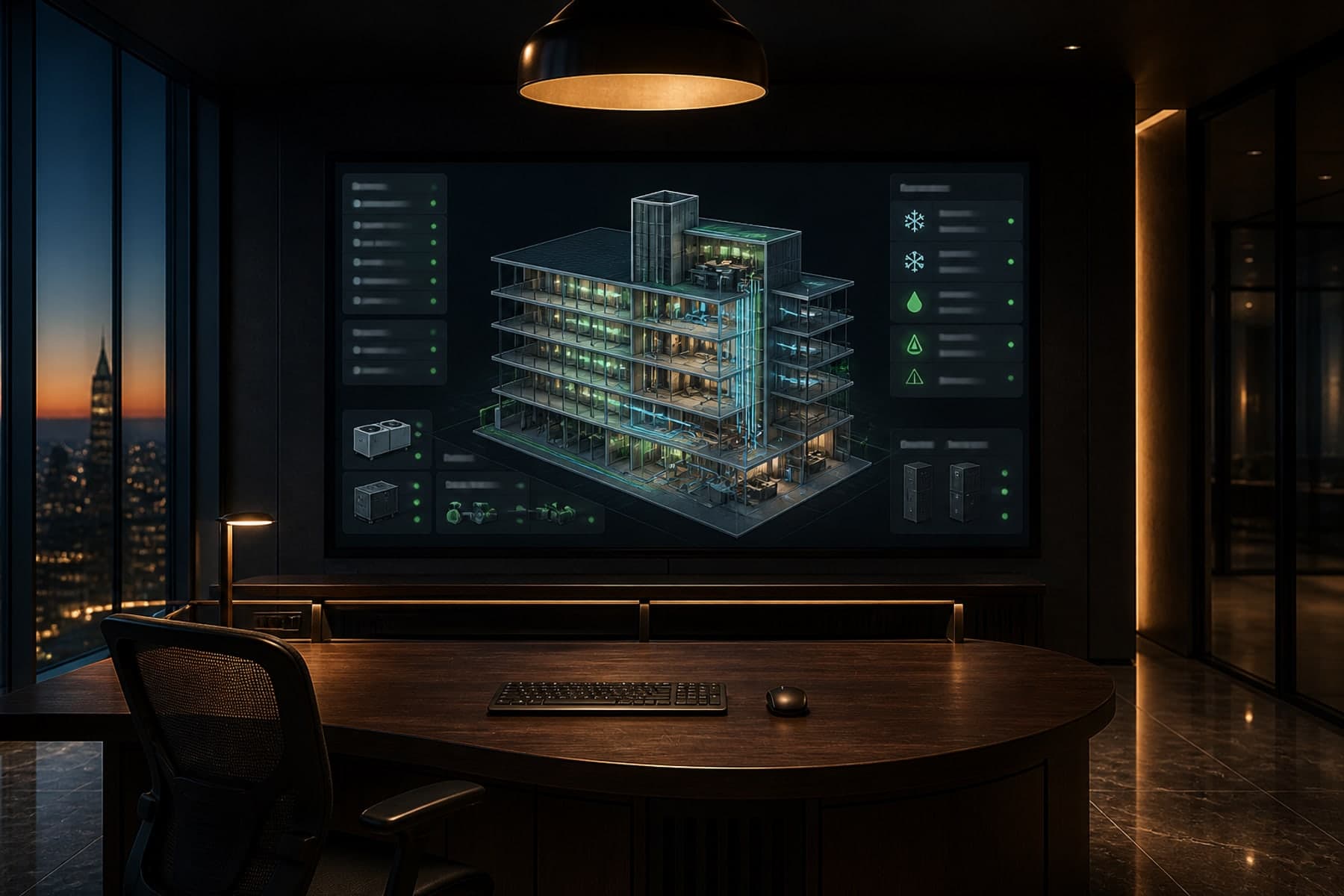
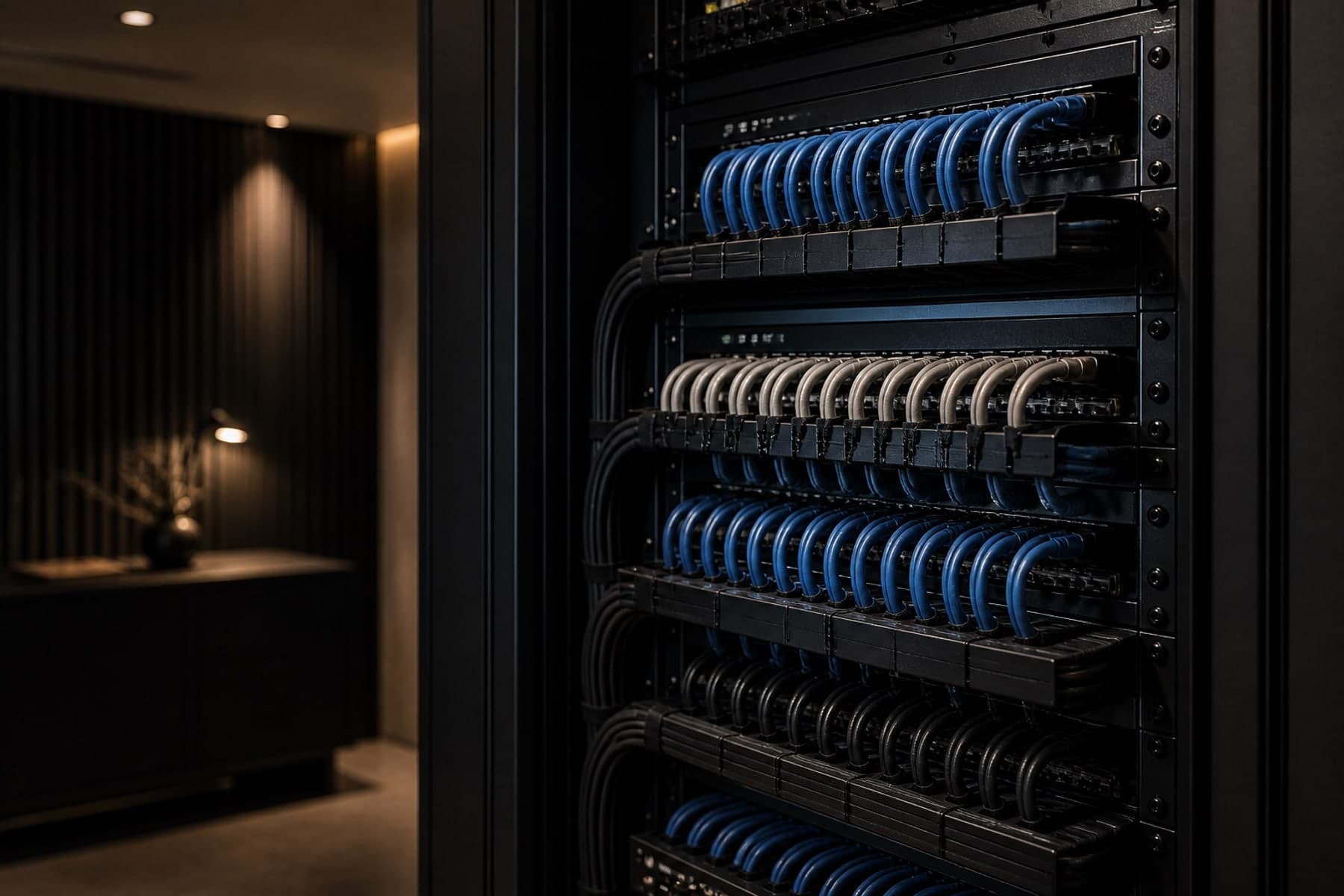
BMS dashboards, Wi-Fi heat-maps and structured cabling are not abstractions — they are the daily tools of the practice. The glossary attempts to keep both halves visible.