
ELV / Life-Safety Building Map.
— Building map · ELV intelligence board
Seven systems. One building.
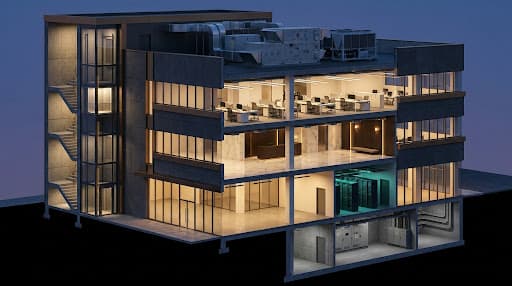
Pick a system. The cross-section lights up its devices and cabling, drawing the head-end relationships in one glance.
Building systems index
- IP Surveillance · CCTV. Edge cameras across perimeter, lobby, corridors and lifts. NVR in the server room. Retention sized to 30–90 days. Recording continues on UPS during outages.
- Access Control. Card / fingerprint readers on every restricted door. Magnetic locks fail-safe on fire alarm. Controllers daisy-chained to the access server in the server room.
- Addressable Fire Alarm. Detector loop addresses every device individually. Cause-and-effect logic shuts dampers, releases mag-locks, homes lifts to ground. Panel in BMS / FCC room.
- Public Address · PAVA. EN 54-16 voice-evacuation backbone. Zoned paging by floor / area. Fire-alarm event overrides routine paging instantly. Amplifier rack in server room.
- IP-PBX · Voice. DID numbering, voicemail-to-mail, mobile twinning, hunt groups. Survivable branch path keeps voice live when the WAN drops.
- Server / MDF Room. Climate-controlled enclosure for NVR, IP-PBX, AC server, switches and routers. UPS-backed; precision cooling; addressable detection inside the room.
- Building Management System. Supervisory control over HVAC, lighting and sub-metering. Coordinated trips on fire-alarm cause-and-effect. Head-end in the FCC / BMS room.
ELV · Reference · Cross-section
Interactive building cross-section. Toggle CCTV, access control, addressable fire alarm, public address, IP-PBX, server room and BMS — see device locations, cabling and where each system terminates.
- Layers
- 7
- View
- Cross-section
- Type
- Interactive
- Voltage
- < 50V
· Engineering advisory · ELV / Life-Safety Map
What the cross-section tells the architect and the owner.
The toggles reveal where seven systems live in the building, but the four notes below frame what coordinating them as one stack means for conduit count, civil scope, head-end space and operations after handover.
01 · Deployment observations
Deployment observations
The observations3 notes — engineering detail behind this section
- Coordinating CCTV, access control, fire alarm, PA, IP-PBX, structured cabling and BMS as one stack lets the seven systems share conduit runs, cable trays and head-end rack space, so the civil scope is drawn once rather than seven times and reconciled on site. How much that reduces the civil package depends on the building's form and riser count, so we publish no single figure for it.
- Fire-alarm cabling is kept segregated from data cabling at installation — physical separation in the conduit, or a fire-rated jacket. The cross-section is a useful surface for coordinating that early, but the governing requirement belongs to the project's fire scheme and the appointed fire consultant; take the specification from the fire-alarm discipline, not from this drawing.
- BMS integration with the other six systems is increasingly the default — fire-alarm cause-and-effect signals trigger AHU shutdown, access-control events open BMS audit trails, CCTV events bookmark BMS log entries. Specify the integration API at design freeze, not at commissioning.
02 · Operational notes
Operational notes
Read the operational notes2 notes — engineering detail behind this section
- One ELV head-end rack with all seven systems requires one operator workflow and one configuration baseline — versus seven separate vendor consoles with seven separate operations cadences. The reduction in operator load is the highest-impact decision for facility managers.
- Patch-panel labelling against the architect's floor plan (room number + system + cable ID) is the discipline that pays back across the building's life. The first ELV move-around after handover reveals whether the labelling discipline held.
03 · Lifecycle implications
Lifecycle implications
Read the lifecycle implications2 notes — engineering detail behind this section
- Structured cabling is a 20-year asset; the systems running on it (CCTV NVRs, fire panels, BMS controllers) are 8-12 year refresh cycles. Pull Cat6A to every device location at first install — the cable plant outlives two generations of head-end equipment, and rip-out cost is the largest avoidable scope creep in ELV.
- Spare conduit capacity at first install is the single best protection against future scope creep. Specify 30-40 percent spare conduit fill at architectural drawings; the marginal civil cost is trivial compared to a re-pull years later.
Verification status: Decision support — editorial logic, no numeric claim · Methodology documented · reviewed 2026-08-30
· Engineering notes
How to read this tool’s output
Stage 2 (survey) or stage 3 (design). Use to align stakeholders on the ELV backbone architecture.
The assumptions, limits and reference architectures behind this
What an engineer should know
The assumptions behind the numbers this tool produces.
- Interactive cross-section of a building with seven ELV layers — CCTV, access control, fire, PA, IP-PBX, server room and BMS. Hover any device to see its role.
When this tool is the right one
The project moments and room types this is built for.
- Architect or consultant reference for ELV scope conversation.
- Facilities manager orientation to the building's ELV layer.
Defensible starting architectures
Vendor-neutral reference points, not a recommendation to buy — the right answer is the one that survives your site survey.
- ELV backbone on Cat6A across all seven layers, with cable pathways coordinated against the architectural plan.
Common mistakes
Failure patterns we see on real projects.
- Treating the map as project-specific — it is a reference architecture, not a tailored design.
Where this tool fits
The building types this output is calibrated for — and, where we have said so, the ones it is not.
The standards and technologies this touches
Reference pages for the protocols, standards and systems behind this tool’s output.
Compare the options ·
KNX vs wireless smart-home automation — the control backbone· Why it matters
Most owners learn that ELV exists when the building does not get its occupancy certificate. Toggling each system on the cross-section makes the picture concrete — a fire-alarm loop wraps every floor, CCTV tails the perimeter and lobbies, access-control covers every locked door, public-address zones the building, and the BMS pulls all of it into one head-end. Together they share the same conduits and the same rack — but only if someone plans them together.
· Frequently asked
ELV systems —
what people ask first.
What counts as ELV?
Extra-low-voltage systems — anything running below 50 V. The seven canonical systems are CCTV, access control, addressable fire alarm, public address, IP-PBX, structured cabling and BMS. Some practitioners include intrusion alarm and intercom; we cover those under access control and PA respectively.
Why design ELV as one stack?
Because they share infrastructure — conduits, racks, cable trays, server rooms and power. A coordinated ELV design draws that civil scope once instead of once per vendor, and it settles fire-alarm cable segregation before anyone is pulling cable beside a data run. How much civil scope the coordination saves varies with the building, so we publish no figure for it; the segregation requirement itself comes from the project's fire scheme and the appointed fire consultant.
Do you handle each system in-house?
Yes — CCTV, access, fire alarm, PA, IP-PBX, structured cabling and BMS are all delivered by the same studio. The single-handle commercial model is the reason the integration actually works.
What about retrofit?
We start with a building survey, then layer the missing systems into existing tray runs where possible. Fire alarm and access control are the most common retrofits; CCTV and BMS retrofit cleanly when there is a coherent network backbone.
How does this relate to the cinema, automation or BMS scope?
ELV is the shared chassis. Cinema, automation and BMS sit on top of it — they all need the same network, the same head-end and the same cable plant. We design ELV first because everything else hangs from it.
Engineering toolkit
Next in this sequence
Calculators whose inputs or outputs connect to this one.
- Healthcare · Readiness
Healthcare ELV Readiness Checker
A readiness self-check for a hospital, diagnostic centre or clinic coordinating nurse call, CCTV, access, fire alarm + PA, network, patient TV and BMS for critical HVAC — with the gap list and who owes what. Statuses and bands only; no bed counts, layouts or camera specifics.
Advisory · readinessOpen - ELV · Surveillance · Storage
CCTV Storage Retention Calculator
Multi-brand, codec-aware CCTV storage retention sizing across a source-cited camera-profile catalogue including Hikvision, Dahua, Axis, Hanwha, Bosch, Honeywell, CP Plus, Ubiquiti, Verkada, Meraki, Avigilon, Pelco and more. Computes storage TB, HDD count plan, recorded bandwidth and an NVR/VMS class recommendation against camera count. Pairs with the CCTV Coverage Calculator.
47 brands · codec-awareOpen - Life-safety
NBC Compliance Checker
Building height, type and occupancy in — the life-safety and ELV systems NBC 2016 indicates for that building, citing NBC 2016 and the relevant IS codes.
NBC 2016 · IS codesOpen
· Begin
Need an ELV stack
that actually integrates?
Send the building drawings, the occupancy and the systems already in place. We will write back with an integrated scope within two working days.