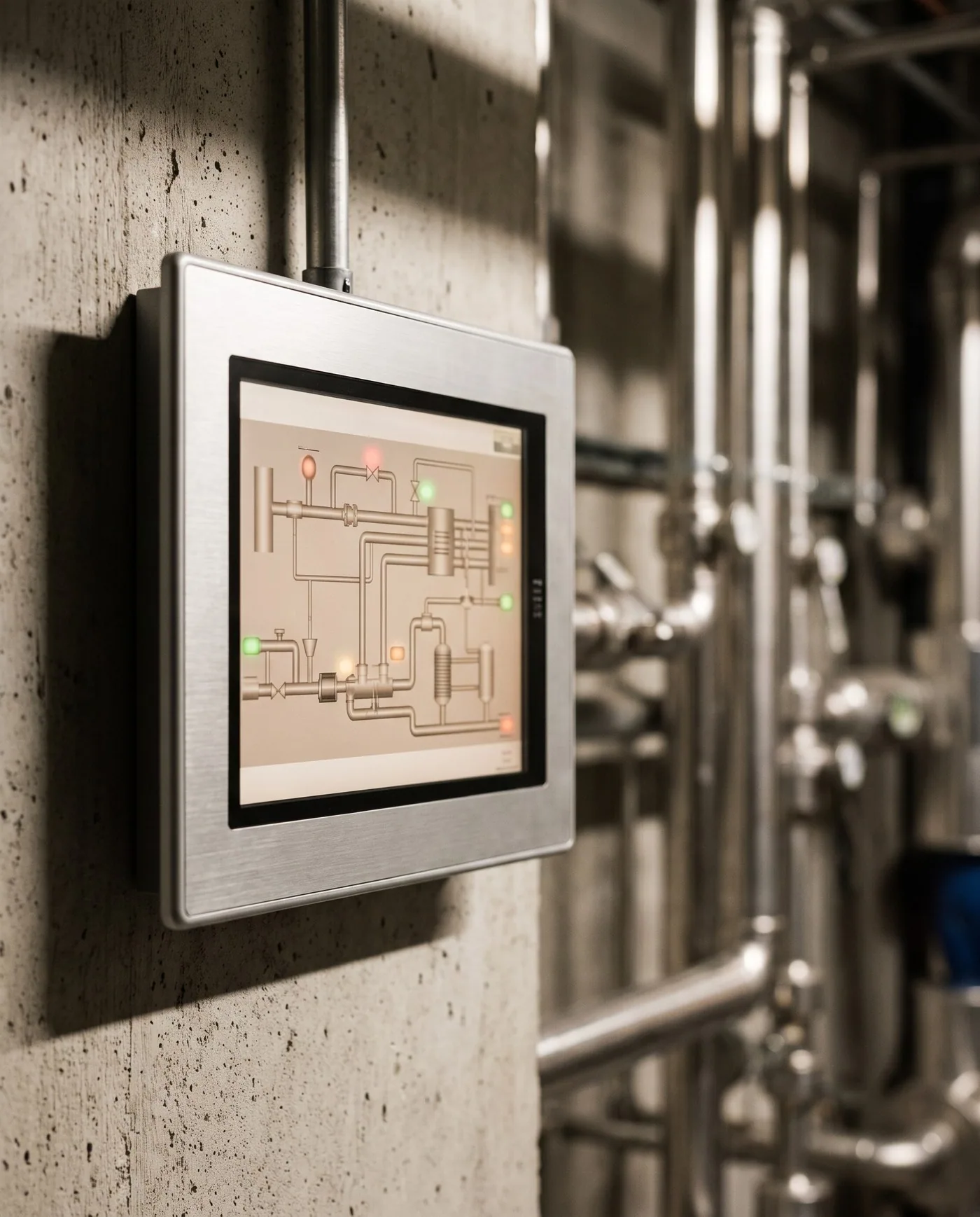
Building Management. The building, on a single dashboard.
3 sub-services · 6 brands
BMS, HVAC integration, central dashboards and mission-critical UPS-with-BESS — engineered for facilities teams to operate, not for vendors to sell.
· Quick answer
What is a building management system, and how does TechnoGuru deliver it?
TechnoGuru engineers building management as the supervisory layer that orchestrates HVAC, lighting and life-safety into one operating picture, with analytics that turn alarm logs into decisions and online UPS coupled with lithium-ion BESS underneath. A single Guwahati practice designs the dashboard around the priorities a facilities team actually monitors, across North-East India, so the BMS is something the team can run rather than something a vendor sells.
When to use it
A building where HVAC, lighting and life-safety should run from one dashboard the facilities team can operate after handover.
When it’s not the right fit
If the plant is a handful of standalone units with no operating team behind them, a head-end and points list add overhead the building will not use.
BMS delivery: vendor-led vs facilities-operable
BMS delivery: vendor-led vs facilities-operable
Aspect
Vendor-led approach
Facilities-operable approach
Alarms
Cryptic vendor codes
Named alarms in plain English routed to mobile devices
Analytics
Logs nobody reads
Deviations surfaced early, such as a chiller drawing extra current
Power
VRLA UPS as a default
Online UPS with lithium-ion BESS sized to the critical load
Educational comparison of delivery models — not a statement about any specific vendor.
/ Stack depth
Six layers, one integration
Power discipline at the base, user experience at the top. Every layer is explicit and documented.
Diagram · described
System layer map
A vertical six-layer stack visualising the engineering depth behind a serious deployment: power and infrastructure at the base, network, devices, integration, control logic and finally user experience at the top. The two end layers are highlighted to signal that both ends — power discipline and the experience itself — are deliberately engineered.
Six-layer stack — every project layer is explicit and documented.
A BMS justifies itself the day it spots a chiller drawing twelve percent more current than it drew last month. We design supervisory control around the priorities that actually move a P&L — comfort, plant health and compliance — and we specify analytics that turn alarm logs into decisions. Online UPS coupled with lithium-ion BESS sits underneath, isolating the building from grid reality.
/ Capability stack
3 services in BMS.
Click or hover any service in the index to see its capabilities, brand stack and a representative installation context.
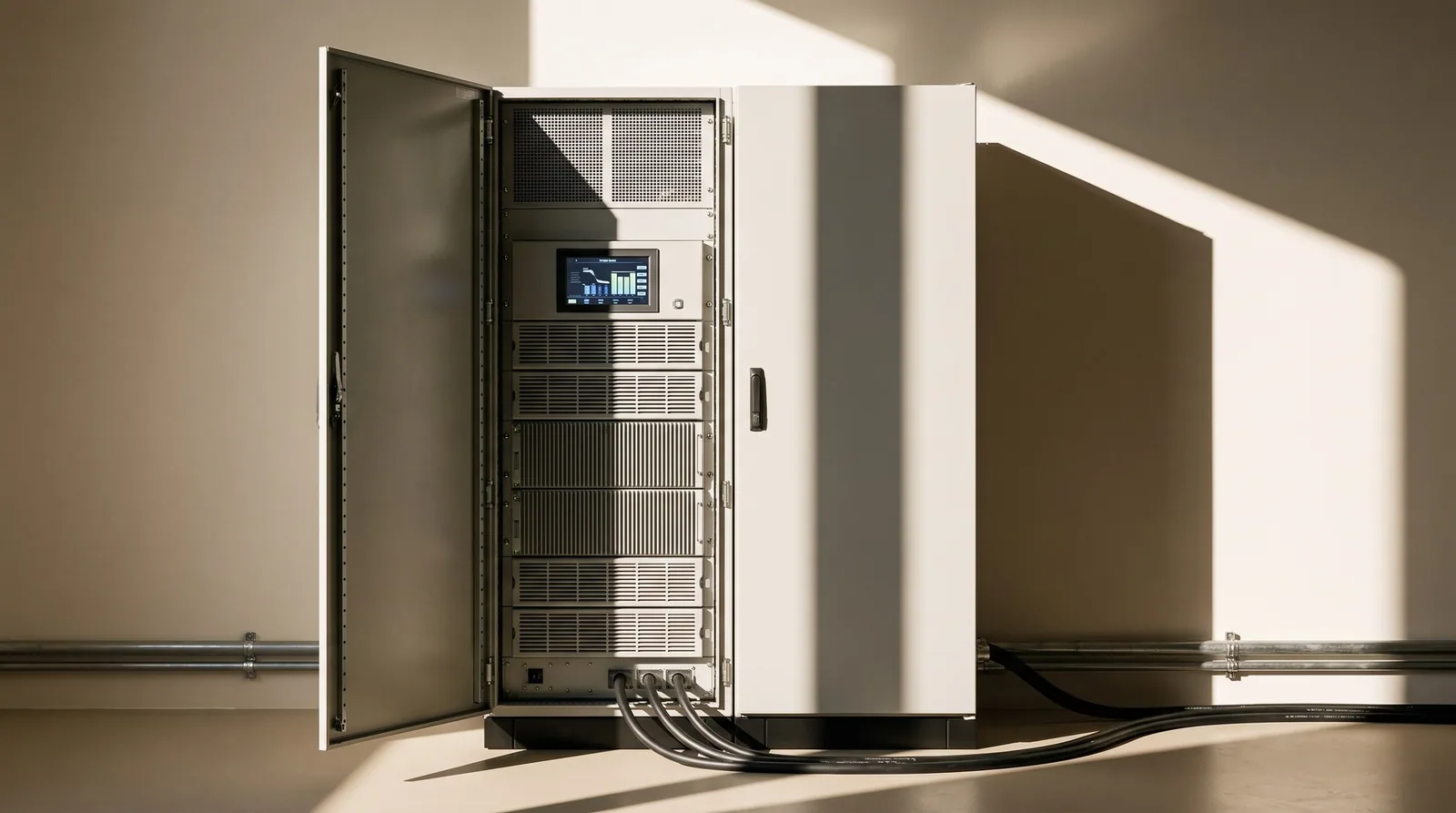
Illustrative — generated visual, not a real project photograph.
The building, on a single dashboard.
Building Management System (BMS)
Open-protocol BMS frameworks — HVAC, lighting, fire and access integrated to a single graphical front-end with operator analytics and alarm escalation.
BMS, HVAC integration, central dashboards and mission-critical UPS-with-BESS — engineered for facilities teams to operate, not for vendors to sell.
Building Management System (BMS)
Open-protocol BMS frameworks — HVAC, lighting, fire and access integrated to a single graphical front-end with operator analytics and alarm escalation.
Capabilities
HVAC and lighting supervisory control
BACnet, Modbus and KNX field-bus integration
Operator analytics and trend dashboards
Mobile dashboards and alarm escalation
Integration with fire alarm, access, CCTV
Brand stack
Honeywell, Bosch, Honeywell
Online UPS
Double-conversion online UPS — continuous AC-to-DC-to-AC rectification that delivers regulated sine to your load with zero transfer time and complete isolation from grid sag, surge, harmonics and frequency drift.
Capabilities
Double-conversion online UPS (3 kVA to 800 kVA)
Single-module, parallel and N+1 redundancy
VRLA and lithium-ion battery banks
Remote monitoring and predictive analytics
Diesel-set integration and ATS coordination
Site audit, load study and topology recommendation
Line-interactive UPS
Brand stack
Vertiv, Delta, Fuji
Battery Energy Storage (BESS)
Lithium-ion Battery Energy Storage Systems — installed alongside online UPS, paired with rooftop solar, or stand-alone — for peak-shave, demand-response, off-peak tariff arbitrage and ride-through. The same battery, working three shifts.
Capabilities
LFP-chemistry BESS (50 kWh to 2 MWh+)
BESS coupled with online UPS (hybrid topology)
Solar-self-consumption and peak-shave control
Demand-response and time-of-use tariff arbitrage
Cell-level BMS with predictive analytics
VRLA migration audit and replacement (UPS-BESS)
Integration with building BMS dashboard
Microgrid and grid-tie engineering
Brand stack
Vertiv, Delta, Fuji, Schneider
Equipment categories
See the equipment behind the solution.
Explore equipment we supply and the services around it. The final specification follows your space, operating needs and agreed scope.
What is a BMS and what does it actually do for a building?
A BMS is the supervisory control layer that orchestrates HVAC, lighting and life-safety into one operating picture, typically paying back in 18–36 months. The supervisory control layer that orchestrates HVAC, lighting and life-safety into one operating picture. It sets chiller schedules, adjusts AHU dampers based on CO₂ levels, dims lighting on daylight harvesting, and surfaces deviations from normal as alarms. The right BMS pays back in 18–36 months purely through HVAC and lighting energy savings.
Honeywell, Siemens or Johnson Controls BMS — how to choose?
Choose Siemens Desigo for large HVAC-heavy campuses, Honeywell for tenant-billing dashboards, and Johnson Controls Metasys for very large enterprise estates. By analytics maturity and integration breadth. Siemens Desigo is excellent on large campuses with deep HVAC integration. Honeywell is strong on tenant-billing dashboards. Johnson Controls Metasys suits very large enterprise estates. We are vendor-flexible — we recommend by project profile, not partnership.
Why is online UPS with lithium-ion BESS now the default for new mission-critical installs?
Lithium-ion BESS is now the default for new mission-critical UPS above 20 kVA because eight-year lifetime cost is 30–45% lower than VRLA despite a 1.8× initial premium. The eight-year economics flipped. Lithium-ion delivers 3–4× cycle life, half the floor space, and a fraction of the maintenance versus VRLA. Initial cost is ~1.8× but lifetime cost is typically 30–45% lower. Above 20 kVA in any new installation, lithium is now the right answer in almost every case.
Can a BMS retrofit be done without disrupting operations?
BMS retrofits are planned zone by zone around the building and its operations. Parallel running, controller changes, testing and cutover windows are agreed after reviewing the existing plant and controls. Scope, procurement, approvals and site coordination determine the schedule and acceptable interruption windows.
Will the BMS dashboard be usable by our facilities team without us in the room?
Yes — the BMS dashboard is designed for the facilities team to operate without us, with named alarms in plain English and escalation routing to mobile devices. That is the test we design to. The supervisory layer is configured around the priorities the facilities lead actually monitors, with named alarms in plain English rather than vendor codes, escalation routing to mobile devices, and a daily operations report that lands in the facility manager's inbox. The dashboard is theirs after handover, not ours.
What is a BESS doing that a traditional generator does not?
A BESS rides through transient events instantly, peak-shaves against demand-charge tariffs and absorbs solar over-generation — complementary to a generator, not a replacement. Riding through transient events instantly, peak-shaving against demand-charge tariffs, and absorbing solar over-generation where rooftop PV is in scope. A diesel generator still has its place for sustained outage backup, but the first 30–60 seconds of any grid event — which is where most equipment damage and process disruption occurs — is BESS territory now. The two layers are complementary, not competitive.
Engineering toolkit
Planning tools for bms
Advisory calculators and reference checkers that scope this discipline before drawings — planning references, not final designs.