
05 / 06
Case file
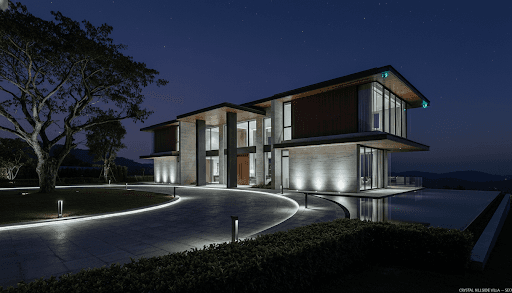
Façade graze, in-grade uplights, linear coves, water-feature lighting, drive and pathway detailing, tree uplights and perimeter flood — engineered, programmed and night-commissioned on one Rako control surface.
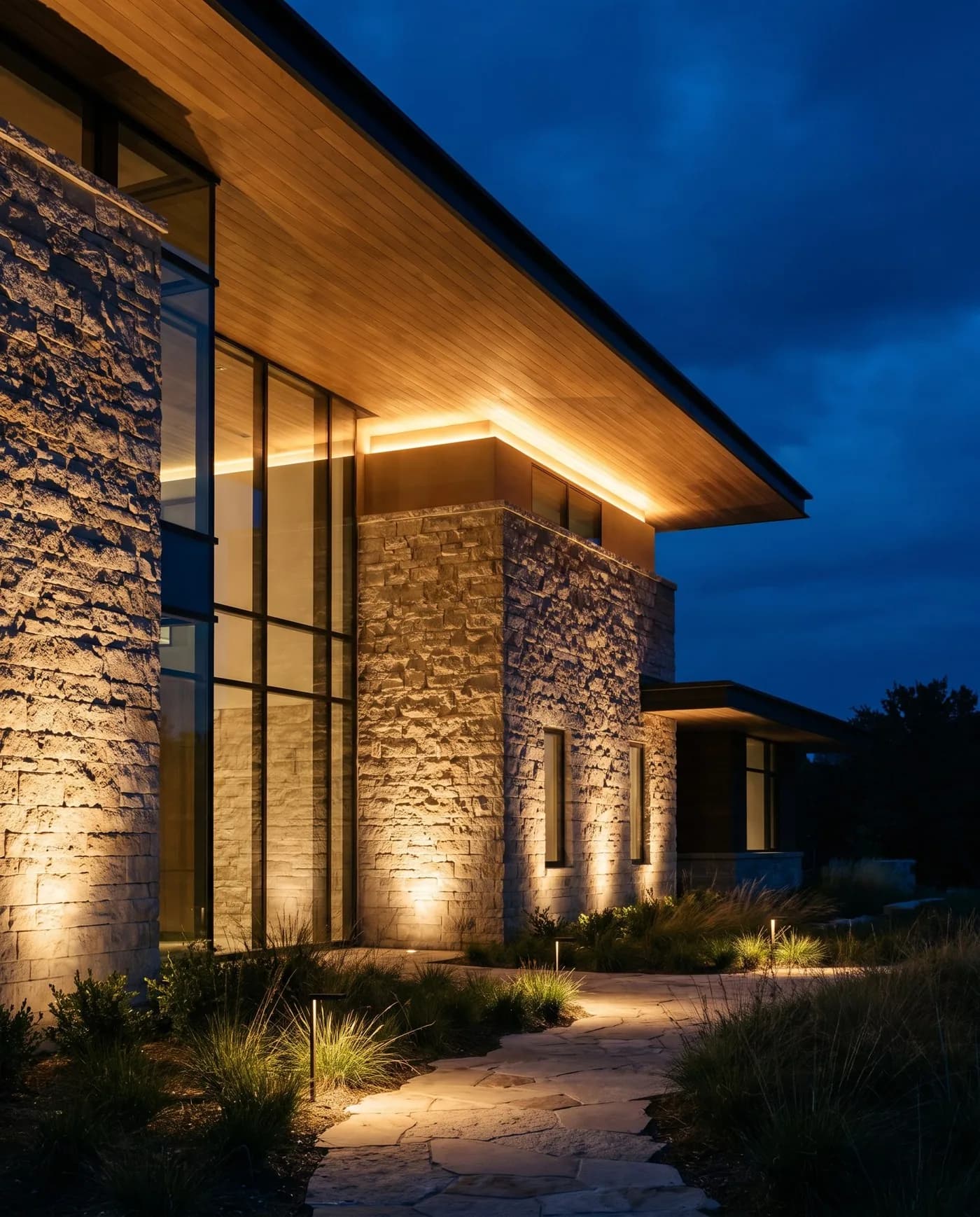
| Aspect | Generic wall-wash approach | Composed approach |
|---|---|---|
| Composition | Even flood across the wall | Grazing, uplights and coves with deliberate dark zones |
| Control | On/off switching | Rako scenes on astronomical and event-calendar scheduling |
| Commissioning | Signed off in daylight | Night-commissioned with a colorimeter and re-aimed on site |
Educational comparison of design rigour — not a statement about any specific installer.
/ Landscape · Dawn
The grounds, choreographed to the hour.
Façade graze, drive pathway, tree uplights, pool feature and perimeter flood on one control surface — four operator presets across the day, one named keypad in the porte-cochère.
Pre-sunrise blue hour. The villa wakes up, façade lifts to 35%.
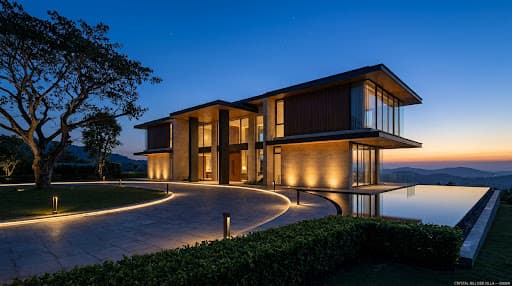
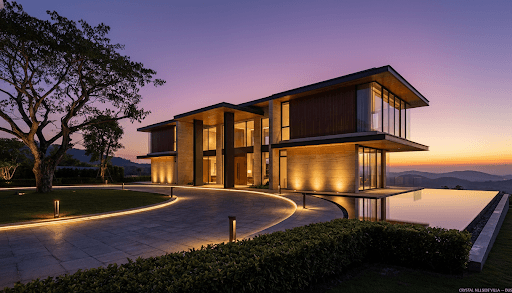
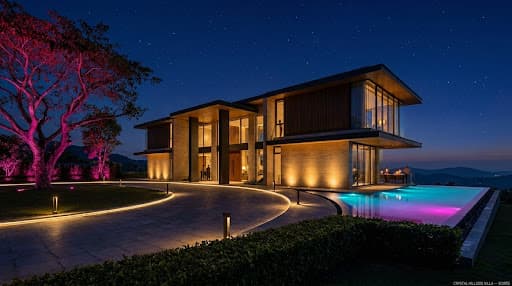
Scene composition
Façade graze · drive pathway · foyer interior
Multi-zone hillside villa · demonstration
Commission landscape lighting at night, not in a render.
Façade graze tuned on site. Pool RGB programmed for the soirée scene. Perimeter flood aligned with the CCTV plan.
Façade · pathway · tree · pool · interior
/ Time of Day
Pre-rendered preview. Not live grounds control.
Landscape lighting scenes
- Dawn: Pre-sunrise blue hour. The villa wakes up, façade lifts to 35%.
- Dusk: Façade full. Pool warm. Tree canopy uplit. The building performs.
- Soirée: Pool RGB. Tree magenta wash. Façade dimmed for intimacy.
- Security: Cool 5000 K perimeter flood. Camera corners armed. Interior off.
/ The discipline, in detail
How we approach architectural & façade lighting.
Most façade lighting is afflicted by a single mistake: it lights the wall instead of the building. Real architectural lighting is composed shot by shot — grazing for texture, uplights for proportion, coves for layering, and dark zones held back deliberately so the lit zones can speak. The same composition discipline extends to the grounds: drive pathway, garden uplights, pool feature and perimeter flood are programmed as scenes that move through the day, not as switches the operator hunts for.
We work alongside lighting designers, or take on the LD role when the architect requires a single accountable hand from concept to commissioning. We commission on site, at night, with a colorimeter — and we re-aim, re-shim and re-balance against what the architecture is actually doing under the fixtures. Underneath, iGuzzini, Erco, Bega and Pharos specify the actual fixtures; Rako and MADRIX carry the control. Every project ships with a calendar of named scenes, a manual override panel for the operations team, and night-photography proof before handover.
On record
Every architectural & façade lighting engagement is documented end-to-end — design, programming, commissioning, calibration — and handed over with the files our successors would need if we were never to return.
/ Protocol stack
Facade circuits, addressed
Exterior architectural lighting follows the same addressable-control discipline as interior scenes — schedules, zones and dimming curves on one stack.
Diagram · described
Lighting protocol stack
A three-layer canonical lighting control architecture: BMS supervisor layer at the top, scene/keypad layer in the middle (Rako and Lutron control systems or the open KNX standard), an addressable bus layer connecting the scene controls to fittings (DALI-2 typically), and fittings at the bottom with addressable drivers and emergency self-test. The arrows show the direction of control telegrams; the gateway bridges scene-control systems to DALI-2 at the fitting layer.
Diagrammatic view — a system planning illustration for design discussion, not a project drawing or live interface.
/ Where we deploy this
Active across 6 sectors.
Architectural & Façade Lighting is rarely a standalone brief — it sits inside a wider sector practice with its own codes, expectations and operating rhythm.
/ Sister services
The rest of automation.
A serious brief usually crosses two or three of these. Read across the discipline — we deliver them as one contract.
- 01
Home & Office Automation
One press. The whole space responds.
Lights, climate, blinds, audio, cinema and security — orchestrated by a single Rako, Fibaro or KNX backbone and controlled from a touch panel, voice or a discreet keypad on the wall.0 - 02
Lighting Automation
Light, tuned to the hour.
Dimmable, scene-based, daylight-aware lighting on Rako, Fibaro, KNX or DALI — programmed to the rhythm of the room rather than the switch on the wall.1 - 03
Smart Control
One panel. The whole building.
Touch panels, keypads, voice and mobile control surfaces — Rako, Fibaro Home Center and KNX — engineered as the single, learnable interface to everything else we install.2 - 04
Drapery & Shading Control
Daylight, on a quiet motor.
Motorised curtain tracks, roller and roman blinds, sheer-and-blackout double-rolls, and external louvres — silent, scheduled, scene-aware and integrated with the rest of the home or building.3 - 06
Motorised Shutters & Skylights
The building envelope, on a quiet motor.
Motorised building-envelope openings — automatic rolling shutters, motorised skylights and retractable roof glass, and façade and ventilation openings — scheduled, scene-aware and integrated with the wider automation system.4
/ Integration with
How architectural & façade lighting talks to the rest.
A serious deployment of this system rarely operates in isolation. The disciplines below most commonly share its cabling pathways, its controller logic, and its cause-and-effect matrix.
Lighting Automation
Light, tuned to the hour.
Dimmable, scene-based, daylight-aware lighting on Rako, Fibaro, KNX or DALI — programmed to the rhythm of the room rather than the switch on the wall.Stage Lighting
Light that performs.
Theatre, concert, event, nightclub and place-of-worship stage lighting — moving heads, washes, profiles, pixel-mapped LED, effect lighting and MADRIX or ProtoPixel show control on DMX / Art-Net / sACN.
/ Read deeper
The engineering, in long form.
Each article below goes deeper than this service page can — a full walk-through of the engineering decisions, written by the team that delivers this work.
Engineering toolkit
Tools to scope this work
Calculators and reference checkers we use ourselves to sense-check the engineering before any drawings change hands.
- Automation · Lighting
Lighting Scenes Interactive
Tap a scene — Welcome, Dinner, Film, Rest, Away, Goodnight — and watch every circuit, shade, AC zone and AV source shift at once across a reference 4 BHK plan. KNX + Rako + DALI.
6 scenes · photorealOpen - AV · Projection
Projector Throw Distance Calculator
Engineering-grade throw distance calculator across a verified multi-brand projector catalogue — Sony, JVC, Epson, BenQ, LG, Optoma, ViewSonic, Panasonic, Barco, Christie, Canon, InFocus, Maxell, Casio, EIKI, Philips, Nebula, JMGO, Dangbei, Boxlight, ASUS, Leica, Xiaomi, WEMAX, Ricoh and more. Searchable picker, throw range, lens-shift envelope, viewing distance, pixel density, feasibility flags and a custom-throw fallback. Sources cited per model.
51 brands · sourcedOpen - BMS · Energy
Energy & Efficiency Estimator
Adjust building variables and see indicative energy and CO₂ savings (kWh) for a BMS-driven energy upgrade plus daylight-harvesting LED retrofit. Conservative; defensible in a first conversation.
kWh · CO₂ savedOpen
/ Engineering concepts
Related engineering concepts
Concept
Rako Lighting Control
British wireless and wired lighting and scene-control platform. The default residential and hospitality lighting backbone for retrofit and new-build where Rako's keypad-and-scene ecosystem fits the design intent.
Concept
KNX Building Bus
ISO-standard wired open-protocol building bus. Multi-vendor, scalable to thousands of devices, designed for 20+ year lifecycles. The right backbone for vendor independence and longevity.
Concept
DALI Protocol
IEC-standard digital lighting protocol. Each fitting is individually addressable and dimmable; preferred for premium lighting where each circuit needs scene-level and tunable-white control.
Concept
Scene Orchestration Pattern
Engraved-keypad-driven scene programming where lighting, shades, climate, audio and AV move together to a named room state (Welcome, Dinner, Film, Goodnight) — programmed once and triggered as one.
/ Used alongside
Commonly deployed alongside
Sector
Restaurants, Bars & Clubs
The room. The night. The sound.
Service
Stage Lighting
Light that performs.
Service
Lighting Automation
Light, tuned to the hour.
Service
Home & Office Automation
One press. The whole space responds.
Service
Fire Alarm System
Detection that pinpoints. Response that is coordinated.
Service
Smart Control
One panel. The whole building.
/ Plan it right
Architectural & Façade Lighting — getting the brief right.
Common mistakes to avoid
- Lighting the wall instead of the building — fixture-first schemes with no composition intent read as floodlit, not lit.
- Choosing fixtures without ingress and impact ratings honest to the exposure — monsoon rain, dust and insects retire under-specified fittings within a season.
- Skipping night commissioning — aiming, shimming and balancing cannot be done from a render at noon.
- No maintenance-access plan for in-grade and high-level fixtures, so failed fittings simply stay dark.
- Designing the façade scheme apart from the perimeter-security lighting and CCTV plan, so the two fight each other after dark.
What to share before a quotation
- Elevations and the site plan — the façades, grounds and features to be lit.
- The architectural intent — what should read at night, and what should deliberately stay dark.
- The exposure each fixture position faces — rain, dust, irrigation, vehicle areas.
- Control expectations — scenes, schedules, event calendar — and the platform in use.
- The power and containment provisions already in the civil and electrical design.
/ Frequently asked
Architectural & Façade Lighting — what buyers ask first.
Static or dynamic façade?
Choose a single static façade scene tuned to the architecture for most premium buildings; dynamic colour cycles only earn their place on civic and event-centred buildings, and quickly date a quieter project. We recommend dynamic only where the building's role earns it.
Why do landscape and façade jobs need night commissioning?
Because daylight cannot tell you what a façade graze looks like at 2700 K against textured stone, what a tree uplight does to a Frangipani canopy in monsoon humidity, or whether the pool RGB matches the cabana scene at 9 pm. Render walks do not catch any of that. We commission on site, at night, with a colorimeter — and we re-aim, re-shim and re-balance against what the architecture is actually doing under the fixtures.
Can the grounds integrate with the home automation system?
Yes — Rako landscape scenes share the same keypad layer as the interior on a single Wi-Bridge backbone, so the porte-cochère keypad calls 'Welcome' as one gesture that lifts the foyer cove and the drive pathway in the same instant. The integration is at the controller, not at the keypad — there is no second remote for the grounds.
What makes architectural facade lighting 'good' versus garish?
Restraint. The best facade lighting reveals the building's geometry — uplighting on stone walls, cove lighting in a soffit, water-feature lighting from below — without using colour-cycling RGB. We almost always specify warm-white (2200–3000K) static or single-channel tunable, never RGB chase patterns.
How much does facade lighting save on energy with daylight sensors?
Astronomical timers and lux sensors typically run facade lighting for 8–10 hours per day rather than 12–14. On a building with 5–8 kW of facade load, that's 8,000–12,000 kWh per year of recovered consumption. The control system pays back its cost on energy alone in 2–3 years.
How do you protect facade fixtures from monsoon?
All exterior fixtures are specified to IP66 minimum, with potted electronics and stainless or marine-grade aluminium housings. Drivers are mounted internally where possible, with conduits routed through the architecture rather than over its surface. We design for the coastal/humid environment our region experiences.
Can dynamic facade lighting be programmed for events?
Yes — we programme event scenes (Diwali warm tone, Republic Day tricolour, brand-event-specific palettes) into the controller, accessible via a single keypad press from reception or a tablet. The everyday default is restrained warm-white; the dynamic scenes are an option, not a constant.
Will facade lighting attract pests?
Cool-temperature LEDs (above 4000K) attract significantly more insects than warm-white (2700K and below). We default to 2700K or warmer for any facade-lighting scheme that is on continuously, which dramatically reduces the moth-and-mosquito magnet effect that cheap landscape lighting creates.
· Begin
Begin a
architectural & façade lighting
brief.
Tell us about the building, the timeline, and what success looks like a year after handover. We will reply within two working days with a written response, not a sales pitch.