
12 / 18
Case file
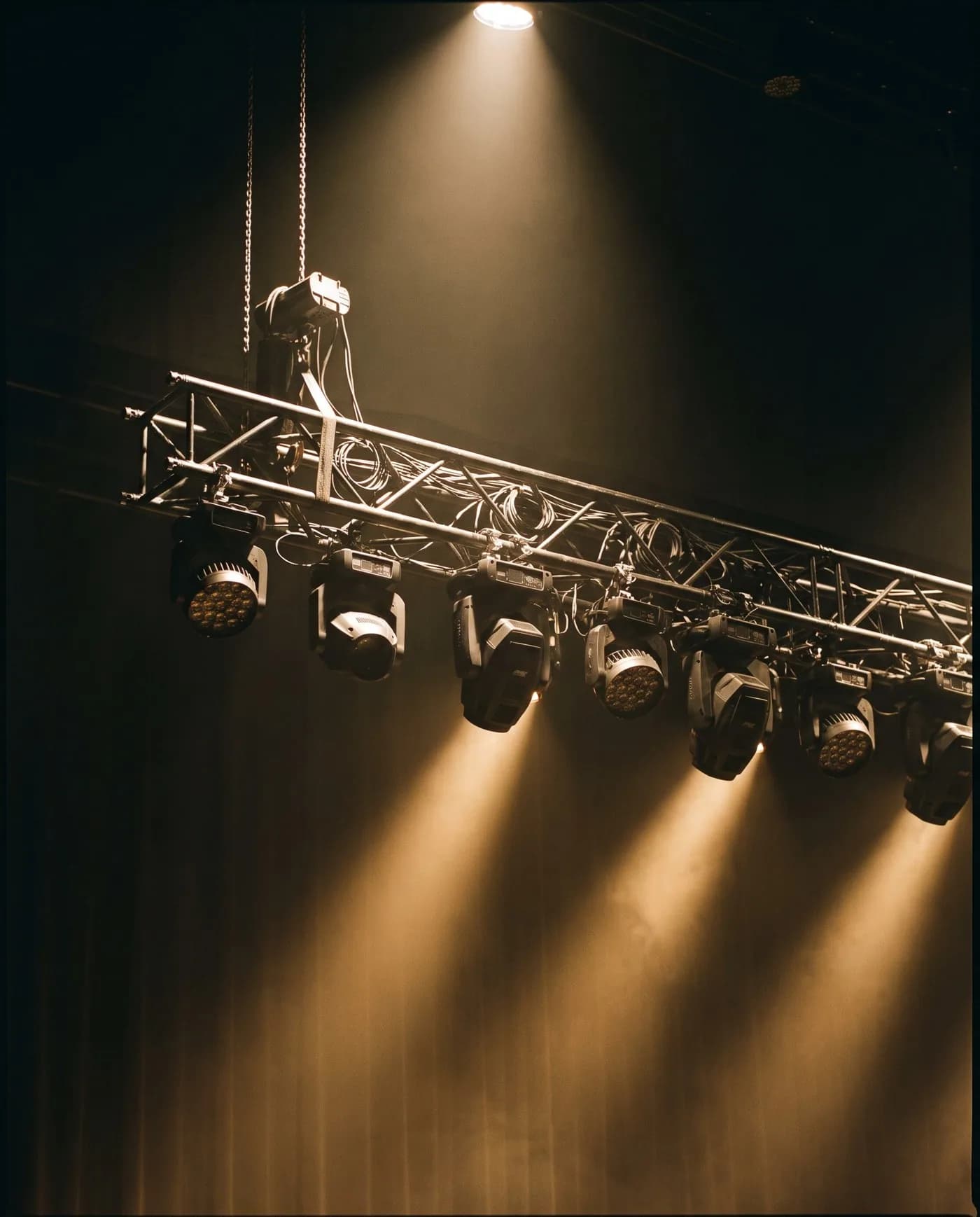
Theatre, concert, event, nightclub and place-of-worship stage lighting — moving heads, washes, profiles, pixel-mapped LED, effect lighting and MADRIX or ProtoPixel show control on DMX / Art-Net / sACN.
| Venue need | Presets on a small console | Programmable console |
|---|---|---|
| Fixed-cue services | Suffice for entry, sermon, hymn and blessing | More than required |
| Visiting choirs or theatrical productions | Limiting | Pays back within a season |
Educational comparison — console choice follows the show's actual programming needs.
/ The discipline, in detail
How we approach stage lighting.
Stage lighting is choreography. Beam angles, colour temperature, intensity envelopes and cue stack design are the language. We program lighting cues to the actual show — a play, a sermon, a graduation, a concert — not a generic preset. ETC, Robe, Martin and Chauvet are specified per the rigger's structural reality and the LD's brief.
On nightclub, dance-floor and event work the same discipline extends to the pixel and media layer. LED battens, dance-floor tiles and video content are pixel-mapped on a MADRIX or ProtoPixel engine over Art-Net or sACN, effect lighting — strobes, blinders and atmospheric haze — is cued to the set rather than run on a loop, and the show is synced to the DJ by BPM, MIDI or timecode. Everyday architectural room lighting stays on Rako or DALI, so a build, a drop and a house-lights-down cue read as one operator gesture across sound and light.
On record
Every stage lighting engagement is documented end-to-end — design, programming, commissioning, calibration — and handed over with the files our successors would need if we were never to return.
/ Where we deploy this
Active across 3 sectors.
Stage Lighting is rarely a standalone brief — it sits inside a wider sector practice with its own codes, expectations and operating rhythm.
/ Sister services
The rest of av.
A serious brief usually crosses two or three of these. Read across the discipline — we deliver them as one contract.
- 01
Home Theatre
Reference cinema, in your living room.
Custom-engineered private cinemas — projector, processor, screen, seating and acoustics designed to a single sweet-spot, following THX and Dolby Atmos reference layouts.0 - 02
Multi-Room Audio
One song. Every room. Or six different ones.
Whole-home audio on Yamaha, Sonance and BluOS — invisible in-ceiling speakers, hidden subs, room-corrected and zone-routed.1 - 03
Acoustic Solutions
Rooms that sound the way they look.
Acoustic design and treatment for cinemas, auditoriums, recording studios, places of worship and conference halls — engineered absorbers, diffusers, bass traps and ceiling clouds.2 - 04
Video Walls
Pixels at the scale of architecture.
Direct-view LED, fine-pitch LCD and rear-projection video walls for command centres, lobbies, broadcast studios, control rooms and event venues.3 - 05
Control Rooms & Command Centres
The room is the instrument.
Operator environments for security, utilities, transport and industrial monitoring — where the display wall, the operator position and the infrastructure behind them are engineered as one system that runs continuously.4 - 06
Smart Classrooms
Every student. Every word. Every time.
Interactive flat-panels, lecture-capture, voice-lift and learning-management integrations — engineered to NCERT, NEP-2020 and university lab specifications.5 - 07
LED Panels & Projectors
The right pixels for the room.
Direct-view LED, OLED, microLED and laser projection — selected to the room's lux, throw, sightline and content.6 - 08
Professional Audio & PA Systems
Intelligible, every seat in the house.
Public address, voice-evacuation and concert-grade audio for auditoriums, places of worship, stadia, transit hubs and event venues.7 - 09
Auditoriums & Boardrooms
Rooms that begin on time.
Turnkey auditorium, boardroom, training-room and conference-room AV — display, audio, control, video-conferencing and lighting integrated to a single touch.8 - 10
Digital Conferencing & Voting Systems
Sittings, voting, interpretation — one system, every seat.
Parliamentary-grade digital conferencing for legislative chambers, council halls and corporate boardrooms — mic management, electronic voting, 8-channel interpretation, camera control and chamber recording, integrated through Bosch DCN, Dicentis and Integrus.9 - 11
Recording Studios & Nightlife
Rooms tuned to the recording.
Recording studio design, post-production suites, broadcast booths and nightlife audio — acoustic isolation, monitoring, console integration and DJ infrastructure.10 - 13
Conference Room AV
Single-touch join. Every meeting.
Microsoft Teams Rooms, Zoom Rooms and Cisco Webex meeting rooms on platform-certified hardware, with auto-tracking cameras, ceiling-array microphones and one-touch room controllers.11 - 14
Hospitality Venue AV
From the banquet stage to the last bar stool.
Hospitality venue AV — banquet hall, ballroom and conference AV, restaurant and bar zone audio, and club-grade nightlife systems with JBL Professional, K-array and Kgear, engineered for hotels, resorts and standalone venues.12 - 15
Digital Signage & Wayfinding
The right message, in the right place, on schedule.
Commercial indoor and outdoor display panels, signage video walls, menu boards, wayfinding and queue or information screens — driven by content-management software with scheduling and remote management for retail, hospitality, corporate, transport and institutional spaces.13 - 16
IPTV & Hospitality TV
Live channels, your channel, on every screen in the building.
Head-end reception and IP distribution of live television, in-house channels and content to commercial-grade and hotel TVs — with interactive welcome screens, an electronic programme guide, casting and integration into the property's network and guest-room systems.14 - 17
Queue Management System
Take a token, watch the counter, walk up.
Token and queue management — ticket dispensers, counter and main calling displays, audio call-forward, multi-counter routing and wait-time analytics — for healthcare, banks, government and retail counters.15 - 18
IP Paging & Announcement
Page the right zone, over the network.
IP network paging and announcement — zoned paging over the data network, SIP/telephone and desktop paging, scheduled bells and announcements — integrated with the PA and telephony systems for offices, campuses, industrial and transit sites.16
/ Where this system has been deployed
Stage Lighting on the ground.
The reference projects below carry a stage lighting layer engineered as part of an integrated stack. Each case study walks through the engineering challenges that were solved, the standards the work was held to, and the operational outcome on the day-two team.
- Completed · Handover 2018
Multi-Purpose Hall, Arunachal Pradesh Assembly Complex
Government · Multi-Purpose Auditorium · Itanagar, Arunachal Pradesh
- Completed · Handover 2022
Capital Cultural Hall, Kohima
Government · Cultural Auditorium · Kohima, Nagaland
- Completed · Handover 2024
Town Hall Auditorium, Dimapur
Government · Civic Auditorium · Dimapur, Nagaland
- Completed · Handover 2018
Multipurpose Cultural Hall, Namsai
Government · Cultural Auditorium · Namsai, Arunachal Pradesh
Public project summaries describe systems and outcomes only — BOQ values, quantities, device counts and security layouts are kept off public surfaces.
Request a feasibility review/ Integration with
How stage lighting talks to the rest.
A serious deployment of this system rarely operates in isolation. The disciplines below most commonly share its cabling pathways, its controller logic, and its cause-and-effect matrix.
Auditoriums & Boardrooms
Rooms that begin on time.
Turnkey auditorium, boardroom, training-room and conference-room AV — display, audio, control, video-conferencing and lighting integrated to a single touch.Professional Audio & PA Systems
Intelligible, every seat in the house.
Public address, voice-evacuation and concert-grade audio for auditoriums, places of worship, stadia, transit hubs and event venues.Lighting Automation
Light, tuned to the hour.
Dimmable, scene-based, daylight-aware lighting on Rako, Fibaro, KNX or DALI — programmed to the rhythm of the room rather than the switch on the wall.
/ Read deeper
The engineering, in long form.
Each article below goes deeper than this service page can — a full walk-through of the engineering decisions, written by the team that delivers this work.
Engineering toolkit
Tools to scope this work
Calculators and reference checkers we use ourselves to sense-check the engineering before any drawings change hands.
- Auditorium AV · Readiness
Auditorium AV Scope & Readiness Planner
A scope-level self-check for an auditorium, convention or multipurpose hall — the AV signal chain (sources, mixing & DSP, amplification & loudspeaker zones, projection, stage-lighting, assistive listening, recording, control), plus acoustics, infrastructure and operations — with the gap list and who owes what. Statuses and bands only; no seat counts, SPL targets or model choices.
Advisory · readinessOpen - AV · Audio · Coverage
Speaker Coverage Planner
Engineering-grade speaker coverage and SPL planner across a source-cited public model catalogue spanning pro touring, commercial audio and architectural speakers. Predicts SPL at listener distance, the horizontal coverage width at that distance on the -6 dB dispersion axis, and the quantity needed for the room.
45 brands · SPL predictionOpen - AV · Projection
Projector Throw Distance Calculator
Engineering-grade throw distance calculator across a verified multi-brand projector catalogue — Sony, JVC, Epson, BenQ, LG, Optoma, ViewSonic, Panasonic, Barco, Christie, Canon, InFocus, Maxell, Casio, EIKI, Philips, Nebula, JMGO, Dangbei, Boxlight, ASUS, Leica, Xiaomi, WEMAX, Ricoh and more. Searchable picker, throw range, lens-shift envelope, viewing distance, pixel density, feasibility flags and a custom-throw fallback. Sources cited per model.
51 brands · sourcedOpen
/ Engineering concepts
Related engineering concepts
Concept
Harman Pro Ecosystem (JBL · Crown · BSS · Soundcraft · AKG)
Harman Professional brand family used across our cinema, auditorium and PA deployments — JBL loudspeakers, Crown amplification, BSS DSP, Soundcraft consoles, AKG microphones.
Concept
Rako Lighting Control
British wireless and wired lighting and scene-control platform. The default residential and hospitality lighting backbone for retrofit and new-build where Rako's keypad-and-scene ecosystem fits the design intent.
Concept
KNX Building Bus
ISO-standard wired open-protocol building bus. Multi-vendor, scalable to thousands of devices, designed for 20+ year lifecycles. The right backbone for vendor independence and longevity.
Concept
ELV Cabling Backbone
The unified low-voltage cable plant carrying fire, CCTV, access, PA, IP-PBX, BMS and structured data across a building — coordinated as one cause-and-effect pathway rather than per-discipline runs.
/ Used alongside
Commonly deployed alongside
Service
Professional Audio & PA Systems
Intelligible, every seat in the house.
Service
Acoustic Solutions
Rooms that sound the way they look.
Service
Auditoriums & Boardrooms
Rooms that begin on time.
Project
Capital Cultural Hall, Kohima
An 1,800-seat civic auditorium engineered for live cultural performance, public address, recorded music and government convocation — delivered as a coordinated build covering pro audio, active LED, acoustics, stage lighting, stage furnishing, fire alarm, fire hydrant and chair installation across the entire house.
Project
Town Hall Auditorium, Dimapur
A civic auditorium engineered for council meetings, official functions and community performance. TechnoGuru delivered audio, video, acoustics, stage furnishing, stage lighting, active LED, DALI lighting automation, fire alarm, fire hydrant, HVAC, CCTV and auditorium chairs / seating.
Service
Fire Alarm System
Detection that pinpoints. Response that is coordinated.
/ Plan it right
Stage Lighting — getting the brief right.
Common mistakes to avoid
- Specifying fixtures before the rigging reality — truss positions, motor points and structural loads decide what can hang where.
- Buying moving heads for a venue whose real programme is fixed-cue services that presets would serve better.
- No dimmer and power planning — stage-lighting loads and the building's electrical design must meet before the fixtures arrive.
- Ignoring the operator — a console the volunteer team cannot run means the rig plays one look forever.
- Skipping house-light integration, so the transition from architecture to performance is a wall of switches.
- Treating the pixel and media-server show layer as an afterthought — dance-floor, media-façade and music-responsive content lives on a MADRIX or ProtoPixel engine over Art-Net or sACN, not on the architectural dimmer.
What to share before a quotation
- The venue drawings — stage dimensions, grid or ceiling height, and structural positions.
- The programme — plays, concerts, services, ceremonies, club nights — and how often each runs.
- Who operates the lighting — a trained designer, staff, or volunteers.
- Power availability at the stage and the dimmer or rack positions.
- Whether audio, AV and house-lighting integration is in scope.
- Whether dance-floor, LED-wall or music-responsive pixel content is in scope, and how it should sync to the DJ or programme.
/ Frequently asked
Stage Lighting — what buyers ask first.
Do we need a console for our church lighting, or will presets suffice?
For fixed-cue services (entry, sermon, hymn, blessing) presets on a small console do beautifully; for visiting choirs or theatrical productions a programmable console pays back within a season.
How is a nightclub or dance-floor light show synced to the DJ?
The lighting console or a MADRIX / ProtoPixel pixel engine listens to the DJ rig for tempo — BPM over MIDI clock, Ableton Link, or SMPTE timecode where the set is pre-produced — and drives the moving heads, LED battens, dance-floor and video wall from that beat. Effects are built as banks the operator (or an auto-BPM engine) fires live rather than a fixed timeline, and the pixel content is mapped to the actual fixture layout so a chase reads cleanly across the floor. We commission the sync against the venue's real DJ hardware, not a generic controller.
What is the difference between architectural dimming and pixel or media show control?
Architectural dimming (Rako, KNX, DALI) sets the room — warm scenes, daylight-aware levels, keypad recall — and is what people live and work under. Pixel and media show control (MADRIX, ProtoPixel, Pharos on DMX / Art-Net / sACN) drives the addressable RGB/RGBW effects — pixel chases, dance-floor content, media-façade video and music-responsive shows. They are different layers for different jobs; we specify the show layer where the venue's role earns it and keep the everyday lighting on the architectural layer.
What's the difference between architectural and theatrical lighting?
Architectural lighting illuminates the building; theatrical lighting illuminates the performer. Architectural fixtures favour energy efficiency, long life and concealment; theatrical fixtures favour beam control, colour accuracy, intensity and rapid programmability. The two share controllers but use different fixture families.
DMX, sACN or Art-Net — which control protocol?
DMX-512 is universal and the right answer for any small-to-medium venue — every fixture speaks it. sACN and Art-Net are network-based protocols that scale beyond DMX's 512-channel-per-universe limit; we specify them for venues above ~300 fixtures or where the control needs to span multiple buildings.
Moving heads or fixed wash fixtures?
Moving heads (Robe, ChamSys, Martin) are essential for any venue programmed for music or theatrical performance — flexibility per cue is decisive. Fixed wash fixtures are right for architectural lighting that doesn't need to move. Most venues specify a mix: 60–70% fixed wash for the architectural envelope, 30–40% moving heads for performance flexibility.
How is haze used in a venue without setting off the fire alarm?
Through theatrical-grade haze fluid (water-glycol based, MSDS-clean) and a fire-alarm system zoned to ignore the haze area during performances. The fire alarm panel has a documented show-mode that disables specific detectors during programmed events; this is a written cause-and-effect rule we coordinate with the AHJ.
What's the maintenance overhead on a theatrical lighting rig?
Significant. Moving heads need quarterly head-rotation lubrication, lamp or LED-engine inspection, gobo and colour-wheel cleaning, fan replacement on a 5-year cycle. We hold spare lamps, gobos, fans and PSUs for every active deployment; the AMC is scoped to the venue's active fixtures and priced in writing after review.
· Begin
Begin a
stage lighting
brief.
Tell us about the building, the timeline, and what success looks like a year after handover. We will reply within two working days with a written response, not a sales pitch.