
11 / 18
Case file
Recording studio design, post-production suites, broadcast booths and nightlife audio — acoustic isolation, monitoring, console integration and DJ infrastructure.
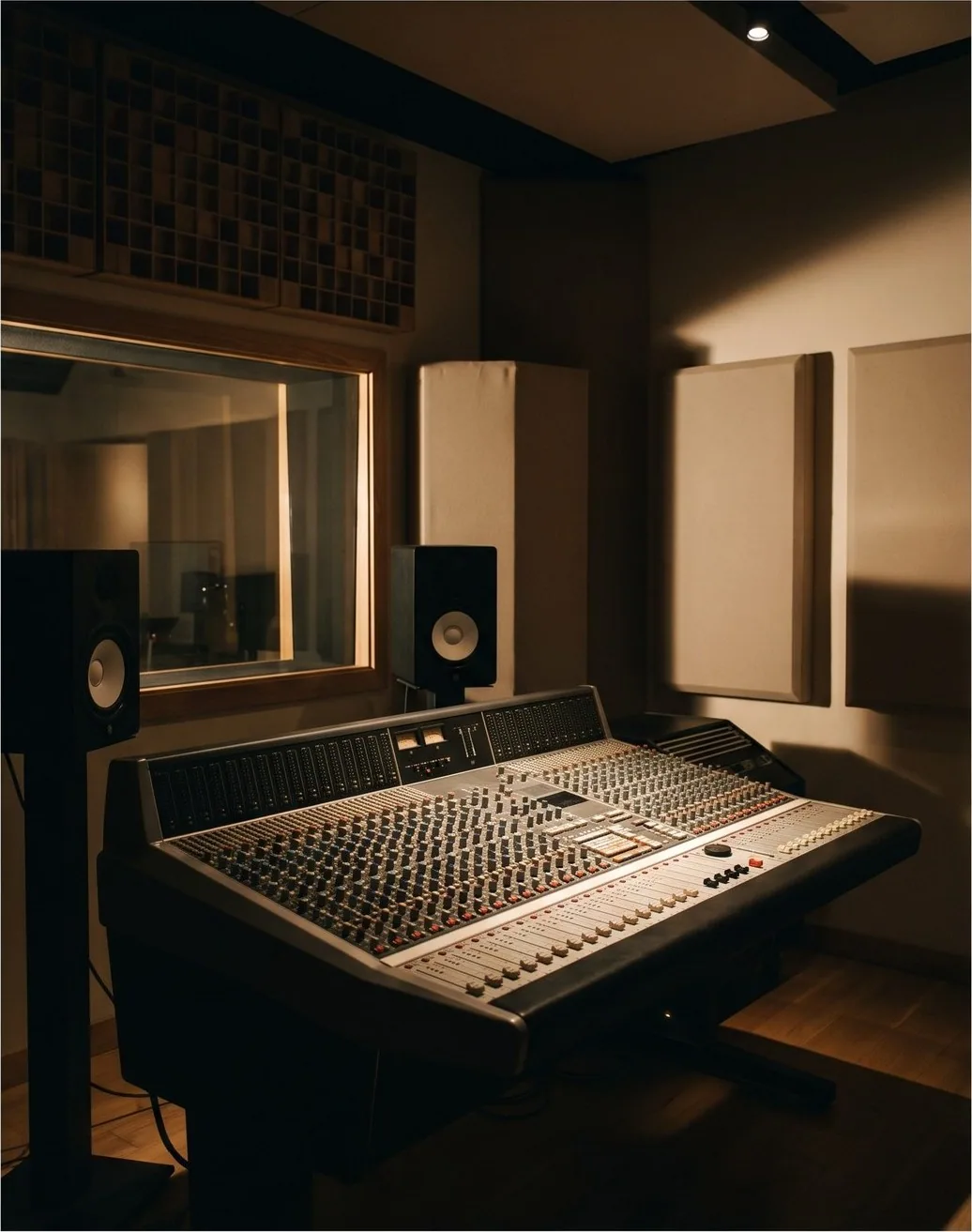
| Layer | Treated-room approach | Engineered approach |
|---|---|---|
| Acoustics | Foam added after the fact | Acoustic isolation and treatment engineered into the envelope |
| Monitoring | Speakers placed by guess | Calibrated monitoring chain |
| Signal path | Cabling improvised | Console, patchbay and DAW integrated as a working layout |
Educational comparison of build approaches — not a statement about any specific installer.
/ The discipline, in detail
How we approach recording studios & nightlife.
A studio is the union of the acoustic envelope, the monitoring chain and the signal path. We engineer all three. Live rooms isolated to NIC ≥ 65, control rooms with non-environmental design and tuned LEDE, and a console-and-patchbay layout the engineer can work without looking. For nightlife — clubs, lounges, rooftop bars — we design JBL Professional, K-array and Pioneer DJ infrastructures with structural rigging, power and acoustic coordination.
On record
Every recording studios & nightlife engagement is documented end-to-end — design, programming, commissioning, calibration — and handed over with the files our successors would need if we were never to return.
/ Ray geometry
The room is the instrument
First-reflection control is where studio accuracy begins — the same geometry that decides monitoring truth in every control room.
Diagram · described
Acoustic ray geometry
A top-down view of a generic listening room showing the direct path from source to listener (solid line) and four first reflections off the ceiling, floor and the two side walls (dashed). The diagram is purely indicative — it visualises how first-reflection treatment placement is derived, not a project-specific room.
Diagrammatic view — a system planning illustration for design discussion, not a project drawing or live interface.
/ Where we deploy this
Active across 2 sectors.
Recording Studios & Nightlife is rarely a standalone brief — it sits inside a wider sector practice with its own codes, expectations and operating rhythm.
/ Sister services
The rest of av.
A serious brief usually crosses two or three of these. Read across the discipline — we deliver them as one contract.
- 01
Home Theatre
Reference cinema, in your living room.
Custom-engineered private cinemas — projector, processor, screen, seating and acoustics designed to a single sweet-spot, following THX and Dolby Atmos reference layouts.0 - 02
Multi-Room Audio
One song. Every room. Or six different ones.
Whole-home audio on Yamaha, Sonance and BluOS — invisible in-ceiling speakers, hidden subs, room-corrected and zone-routed.1 - 03
Acoustic Solutions
Rooms that sound the way they look.
Acoustic design and treatment for cinemas, auditoriums, recording studios, places of worship and conference halls — engineered absorbers, diffusers, bass traps and ceiling clouds.2 - 04
Video Walls
Pixels at the scale of architecture.
Direct-view LED, fine-pitch LCD and rear-projection video walls for command centres, lobbies, broadcast studios, control rooms and event venues.3 - 05
Control Rooms & Command Centres
The room is the instrument.
Operator environments for security, utilities, transport and industrial monitoring — where the display wall, the operator position and the infrastructure behind them are engineered as one system that runs continuously.4 - 06
Smart Classrooms
Every student. Every word. Every time.
Interactive flat-panels, lecture-capture, voice-lift and learning-management integrations — engineered to NCERT, NEP-2020 and university lab specifications.5 - 07
LED Panels & Projectors
The right pixels for the room.
Direct-view LED, OLED, microLED and laser projection — selected to the room's lux, throw, sightline and content.6 - 08
Professional Audio & PA Systems
Intelligible, every seat in the house.
Public address, voice-evacuation and concert-grade audio for auditoriums, places of worship, stadia, transit hubs and event venues.7 - 09
Auditoriums & Boardrooms
Rooms that begin on time.
Turnkey auditorium, boardroom, training-room and conference-room AV — display, audio, control, video-conferencing and lighting integrated to a single touch.8 - 10
Digital Conferencing & Voting Systems
Sittings, voting, interpretation — one system, every seat.
Parliamentary-grade digital conferencing for legislative chambers, council halls and corporate boardrooms — mic management, electronic voting, 8-channel interpretation, camera control and chamber recording, integrated through Bosch DCN, Dicentis and Integrus.9 - 12
Stage Lighting
Light that performs.
Theatre, concert, event, nightclub and place-of-worship stage lighting — moving heads, washes, profiles, pixel-mapped LED, effect lighting and MADRIX or ProtoPixel show control on DMX / Art-Net / sACN.10 - 13
Conference Room AV
Single-touch join. Every meeting.
Microsoft Teams Rooms, Zoom Rooms and Cisco Webex meeting rooms on platform-certified hardware, with auto-tracking cameras, ceiling-array microphones and one-touch room controllers.11 - 14
Hospitality Venue AV
From the banquet stage to the last bar stool.
Hospitality venue AV — banquet hall, ballroom and conference AV, restaurant and bar zone audio, and club-grade nightlife systems with JBL Professional, K-array and Kgear, engineered for hotels, resorts and standalone venues.12 - 15
Digital Signage & Wayfinding
The right message, in the right place, on schedule.
Commercial indoor and outdoor display panels, signage video walls, menu boards, wayfinding and queue or information screens — driven by content-management software with scheduling and remote management for retail, hospitality, corporate, transport and institutional spaces.13 - 16
IPTV & Hospitality TV
Live channels, your channel, on every screen in the building.
Head-end reception and IP distribution of live television, in-house channels and content to commercial-grade and hotel TVs — with interactive welcome screens, an electronic programme guide, casting and integration into the property's network and guest-room systems.14 - 17
Queue Management System
Take a token, watch the counter, walk up.
Token and queue management — ticket dispensers, counter and main calling displays, audio call-forward, multi-counter routing and wait-time analytics — for healthcare, banks, government and retail counters.15 - 18
IP Paging & Announcement
Page the right zone, over the network.
IP network paging and announcement — zoned paging over the data network, SIP/telephone and desktop paging, scheduled bells and announcements — integrated with the PA and telephony systems for offices, campuses, industrial and transit sites.16
/ Where this system has been deployed
Recording Studios & Nightlife on the ground.
The reference projects below carry a recording studios & nightlife layer engineered as part of an integrated stack. Each case study walks through the engineering challenges that were solved, the standards the work was held to, and the operational outcome on the day-two team.
Public project summaries describe systems and outcomes only — BOQ values, quantities, device counts and security layouts are kept off public surfaces.
Request a feasibility review/ Integration with
How recording studios & nightlife talks to the rest.
A serious deployment of this system rarely operates in isolation. The disciplines below most commonly share its cabling pathways, its controller logic, and its cause-and-effect matrix.
Acoustic Solutions
Rooms that sound the way they look.
Acoustic design and treatment for cinemas, auditoriums, recording studios, places of worship and conference halls — engineered absorbers, diffusers, bass traps and ceiling clouds.Professional Audio & PA Systems
Intelligible, every seat in the house.
Public address, voice-evacuation and concert-grade audio for auditoriums, places of worship, stadia, transit hubs and event venues.
/ Read deeper
The engineering, in long form.
Each article below goes deeper than this service page can — a full walk-through of the engineering decisions, written by the team that delivers this work.
Engineering toolkit
Tools to scope this work
Calculators and reference checkers we use ourselves to sense-check the engineering before any drawings change hands.
- AV · Acoustics
RT60 Acoustic Calculator
Room dimensions and finish materials in, indicative reverberation time and recommended absorber area out. Sabine equation; defensible for early-stage acoustic planning.
Sabine · seconds · m²Open - ELV · Surveillance
CCTV Coverage Calculator
Building dimensions and risk profile in, recommended camera count, retention storage and bandwidth out. Densities are planning conventions, not a code rule.
Cameras · TB · MbpsOpen - Life-safety
NBC Compliance Checker
Building height, type and occupancy in — the life-safety and ELV systems NBC 2016 indicates for that building, citing NBC 2016 and the relevant IS codes.
NBC 2016 · IS codesOpen
/ Engineering concepts
Related engineering concepts
Concept
Harman Pro Ecosystem (JBL · Crown · BSS · Soundcraft · AKG)
Harman Professional brand family used across our cinema, auditorium and PA deployments — JBL loudspeakers, Crown amplification, BSS DSP, Soundcraft consoles, AKG microphones.
Concept
EN 54-16 — Voice Alarm Equipment
European standard for voice-alarm control and indicating equipment (VACIE) — the equipment benchmark cited on PA voice-evacuation specifications executed under NBC 2016 Part 4's voice-evacuation provisions.
Concept
K-array & KGEAR — Premium Italian Architectural Audio
Premium Italian architectural-audio ecosystem — K-array's slim, discreet loudspeakers and the KGEAR everyday professional line — specified for design-led residences, hospitality and premium interiors across North-East India.
/ Used alongside
Commonly deployed alongside
Project
Recording Studio, Naharlagun
A turnkey recording studio delivered in Naharlagun — a live tracking room and a control room engineered together as one acoustic and monitoring environment. The build pairs purpose-designed room acoustics (broadband wall and ceiling treatment, a timber-slat live wall, wooden flooring over acoustic underlay, and modular diffusion) with a calibrated near-field monitoring chain, multi-touch DAW control and a multi-output cue-monitoring system so several performers can track together. Microphone, multicore and speaker cabling was dressed into conduit as fixed studio infrastructure rather than loose leads.
Sector
Restaurants, Bars & Clubs
The room. The night. The sound.
Service
Acoustic Solutions
Rooms that sound the way they look.
Service
Home Theatre
Reference cinema, in your living room.
Service
Fire Alarm System
Detection that pinpoints. Response that is coordinated.
Service
Auditoriums & Boardrooms
Rooms that begin on time.
/ Plan it right
Recording Studios & Nightlife — getting the brief right.
Common mistakes to avoid
- Spending on equipment before isolation — a great microphone in a leaky room records the traffic outside.
- Building the control room without geometry and monitoring design, so mixes made there never translate anywhere else.
- Under-sizing HVAC silencing — a studio that is quiet only with the air-conditioning off is unusable for half the year in this climate.
- For venue work, designing SPL and rigging without the structure and the neighbouring occupancies — the complaints arrive before the opening month is out.
- No signal-flow documentation or patchbay plan, so every session starts with troubleshooting.
What to share before a quotation
- The rooms in scope and what they must record — voice, band, post-production, broadcast.
- The building context — what surrounds the studio and the isolation it forces.
- The monitoring intent and any equipment being carried over.
- The HVAC arrangement and the noise floor the room must reach with it running.
- For venues — capacity, the programme (DJ, live acts) and operating hours.
/ Frequently asked
Recording Studios & Nightlife — what buyers ask first.
Can a project studio sound like a commercial studio?
Yes, to a remarkable degree — a project studio with the right acoustic envelope and monitoring chain can sound like a commercial studio; we have built 250 sq ft rooms that out-mix half-treated 1,500 sq ft commercial rooms. The acoustic envelope gets you most of the way; the rest is monitoring and engineering.
What's a non-environment (LEDE) control room?
Live-End-Dead-End — a room treatment where the rear (live end) is reflective and diffusive while the front (dead end) is absorptive, creating a sound field where the speakers' direct radiation reaches the engineer cleanly. It is the reference standard for music and broadcast control rooms; we design to it where the brief allows.
How is a studio isolated from the building outside?
Through decoupled wall and ceiling construction — independent inner and outer leaves with no rigid contact, dense fill in the cavity, suspended floating floor. The civil work for true isolation is significant; we engineer it in coordination with the architect at the design stage.
Genelec, Neumann, Adam — which monitors are right?
Genelec is the broad-spectrum standard and our default for most rooms. Neumann KH-series brings a slightly different translation reference that some engineers prefer. Adam Audio S-series is excellent for mastering. We supply and calibrate all three; the choice is artistic and we let the engineer drive it.
Do recording studios need backup power?
Yes — losing power mid-take is unacceptable for any session work. We specify online UPS for the entire control room load (computer, monitors, console) plus the live room's microphone preamps. A 2–4 kVA UPS covers most home studios; commercial studios get larger units sized to the actual load study.
How do you handle the studio-to-live-room audio link?
Through Dante or analogue snake depending on budget — Dante is now the default for new builds (24+ channels over a single Cat6 cable). Dante allows monitor-mix routing, talkback, and remote mic-preamp control without dragging cable. The price-point on Dante interfaces has crossed below analogue parity for any studio above 16 channels.
· Begin
Begin a
recording studios & nightlife
brief.
Tell us about the building, the timeline, and what success looks like a year after handover. We will reply within two working days with a written response, not a sales pitch.