
02 / 18
Case file
Whole-home audio on Yamaha, Sonance and BluOS — invisible in-ceiling speakers, hidden subs, room-corrected and zone-routed.
| Aspect | Yamaha MusicCast | BluOS (NAD, Bluesound) |
|---|---|---|
| Suited to | Multi-zone retrofit homes on Apple Music, Spotify, Tidal | Audiophile playback — Roon-ready, MQA, hi-res lossless |
| Scaling | Simple, reliable streaming | Open control surface scaling cleanly to many zones |
| Speaker layer | Shared — Sonance, KEF, Waterfall, Polk | Shared — same in-ceiling speakers; only the backbone differs |
Educational comparison — both bridge into Rako or KNX scenes as a separate layer where audio and lighting must fire together.
— Multi-Room Audio · Zone 02
Four rooms, four speakers, one decision.
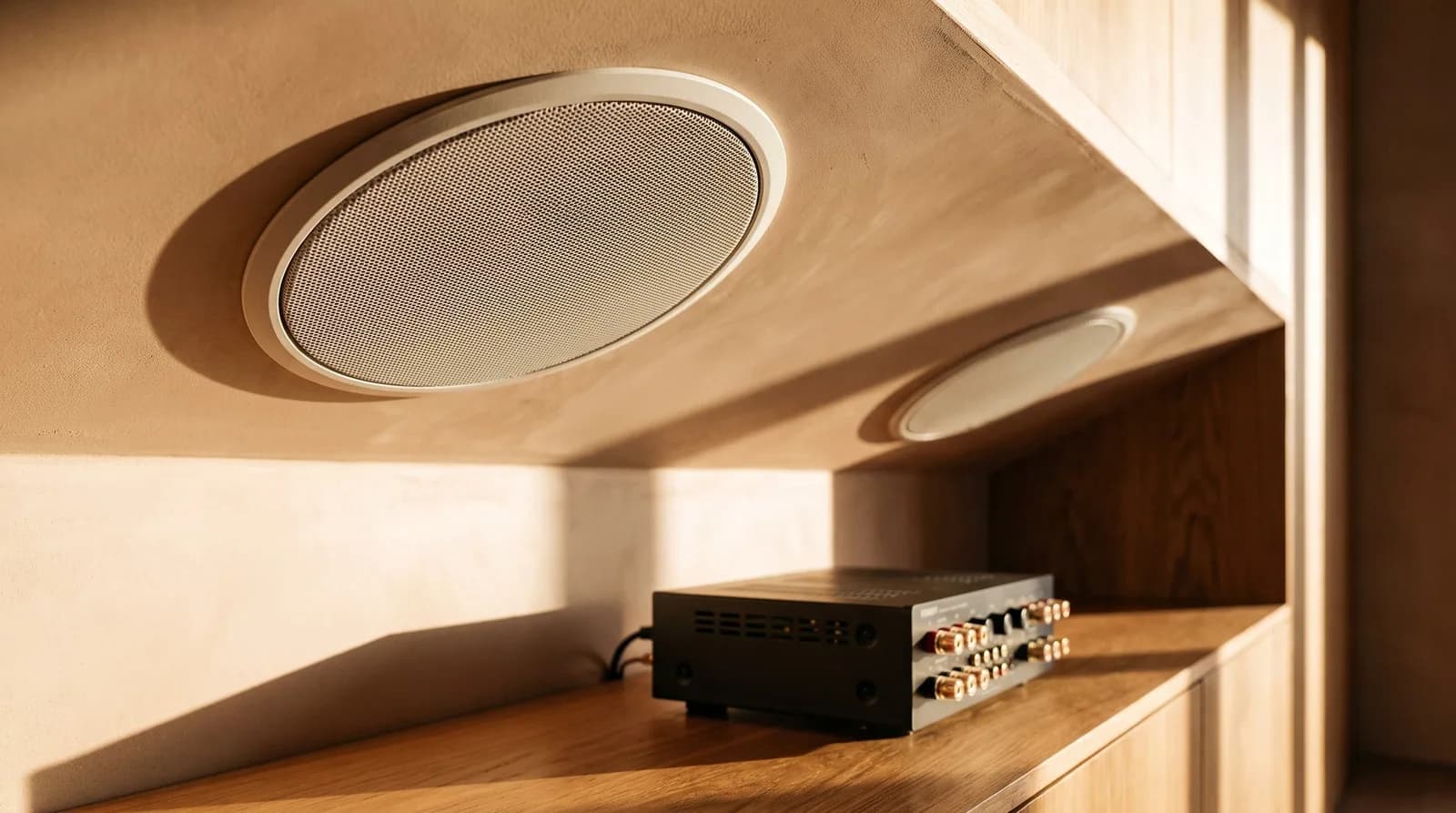
A flush ceiling grille disappears behind plaster in the kitchen. A coaxial in-ceiling pair works the lounge. Glass cabinets stay visible in the theatre. A bookshelf pair handles the study.
Pick a room. Tap the speaker to hear the room.
Four-zone reference home · synthesised demo audio
Specify the rooms before you specify the speakers.
Sonance, KEF, Waterfall Audio, Polk and Yamaha specified per room — not as a catalogue stack.
SONANCE · KEF · WATERFALL · POLK · YAMAHA
/ Zone Selector
/ Spec
Coaxial in-ceiling pair
Tweeter on the woofer axis, so the image holds off-centre across an open plan
Product class, not a model. The model is chosen after the room survey, from records the catalogue can cite.
Zone 02 · 32 m² · ceiling-flush
Multi-Room Audio — zone graph
- Lounge: Coaxial in-ceiling pair (KEF). Stereo + spoken word. Tweeter on the woofer axis, so the image holds off-centre across an open plan. Product class only — no model is named for this zone.
- Home Theatre: Glass-cabinet floorstanders + in-ceiling height layer (Waterfall Audio). 7.1.4 Atmos cinema. A cabinet meant to be seen, with the height channels hidden in the slab. Product class only — no model is named for this zone.
- Kitchen + Dining: Sonance Visual Performance VP66R (Sonance). BGM during prep + service. Flush low-bezel ceiling grille that stays even off-axis at low volume. Model source — Sonance VP66R — manufacturer product page, specification table (Legacy Products; page names replacement model 96014), retrieved 2026-09-19 (https://sonance.com/products/93014).
- Study: Compact bookshelf pair on a streaming pre-amplifier (Polk Audio). Calls + focused listening. Near-field listening at low volume, with the source on the network rather than the desk. Product class only — no model is named for this zone.
/ The discipline, in detail
How we approach multi-room audio.
Multi-room audio should follow the family, not the other way around. We engineer in-ceiling and in-wall speakers that disappear into the cornice, with magnetic grilles, paint-matched bezels, and a sub channel running under the floor where the bass needs to be.
Room correction (Dirac, ARC) is run per zone. Bossa nova in the dining hall, news radio in the kitchen, the kid's playlist in their bedroom, all from one source rack — that's the design intent. Streaming sources are unified through Roon, BluOS or Rako.
Outdoor zones — pool, lawn, terrace — get IP-rated speakers tuned for distance dispersion. The whole layer is documented, addressable, and serviceable without lifting plaster.
On record
Every multi-room audio engagement is documented end-to-end — design, programming, commissioning, calibration — and handed over with the files our successors would need if we were never to return.
/ Signal flow
Sources to zones
How shared sources reach independent listening zones — matrix routing, per-zone level discipline and commissioning verification.
Diagram · described
Signal flow — BGM · 70 V matrix zones
A generic, non-confidential representation of an AV signal flow with five stages: source (media, microphone or stream), processing (DSP and matrix), amplification (power and limiter), distribution (zone routing) and reproduction (loudspeaker or screen). Indicative pattern only — actual project topologies vary with brand stack and brief.
Diagrammatic view — a system planning illustration for design discussion, not a project drawing or live interface.
/ Where we deploy this
Active across 4 sectors.
Multi-Room Audio is rarely a standalone brief — it sits inside a wider sector practice with its own codes, expectations and operating rhythm.
/ Sister services
The rest of av.
A serious brief usually crosses two or three of these. Read across the discipline — we deliver them as one contract.
- 01
Home Theatre
Reference cinema, in your living room.
Custom-engineered private cinemas — projector, processor, screen, seating and acoustics designed to a single sweet-spot, following THX and Dolby Atmos reference layouts.0 - 03
Acoustic Solutions
Rooms that sound the way they look.
Acoustic design and treatment for cinemas, auditoriums, recording studios, places of worship and conference halls — engineered absorbers, diffusers, bass traps and ceiling clouds.1 - 04
Video Walls
Pixels at the scale of architecture.
Direct-view LED, fine-pitch LCD and rear-projection video walls for command centres, lobbies, broadcast studios, control rooms and event venues.2 - 05
Control Rooms & Command Centres
The room is the instrument.
Operator environments for security, utilities, transport and industrial monitoring — where the display wall, the operator position and the infrastructure behind them are engineered as one system that runs continuously.3 - 06
Smart Classrooms
Every student. Every word. Every time.
Interactive flat-panels, lecture-capture, voice-lift and learning-management integrations — engineered to NCERT, NEP-2020 and university lab specifications.4 - 07
LED Panels & Projectors
The right pixels for the room.
Direct-view LED, OLED, microLED and laser projection — selected to the room's lux, throw, sightline and content.5 - 08
Professional Audio & PA Systems
Intelligible, every seat in the house.
Public address, voice-evacuation and concert-grade audio for auditoriums, places of worship, stadia, transit hubs and event venues.6 - 09
Auditoriums & Boardrooms
Rooms that begin on time.
Turnkey auditorium, boardroom, training-room and conference-room AV — display, audio, control, video-conferencing and lighting integrated to a single touch.7 - 10
Digital Conferencing & Voting Systems
Sittings, voting, interpretation — one system, every seat.
Parliamentary-grade digital conferencing for legislative chambers, council halls and corporate boardrooms — mic management, electronic voting, 8-channel interpretation, camera control and chamber recording, integrated through Bosch DCN, Dicentis and Integrus.8 - 11
Recording Studios & Nightlife
Rooms tuned to the recording.
Recording studio design, post-production suites, broadcast booths and nightlife audio — acoustic isolation, monitoring, console integration and DJ infrastructure.9 - 12
Stage Lighting
Light that performs.
Theatre, concert, event, nightclub and place-of-worship stage lighting — moving heads, washes, profiles, pixel-mapped LED, effect lighting and MADRIX or ProtoPixel show control on DMX / Art-Net / sACN.10 - 13
Conference Room AV
Single-touch join. Every meeting.
Microsoft Teams Rooms, Zoom Rooms and Cisco Webex meeting rooms on platform-certified hardware, with auto-tracking cameras, ceiling-array microphones and one-touch room controllers.11 - 14
Hospitality Venue AV
From the banquet stage to the last bar stool.
Hospitality venue AV — banquet hall, ballroom and conference AV, restaurant and bar zone audio, and club-grade nightlife systems with JBL Professional, K-array and Kgear, engineered for hotels, resorts and standalone venues.12 - 15
Digital Signage & Wayfinding
The right message, in the right place, on schedule.
Commercial indoor and outdoor display panels, signage video walls, menu boards, wayfinding and queue or information screens — driven by content-management software with scheduling and remote management for retail, hospitality, corporate, transport and institutional spaces.13 - 16
IPTV & Hospitality TV
Live channels, your channel, on every screen in the building.
Head-end reception and IP distribution of live television, in-house channels and content to commercial-grade and hotel TVs — with interactive welcome screens, an electronic programme guide, casting and integration into the property's network and guest-room systems.14 - 17
Queue Management System
Take a token, watch the counter, walk up.
Token and queue management — ticket dispensers, counter and main calling displays, audio call-forward, multi-counter routing and wait-time analytics — for healthcare, banks, government and retail counters.15 - 18
IP Paging & Announcement
Page the right zone, over the network.
IP network paging and announcement — zoned paging over the data network, SIP/telephone and desktop paging, scheduled bells and announcements — integrated with the PA and telephony systems for offices, campuses, industrial and transit sites.16
/ Integration with
How multi-room audio talks to the rest.
A serious deployment of this system rarely operates in isolation. The disciplines below most commonly share its cabling pathways, its controller logic, and its cause-and-effect matrix.
Home Theatre
Reference cinema, in your living room.
Custom-engineered private cinemas — projector, processor, screen, seating and acoustics designed to a single sweet-spot, following THX and Dolby Atmos reference layouts.Home & Office Automation
One press. The whole space responds.
Lights, climate, blinds, audio, cinema and security — orchestrated by a single Rako, Fibaro or KNX backbone and controlled from a touch panel, voice or a discreet keypad on the wall.Acoustic Solutions
Rooms that sound the way they look.
Acoustic design and treatment for cinemas, auditoriums, recording studios, places of worship and conference halls — engineered absorbers, diffusers, bass traps and ceiling clouds.
/ Read deeper
The engineering, in long form.
Each article below goes deeper than this service page can — a full walk-through of the engineering decisions, written by the team that delivers this work.
Product intelligence
What we specify for this system, and what we hold published figures for
Distributed audio is usually a constant-voltage design, where tap setting and impedance mode matter more than raw output.
Audio — loudspeakers
2543 products · 58 brands · 2278 manufacturer-verified
Including 1 SOUND C4, AUDAC ALTI4, Adamson VGd, Alcons Audio CCS6, AtlasIED FAP33T-W and Biamp Community R.5-94Z.
- Speaker Coverage Planner — the horizontal coverage width this loudspeaker's published dispersion gives at a listening distance.
Audio — amplification
16 products · 2 brands · 16 manufacturer-verified
Including K-array KA104, KGEAR GA46, K-array KA208, KGEAR GA43, K-array KA34 and KGEAR GA201.
No TechnoGuru calculator consumes this category yet. The published figures are held and used in design; they are not yet behind a self-serve tool.
Figures come from manufacturer documents, each recorded with its source and the date it was read. Holding published data for a product means we specify and integrate it. It does not make TechnoGuru that manufacturer’s dealer, distributor, reseller or appointed representative, and no such relationship should be inferred from a product appearing here.
Engineering decisions
Compare the options
Decision · AV & Audio
Architectural audio vs conventional loudspeakers — the design approach
You are choosing a loudspeaker approach for a design-sensitive space and weighing concealment and even coverage against conventional flexibility and cost.
Decision · AV & Audio
Home theatre AVR vs separates — processing and amplification
You are specifying the processing and amplification for a home cinema and weighing a single receiver against separates.
Decision · AV & Audio
70V/100V distributed audio vs low-impedance audio
You are deciding how loudspeakers will be distributed across a building or venue and need to know which architecture each area should use.
Engineering toolkit
Tools to scope this work
Calculators and reference checkers we use ourselves to sense-check the engineering before any drawings change hands.
- AV · Audio · Coverage
Speaker Coverage Planner
Engineering-grade speaker coverage and SPL planner across a source-cited public model catalogue spanning pro touring, commercial audio and architectural speakers. Predicts SPL at listener distance, the horizontal coverage width at that distance on the -6 dB dispersion axis, and the quantity needed for the room.
45 brands · SPL predictionOpen - AV · Cinema
Cinema Sizer
Room dimensions in, recommended screen size, seat layout, Atmos format and projector throw out. Reference / Premium / Media-room tiers.
Screen · seats · AtmosOpen - Smart Home
Smart Home Discovery Wizard
For villa and apartment owners — pick your home, the zones that matter and the experiences you want, and map a coordination scope and room checklist. Not a final design, device count or security layout.
Advisory · discoveryOpen
/ Engineering concepts
Related engineering concepts
Concept
JBL Synthesis Cinema
JBL's reference home-cinema speaker and amplification line. Custom-installed Atmos arrays with Crown amplification — the loudspeaker layer behind the Trinnov + JBL Synthesis reference cinema specification.
Concept
Trinnov Altitude Processor
French immersive cinema processor. Reference 3D-audio processing with Optimizer room correction. The default specification for reference-grade 9.1.6 and 11.4.6 Dolby Atmos rooms.
Concept
Harman Pro Ecosystem (JBL · Crown · BSS · Soundcraft · AKG)
Harman Professional brand family used across our cinema, auditorium and PA deployments — JBL loudspeakers, Crown amplification, BSS DSP, Soundcraft consoles, AKG microphones.
Concept
K-array & KGEAR — Premium Italian Architectural Audio
Premium Italian architectural-audio ecosystem — K-array's slim, discreet loudspeakers and the KGEAR everyday professional line — specified for design-led residences, hospitality and premium interiors across North-East India.
/ Used alongside
Commonly deployed alongside
Sector
Hospitality
Guest experience, engineered.
Sector
Residential
The premium home, made quiet.
Service
Home Theatre
Reference cinema, in your living room.
Service
Acoustic Solutions
Rooms that sound the way they look.
Sector
Restaurants, Bars & Clubs
The room. The night. The sound.
Service
Home & Office Automation
One press. The whole space responds.
/ Plan it right
Multi-Room Audio — getting the brief right.
Common mistakes to avoid
- Cabling speaker positions after the false ceiling closes, so every zone becomes a compromise between where sound should be and where cable can reach.
- Zoning by room count instead of by how the family moves through the house — open-plan areas need coordinated coverage, not one loud speaker.
- Choosing the streaming platform last, after speakers and amplifiers, when it should drive the architecture.
- Putting indoor ceiling speakers on a verandah — outdoor zones need IP-rated hardware and different dispersion, or they last one monsoon.
- No documentation of zones, amplifier channels and speaker runs, so future service means opening ceilings.
What to share before a quotation
- Floor plans with the rooms and outdoor areas in scope.
- How each zone is used — background listening, primary listening, or TV-audio reinforcement.
- The streaming services the household actually uses.
- New-build or retrofit — whether ceilings and walls are still open.
- Whether the audio joins the lighting and automation scenes or stands alone.
/ Frequently asked
Multi-Room Audio — what buyers ask first.
Yamaha MusicCast or BluOS — which whole-home streaming layer?
Choose Yamaha MusicCast for 4–8 zone retrofit homes where the family lives in Apple Music, Spotify and Tidal and wants simple, reliable streaming. Choose BluOS (NAD, Bluesound) when audiophile playback matters — Roon-ready, MQA, hi-res lossless, and a more open multi-room control surface that scales cleanly to 12+ zones. Both ride the same in-ceiling speaker layer (Sonance, KEF, Waterfall, Polk) — the choice is the streaming backbone, not the speakers. Where lighting and audio scenes need to fire together — dim the cove, fade the music to 30%, page through every zone — we bridge MusicCast or BluOS into the Rako or KNX scene graph as a separate layer.
Can speakers really be invisible?
Yes — Stealth Acoustics and Sonance Invisible Series speakers mount behind plaster and disappear entirely. Sound quality is excellent for background and voice; for critical-listening rooms we still recommend visible reference speakers.
Yamaha vs architectural speakers — which is right for the home?
Choose Yamaha or visible speakers in kitchens, bedrooms and outdoor decks; choose architectural in-ceiling and in-wall (Sonance, Cornered, Waterfall) where the design wants the sound to disappear. We mix both freely. Yamaha is excellent where the speaker can be visible and the source is streamed — kitchens, bedrooms, outdoor decks. Architectural in-ceiling and in-wall speakers (Sonance, Cornered, Waterfall) are the right answer where the design wants the sound to disappear into the architecture. We mix both in the same home freely.
How many audio zones does a typical villa need?
A 5,000-sqft villa typically needs 8–12 named audio zones, each with independent source, volume and EQ through a BSS Soundweb, Symetrix or Yamaha MTX audio matrix. Eight to twelve named zones is typical: living, dining, kitchen, master bedroom, master bath, two guest rooms, study, deck or pool, gym, cinema. Each zone gets independent source selection, volume and parametric EQ through a dedicated audio DSP — BSS Soundweb London, Symetrix Radius or Yamaha MTX5-D. The Rako or KNX lighting bus rides alongside as a separate scene layer, so 'Dinner' fades the music and dims the cove together.
Will multi-room audio work with my existing AV receiver?
Sometimes — modern Denon and Marantz receivers support HEOS multi-room natively, and Yamaha integrates via Connect:Amp; we audit the existing receiver before quoting. Modern Denon and Marantz receivers support HEOS multi-room natively, and Yamaha integrates with most receivers via their Connect:Amp. We audit the existing equipment before quoting; if the receiver is the bottleneck we will say so rather than work around it.
What's the difference between distributed audio and zone audio?
Distributed audio sends one source to many zones with the same content; zone audio gives each zone independent source selection — we design for zone audio in any home above 3 zones. Sends one source to many zones with the same content (a single playlist heard everywhere); zone audio gives each zone independent source selection. We design for zone audio in any home above 3 zones — it costs 30% more in equipment but is dramatically more usable.
Which multi-room audio brands does TechnoGuru work with?
We work with Sonance, Russound, VSSL, Denon and Xantech, and, where the design calls for compact architectural output, K-array and KGEAR. Streaming platforms, in-ceiling architectural speakers and outdoor models are mixed in the same home where it suits the brief. Final make and model are selected after the drawings and site conditions are reviewed, subject to availability.
How is each zone controlled — app, keypad or both?
Most homes use a combination: a phone app for full source and volume control, wall keypads at natural points for quick access, and voice where the household already uses it. The amplification and matrix are sized to the zone count and the sources, and platforms such as those on Russound and VSSL keep control consistent across zones. The control layout is agreed against the room plan and the way the household actually lives.
Can multi-room audio extend to the deck, pool or garden?
Yes — outdoor zones use weatherised speakers, including landscape and rock-form models, on their own amplified and equalised zone so the outdoor level and tone stay independent of the interior. The layout depends on the coverage area, the mounting positions and the network reach, and it is designed against the site rather than a fixed kit. Final selection stays subject to the drawings, site conditions and availability.
· Begin
Begin a
multi-room audio
brief.
Tell us about the building, the timeline, and what success looks like a year after handover. We will reply within two working days with a written response, not a sales pitch.