
/ AV
Spec'ing a residential 9.1.6 cinema in 2026 — the order of operations
Quick answer
A reference 9.1.6 Atmos cinema is built in seven decisions, in order: (1) the acoustic envelope (NIC ≥ 65, NC ≤ 25), (2) the listening sweet-spot at 38–42% of room length, (3) the acoustic treatment to RT60 0.30–0.40 s, (4) the speaker layout calibrated within ±2 dB at the sweet-spot, (5) the screen sized to 30–40° subtended angle, (6) the processor (Trinnov Altitude 32 or Storm Audio ISP MK3) behind a Yamaha DSP and 16-channel Crown amplification, and (7) calibration to a written test plan. Skip the order and the most expensive amplifier chain in the world cannot recover the result.
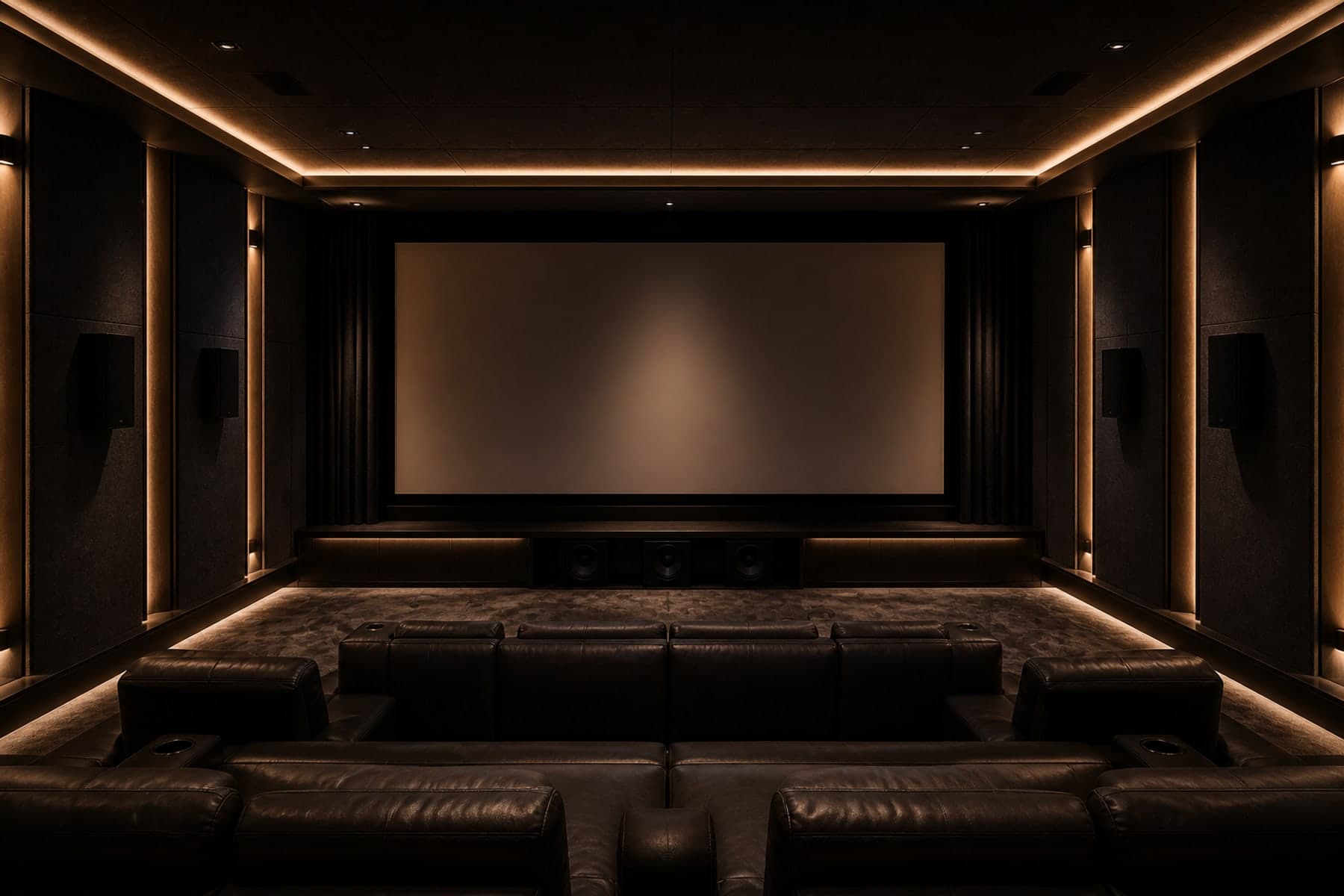
Most residential cinemas we are asked to take over from another integrator have a similar story behind them. The hardware is reference-grade — Yamaha DSP, BenQ projection, Crown amplification, JBL Professional speakers — and the room reads as careful interior design. But the listening experience falls short of what the components should deliver, and the homeowner cannot articulate why. The reason is almost always that the decisions were taken in the wrong order. The room was decided after the hardware; the seats were placed against the architecture rather than the listening geometry; the acoustic envelope was treated as a finishing exercise rather than the foundation.
A reference 9.1.6 Atmos cinema in 2026 is not a procurement exercise. It is a sequence of decisions, in a strict order, where every later decision is constrained by every earlier one. Get the sequence right and the room performs to its hardware spec. Get it wrong and the most expensive amplifier chain in the world cannot recover the result. Below is the order of operations we follow on every reference cinema we hand over.
Cinema chain
The home cinema signal chain
In a private cinema the room is part of the chain. Treatment and geometry are specified alongside the electronics, not after them.
01
Sources
The programme material the room is built to reproduce.
- Disc and streaming sources
- Media server
02
Processor
Decodes immersive formats, applies room correction and manages bass.
- Immersive audio processor
- Room correction and bass management
03
Amplification
Drives every channel to reference level without running out of headroom.
- Multi-channel amplification
- Dedicated subwoofer amplification
04
Loudspeakers
Placed to the layout the format requires, then calibrated to the seats.
- Screen-channel loudspeakers
- Surround and overhead channels
- Subwoofers
05
Display
Sized and positioned from the seating geometry, not from the wall.
- Projector and screen, or direct-view display
- Masking and seating geometry
Illustrative chain. Channel layout, treatment and calibration targets are set per room against the published cinema design guidance.
1. The acoustic envelope, before everything else
The first decision is structural. Wall mass, decoupling, HVAC silencer paths, door seals, ceiling isolation. None of this is glamorous and none of it can be retrofit gracefully once the room is built. We engineer the envelope to a target — typically NIC ≥ 65 between the cinema and the adjacent rooms, NC ≤ 25 with HVAC running, and a clean low-frequency cut-off below 30 Hz from external transmission. The envelope decisions are made before the room dimensions are finalised, because the envelope changes the room dimensions.
The double-stud wall with resilient channels and 100 mm rock wool, the floating floor on neoprene isolators, the ceiling on independent joists with continuous mass — these are not optional finishing details. They are the load-bearing structure of the listening experience. We have walked away from cinema briefs where the homeowner refused to engineer the envelope; the alternative is delivering a room that we cannot put our name on.
2. The listening position, before the room dimensions
Once the envelope is settled, the next decision is the sweet-spot — the precise location of the primary listener's head. This decision shapes everything that follows: the room dimensions, the seating layout, the speaker positions, the screen size, the acoustic treatment. Most residential cinemas mistake the sweet-spot for the centre of the seating — it is not. The sweet-spot is the geometric centre of the immersive sound field, and the seating is arranged around it.
For a 9.1.6 layout, the sweet-spot sits at roughly 38–42% of the room length from the screen wall, with a height of 1.05–1.15 m above the finished floor for a seated listener. Off-axis seating positions are tolerated but never pretended to be sweet-spots; we model the listening experience at every seat in CAD before the room is built and we publish the model to the homeowner before specifying. If the sweet-spot is fudged toward 'a more sensible seating layout', the cinema delivers domestic-grade results no matter what hardware is bolted to the walls.
3. The acoustic treatment, before the speakers
With envelope and sweet-spot settled, the third decision is treatment. We design to a target RT60 of 0.30–0.40 seconds across 125 Hz–4 kHz, with a slight rising curve at low frequencies for warmth and a slight falling curve at high frequencies for clarity. This target dictates the absorption coverage, the diffusion strategy and the bass-trap volume. We typically allocate 35–45% of the room's interior surface to engineered absorption, with bass-trapping in every volume corner and behind the screen wall.
The treatment decisions are made before the speaker positions because the treatment changes where the speakers can usefully sit. A speaker placed where the room's modal pattern peaks at the sweet-spot will deliver muddy bass no matter how good the speaker is. We model the modal pattern in EASE or REW, place the speakers to avoid the worst modes, and treat the residual modes with calibrated bass-traps. This is the part most reference cinemas under-deliver on.
4. The speaker layout, before the screen
The fourth decision is the 9.1.6 speaker layout. Three front speakers (LCR) at ear height behind the acoustically transparent screen; six surround speakers (4 surround, 2 surround-back) at 90° and 135° from the listener; six height speakers (front, mid, rear) at calculated elevation; one or more subwoofers placed for modal smoothing rather than visual symmetry. The Atmos object renderer requires every speaker to be within ±2 dB of the others at the sweet-spot — we measure this on every commissioning and tune until the criterion is met.
The single most-neglected detail at this stage is the screen-speaker distance. An acoustically transparent screen passes audio with a ~1.5 dB high-frequency loss; we EQ for this. A non-transparent screen blocks the LCR speakers entirely and forces them above or below the screen, which destroys the dialog imaging. We do not deliver a 9.1.6 cinema without an acoustically transparent screen — the alternative is a 7.1.6 with a phantom centre, which is not what the homeowner thought they were buying.
5. The screen and projection, after the speakers
Only at this point does the screen specification get finalised. Screen size is dimensioned around the sweet-spot — a screen height that subtends 30–40° of the listener's vertical field of view at the sweet-spot is the cinema reference. Most homeowners want a larger screen than this; we model the result and explain that screens beyond about 45° subtended angle force the listener to scan rather than experience the image. Where the homeowner insists on the larger screen, we deliver it and we document the trade-off.
Projection in 2026 means a 4K laser projector with HDR and full Rec.2020 gamut for the dedicated cinema. Sony GTZ-380, Barco Bragi or JVC RS4100 are the brands we specify per the room's actual brightness and contrast budget. Lamp luminance is calculated against the screen's gain and the room's ambient-light envelope; we publish the calculation in every commissioning report. ALPD or three-laser RGB are the right answer for any reference cinema today; lamp-based projection is reserved for budget rooms where the homeowner is making an informed choice.
Callout — what buyers most miss
The order of operations matters more than the brand selection. A homeowner choosing between Sony and Barco projection is asking the wrong question if the room envelope has not been engineered. The brand decision is the easiest part of a reference cinema; the engineering decisions taken in sequence are the hard part, and they are what separate a genuine reference room from an expensive disappointment.
6. The processing, after the room is treated
With envelope, sweet-spot, treatment, speakers and screen settled, the processor is selected. In 2026 the choice is between Trinnov Altitude 32 (the reference processor for serious cinemas) and Storm Audio ISP MK3 — both Atmos-capable to 9.1.6 with full immersive object rendering and per-speaker calibration. We almost always specify Trinnov for a reference 9.1.6 room because of its calibration ceiling and its ongoing firmware support; Storm is the alternative where the budget envelope drives the decision.
The processor sits behind a Yamaha DSP for room-EQ and dynamic-range management, with 16-channel Crown power amplification driving the speaker complement. The signal chain is engineered for ≥ 110 dB peak SPL at the sweet-spot with no clipping, which is the cinema reference. The homeowner does not care about peak SPL specifications; we engineer to it because the moment a kick drum or an explosion pushes any element of the chain into clipping, the immersive illusion breaks. We measure clipping margin on commissioning and document it.
7. Calibration and commissioning, against a written test
The final decision in the sequence is calibration. We commission against a written test plan: per-seat SPL measurement across 1/3-octave bands, per-speaker time-alignment to ±0.1 ms, per-channel level matching to ±0.5 dB, modal smoothing at the sweet-spot to ±3 dB across 30–200 Hz, and full Atmos object-rendering validation against test material. The calibration scope and programme are agreed for the actual room, with a written acceptance report for owner review.
Most reference cinemas we audit have never been calibrated against a written test; the original integrator commissioned by ear and moved on. The result is a room that sounds 'fine' to its owner because they have nothing to compare against, and a room that fails any objective measurement an outside reviewer applies. We do not hand over a cinema without the calibration report; the report is the proof that the room performs to its hardware spec.
When to break the order
The order of operations is the discipline. There are situations where the sequence has to bend: a heritage residence where the envelope cannot be re-engineered, a retrofit where the room dimensions are fixed, a homeowner who has already procured speakers before engaging us. In each case we open with a written audit of what the constraints will cost, document the trade-offs, and proceed only if the homeowner accepts the result. We do not deliver a reference cinema and pretend the constraints did not exist; that path leads to the rooms we are asked to take over from another integrator.
References
1. Toole, F. E. (2017). Sound Reproduction: The Acoustics and Psychoacoustics of Loudspeakers and Rooms, 3rd ed. Routledge.
2. Dolby Atmos Home Theater Installation Guidelines, Version 7 (2024). Dolby Laboratories.
3. THX Reference Cinema Specifications, 2024 update. THX Ltd.
4. EBU Tech 3276, Listening conditions for the assessment of sound programme material (2020 revision).
5. CEDIA/CTA-RP22 — Immersive Audio Design Recommended Practice, September 2023. https://www.cta.tech/standards/cediacta-rp22/
/ Frequently asked
Quick answers from the practice.
- Why is the acoustic envelope the first decision?
- Because every subsequent decision (speaker count, calibration target, processor headroom, screen size) depends on the room's noise floor and isolation. A reference 9.1.6 in a room with NC 35 and NIC 50 cannot deliver reference SPL without the neighbours hearing it. The envelope is decided at construction; nothing later in the sequence can recover it.
- Trinnov Altitude 32 or Storm Audio ISP MK3?
- Both are reference-grade. Trinnov Altitude 32 wins on room-correction (Optimizer) and on industry-standard calibration workflow; Storm Audio wins on broader codec support (Auro-3D, IMAX Enhanced) and on chassis modularity. For a 9.1.6 build today the Trinnov is the safer default; for a 13.4.6+ build the Storm earns its premium.
- Why 30–40° subtended angle for the screen?
- It's the SMPTE / THX-recommended angle for cinematic immersion at the reference seat. Below 30° the screen reads as a TV; above 40° eye-tracking fatigue surfaces on long-form content. The angle defines the screen size for a given seat-to-screen distance, not the other way around.
- How long does the seven-step sequence take?
- The programme depends on the room scope, equipment procurement, approvals, site readiness and coordination. Agree the acoustic envelope and system design before construction decisions become difficult to change, then schedule installation, commissioning and calibration against those dependencies.
- How are cinema design and commissioning documented?
- We agree the design scope, commissioning checks and handover records for the project. CEDIA/CTA-RP22 informs immersive audio design; audio calibration measurements and video-performance checks are documented under their respective agreed scopes.
/ What to do next
Three next steps for a residential cinema
- Try the Cinema Sizer tool →Room dimensions in, recommended screen size, seat layout and Atmos format out.
- Read the CEDIA/CTA-RP22 audio design insight →How to structure the immersive audio design brief.
- Read the home-theatre service page →Engineering scope, brand bands, AMC structure.
Engineering toolkit
Tools that go with this read
If this article gave you a question worth pricing, these calculators give a defensible first number.
- AV · Cinema
Cinema Sizer
Room dimensions in, recommended screen size, seat layout, Atmos format and projector throw out. Reference / Premium / Media-room tiers.
Screen · seats · AtmosOpen - AV · Audio · Coverage
Speaker Coverage Planner
Engineering-grade speaker coverage and SPL planner across a source-cited public model catalogue spanning pro touring, commercial audio and architectural speakers. Predicts SPL at listener distance, the horizontal coverage width at that distance on the -6 dB dispersion axis, and the quantity needed for the room.
45 brands · SPL predictionOpen - AV · Acoustics
RT60 Acoustic Calculator
Room dimensions and finish materials in, indicative reverberation time and recommended absorber area out. Sabine equation; defensible for early-stage acoustic planning.
Sabine · seconds · m²Open
Related engineering decision
The comparison behind this question.
/ Services this article informs
Read the discipline pages.
/ Reference work
Projects where this engineering shows up.
Arunachal Pradesh Legislative Assembly
Government · Legislative Chamber
Itanagar, Arunachal Pradesh · Handover 2017Multi-Purpose Hall, Arunachal Pradesh Assembly Complex
Government · Multi-Purpose Auditorium
Itanagar, Arunachal Pradesh · Handover 2018Cabinet Conference Room, Arunachal Pradesh Secretariat
Government · Cabinet Conferencing
Itanagar, Arunachal Pradesh · Handover 2018Conference Room, Chief Minister's Residential Complex, Kohima
Government · Executive Conference Room
Kohima, Nagaland · Handover 2022Capital Cultural Hall, Kohima
Government · Cultural Auditorium
Kohima, Nagaland · Handover 2022Town Hall Auditorium, Dimapur
Government · Civic Auditorium
Dimapur, Nagaland · Handover 2024Multipurpose Cultural Hall, Namsai
Government · Cultural Auditorium
Namsai, Arunachal Pradesh · Handover 2018Taraghar — State Guest House
Government · State Guest House
Shillong, Meghalaya · Handover 2025BJP Head Office, Guwahati — Conference Room AV
Government · Conference Room AV
Guwahati, Assam · Completed projectAssam State Guest House, Koinadhara
Government · Protocol Residence
Guwahati, Assam · Handover 2021Recording Studio, Naharlagun
Media Production · Recording Studio
Naharlagun, Arunachal Pradesh · Handover 2016
Editorial — about this surface
TechnoGuru AV Systems Practice
The AV systems practice engineers residential reference cinema and commercial audio-visual systems against the AVIXA CTS, CEDIA, HAA Level 1 and K-Array Certified Designer reference frames. Every installation pairs measurable acoustic and visual targets with the field calibration that proves the room actually meets them.
Reviewed against calibrated measurement realities — room performance is verified against reference targets before sign-off.
Last reviewed
4 May 2026
Engineering domains
Residential cinema and reference audio · Commercial audio-visual systems · Acoustic engineering and room treatment · Loudspeaker and line-array design
Operating environments
Residential reference cinema · Hospitality lounges and venues · Corporate AV and boardrooms · Auditoria and assembly halls
/ Discuss your project
If this article matches a brief you are working on, the next step is a short brief — a project lead replies to it directly.
We do not run sales pipelines. The first reply comes from a project lead, within two working days, and it goes straight to the engineering question rather than a brochure.