
/ BMS
Lithium-ion BESS vs VRLA: the eight-year economics for mission-critical UPS
Quick answer
Lithium-ion BESS now beats VRLA on eight-year total cost above 20 kVA: 3–4× cycle life, half the floor space, a fraction of the maintenance, and roughly 30–45% lower lifetime cost despite a 1.8× initial premium. We specify it on almost every new mission-critical install; below 20 kVA the calculation is closer, and a hybrid migration is usually right for hospitals where downtime is unacceptable.
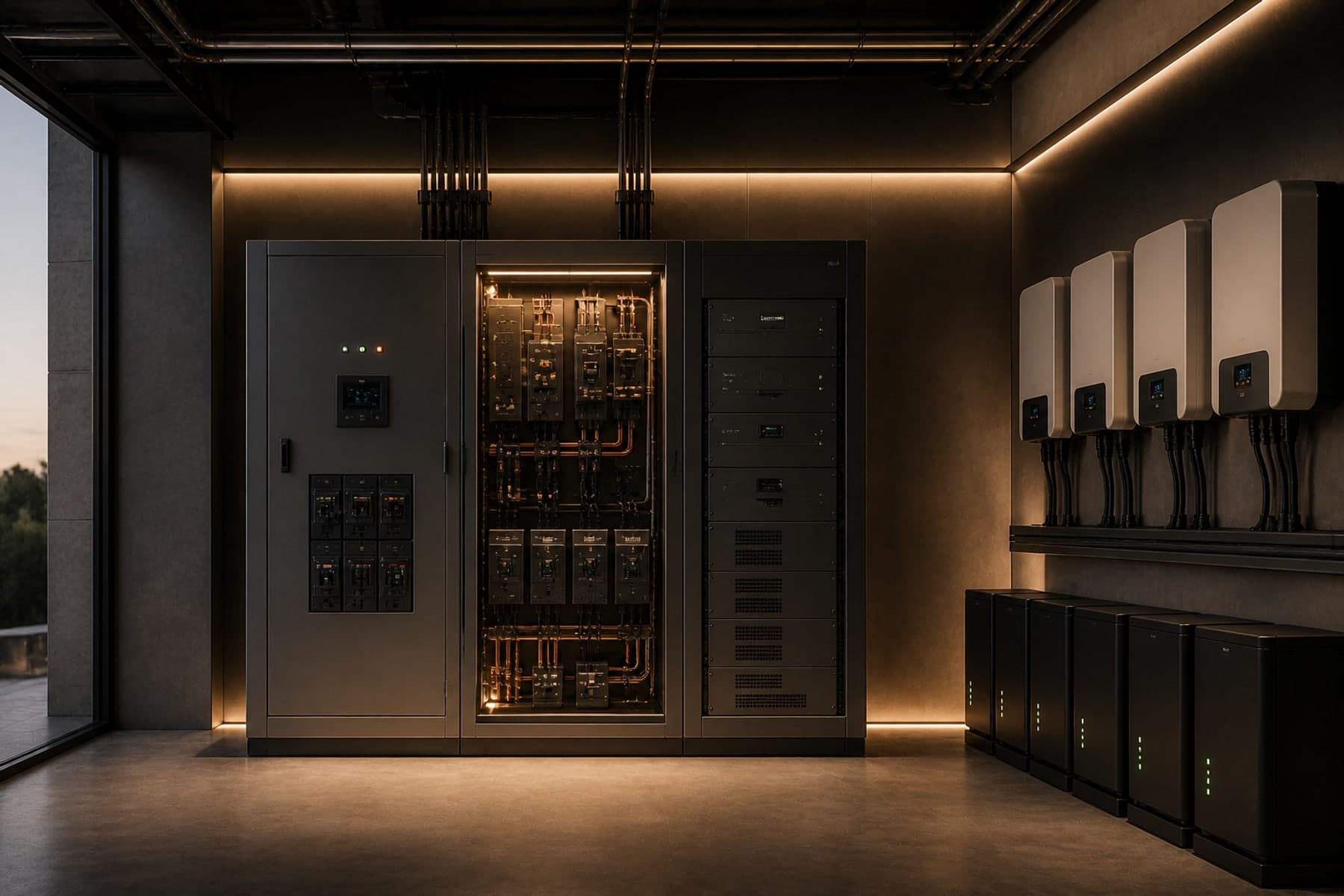
Valve-regulated lead-acid (VRLA) banks have done the work of mission-critical battery storage for three decades, but the lithium-ion economics have shifted decisively in favour of the new chemistry over the past five years. The headline difference is simple: lithium-ion delivers three to four times the cycle life, occupies roughly half the floor space, and requires a fraction of the maintenance — all for an initial cost premium that has now compressed to roughly 1.8× of an equivalent VRLA bank.
The eight-year total-cost-of-ownership comparison flips clearly to lithium for any new install above 20 kVA. Across that horizon, the lithium bank typically delivers a 30–45% reduction in total cost when battery replacements, floor-space cost, and maintenance hours are properly accounted for. Below 20 kVA the calculation gets closer; above 50 kVA lithium is a clear winner without nuance.
Migration of an existing VRLA bank is its own engineering exercise. We open with an audit: cell-voltage profile, internal resistance, depth-of-discharge history, and the actual ride-through requirement of the load. Migration paths range from full like-for-like swap (highest capex, lowest disruption) to staged hybrid (a smaller lithium bank installed in parallel with the existing VRLA to absorb peak ride-through events while the VRLA bank is wound down at end-of-life). The hybrid path is often the right answer for hospitals and broadcast-grade facilities where downtime is unacceptable.
Per-load UPS vs shared-bus topology
ups-ats-redundancyDiagram · described
Per-load UPS vs shared-bus UPS topology
Per-load UPS architecture (left): each critical support load sits on its own dedicated online double-conversion UPS so a fault on one load cannot cascade across the stack. Shared-bus architecture (right): one mainline UPS feeds every load, so a fault or maintenance event takes the entire stack offline. The per-load architecture costs more capex but enforces fault containment at the power layer rather than the application layer.
/ Frequently asked
Quick answers from the practice.
- Below what kVA does VRLA still make sense?
- Below ~20 kVA the economics are close; lithium's eight-year TCO advantage compresses to under 15%, and the floor-space and weight benefits matter less. For single-server-room IT loads below 10 kVA, VRLA remains a defensible specification with a 5-year refresh budget assumed.
- Is thermal-runaway risk a real concern for indoor LFP installs?
- LFP chemistry (lithium iron phosphate) is decisively safer than NMC — thermal runaway is effectively eliminated at the cell level, the cells do not vent flammable electrolyte under abuse, and indoor installations are NFPA 855-compliant without bespoke fire suppression. NMC chemistry, by contrast, requires dedicated fire suppression for indoor banks.
- How is the BESS sized against the existing UPS load?
- We size for the worst-case ride-through requirement (e.g. 30 min at full load for medical / data-centre, 15 min for commercial) plus a 20% safety margin against degradation over the cycle. The Battery Sizing tool at /tools/bess-sizer runs the same calculation conservatively.
- What manufacturers do you specify?
- Vertiv, Delta and Fuji on the inverter / UPS layer paired with LFP cabinet manufacturers including Vertiv's own EnergyCore, Delta's Modulon DPH-S, and BYD Battery-Box premium for residential-class deployments. Cell-level sourcing is via approved Tier-1 suppliers only — Tier-2 cells fail the 6,000-cycle longevity assumption.
- Will TechnoGuru deliver the VRLA-to-lithium migration end-to-end?
- Yes. We audit the existing VRLA bank, propose a migration path (swap or hybrid), engineer the BESS sizing, supply and install the new lithium cabinets, commission the inverter integration with the existing UPS, and AMC the lifecycle. End-to-end accountability on a single contract.
/ What to do next
Three next steps for BESS scope
- Size a BESS for your load →Peak demand and solar in, battery + inverter sizing out.
- Try the DG → Solar+BESS crossover calculator →Especially relevant for diesel-heavy industrial sites.
- Send the existing UPS specifications →We return a migration plan with capex, payback and downtime impact within two working days.
Engineering toolkit
Tools that go with this read
If this article gave you a question worth pricing, these calculators give a defensible first number.
- BMS · BESS
BESS Sizer
Peak demand + solar + storage strategy in, indicative LFP battery size, inverter rating, daily throughput and cell life out. Vertiv, Delta and Fuji-class deployments.
LFP · kWh · cell lifeOpen - Power · BESS · Solar
DG → Solar+BESS Crossover
DG capacity and monthly run-hours in — the kWp solar + kWh LFP BESS that displaces the genset's run-hours out, plus annual diesel litres displaced and CO₂ avoided.
kWp · kWh · yearsOpen - BMS · Readiness
BMS Readiness Checker
A readiness self-check before a BMS conversation — which plant systems to supervise, how BMS-ready the existing controls are, and whether the network, operations team and documentation are in place. Statuses only; no points counts, plant capacities or network detail.
Advisory · readinessOpen
Related engineering decision
The comparison behind this question.
/ Services this article informs
Read the discipline pages.
/ Reference work
Projects where this engineering shows up.
Editorial — about this surface
TechnoGuru Operational Continuity Practice
The operational continuity practice engineers for environments where the system simply cannot drop. UPS sizing, battery and BESS engineering, redundancy architecture, fail-over discipline and the operational drills that make sure continuity holds when the grid does not.
Reviewed against operational-continuity field realities — every recommendation is held to what survives a drilled fail-over.
Last reviewed
12 May 2026
Engineering domains
UPS and BESS sizing · Power-redundancy architecture · Fail-over and load-shedding design · Mission-critical observability
Operating environments
Healthcare and clinical environments · Datacenter-adjacent facilities · Broadcast and live-event venues · Mission-critical institutional sites
/ Discuss your project
If this article matches a brief you are working on, the next step is a short brief — a project lead replies to it directly.
We do not run sales pipelines. The first reply comes from a project lead, within two working days, and it goes straight to the engineering question rather than a brochure.