
02 / 03
Case file
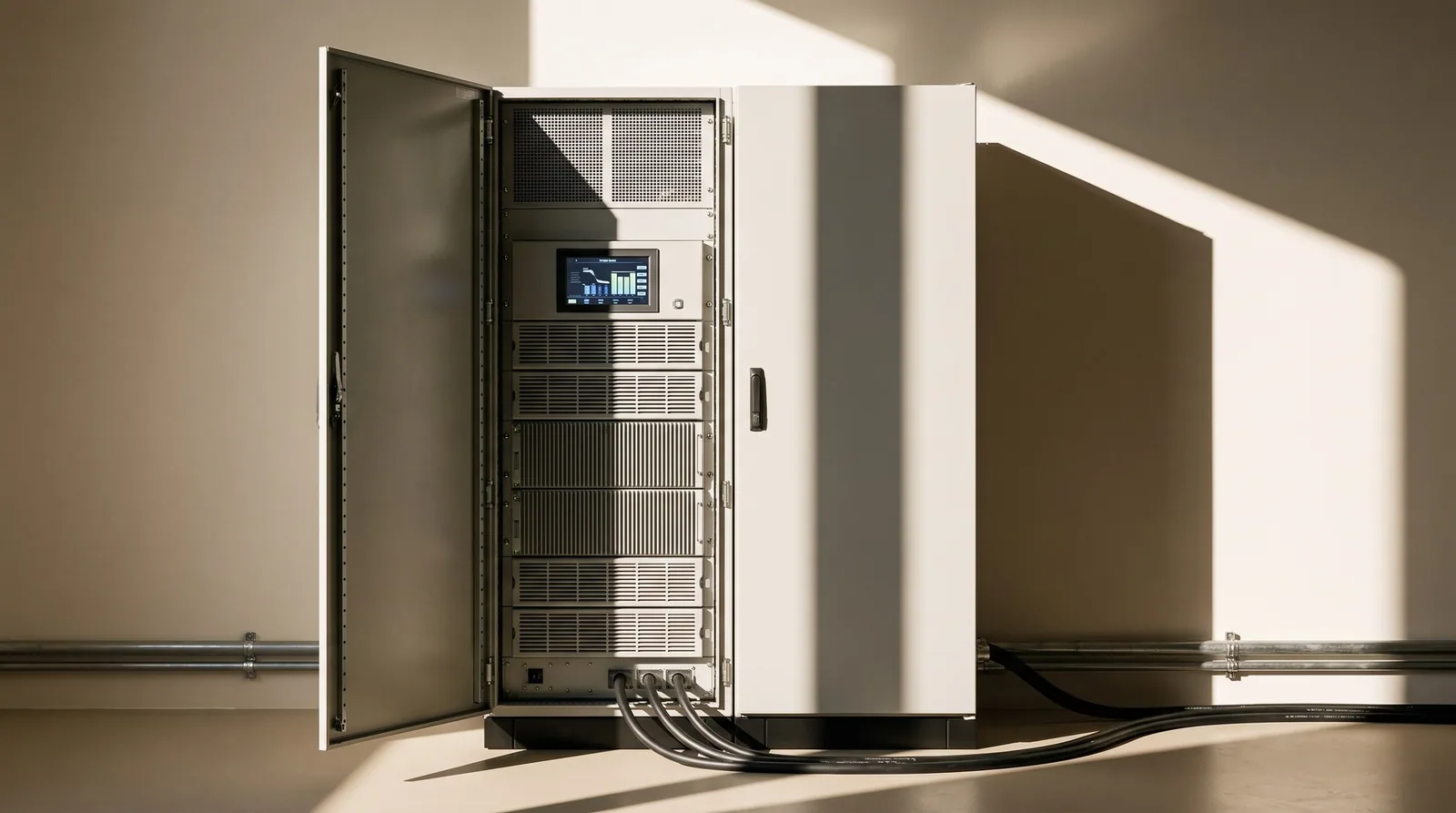
Double-conversion online UPS — continuous AC-to-DC-to-AC rectification that delivers regulated sine to your load with zero transfer time and complete isolation from grid sag, surge, harmonics and frequency drift.
| Aspect | Line-interactive UPS | Double-conversion online UPS |
|---|---|---|
| Transfer on grid drop | A brief switching gap | No transfer event — no switching path |
| Typical fit | Office loads that tolerate the gap | Medical, broadcast, mission-critical loads |
| Power conditioning | Partial | Full isolation and regulated sine |
Educational comparison — not about any specific installer.
How we approach it
Clean, continuous power — sized and supported
Backup power is only as good as its weakest cell and its last service. We plan UPS provision to the actual load and then keep it dependable through its service life.
- Sized to the real load
- Capacity is matched to the connected load and the runtime the site genuinely needs, with BOQ / scope alignment kept clear — not a number picked in the abstract.
- Designed to be serviced
- We plan for access and orderly battery replacement so maintenance is routine rather than disruptive.
- Battery health over time
- Batteries age whether or not they are used; an AMC scope can fold in periodic UPS and battery health checks so backup is there when the mains is not. Response targets are documented in the AMC scope.
/ The discipline, in detail
How we approach online ups.
Power architecture is where the cost of getting it wrong shows up months later — in compressor failures, drive trips, telco modem reboots, and the slow attrition of equipment that nobody links back to dirty mains. Double-conversion online UPS isolates the load from grid reality completely: the rectifier converts utility AC to clean DC, the inverter rebuilds it as a regulated sine wave, and the battery acts as the kinetic-energy reservoir between the two. There is no transfer event when the grid drops because there was never a switching path; the load has been on the inverter the whole time.
We size the topology to the actual load profile and the actual recovery time the building's diesel set can guarantee, then we right-size the battery accordingly. For data centres and clinical environments we engineer N+1 or 2N redundancy with synchronised parallel modules; for smaller deployments a single right-sized unit is the more honest answer than over-engineered architecture for its own sake.
VRLA versus lithium-ion is the second decision after topology. We almost always recommend lithium for any new deployment above 20 kVA — see our separate BESS service for the energy-asset case lithium unlocks. For sub-20 kVA loads where battery autonomy is short, VRLA remains a reasonable choice and we will say so in writing.
On record
Every online ups engagement is documented end-to-end — design, programming, commissioning, calibration — and handed over with the files our successors would need if we were never to return.
/ Power hierarchy
Continuity, by architecture
Utility, DG, ATS and double-conversion UPS as one power hierarchy — which loads ride through, which transfer, and how runtime is engineered.
Diagram · described
Per-load UPS vs shared-bus UPS topology
Per-load UPS architecture (left): each critical support load sits on its own dedicated online double-conversion UPS so a fault on one load cannot cascade across the stack. Shared-bus architecture (right): one mainline UPS feeds every load, so a fault or maintenance event takes the entire stack offline. The per-load architecture costs more capex but enforces fault containment at the power layer rather than the application layer.
Diagrammatic view — a system planning illustration for design discussion, not a project drawing or live interface.
/ Where we deploy this
Active across 6 sectors.
Online UPS is rarely a standalone brief — it sits inside a wider sector practice with its own codes, expectations and operating rhythm.
Residential
The premium home, made quiet.
Commercial & Corporate
Workplaces that begin meetings on time.
Healthcare
Hospitals where systems serve the patient.
Government & Public Safety
Mission-grade integration.
Restaurants, Bars & Clubs
The room. The night. The sound.
Industrial & Warehousing
Operations that don't take a day off.
/ Sister services
The rest of bms.
A serious brief usually crosses two or three of these. Read across the discipline — we deliver them as one contract.
- 01
Building Management System (BMS)
The building, on a single dashboard.
Open-protocol BMS frameworks — HVAC, lighting, fire and access integrated to a single graphical front-end with operator analytics and alarm escalation.0 - 03
Battery Energy Storage (BESS)
Power as an asset, not a cost.
Lithium-ion Battery Energy Storage Systems — installed alongside online UPS, paired with rooftop solar, or stand-alone — for peak-shave, demand-response, off-peak tariff arbitrage and ride-through.1
/ Integration with
How online ups talks to the rest.
A serious deployment of this system rarely operates in isolation. The disciplines below most commonly share its cabling pathways, its controller logic, and its cause-and-effect matrix.
/ Read deeper
The engineering, in long form.
Each article below goes deeper than this service page can — a full walk-through of the engineering decisions, written by the team that delivers this work.
Engineering decisions
Compare the options
Decision · Power & UPS
Online UPS vs BESS-backed backup — the right ride-through
You are deciding how to protect a critical load and are weighing instantaneous ride-through against longer-duration backup or an energy strategy.
Decision · Power & UPS
Online UPS vs line-interactive UPS — the topology decision
You are choosing UPS topology for a specific load group and need to know whether a transfer event is acceptable to the equipment behind it.
Engineering toolkit
Tools to scope this work
Calculators and reference checkers we use ourselves to sense-check the engineering before any drawings change hands.
- BMS · BESS
BESS Sizer
Peak demand + solar + storage strategy in, indicative LFP battery size, inverter rating, daily throughput and cell life out. Vertiv, Delta and Fuji-class deployments.
LFP · kWh · cell lifeOpen - Power · BESS · Solar
DG → Solar+BESS Crossover
DG capacity and monthly run-hours in — the kWp solar + kWh LFP BESS that displaces the genset's run-hours out, plus annual diesel litres displaced and CO₂ avoided.
kWp · kWh · yearsOpen - Handover
System Handover Readiness Checker
Score a project's handover readiness across as-builts, test records, O&M manuals, warranties, spares, training, credential transfer and the AMC decision — and get the chase list to close the gaps. Statuses only; no credential capture.
Advisory · readinessOpen
/ Engineering concepts
Related engineering concepts
Concept
Online (Double-Conversion) UPS
Double-conversion uninterruptible power supply. Rectifies AC to DC and inverts back to clean AC, isolating the load from grid disturbances. Default for mission-critical IT and life-safety equipment.
Concept
Vertiv EnergyCore BESS
Vertiv's LFP battery-energy-storage cabinet line. Drop-in lithium replacement for VRLA banks on mission-critical UPS, with eight-year TCO advantages above 20 kVA.
Concept
LFP (Lithium Iron Phosphate) Chemistry
The lithium-ion chemistry of choice for stationary BESS — thermally stable, safe for indoor install, 6,000+ cycle life, with eight-year TCO advantages over VRLA above 20 kVA loads.
Concept
Command-and-Control Facility Archetype
Three-envelope facility: perimeter screening, surveillance + communication, command + briefing. Per-envelope power and earthing strategy; hand-off boundaries between envelopes; operator console correlates events across all three.
/ Used alongside
Commonly deployed alongside
Sector
Healthcare
Hospitals where systems serve the patient.
Service
Fire Alarm System
Detection that pinpoints. Response that is coordinated.
Sector
Industrial & Warehousing
Operations that don't take a day off.
Sector
Commercial & Corporate
Workplaces that begin meetings on time.
Service
Building Management System (BMS)
The building, on a single dashboard.
Service
CCTV & Surveillance
Coverage. Storage. Evidence.
/ Plan it right
Online UPS — getting the brief right.
Common mistakes to avoid
- Sizing the UPS to the nameplate sum of every connected device instead of the measured demand and its inrush — the unit ends up either oversized and inefficient or tripping on startup surges.
- Choosing battery autonomy as a round number instead of deriving it from the generator's real start-and-stabilise time — the battery exists to bridge exactly that window.
- Ignoring the battery room — ventilation, ambient temperature and dust decide battery life as much as the chemistry does, and heat is the quiet killer of VRLA banks.
- Buying the UPS, diesel set and ATS as three separate contracts, so the changeover sequence is never engineered or tested as one chain.
- Skipping the maintenance-bypass provision, so the first service visit requires a full load shutdown.
What to share before a quotation
- The load list — what must ride through an outage, its measured or estimated demand, and any motor or compressor inrush on the circuit.
- Whether a diesel generator exists, and how long it really takes to start and stabilise.
- The autonomy expectation — minutes to reach generator power, or a longer window for clean shutdown.
- Room conditions where the UPS and batteries will live — space, ventilation, ambient temperature.
- Any existing UPS or battery bank being replaced or migrated, with its age and service history.
Equipment categories
See the equipment behind the solution.
Explore equipment we supply and the services around it. The final specification follows your space, operating needs and agreed scope.
/ Frequently asked
Online UPS — what buyers ask first.
Why double-conversion online and not line-interactive UPS?
Choose double-conversion online UPS for medical, broadcast and mission-critical loads. Line-interactive UPS uses a transfer switch that introduces a 4–10 ms gap when the grid drops. For most office equipment that gap is invisible; for medical devices, broadcast servers, fire-alarm panels, switching-mode power supplies running tight tolerances and any equipment with sensitive transformers, that gap registers and over time accumulates as failures. Double-conversion online removes the question: there is no transfer event because there was never a switching path. We use line-interactive only where the load can genuinely tolerate it.
How long should the battery autonomy be?
UPS battery autonomy is typically 10–15 minutes for buildings with diesel backup, 30–60 minutes for IT loads without generators, and longer with redundancy for critical-care clinical loads. We size it to the longer of two windows: the time your generator takes to start and stabilise, plus a 50% safety margin; or the time the load needs to shut down cleanly.
Lithium-ion or VRLA batteries?
Choose lithium-ion for new UPS deployments above 20 kVA — 3–4× cycle life, half the floor space and 30–45% lower 8-year lifetime cost than VRLA. 3–4× cycle life, half the floor space and a fraction of the maintenance versus VRLA. Initial cost is ~2× but lifetime cost is typically 30–45% lower over 8 years. For new installations above 20 kVA we almost always recommend lithium. For sub-20 kVA loads with short autonomy requirements, VRLA remains acceptable.
What's the AMC scope for an online UPS?
Online UPS AMC scope includes quarterly preventive checks — capacitor inspection, fan-bearing health, internal-temperature trend, log review and a battery-bank impedance test (or BMS report for lithium) — plus an annual full discharge test, firmware patching on schedule and a spare-board pool for the modules in your rack. Response targets are documented in writing for the Guwahati metropolitan area and structured around scheduled rotations elsewhere.
Do you handle the diesel set and ATS coordination?
Yes — we coordinate the UPS with the building's diesel generator and automatic transfer switch as one engagement: runtime calculations, ATS logic, harmonic-load coordination and the documented start-up sequence. The whole power chain is treated as one system rather than three contracts.
Can you migrate an existing VRLA bank to lithium without replacing the UPS?
Yes in most cases — a careful audit of UPS firmware, charging-curve compatibility, communications interface and physical mounting tells us whether the existing UPS supports lithium without replacement. Many recent generations of Vertiv, Delta and Fuji modules do. We provide the audit report before quoting; if the UPS itself needs replacement we will say so.
Does an online UPS protect equipment against lightning?
It is one layer, not the whole answer. Double-conversion isolates the load from sag, surge, harmonics and frequency drift on the mains, but a direct or nearby lightning strike calls for a coordinated protection design — surge protection at the distribution boards and a sound earthing system — engineered alongside the UPS. In a high-lightning region like the Northeast we treat the two as one conversation.
Why do UPS batteries fail so much earlier than the datasheet says?
Almost always heat. VRLA battery life is rated at a controlled ambient temperature, and a widely used engineering rule of thumb is that service life roughly halves for every ten degrees above it — so a battery bank in a hot, unventilated room quietly loses years. Ventilation, charging settings and periodic impedance testing are what close the gap between datasheet life and real life.
Should the UPS back up the whole building or only the critical loads?
Usually the critical loads. The honest design separates essential circuits at the distribution board — servers, clinical equipment, fire and security panels, the network stack — and sizes the UPS to those, letting the diesel set carry the general building load after its start-up window. Backing everything through the UPS inflates the battery bank for loads that can tolerate a brief gap.
· Begin
Begin a
online ups
brief.
Tell us about the building, the timeline, and what success looks like a year after handover. We will reply within two working days with a written response, not a sales pitch.