
03 / 03
Case file
Lithium-ion Battery Energy Storage Systems — installed alongside online UPS, paired with rooftop solar, or stand-alone — for peak-shave, demand-response, off-peak tariff arbitrage and ride-through. The same battery, working three shifts.
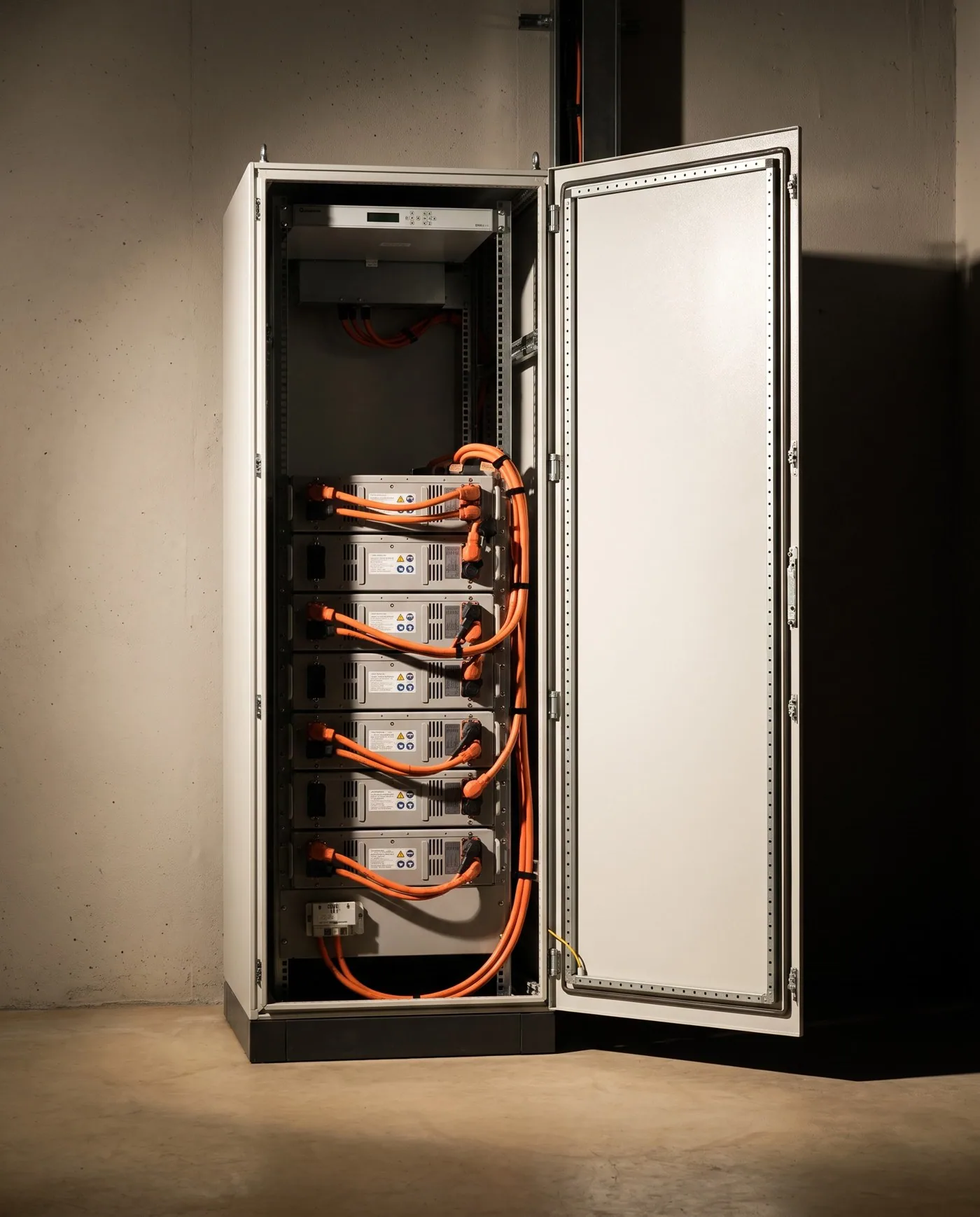
| Aspect | UPS battery | BESS |
|---|---|---|
| Primary job | Bridge to generator startup, then idle | Peak-shave, absorb solar and provide backup |
| Sizing | Short ride-through | Sized larger for daily cycling |
| Control | Discharges only on grid failure | Smart inverter cycles it across the day |
Educational comparison — not about any specific installer.
/ The discipline, in detail
How we approach battery energy storage (bess).
BESS is what changes the economics of premium and mission-critical power. A traditional UPS battery sits idle 99% of the time, waiting for the grid to fail; a BESS-coupled deployment uses that same chemistry as an energy asset — discharging into the building during peak-tariff hours to reduce demand charges, absorbing surplus rooftop solar that would otherwise be exported below cost, and acting as the ride-through buffer when the grid actually does drop.
We design BESS at three scales. Building-level (50–500 kWh) for premium residential, hospitality and corporate installations where peak-tariff arbitrage and solar self-consumption are the primary case. Mission-critical (250 kWh–2 MWh) where the BESS is also the UPS battery, providing both clean-power backup and energy-asset behaviour from the same chemistry. Industrial and microgrid (2 MWh+) where we engineer in coordination with the utility and existing diesel-set infrastructure.
Lithium iron phosphate (LFP) chemistry has become the default for stationary BESS because of its thermal stability, cycle life (typically 6,000+ cycles to 80% capacity at 1C) and tolerance to deep discharge. We specify LFP almost always; NMC chemistries are reserved for specific use-cases where energy density is critical and the operating envelope is controlled. Every system ships with a battery management system that monitors cell-level voltage, temperature and impedance, balanced state-of-charge across the pack, and a full diagnostic dashboard that integrates into the building's BMS.
Payback math works for buildings that have either (a) significant peak-tariff exposure (commercial demand charges, time-of-use industrial tariffs); (b) rooftop solar with a poor export tariff; or (c) mission-critical loads where lithium displaces VRLA on lifetime cost. Which of the three applies changes the answer enough that a published range would mislead, so we model the case against your tariff and load profile and share it in a written estimate before quoting.
On record
Every battery energy storage (bess) engagement is documented end-to-end — design, programming, commissioning, calibration — and handed over with the files our successors would need if we were never to return.
/ Power hierarchy
Storage in the hierarchy
Where battery energy storage sits in the same continuity architecture — between the sources that charge it and the loads it carries.
Diagram · described
Per-load UPS vs shared-bus UPS topology
Per-load UPS architecture (left): each critical support load sits on its own dedicated online double-conversion UPS so a fault on one load cannot cascade across the stack. Shared-bus architecture (right): one mainline UPS feeds every load, so a fault or maintenance event takes the entire stack offline. The per-load architecture costs more capex but enforces fault containment at the power layer rather than the application layer.
Diagrammatic view — a system planning illustration for design discussion, not a project drawing or live interface.
/ Where we deploy this
Active across 5 sectors.
Battery Energy Storage (BESS) is rarely a standalone brief — it sits inside a wider sector practice with its own codes, expectations and operating rhythm.
/ Sister services
The rest of bms.
A serious brief usually crosses two or three of these. Read across the discipline — we deliver them as one contract.
- 01
Building Management System (BMS)
The building, on a single dashboard.
Open-protocol BMS frameworks — HVAC, lighting, fire and access integrated to a single graphical front-end with operator analytics and alarm escalation.0 - 02
Online UPS
Clean power, isolated from grid reality.
Double-conversion online UPS — continuous AC-to-DC-to-AC rectification that delivers regulated sine to your load with zero transfer time and complete isolation from grid sag, surge, harmonics and frequency drift.1
/ Integration with
How battery energy storage (bess) talks to the rest.
A serious deployment of this system rarely operates in isolation. The disciplines below most commonly share its cabling pathways, its controller logic, and its cause-and-effect matrix.
Online UPS
Clean power, isolated from grid reality.
Double-conversion online UPS — continuous AC-to-DC-to-AC rectification that delivers regulated sine to your load with zero transfer time and complete isolation from grid sag, surge, harmonics and frequency drift.Building Management System (BMS)
The building, on a single dashboard.
Open-protocol BMS frameworks — HVAC, lighting, fire and access integrated to a single graphical front-end with operator analytics and alarm escalation.
/ Read deeper
The engineering, in long form.
Each article below goes deeper than this service page can — a full walk-through of the engineering decisions, written by the team that delivers this work.
Engineering decisions
Compare the options
Decision · Power & UPS
Online UPS vs BESS-backed backup — the right ride-through
You are deciding how to protect a critical load and are weighing instantaneous ride-through against longer-duration backup or an energy strategy.
Decision · Power & UPS
Online UPS vs line-interactive UPS — the topology decision
You are choosing UPS topology for a specific load group and need to know whether a transfer event is acceptable to the equipment behind it.
Engineering toolkit
Tools to scope this work
Calculators and reference checkers we use ourselves to sense-check the engineering before any drawings change hands.
- Power · BESS · Solar
DG → Solar+BESS Crossover
DG capacity and monthly run-hours in — the kWp solar + kWh LFP BESS that displaces the genset's run-hours out, plus annual diesel litres displaced and CO₂ avoided.
kWp · kWh · yearsOpen - BMS · BESS
BESS Sizer
Peak demand + solar + storage strategy in, indicative LFP battery size, inverter rating, daily throughput and cell life out. Vertiv, Delta and Fuji-class deployments.
LFP · kWh · cell lifeOpen - Power · UPS · Runtime
UPS Runtime Estimator
Critical load in kW + redundancy target in — runtime per battery string at 100/75/50% load, recommended VA rating and the load-vs-runtime curve. Online double-conversion UPS only.
kW · minutes · VAOpen
/ Engineering concepts
Related engineering concepts
Concept
LFP (Lithium Iron Phosphate) Chemistry
The lithium-ion chemistry of choice for stationary BESS — thermally stable, safe for indoor install, 6,000+ cycle life, with eight-year TCO advantages over VRLA above 20 kVA loads.
Concept
Online (Double-Conversion) UPS
Double-conversion uninterruptible power supply. Rectifies AC to DC and inverts back to clean AC, isolating the load from grid disturbances. Default for mission-critical IT and life-safety equipment.
Concept
Vertiv EnergyCore BESS
Vertiv's LFP battery-energy-storage cabinet line. Drop-in lithium replacement for VRLA banks on mission-critical UPS, with eight-year TCO advantages above 20 kVA.
Concept
NFPA 855 — BESS Installation
US standard for the installation of stationary energy-storage systems. LFP-chemistry banks are NFPA 855-compliant for indoor installation without bespoke fire suppression; NMC chemistry is not.
/ Used alongside
Commonly deployed alongside
Service
Online UPS
Clean power, isolated from grid reality.
Sector
Industrial & Warehousing
Operations that don't take a day off.
Sector
Healthcare
Hospitals where systems serve the patient.
Sector
Commercial & Corporate
Workplaces that begin meetings on time.
Service
Building Management System (BMS)
The building, on a single dashboard.
Service
Servers, Storage & Data Centre
On-prem, hybrid and edge — sized for actual workload.
/ Plan it right
Battery Energy Storage (BESS) — getting the brief right.
Common mistakes to avoid
- Sizing the BESS before studying the tariff structure and load profile — the commercial case lives in the interval data, not the brochure.
- Treating the BESS, rooftop solar and diesel set as separate projects, so the control logic that should coordinate all three is never designed.
- Under-engineering thermal management and the enclosure — cell life is set by operating temperature, and a hot, unventilated room quietly consumes the asset.
- No cell-level monitoring plan, so degradation is discovered as lost capacity instead of being tracked as a trend.
- Leaving fire-safety coordination for the battery room — detection, ventilation and the response plan — to the handover punch list instead of the design stage.
What to share before a quotation
- Recent electricity bills and, where available, interval or load-profile data.
- The tariff structure — demand charges, time-of-use windows and any solar export arrangement.
- Existing power assets — rooftop solar capacity, UPS, diesel set — and their ratings.
- The intended role — peak-shave, solar self-consumption, backup, or a combination.
- The space, ventilation and access available for the battery system.
/ Frequently asked
Battery Energy Storage (BESS) — what buyers ask first.
What's the difference between BESS and a UPS battery?
A UPS battery sits idle waiting for grid failure; a BESS is sized larger and controlled to discharge during peak-tariff hours, absorb solar and provide backup — same chemistry, three shifts. A UPS battery exists to bridge the gap between mains failure and generator startup; it sits idle the rest of the time. A BESS is sized larger and controlled by a smarter inverter that allows it to discharge into the building during peak-tariff hours, absorb surplus solar, and provide grid services in addition to backup. The same lithium chemistry can do both jobs in a hybrid topology — that's what we mean by 'three shifts'.
What's the typical payback period?
It depends on tariff exposure and topology, not a published figure. Buildings with significant peak-demand charges and a good peak/off-peak tariff spread see the fastest return from peak-shaving; where rooftop solar export tariff is poor, self-consumption is the stronger case; mission-critical hybrid topology (where the BESS is also the UPS battery) builds the case on lifetime-cost displacement of VRLA rather than tariff arbitrage. We model your tariff exposure and load profile and share the commercial case — including an indicative payback — in a written estimate after review.
What chemistry should we specify — LFP or NMC?
Specify LFP (lithium iron phosphate) for stationary BESS — better thermal stability, longer cycle life, more tolerance of deep discharge, lower fire risk. NMC (nickel manganese cobalt) has higher energy density per kg and is appropriate only where weight or footprint is critical and operating temperature is controlled. For 95% of the buildings we engineer, LFP is the right answer.
How long does a BESS last?
An LFP BESS lasts 16+ years cycled once daily for peak-shave or 8–10 years cycled twice daily for arbitrage — 6,000+ cycles at 1C discharge to 80% retained capacity. We specify and warranty against actual usage profile, not against an idealised cycle count.
Can a BESS run a building entirely off-grid?
Yes for short windows; continuous off-grid operation needs solar generation exceeding daily consumption plus a BESS sized for night-time — that's microgrid territory, and we engineer it where the location and economics support it. Sizing the BESS to building-level autonomy is what 'mission-critical' deployments do.
What does a BESS deployment AMC look like?
BESS AMC includes quarterly cell-bank impedance and temperature-trend reviews, annual capacity tests, BMS firmware management, balancing-routine verification and an integration health-check with the building's BMS, plus a spare-cell and BMS-board pool for active deployments. Response targets are written into the contract.
Can a BESS work alongside our existing diesel generator?
Yes — and the pairing is usually the point. The BESS rides through short outages and shaves peaks silently and instantly, while the diesel set remains the long-duration backstop; the control logic decides when each runs. Done well, the generator starts less often, runs closer to its efficient load band, and the building stops living with the start-up gap.
What safety engineering does a battery installation need?
Chemistry choice comes first — LFP is specified for stationary systems largely for its thermal stability. Around it sit a battery-management system supervising every cell's voltage and temperature, an enclosure or room with designed ventilation and thermal management, coordination with the building's fire-detection scope, and a written response procedure. These belong in the design stage, not the handover punch list.
We already have rooftop solar — what does a battery add?
Solar generates when the sun decides; the battery shifts that energy to when the building needs it. Where the export arrangement pays poorly, storing surplus generation for the evening peak is worth more than exporting it, and the same capacity doubles as ride-through when the grid drops. Whether the case works depends on your tariff and load profile, which is why we model both before writing an estimate.
· Begin
Begin a
battery energy storage (bess)
brief.
Tell us about the building, the timeline, and what success looks like a year after handover. We will reply within two working days with a written response, not a sales pitch.