
02 / 06
Case file
Dimmable, scene-based, daylight-aware lighting on Rako, Fibaro, KNX or DALI — programmed to the rhythm of the room rather than the switch on the wall.
| Aspect | Dimming alone | Lighting automation |
|---|---|---|
| Scope | One fixture on a knob or slider | Whole-room scenes, schedules, sensors and inter-room logic |
| Colour temperature | Fixed | Tunable-white shifts from warm to cool across the day |
| Energy | Manual switching | Astronomical timers, daylight harvesting and occupancy sensing recover energy automatically |
| Control | Bank of toggles | Engraved keypads carrying the room's real scenes |
Educational comparison — design choices vary by fixture and architecture.
— Interactive · live scene state
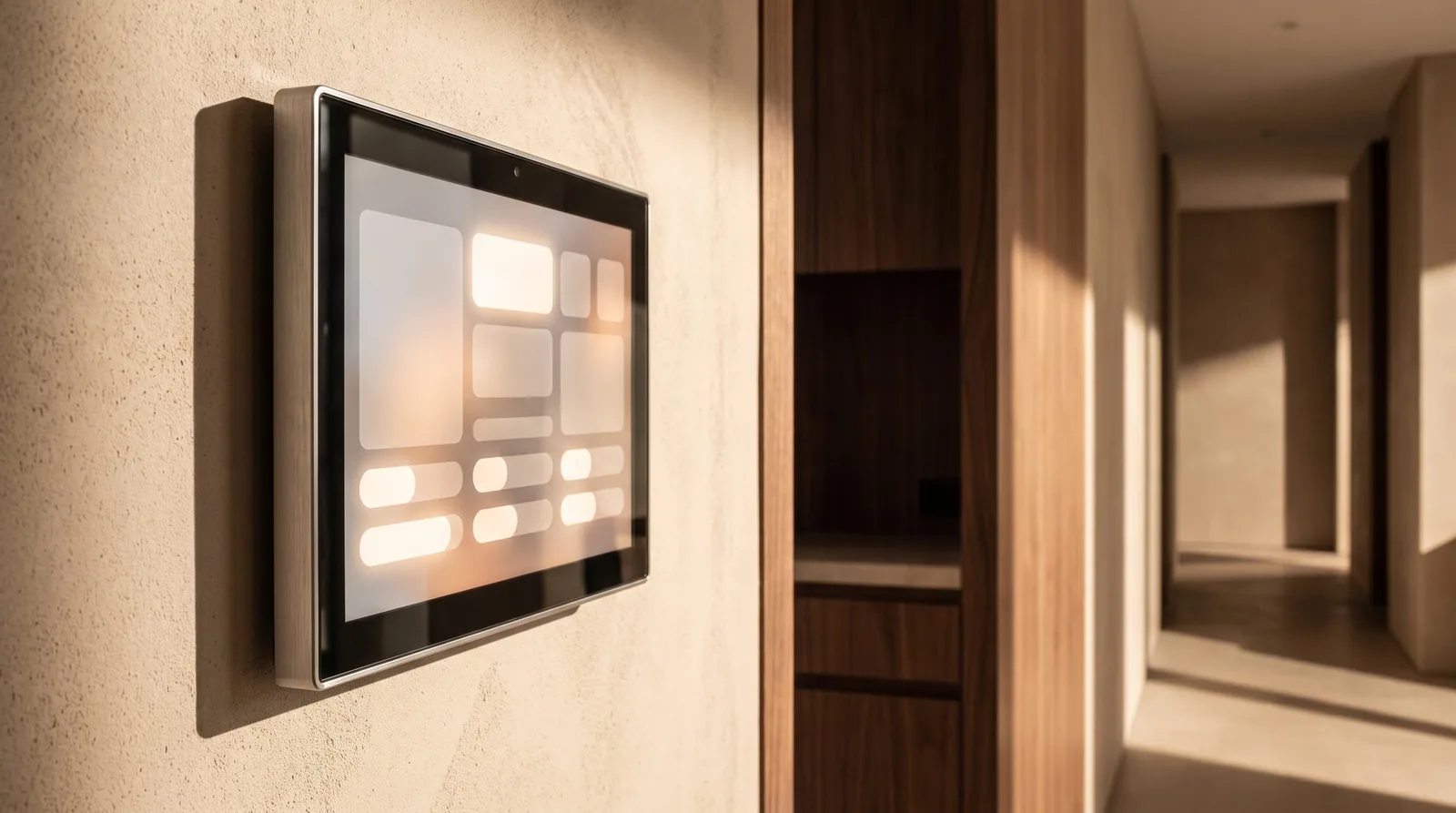
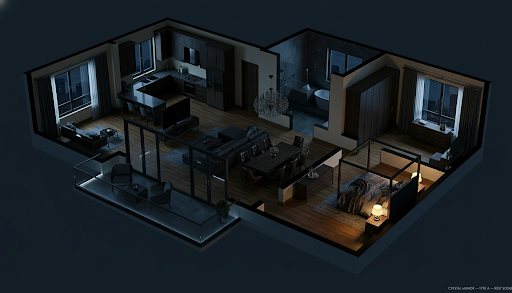
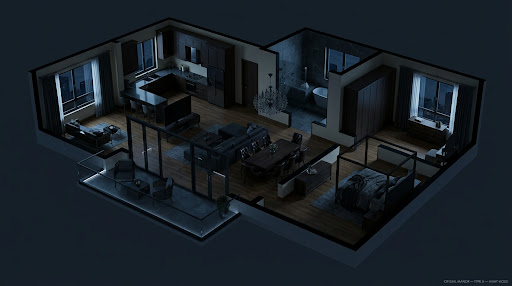
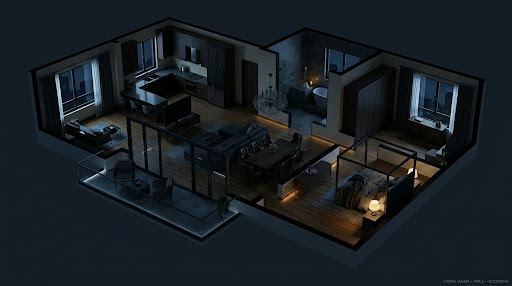
One panel. The whole apartment responds.
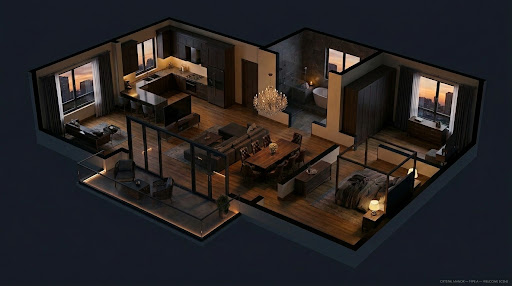
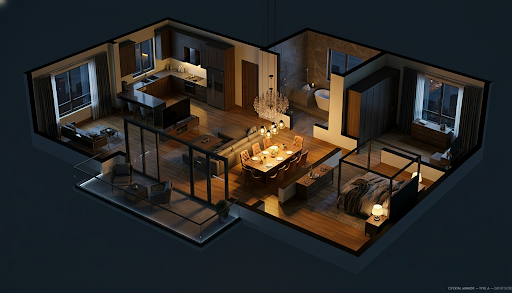
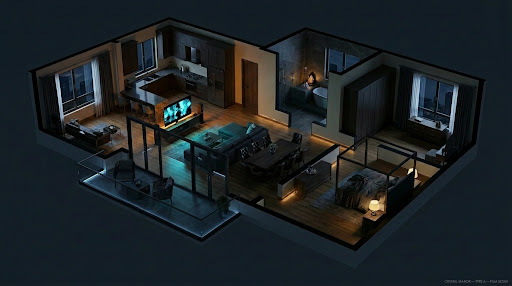
Tap a scene. Every circuit, shade, AC zone and AV source shifts at once.
/ The discipline, in detail
How we approach lighting automation.
Lighting is the single largest sensory layer in any premium space. Done well, it disappears. Done poorly, it dominates every room. We commission lighting scenes per zone — Welcome at 80% / 2700K, Dinner at 40% / 2200K, Film at 4% bias — and let the system fade between them at sunset, on a calendar, or on a single press.
Astronomical timers, daylight harvesting and occupancy sensors recover energy automatically. Engraved keypads replace the bank of toggles next to every door. Battery-backed circuits hold scene memory through power outages.
We work to the architect's lighting plan, not against it — specifying drivers, dimmer curves and load-balancing for every fixture before the wiring is pulled.
On record
Every lighting automation engagement is documented end-to-end — design, programming, commissioning, calibration — and handed over with the files our successors would need if we were never to return.
/ Protocol stack
Keypads, bus and fixtures
The three-layer lighting-control stack — scene keypads over an addressable bus over dimmable circuits. Brand-neutral; the exact stack is per brief.
Diagram · described
Lighting protocol stack
A three-layer canonical lighting control architecture: BMS supervisor layer at the top, scene/keypad layer in the middle (Rako and Lutron control systems or the open KNX standard), an addressable bus layer connecting the scene controls to fittings (DALI-2 typically), and fittings at the bottom with addressable drivers and emergency self-test. The arrows show the direction of control telegrams; the gateway bridges scene-control systems to DALI-2 at the fitting layer.
Diagrammatic view — a system planning illustration for design discussion, not a project drawing or live interface.
/ Where we deploy this
Active across 5 sectors.
Lighting Automation is rarely a standalone brief — it sits inside a wider sector practice with its own codes, expectations and operating rhythm.
/ Sister services
The rest of automation.
A serious brief usually crosses two or three of these. Read across the discipline — we deliver them as one contract.
- 01
Home & Office Automation
One press. The whole space responds.
Lights, climate, blinds, audio, cinema and security — orchestrated by a single Rako, Fibaro or KNX backbone and controlled from a touch panel, voice or a discreet keypad on the wall.0 - 03
Smart Control
One panel. The whole building.
Touch panels, keypads, voice and mobile control surfaces — Rako, Fibaro Home Center and KNX — engineered as the single, learnable interface to everything else we install.1 - 04
Drapery & Shading Control
Daylight, on a quiet motor.
Motorised curtain tracks, roller and roman blinds, sheer-and-blackout double-rolls, and external louvres — silent, scheduled, scene-aware and integrated with the rest of the home or building.2 - 05
Architectural & Façade Lighting
The building and the grounds, after dark.
Façade graze, in-grade uplights, linear coves, water-feature lighting, drive and pathway detailing, tree uplights and perimeter flood — engineered, programmed and night-commissioned on one Rako control surface.3 - 06
Motorised Shutters & Skylights
The building envelope, on a quiet motor.
Motorised building-envelope openings — automatic rolling shutters, motorised skylights and retractable roof glass, and façade and ventilation openings — scheduled, scene-aware and integrated with the wider automation system.4
/ Where this system has been deployed
Lighting Automation on the ground.
The reference projects below carry a lighting automation layer engineered as part of an integrated stack. Each case study walks through the engineering challenges that were solved, the standards the work was held to, and the operational outcome on the day-two team.
- Completed · Handover 2018
Cabinet Conference Room, Arunachal Pradesh Secretariat
Government · Cabinet Conferencing · Itanagar, Arunachal Pradesh
- Completed · Handover 2024
Town Hall Auditorium, Dimapur
Government · Civic Auditorium · Dimapur, Nagaland
Public project summaries describe systems and outcomes only — BOQ values, quantities, device counts and security layouts are kept off public surfaces.
Request a feasibility review/ Integration with
How lighting automation talks to the rest.
A serious deployment of this system rarely operates in isolation. The disciplines below most commonly share its cabling pathways, its controller logic, and its cause-and-effect matrix.
Home & Office Automation
One press. The whole space responds.
Lights, climate, blinds, audio, cinema and security — orchestrated by a single Rako, Fibaro or KNX backbone and controlled from a touch panel, voice or a discreet keypad on the wall.Drapery & Shading Control
Daylight, on a quiet motor.
Motorised curtain tracks, roller and roman blinds, sheer-and-blackout double-rolls, and external louvres — silent, scheduled, scene-aware and integrated with the rest of the home or building.
/ Read deeper
The engineering, in long form.
Each article below goes deeper than this service page can — a full walk-through of the engineering decisions, written by the team that delivers this work.
Engineering toolkit
Tools to scope this work
Calculators and reference checkers we use ourselves to sense-check the engineering before any drawings change hands.
- BMS · Energy
Energy & Efficiency Estimator
Adjust building variables and see indicative energy and CO₂ savings (kWh) for a BMS-driven energy upgrade plus daylight-harvesting LED retrofit. Conservative; defensible in a first conversation.
kWh · CO₂ savedOpen - BMS · Readiness
BMS Readiness Checker
A readiness self-check before a BMS conversation — which plant systems to supervise, how BMS-ready the existing controls are, and whether the network, operations team and documentation are in place. Statuses only; no points counts, plant capacities or network detail.
Advisory · readinessOpen - BMS · Readiness
BMS Energy & Fault-Response Readiness Planner
A readiness self-check for turning building-management data into detected faults, sent alerts and closed actions — metering & visibility, fault classes as monitoring categories, and the response process behind the alarm. Statuses and bands only; no plant capacities, no simulated events, no kWh, rupee or savings figures.
Advisory · readinessOpen
/ Engineering concepts
Related engineering concepts
Concept
Rako Lighting Control
British wireless and wired lighting and scene-control platform. The default residential and hospitality lighting backbone for retrofit and new-build where Rako's keypad-and-scene ecosystem fits the design intent.
Concept
KNX Building Bus
ISO-standard wired open-protocol building bus. Multi-vendor, scalable to thousands of devices, designed for 20+ year lifecycles. The right backbone for vendor independence and longevity.
Concept
DALI Protocol
IEC-standard digital lighting protocol. Each fitting is individually addressable and dimmable; preferred for premium lighting where each circuit needs scene-level and tunable-white control.
Concept
Scene Orchestration Pattern
Engraved-keypad-driven scene programming where lighting, shades, climate, audio and AV move together to a named room state (Welcome, Dinner, Film, Goodnight) — programmed once and triggered as one.
/ Used alongside
Commonly deployed alongside
Sector
Hospitality
Guest experience, engineered.
Sector
Residential
The premium home, made quiet.
Service
Home & Office Automation
One press. The whole space responds.
Service
Fire Alarm System
Detection that pinpoints. Response that is coordinated.
Service
Building Management System (BMS)
The building, on a single dashboard.
Service
Smart Control
One panel. The whole building.
/ Plan it right
Lighting Automation — getting the brief right.
Common mistakes to avoid
- Finalising the lighting layout and circuiting without the control intent, so scenes and dimming zones cannot be created afterwards.
- Mixing dimmable and non-dimmable drivers on one circuit and discovering the flicker on site.
- Ignoring tunable-white and daylight strategy where the architecture clearly calls for it.
- Engraving keypads with numbers instead of the room's real scenes — Welcome, Dinner, Film, Goodnight.
- Treating lighting control as separate from the shade, AV and climate scenes that should fire together.
What to share before a quotation
- Reflected ceiling plan and the lighting layout with fixture types and driver / dimming detail.
- Circuit and panel zoning, and whether DALI, KNX or wireless is preferred.
- The scenes and daily rhythm each space should support.
- Whether shade, AV and climate need to join the same scene logic.
- New-build or retrofit, and the keypad / app control preference.
Equipment categories
See the equipment behind the solution.
Explore equipment we supply and the services around it. The final specification follows your space, operating needs and agreed scope.
/ Frequently asked
Lighting Automation — what buyers ask first.
Difference between dimming and lighting automation?
Dimming is a hardware function on a single fixture — a knob, a slider, a smart dimmer. Lighting automation is the control layer above it: scenes, schedules, sensors and inter-room logic. A dimmer changes one fixture; an automation system changes the entire room's character at one press.
Will lighting automation work with my existing fixtures?
Yes — if the fixtures use standard mains-dimmable, 0–10V, DALI or DMX drivers, lighting automation works with them as they are. Many premium decorative fixtures need a driver swap or a dedicated leading-edge dimmer — we audit every fixture during the survey and tell you upfront.
What is tunable-white lighting?
Tunable-white fixtures shift colour temperature on demand, typically 2200 K (warm candle-glow) to 6500 K (cool daylight). Paired with automation, the home brightens and cools through the morning and warms toward evening, mirroring the sun. The effect on circadian rhythm and the perceived warmth of a space is significant.
How many scenes should I plan for?
Programme 6–10 scenes per primary room for residential projects (Welcome, Day, Dinner, Film, Read, Goodnight is a complete starting set), and 4–6 named states for commercial spaces. We typically programme 6–10 scenes per primary room — Welcome, Day, Dinner, Film, Read, Goodnight is a complete starting set. Scenes beyond that count are rarely used in practice and clutter the keypad UX. For commercial spaces we keep scenes per zone to 4–6 named states.
Will tunable-white fixtures work with all dimmers?
No — tunable-white fixtures require DALI-2, dual-channel 0–10V or supported control interfaces such as Rako Tunable or KNX dimming; standard mains dimmers cannot drive them. Tunable-white needs DALI-2, 0–10V dual-channel, or supported control interfaces such as Rako Tunable or KNX dimming. Standard mains dimmers cannot drive tunable-white fixtures. We specify the driver, dimmer and fixture together at the design stage.
How does daylight harvesting work in practice?
Daylight harvesting uses perimeter lux sensors that dim artificial fixtures inversely as daylight rises, typically saving 20–35% on perimeter-zone lighting bills. Lux sensors mounted at the perimeter measure incident daylight; the controller dims the artificial fixtures inversely so the total illuminance at the work plane stays constant. Done well, occupants do not notice the change; the energy saving on a perimeter office zone runs 20–35% on the lighting bill.
Which lighting-control brands does TechnoGuru work with?
We work across the Rako, KNX and DALI ecosystems, with FutureKNX keypads and drivers, Fibaro and Nice devices where the project fits, and MADRIX or ProtoPixel controllers for dynamic and facade lighting. These are families we specify where suitable, matched to the scheme rather than fixed in advance. The final control topology is selected after the lighting layout, circuit schedule and driver type are reviewed against the drawings.
How are the keypad, dimmer and driver families chosen for a project?
The keypad, dimmer and driver are specified together against the load type — LED, tunable-white, mains, 0–10V or DALI — because a keypad is only as useful as the driver it commands. Rako and KNX keypads follow different wiring and scene conventions, so we match the family to the electrical layout rather than the brochure. Final make and model stay subject to project requirement, site conditions and availability.
How does lighting automation hand off to a hotel or GRMS platform?
In hospitality projects the room lighting integrates with the guest-room management system so check-in, welcome and do-not-disturb states drive the lighting scenes through a documented interface. KNX and DALI both bridge into common GRMS platforms, and the exact integration is designed against the property's chosen room-management system. Share the room drawings and the GRMS platform through /contact for a written scope.
· Begin
Begin a
lighting automation
brief.
Tell us about the building, the timeline, and what success looks like a year after handover. We will reply within two working days with a written response, not a sales pitch.