
Restaurants, Bars & Clubs.
The room. The night. The sound.
Restaurants, bars, lounges, rooftops and nightclubs — JBL Professional, K-array and Kgear audio with stage lighting, DJ infrastructure and acoustic isolation.
| Aspect | Piecemeal fit-out | TechnoGuru — coordinated |
|---|---|---|
| Audio | Speakers chosen on a brochure number | Coverage and DJ sound engineered to the room and its target level |
| Boundary noise | Complaints discovered after opening | Cardioid sub arrays, isolation and a DSP limiter held to the sound NOC |
| Support | No cover on the busy nights | Event-aware AMC with pre-weekend checks and a venue-specific spares pool |
Educational comparison of delivery models — not a statement about any specific installer.
Hospitality nightlife is engineering disguised as atmosphere. Speaker placement, subwoofer arrays, DJ booth ergonomics, floor lighting, façade lighting and acoustic isolation from the apartments above. We deliver a venue that opens on schedule, passes its sound NOC and earns its loyal crowd.
Not every hospitality room is a nightclub. All-day cafés, casual restaurants and quick-service counters want the daytime version of the same discipline — the room's mood set by daypart, the ordering and payment technology kept quietly reliable, and the whole low-voltage layer planned as one coordinated system rather than a drawer of separate contracts. That coordination is what lets a growing café or restaurant brand open its next outlet to the same standard; the individual systems are broken out in the questions below.
The engineering problem in a bar or club is boundary noise as much as sound quality — a venue that cannot hold its sound NOC does not stay open. We design cardioid subwoofer arrays that cancel toward the neighbours, isolate the envelope where the structure allows, and tune a DSP limiter that holds the venue inside its NOC limit automatically through a busy night, then document the boundary measurements in the format the authority asks for.
Service is built around the operating week rather than office hours: pre-weekend health checks, support windows on operating nights and a venue-specific spares pool, because a failed amplifier on a Friday costs the venue the whole night's trade. Retrofits of existing venues are scheduled as overnight work — typically four to eight days — and the room is re-tuned to its specification before it reopens.
· Selected clients · Nightlife / Clubs / Lounges
Systems delivered across nightlife sites in the North-East.
- Cafe 361
- SkyScape
- Piazza
- Botanee
- Mamagoto
- Terra Mayaa
- The Shuffle
- House of Madira
- The View
- Dhaba
- Uptown Escape
- Hard Rock Cafe
- Abacus Brewing Co. & Kitchen
- Skye
- Havelli
- Lord of the Drinks
- Town Hall
- Urban Mantra
- Malt
- Breathe
- Octave
- NYX Lounge & Deck
- Tango
- The Elite Club
Organisations across whose sites and facilities we have delivered systems — directly or as a specialist sub-contractor. Most engagements stay under contractual confidentiality; listing implies no endorsement or exclusivity, and trademarks remain the property of their owners. The full roster.
· What we coordinate in dining & nightlife
Audio, lighting, screens and a covered floor — engineered for the night.
Restaurants, cafés, lounges, bars, clubs and nightlife venues. These are the systems TechnoGuru can plan, integrate and support — built around the audio and ambience that define the room — sized to the venue and supported with event-aware AMC.
Audio and ambience
The sound that defines the room.
- Background-music systems
- High-performance lounge audio
- Zone-wise audio control
- Outdoor and terrace audio
Club and stage systems
Built for the busy night.
- Bar and nightclub sound systems
- DJ audio setup
- Live-performance package — vocal mics, instrument inputs, monitor wedges and a compact mixer
- Lighting control and club lighting
- Stage lighting
- Music-responsive & pixel-mapped show lighting (DMX / Art-Net / sACN)
- LED walls and display systems
Display and signage
Menus and moments on screen.
- Digital signage and menu displays
- Promotional and feature screens
Security and IT
Guests connected, premises covered.
- CCTV and surveillance
- Guest Wi-Fi
- POS and IT-network cabling
- Access control for staff and store areas
Acoustics, power and support
Held inside the venue, ready for every event.
- Acoustics and sound-isolation support
- Fire alarm and safety systems
- AV-rack and equipment planning
- UPS backup for networking and critical systems
- AMC and event-support coordination
We provide acoustics and sound-isolation support coordinated to the venue; we do not promise blanket soundproofing or handle entertainment licensing. We agree the detail privately against the drawings — no device counts, quantities or layouts are published here.
Planning the room and the night
What a venue has to get right after dark
A room that feels effortless at 9pm was planned carefully beforehand. These are the choices that shape how a restaurant, bar or club sounds and feels.
- Zoned audio by area and daypart
- Different areas and different hours want different sound, so audio is zoned to be controlled independently through the night.
- Lighting scenes and mood
- Lighting scenes are planned to move the room from daytime service to late-night energy at the touch of a control.
- Acoustics for speech and music
- Treatment is considered so conversation and music can coexist, rather than the room turning into noise.
- AV and content sources
- Screens, sources and content are planned so the visual layer supports the atmosphere instead of fighting it.
· Core services
16 services
delivered to this sector.
Grouped by the engineering layer each system belongs to — the way the scope is actually coordinated on site.
- Hospitality Venue AVFrom the banquet stage to the last bar stool.
- Professional Audio & PA SystemsIntelligible, every seat in the house.
- Multi-Room AudioOne song. Every room. Or six different ones.
- Stage LightingLight that performs.
- Acoustic SolutionsRooms that sound the way they look.
- Digital Signage & WayfindingThe right message, in the right place, on schedule.
- Queue Management SystemTake a token, watch the counter, walk up.
- Recording Studios & NightlifeRooms tuned to the recording.
Indicative coordination scope. Not every project engages every layer; the working scope is agreed against the drawings before anything is specified.
Equipment categories
See the equipment behind the solution.
Explore equipment we supply and the services around it. The final specification follows your space, operating needs and agreed scope.
Equipment illustration
Interactive kiosks
Interactive kiosk equipment for visitor information and service-counter applications. The software and workflow are agreed for each project.
Explore related service
Equipment illustration
Kiosk LED displays
Kiosk-format LED displays for information and promotional content, selected around viewing position and the installation setting.
Explore related service
Equipment illustration
Digital signage TVs & displays
Signage screens for menus, directions and information. Content scheduling and management are scoped alongside the display equipment.
Explore related service
Equipment illustration
POS machines & systems
Point-of-sale equipment for retail and food-service counters. Billing software, payment interfaces and compatibility need project-specific confirmation.
Explore related service
Equipment illustration
KOT printers
Kitchen order ticket printers for restaurant, café and hospitality workflows. The ordering system and connection method are confirmed before supply.
Explore related service
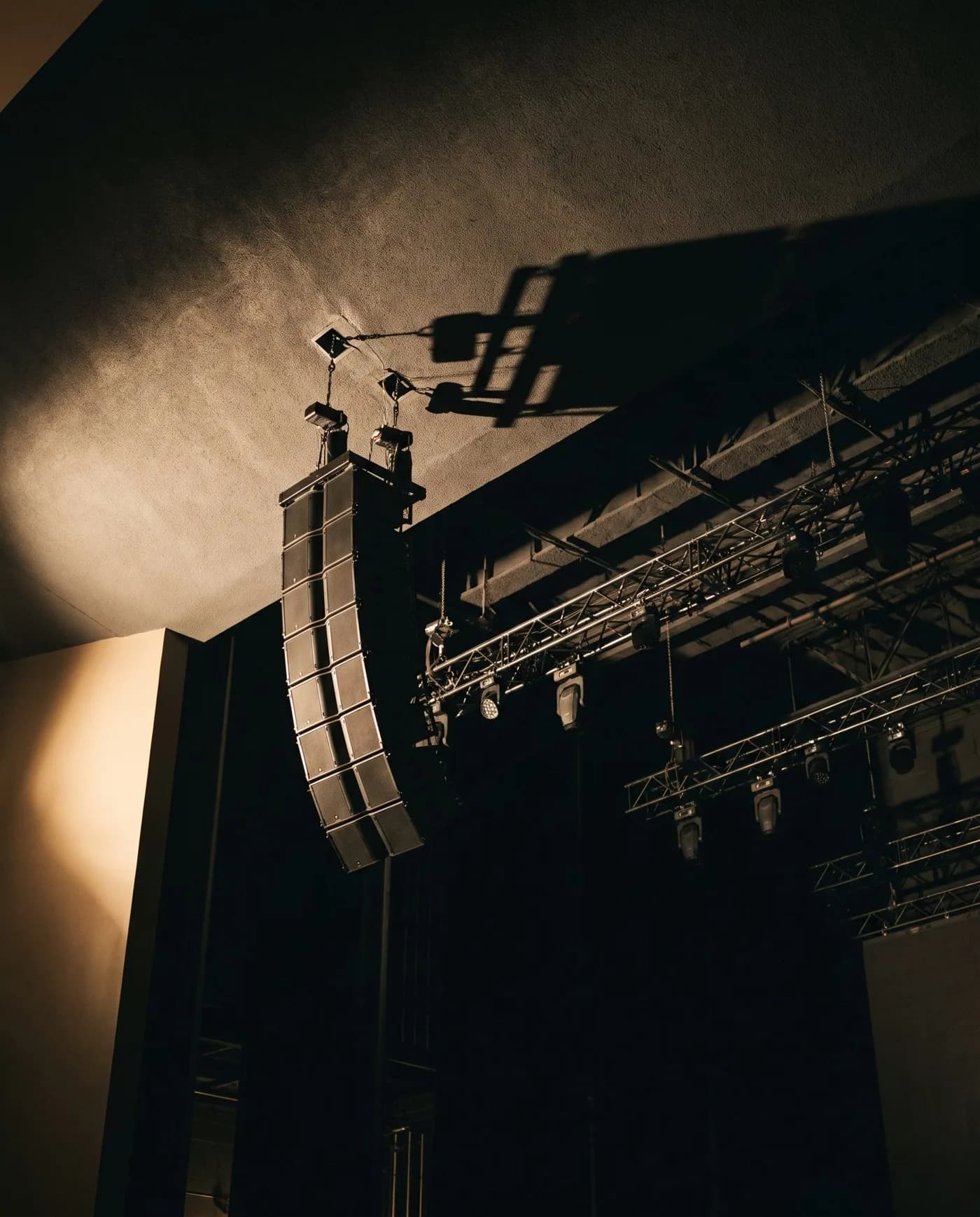
Illustrative — generated visual, not a real project photograph. Illustrative category scene
Professional audio
Loudspeakers, amplification and audio processing for speech, music and performance applications.
Explore related service
· Frequently asked
Nightlife —
what buyers ask first.
What systems can TechnoGuru support for a restaurant, bar, lounge or club?
For restaurants, cafés, lounges, bars, clubs and nightlife venues, TechnoGuru can plan and integrate background-music and high-performance lounge audio, bar and nightclub sound with DJ setup and zone-wise control, outdoor / terrace audio, lighting control with club and stage lighting, LED walls, digital signage and menu displays, CCTV, guest Wi-Fi, POS and IT-network cabling, access control for staff and store areas, fire alarm and safety systems, acoustics and sound-isolation support, AV-rack and equipment planning, and UPS backup for networking and critical systems — with AMC and event-support coordination afterwards.
What technology does an all-day café or casual restaurant actually need?
A café or casual restaurant runs on a smaller, quieter version of the nightlife stack: zoned background music set by daypart, a POS and billing network on its own segment beside a captive-portal guest Wi-Fi, digital menu boards and a token or order-ready display at the counter, CCTV with cover-count and occupancy analytics, structured cabling and a small rack, UPS behind the till and network, and coordination of kitchen ventilation and cooling with the building services. TechnoGuru plans it as one coordinated layer so a growing café or restaurant brand can roll the same specification out to its next outlet.
What's the cost range for a club-grade audio system in India?
Cost scales with venue size, target SPL and rider expectations. A rooftop bar PA — main array, two subs, monitors and processing — is the entry scale; a dedicated dance-floor club at 110 dBA SPL with cardioid sub array, full coverage and DJ booth is a larger one; a reference touring-spec venue (K-array Mugello / KH8 line-array or JBL VTX A12) is larger again. TechnoGuru does not publish tentative prices or budget bands because every project depends on site conditions, drawings, system scope, brands, integration depth, commissioning and support requirements. Please email info@technoguru.in or WhatsApp/call +91 88110 34444 with your drawings, BOQ or project brief for a written estimate after review.
How do you prevent the residential boundary noise complaints that close venues?
Boundary noise is prevented through cardioid subwoofer arrays that cancel toward residences, structural acoustic isolation and a DSP limiter that holds the venue inside its sound-NOC limit automatically. Cardioid subwoofer arrays that aim into the dance-floor and cancel toward the residences upstairs, plus structural acoustic isolation of the venue envelope, plus a properly tuned DSP that holds the venue within its sound-NOC limit at the boundary measurement point. We engineer the venue to pass its sound NOC inspection — not to fail it.
DJ booth, console, monitor wedges — what's typical for a serious venue?
Serious DJ booths use Pioneer CDJ-3000s, a DJM-A9 mixer, isolated booth monitors, talkback to FOH and MIDI tempo to the lighting console for cue sync. Pioneer DJ CDJ-3000s and DJM-A9 mixer for the booth, isolated booth monitors, talkback to FOH, MIDI tempo to the lighting console for cue sync, and structural cable management so the booth is not a hazard. A serious venue commits to this layer rather than treating it as DJ-rider afterthoughts.
Do you handle stage lighting and façade lighting alongside the audio?
Yes — we deliver programmable stage and façade lighting on DMX/Art-Net plus Rako or DALI alongside the audio, all cued together so 'house lights down' is one button press. Programmable stage lighting (Robe, ETC, Chauvet) on DMX/Art-Net with grandMA console, plus dance-floor and media content pixel-mapped on MADRIX or ProtoPixel, plus architectural and façade lighting on Rako or DALI. Every layer cues together with the audio system so a 'house lights down' command is one button press.
Can the dance-floor and LED walls react to the music?
Yes — dance-floor tiles, pixel battens and LED or video walls can run as a music-responsive show driven by a MADRIX or ProtoPixel pixel engine over DMX, Art-Net or sACN. The engine takes BPM, MIDI or timecode off the DJ setup so the visuals move with the set rather than looping on a timer, and the show sits on its own lighting universe while the venue's everyday house lighting stays on Rako or DALI. We program the looks to the room and the night rather than shipping a generic effects pack.
Can the venue host a live singer, duo or small band, not just a DJ?
Yes — beyond the DJ booth the room can be set up for a live act, with vocal mics, instrument inputs, performer monitoring and a compact mixer sized to the act, all held inside the venue's sound-NOC by the same DSP limiter that governs the DJ. A background-music evening, a solo singer, a duo or a small band then run on the one system without a separate rig. The full live-performance package — wireless-mic coordination, DI inputs, monitor wedges or in-ear monitoring — is set out on our Hospitality Venue AV service page.
Can you take over an existing venue and refresh just the audio without disturbing the rest?
Venue audio retrofits can be planned around operating hours where site access and the confirmed scope allow. Procurement, approvals, installation constraints and coordination determine the programme. Testing, tuning and operator handover are agreed with the venue before reopening the affected areas.
What does the ongoing service profile for a club or bar typically look like?
Nightlife venue AMC is intensive — pre-weekend health checks, support windows for operating nights and a venue-specific spares pool so a failed amplifier is swapped within hours. Hospitality nightlife AMC is intensive — speakers and amplifiers see 30–50 hours of high-SPL operation each week, DJ booth equipment takes physical wear, and a single failure on a Friday evening costs the venue a full night's revenue. We design the service profile around that reality: pre-weekend health checks, support windows for operating nights, and a small spares pool held against the specific venue so a failed amplifier is swapped within hours rather than ordered from elsewhere.
How early should we bring you in for a new venue fit-out?
At the architectural drawing stage — acoustic envelope, structural isolation, cable pathways and HVAC noise paths are all easier to design alongside the architecture than to retrofit. Acoustic envelope, structural isolation from neighbours, cable pathways for stage lighting, ventilation noise from HVAC into the listening space — all are easier to design alongside the architecture than to retrofit. We have seen excellent venues constrained for life by decisions made before the AV consultant was appointed; the right time is now, not later.
Can you handle the sound-NOC paperwork and the noise-monitoring evidence the authority asks for?
Yes — we handle sound-NOC boundary measurement, calibrated SPL logging at FOH, and written acoustic compliance reports, with a DSP limiter holding the venue inside its NOC limit through busy nights. Boundary noise measurement at the residential property line, calibrated SPL logging at the FOH position, and a written acoustic compliance report in the format the authority expects. Where the venue is in a sensitive location, we engineer the cardioid sub array and DSP limiter to hold the venue inside its NOC limit automatically — the limiter, not the engineer at the desk, is what holds that ceiling through a busy night.
Engineering decisions
Decisions that shape nightlife projects
Engineering toolkit
Tools we use for nightlife work
Calculators and reference checkers our engineers reach for first on projects in this sector.
- AV · Audio · Coverage
Speaker Coverage Planner
Engineering-grade speaker coverage and SPL planner across a source-cited public model catalogue spanning pro touring, commercial audio and architectural speakers. Predicts SPL at listener distance, the horizontal coverage width at that distance on the -6 dB dispersion axis, and the quantity needed for the room.
45 brands · SPL predictionOpen - Lead intake
Project Brief Wizard
Six structured questions, a written response within two working days. The fastest path to engaging the practice on a real project.
6 questions · 2-day replyOpen - BMS · Energy
Energy & Efficiency Estimator
Adjust building variables and see indicative energy and CO₂ savings (kWh) for a BMS-driven energy upgrade plus daylight-harvesting LED retrofit. Conservative; defensible in a first conversation.
kWh · CO₂ savedOpen
/ Engineering notes
Long-form reading for nightlife projects
Insight
Anatomy of a premium villa automation scope — an anonymised discipline breakdown
An anonymised, discipline-by-discipline breakdown of a real 2,800 sq-ft North-East India villa fit-out — lighting automation, shading, multi-room audio, AV, CCTV, access control, structured cabling, Wi-Fi, UPS and AMC. What each discipline actually contains, the brand bands and the trade-offs we made. Pricing is project-specific and follows a written estimate after review.
Insight
AMC scope transparency — what a serious AMC actually includes (and what thin ones omit)
An honest breakdown of what an Annual Maintenance Contract on a premium integrated system actually has to deliver — preventive visits, response-target capacity, parts pool and obsolescence reserve, configuration discipline, lifecycle planning — and what gets quietly excluded from a thin AMC. Pricing is scoped per project and shared in writing after review.
Insight
Government ELV procurement: GeM, EMD, BG, BOQ and the paperwork that decides who wins
How Central and State Government ELV tenders work in India — the role of GeM empanelment, EMD/BG instruments, BOQ formats and the technical specifications that decide a bid before commercial opening. A field guide for systems integrators bidding their first government contract and for departments writing their first tender.
· Begin
Project in nightlife?
Begin a brief.
The first reply will come from a project lead, not a sales gateway, within two working days.