
03 / 09
Case file
Cat6A, OS2 and OM4/OM5 structured cabling — designed to TIA-568, terminated to manufacturer warranty and labelled to a documented patch schedule.
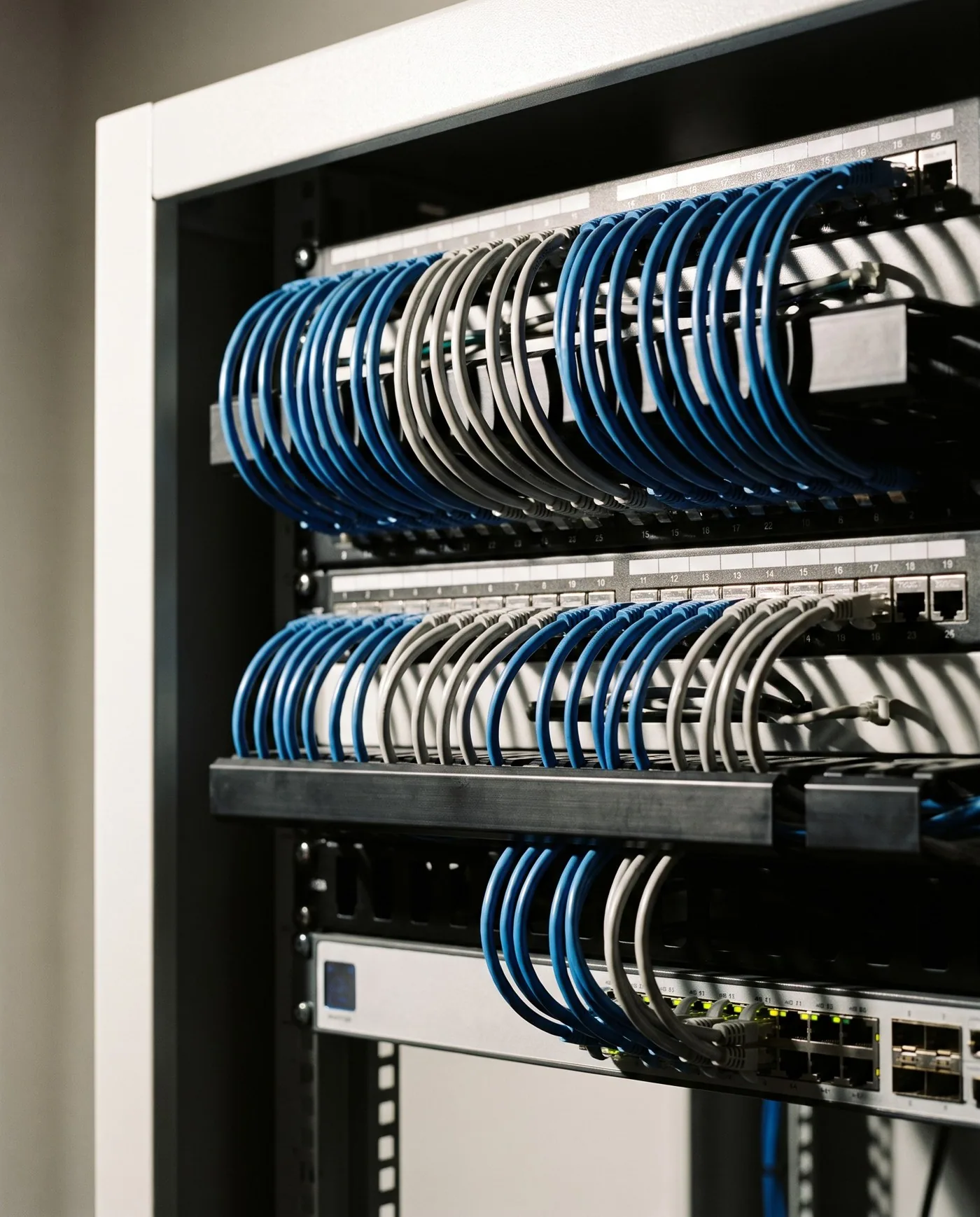
| Requirement | Code-minimum approach | Engineered approach |
|---|---|---|
| Cable class | Cat6, chosen by default | Cat6A — 10G to the desk over the full channel |
| Certification | Visual or untested | Every link Fluke DSX certified to class |
| Documentation | Minimal | As-built schedule, every link labelled and mapped |
Educational comparison — not about any specific installer.
/ The discipline, in detail
How we approach structured cabling.
Structured cabling is the layer that decides every other system's lifespan. We design to actual cable counts not table-of-contents minimums, certify every link to performance class with a Fluke DSX, and label patches to a schedule the building's IT team can hand to its next employee on day one. Risers are sized for the year-five expansion, not the year-zero count, and copper-to-fibre converge points are documented down to the patch port.
For the design team, cabling is the cheapest thing to get right at carcass stage and the most expensive to retrofit later. We coordinate containment, riser sizing and rack-room positions with the architect and MEP before the slab is poured, so the plant is installed once and certified to manufacturer warranty. The as-built schedule handed over — every link labelled, tested and mapped to a patch port — is what lets the building's own team add a desk, a camera or an access point years on without a forensic exercise.
On record
Every structured cabling engagement is documented end-to-end — design, programming, commissioning, calibration — and handed over with the files our successors would need if we were never to return.
/ Backbone
Campus, connected
The MDF–IDF fibre backbone pattern behind every serious campus — pathways, redundancy and the test documentation that certifies them.
Diagram · described
Multi-building fibre backbone topology
A campus-grade single-mode fibre backbone connecting a core MDF to four building IDFs (academic, clinical, admin, hostel) over a redundant ring topology with HDPE under-conduit during civil build-out, draw pits at every IDF entry, LIU termination with 6-port and 24-port panels, OSPF L3 with EIGRP/static fall-back, single-disk failure tolerance per NVR aggregator, and a documented loss-budget test record per fibre core.
Diagrammatic view — a system planning illustration for design discussion, not a project drawing or live interface.
/ Where we deploy this
Active across 8 sectors.
Structured Cabling is rarely a standalone brief — it sits inside a wider sector practice with its own codes, expectations and operating rhythm.
Residential
The premium home, made quiet.
Hospitality
Guest experience, engineered.
Commercial & Corporate
Workplaces that begin meetings on time.
Education & Institutions
Schools, colleges and universities.
Healthcare
Hospitals where systems serve the patient.
Government & Public Safety
Mission-grade integration.
Restaurants, Bars & Clubs
The room. The night. The sound.
Industrial & Warehousing
Operations that don't take a day off.
/ Sister services
The rest of it.
A serious brief usually crosses two or three of these. Read across the discipline — we deliver them as one contract.
- 01
EPABX & IP-PBX
Voice, routed cleanly.
Enterprise voice — IP-PBX, SIP trunking, hosted UC and hospitality PMS integrations — Grandstream, NEC, Cisco and Yeastar.0 - 02
Enterprise Network Design & Installation
Wires the building's nervous system.
Structured cabling, Wi-Fi 7, switching, SD-WAN and data-centre networking — Cisco, HPE Aruba, Juniper, Netgear, CommScope.1 - 04
Enterprise Wi-Fi
Coverage you can measure, not just claim.
Wi-Fi 7 and Wi-Fi 6E enterprise wireless — Cisco, Aruba, Juniper Mist, Netgear — site-surveyed to the building's actual cell-edge SNR.2 - 05
Network Security
Segmentation. Visibility. Recoverable backups.
Next-generation firewalls, segmentation, NAC, EDR, SIEM and backup — Fortinet, Palo Alto, Sophos, Check Point — designed to how breaches actually unfold, not how vendors describe them.3 - 06
Servers, Storage & Data Centre
On-prem, hybrid and edge — sized for actual workload.
Server and storage architecture — Dell, HPE, Lenovo, Pure, NetApp — for on-prem and hybrid workloads, including precision cooling, rack design and DR.4 - 07
Video Conferencing Infrastructure
Reliability beats features.
Cloud, on-prem and hybrid VC — Microsoft Teams, Zoom, Google Meet, Cisco Webex — with bridges, gateways, recording and transcription infrastructure.5 - 08
Digital Library & RFID Automation
The whole collection, tracked and self-service.
RFID-based library automation — tagging of books and media, self-issue and self-return kiosks, EAS security gates, handheld inventory readers and drop-box automation, integrated with the library-management software.6 - 09
Smart Rack & Precision Cooling
A server room, contained in one cabinet.
Self-contained smart racks — a sealed cabinet with close-coupled precision cooling, in-rack UPS, environmental and access monitoring, and optional integrated fire detection and suppression — for edge and server-room sites without a full data-centre room.7
/ Where this system has been deployed
Structured Cabling on the ground.
The reference projects below carry a structured cabling layer engineered as part of an integrated stack. Each case study walks through the engineering challenges that were solved, the standards the work was held to, and the operational outcome on the day-two team.
- Completed · Handover 2024
Tinsukia Medical College & Hospital
Healthcare · Government · Tinsukia, Assam
- Completed · Handover 2022
Agartala Medical College & GBP Hospital
Healthcare · Government · Agartala, Tripura
- Ongoing · In progress · 2026
PM Ekta Mall, Guwahati
Commercial · Retail · Guwahati, Assam
- Completed · Handover 2025
Taraghar — State Guest House
Government · State Guest House · Shillong, Meghalaya
- Completed · Handover 2021
Assam State Guest House, Koinadhara
Government · Protocol Residence · Guwahati, Assam
Public project summaries describe systems and outcomes only — BOQ values, quantities, device counts and security layouts are kept off public surfaces.
Request a feasibility review/ Integration with
How structured cabling talks to the rest.
A serious deployment of this system rarely operates in isolation. The disciplines below most commonly share its cabling pathways, its controller logic, and its cause-and-effect matrix.
Enterprise Wi-Fi
Coverage you can measure, not just claim.
Wi-Fi 7 and Wi-Fi 6E enterprise wireless — Cisco, Aruba, Juniper Mist, Netgear — site-surveyed to the building's actual cell-edge SNR.Network Security
Segmentation. Visibility. Recoverable backups.
Next-generation firewalls, segmentation, NAC, EDR, SIEM and backup — Fortinet, Palo Alto, Sophos, Check Point — designed to how breaches actually unfold, not how vendors describe them.CCTV & Surveillance
Coverage. Storage. Evidence.
IP video surveillance — Hikvision, Dahua, Axis, Bosch — designed to coverage, recording-bandwidth and retention specifications, with VMS and AI-analytics overlays.
/ Read deeper
The engineering, in long form.
Each article below goes deeper than this service page can — a full walk-through of the engineering decisions, written by the team that delivers this work.
- IT · 10 min
Structured cabling planning: the 25-year decisions you take in week one of design
Structured cabling is the layer everything else runs on, and almost every decision about it is taken in the first week of design — when the architect's drawings are still fluid and the IT team has not yet assembled. Get those decisions right and the building runs cleanly for 25 years. Get them wrong and every device added in year three is a retrofit exercise.
Read article - ELV · 11 min
Eight ELV integration mistakes that survive into commissioning — and how to catch them earlier
ELV integration faults rarely surface in design review or installation — they survive into commissioning because the seam-level coordination is nobody's contractual responsibility. The eight failure modes we see most often, and the design-stage discipline that catches each one before it becomes a snag list at handover.
Read article
Engineering decisions
Compare the options
Decision · Networking & IT
Cat6 vs Cat6A — structured cabling grade
You are specifying the horizontal cabling grade for a new fit-out or a re-cable and want to size it for the building's life, not just today's link speed.
Decision · Networking & IT
Wi-Fi 6 vs Wi-Fi 7 — which generation to design for
You are provisioning wireless for a new building or a refresh and want to size the AP grid, cabling and switching for the right generation.
Decision · Networking & IT
Single-mode vs multimode fibre backbone
You are specifying the backbone fibre grade for a new build or a re-cable and want it sized for the building's life rather than the current switch generation.
Engineering toolkit
Tools to scope this work
Calculators and reference checkers we use ourselves to sense-check the engineering before any drawings change hands.
- IT · Cabling
Structured Cabling Estimator
Estimate total structured-cabling length, patch panel count and IDF closet count against floor area and drop count. 50 cable-system brands including Panduit, CommScope, Belden, Legrand, Corning, Furukawa, R&M, Siemon, Nexans, Schneider Electric, STL, Finolex and Polycab. Cat6, Cat6A, Cat7, Cat8 copper plus OM3, OM4, OS2 fibre. TIA-568 compliant.
50 brands · 7 categoriesOpen - Security · Access
Access-Control Door Schedule Planner
Turn generic door types and quantities into a preliminary access-control schedule — reader positions, door position contacts, request-to-exit devices, lock categories and controller grouping. Records no door names, positions or security detail, and never selects the release arrangement for an escape-route door.
door types · devices · controller groupsOpen - IT · Networking
Network & PoE Calculator
Sized to year-three load — switches, Wi-Fi 7 access points, PoE budget (watts), Cat6A run count, port/AP sizing. Cisco / HPE Aruba / Juniper-class enterprise gear.
Switches · APs · PoE WOpen
/ Engineering concepts
Related engineering concepts
Concept
Cat6A Structured Cabling
Augmented Category 6 structured cabling — 10 Gbps over the full 100 m channel, rated for 25 years of service. The default for any new commercial or premium-residential cabling layer.
Concept
Power over Ethernet (IEEE 802.3)
IEEE-standard delivery of low-voltage DC power over the same Cat-class cable as data. PoE+ delivers up to 30 W; PoE++ Type 3/4 up to 90 W — sufficient for IP cameras, APs, VOIP phones and small displays.
Concept
ELV Cabling Backbone
The unified low-voltage cable plant carrying fire, CCTV, access, PA, IP-PBX, BMS and structured data across a building — coordinated as one cause-and-effect pathway rather than per-discipline runs.
Concept
Wi-Fi 7 (IEEE 802.11be)
Current generation of Wi-Fi. Adds 6 GHz band, MLO multi-link operation and 320 MHz channels. Default for new premium deployments where dense-room capacity is the binding constraint.
/ Used alongside
Commonly deployed alongside
Service
Enterprise Network Design & Installation
Wires the building's nervous system.
Service
CCTV & Surveillance
Coverage. Storage. Evidence.
Service
Enterprise Wi-Fi
Coverage you can measure, not just claim.
Sector
Commercial & Corporate
Workplaces that begin meetings on time.
Sector
Industrial & Warehousing
Operations that don't take a day off.
Service
Access Control
Right person. Right door. Right time.
/ Plan it right
Structured Cabling — getting the brief right.
Common mistakes to avoid
- Sizing the cabling to today's device count instead of the year-three load the building will actually carry.
- Mixing categories and vendors across a channel, so the link never certifies to the warranted standard.
- Under-providing pathways, containment and rack space, so future moves-adds-changes become rip-outs.
- Ignoring the power (PoE budget, UPS) and cooling the active network needs alongside the passive cabling.
- Skipping link certification and labelling, so faults later cannot be localised.
What to share before a quotation
- Floor plans with the work areas, device locations and outlet counts.
- Required category / standard and any warranty expectation.
- Rack, IDF and MDF locations and the backbone topology.
- PoE, switching and UPS expectations for the active layer.
- Growth horizon — the load the cabling must still carry in year three.
/ Frequently asked
Structured Cabling — what buyers ask first.
Cat6A or Cat6 in 2026?
Cable any new build with Cat6A — the premium over Cat6 is small and Cat6A supports 10G to the desk over the full 100 m channel for 25 years. Cat6 should be reserved for retrofit-only projects where pathway constraints force the choice.
What's the right cable category for a new building?
Cat6A for the horizontal runs (desk-to-rack), OS2 single-mode fibre for the backbone (floor-to-floor and building-to-building). Cat6A is rated for 10 Gbps over 25 years; OS2 fibre future-proofs the backbone for 100/400 Gbps when the enterprise needs it. We do not specify Cat6 or OM3 for new construction.
How important is cable routing and pathway design?
Decisive. Properly designed cable trays, conduit pathways and rack room ergonomics are what separate a maintainable installation from a future nightmare. We design pathways at the architectural-coordination stage and label every cable end-to-end. Saving on pathway is the single most common false economy in cabling.
How long does the cabling actually last?
Cat6A and OS2 fibre, properly installed and labelled, lasts 25 years. The active components (switches, routers, APs) refresh on 7-year cycles; the structured cabling backbone underneath does not. We design the cabling as the long-life asset of the whole IT layer.
CommScope, Molex, Molex or Belden?
CommScope is our default for most premium deployments — strongest field support in India and consistent quality. Molex is excellent at value-tier pricing. Molex is the right answer for projects where their connectivity ecosystem (PoE, smart cabinets) matters. Belden remains a reference for broadcast and industrial.
Do you certify the installation?
Yes — every Cat6A and fibre run is certified with a Fluke DSX or equivalent, and the certification report is part of the handover documentation. Without certification, a cabling install is not ours; this is non-negotiable.
· Begin
Begin a
structured cabling
brief.
Tell us about the building, the timeline, and what success looks like a year after handover. We will reply within two working days with a written response, not a sales pitch.