
05 / 09
Case file
Next-generation firewalls, segmentation, NAC, EDR, SIEM and backup — Fortinet, Palo Alto, Sophos, Check Point — designed to how breaches actually unfold, not how vendors describe them.
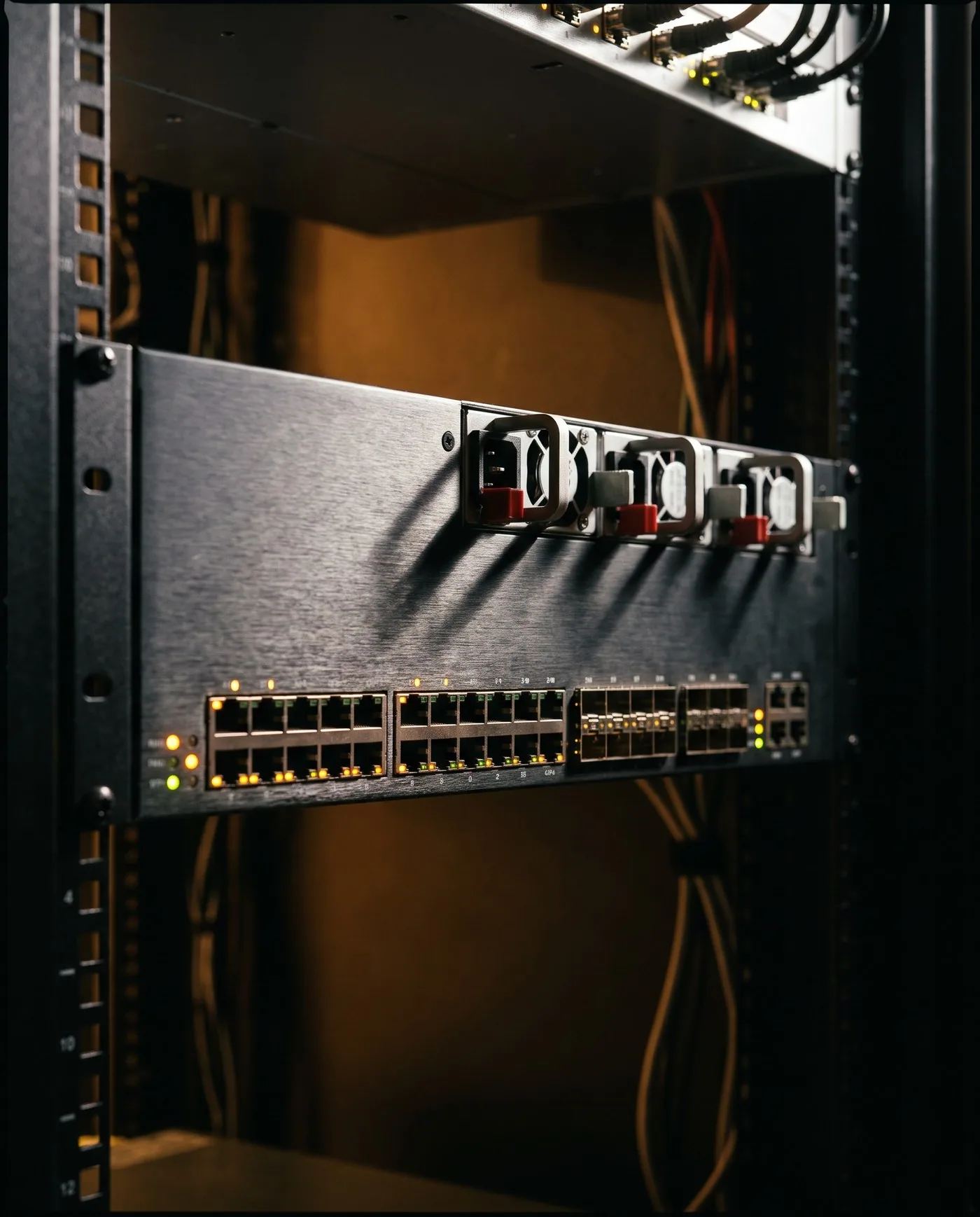
| Aspect | Detection-only stack | Recovery-ready approach |
|---|---|---|
| Design assumption | Keep attackers out | Assume a breach and plan recovery |
| Backups | Online, rarely tested | Immutable, offline, regularly rehearsed |
| Containment | Flat network | Segmentation limits lateral movement |
Educational comparison — not about any specific installer.
/ The discipline, in detail
How we approach network security.
Most network-security stacks fail not at detection but at recovery. We design with the assumption that the bad day will arrive and the question will be how quickly the organisation is back online. Segmentation that contains lateral movement, EDR on every endpoint that matters, immutable backups stored offline, and a runbook that names the human who picks up the phone at three in the morning. The firewall is necessary but not sufficient.
For an owner, the decision that matters is not which firewall but who is accountable on the worst day, and how fast the organisation is back. We scope the posture around real recovery-time tolerance — what must return within the hour, what can wait until morning, and who holds the offline backup and the runbook. Segmentation and endpoint detection limit how far an intrusion travels; immutable, regularly tested backups decide whether a bad day is an incident or a closure. We design to the compliance regime the sector actually answers to, and we rehearse the recovery rather than assume it.
On record
Every network security engagement is documented end-to-end — design, programming, commissioning, calibration — and handed over with the files our successors would need if we were never to return.
/ Segmentation
Boundaries by design
The same three-tier topology, read as a security document — where VLAN boundaries, firewall policy and management planes are drawn.
Diagram · described
Three-tier network topology
A generic enterprise network topology showing a redundant core pair, a distribution layer of stacked switches, and an access layer fanning out to Wi-Fi access points, IP cameras, IP phones and POE-powered building-services endpoints. Brand-neutral pattern — actual project topologies vary with scale and brief.
Diagrammatic view — a system planning illustration for design discussion, not a project drawing or live interface.
/ Where we deploy this
Active across 5 sectors.
Network Security is rarely a standalone brief — it sits inside a wider sector practice with its own codes, expectations and operating rhythm.
/ Sister services
The rest of it.
A serious brief usually crosses two or three of these. Read across the discipline — we deliver them as one contract.
- 01
EPABX & IP-PBX
Voice, routed cleanly.
Enterprise voice — IP-PBX, SIP trunking, hosted UC and hospitality PMS integrations — Grandstream, NEC, Cisco and Yeastar.0 - 02
Enterprise Network Design & Installation
Wires the building's nervous system.
Structured cabling, Wi-Fi 7, switching, SD-WAN and data-centre networking — Cisco, HPE Aruba, Juniper, Netgear, CommScope.1 - 03
Structured Cabling
Backbones rated for the next quarter-century.
Cat6A, OS2 and OM4/OM5 structured cabling — designed to TIA-568, terminated to manufacturer warranty and labelled to a documented patch schedule.2 - 04
Enterprise Wi-Fi
Coverage you can measure, not just claim.
Wi-Fi 7 and Wi-Fi 6E enterprise wireless — Cisco, Aruba, Juniper Mist, Netgear — site-surveyed to the building's actual cell-edge SNR.3 - 06
Servers, Storage & Data Centre
On-prem, hybrid and edge — sized for actual workload.
Server and storage architecture — Dell, HPE, Lenovo, Pure, NetApp — for on-prem and hybrid workloads, including precision cooling, rack design and DR.4 - 07
Video Conferencing Infrastructure
Reliability beats features.
Cloud, on-prem and hybrid VC — Microsoft Teams, Zoom, Google Meet, Cisco Webex — with bridges, gateways, recording and transcription infrastructure.5 - 08
Digital Library & RFID Automation
The whole collection, tracked and self-service.
RFID-based library automation — tagging of books and media, self-issue and self-return kiosks, EAS security gates, handheld inventory readers and drop-box automation, integrated with the library-management software.6 - 09
Smart Rack & Precision Cooling
A server room, contained in one cabinet.
Self-contained smart racks — a sealed cabinet with close-coupled precision cooling, in-rack UPS, environmental and access monitoring, and optional integrated fire detection and suppression — for edge and server-room sites without a full data-centre room.7
/ Integration with
How network security talks to the rest.
A serious deployment of this system rarely operates in isolation. The disciplines below most commonly share its cabling pathways, its controller logic, and its cause-and-effect matrix.
Structured Cabling
Backbones rated for the next quarter-century.
Cat6A, OS2 and OM4/OM5 structured cabling — designed to TIA-568, terminated to manufacturer warranty and labelled to a documented patch schedule.Enterprise Wi-Fi
Coverage you can measure, not just claim.
Wi-Fi 7 and Wi-Fi 6E enterprise wireless — Cisco, Aruba, Juniper Mist, Netgear — site-surveyed to the building's actual cell-edge SNR.Servers, Storage & Data Centre
On-prem, hybrid and edge — sized for actual workload.
Server and storage architecture — Dell, HPE, Lenovo, Pure, NetApp — for on-prem and hybrid workloads, including precision cooling, rack design and DR.Centralised CCTV Monitoring
Many sites. One monitoring picture. Stated limits.
Head-office monitoring across branch sites commissioned years apart on different recorders — surveyed site by site, then built on what each recorder actually exposes.
/ Read deeper
The engineering, in long form.
Each article below goes deeper than this service page can — a full walk-through of the engineering decisions, written by the team that delivers this work.
- AV · 9 min
AV-over-IP deployment realities: network discipline is the binding constraint, not the codec choice
AV-over-IP is a network deployment that happens to carry AV. The codec choice, the platform brand and the encoder count are the visible decisions; the multicast routing, the IGMP snooping, the QoS marking, the VLAN segregation and the BFD discipline are the invisible decisions that decide whether the deployment works. Why network discipline outweighs codec choice on real projects.
Read article - ELV · 11 min
Eight ELV integration mistakes that survive into commissioning — and how to catch them earlier
ELV integration faults rarely surface in design review or installation — they survive into commissioning because the seam-level coordination is nobody's contractual responsibility. The eight failure modes we see most often, and the design-stage discipline that catches each one before it becomes a snag list at handover.
Read article
Engineering decisions
Compare the options
Decision · Networking & IT
Managed Wi-Fi vs consumer mesh — the right wireless for the building
You are deciding the wireless class for a home, office, retail or hospitality space and want it matched to the real client load and ownership model.
Decision · Networking & IT
On-premises IP PBX vs cloud telephony
You are deciding where the call platform should live for a site whose voice has an operational job, not just a desk-phone job.
Decision · Security & Surveillance
DVR vs NVR — which CCTV recorder architecture to specify
You are choosing the recording architecture for a CCTV system and want it matched to the cabling that exists, the resolution required and how the system will grow.
Engineering toolkit
Tools to scope this work
Calculators and reference checkers we use ourselves to sense-check the engineering before any drawings change hands.
- IT · Networking
Network & PoE Calculator
Sized to year-three load — switches, Wi-Fi 7 access points, PoE budget (watts), Cat6A run count, port/AP sizing. Cisco / HPE Aruba / Juniper-class enterprise gear.
Switches · APs · PoE WOpen - Life-safety · 28 states + 8 UTs
NBC Fire-Safety by State
State or union territory, building height and occupancy in — list of sprinkler, voice-evac PA, wet-riser and Fire-NOC triggers out, with explicit source-status tiering across all 28 Indian states and 8 union territories.
NBC 2016 · state ruleOpen - Life-safety
NBC Compliance Checker
Building height, type and occupancy in — the life-safety and ELV systems NBC 2016 indicates for that building, citing NBC 2016 and the relevant IS codes.
NBC 2016 · IS codesOpen
/ Engineering concepts
Related engineering concepts
Concept
Cat6A Structured Cabling
Augmented Category 6 structured cabling — 10 Gbps over the full 100 m channel, rated for 25 years of service. The default for any new commercial or premium-residential cabling layer.
Concept
Wi-Fi 7 (IEEE 802.11be)
Current generation of Wi-Fi. Adds 6 GHz band, MLO multi-link operation and 320 MHz channels. Default for new premium deployments where dense-room capacity is the binding constraint.
Concept
Power over Ethernet (IEEE 802.3)
IEEE-standard delivery of low-voltage DC power over the same Cat-class cable as data. PoE+ delivers up to 30 W; PoE++ Type 3/4 up to 90 W — sufficient for IP cameras, APs, VOIP phones and small displays.
Concept
Honeywell Building & Security Ecosystem
Honeywell BMS (Niagara framework), Pro-Watch access control and addressable fire-alarm — used as the supervisory and life-safety backbone for premium commercial and hospitality buildings.
/ Used alongside
Commonly deployed alongside
Sector
Industrial & Warehousing
Operations that don't take a day off.
Sector
Commercial & Corporate
Workplaces that begin meetings on time.
Service
Enterprise Network Design & Installation
Wires the building's nervous system.
Service
Structured Cabling
Backbones rated for the next quarter-century.
Service
CCTV & Surveillance
Coverage. Storage. Evidence.
Sector
Hospitality
Guest experience, engineered.
/ Plan it right
Network Security — getting the brief right.
Common mistakes to avoid
- Treating the firewall as the whole answer while the network stays flat — one compromised device should not be able to reach everything.
- No written recovery objective — which systems must return within the hour and which can wait — so the design defends everything equally and nothing adequately.
- Backups that are online, on the same network and never restore-tested — discovered on exactly the day they were bought for.
- Leaving cameras, BMS controllers and access panels on the corporate network without segmentation — ELV devices are the least-patched things in the building.
- No named owner for the incident runbook, so detection exists but the response at three in the morning is improvised.
What to share before a quotation
- A picture of the current network — topology, firewall, switching and remote access as they stand.
- The systems and data that matter most, and how long the organisation can tolerate losing each.
- The compliance regime the sector answers to, if any.
- The backup arrangement today — what is backed up, where it lives, and when a restore was last tested.
- Who runs IT day to day — in-house team, external support, or a mix.
/ Frequently asked
Network Security — what buyers ask first.
MDR or SIEM in-house?
Under 500 employees, managed detection-and-response (MDR) is the right call — the talent cost of running a 24/7 SOC in-house rarely makes sense at that size. Above 500 employees, hybrid MDR-plus-internal-SOC begins to pay back.
What's the right firewall for a typical SMB?
FortiGate, Palo Alto Networks PA-series, or Cisco. For small branch sites, a cloud-managed Cisco appliance is excellent (simple, low ops overhead). For headquarters, FortiGate offers the best price-performance with strong threat intelligence. Palo Alto is the premium tier with the deepest application-aware controls.
What does zero-trust architecture mean in practice?
Every request is authenticated regardless of network location — there is no 'inside the firewall' implicitly trusted zone. Practical implementation: identity-driven access (single sign-on with MFA), device-posture checks before network admission, and micro-segmentation that contains lateral movement. We design to zero-trust principles for any new deployment in 2026.
How do we approach endpoint protection?
EDR or XDR (CrowdStrike Falcon, SentinelOne, Microsoft Defender for Endpoint) on every endpoint that matters. Anti-virus alone is no longer sufficient; behaviour-based detection catches modern malware that signature-based scanners miss. We deploy and integrate with the SIEM for centralised visibility.
What about backup and ransomware recovery?
Immutable, offline-capable backups stored on infrastructure that cannot be modified by a compromised primary network. Veeam, Rubrik or Cohesity to a Wasabi or backblaze cold-storage tier with documented recovery testing. The most important security investment many organisations have not yet made.
How often should we run penetration testing?
Annually at minimum; semi-annually for regulated and high-value organisations. We coordinate with independent penetration-test firms (we don't audit our own work) and the findings flow into a remediation plan with documented closure dates. This is part of the AMC programme for premium clients.
Which firewall brands does TechnoGuru work with?
We work with Fortinet, Sophos and Cisco firewalls, matched to the branch or headquarters role rather than fixed in advance. A small branch site and a headquarters call for different sizing and management models, so the platform follows the deployment. Final make and model are selected after the survey, endpoint count, bandwidth and security policy are reviewed.
How is a firewall sized for a site?
Sizing follows the throughput the site actually needs with inspection enabled, the concurrent-session and user counts, the internet links to be terminated, and the headroom for growth — not the headline number on a datasheet. We size against a survey of the endpoints, bandwidth and the security features to be run. We do not promise a specific inspected-throughput or capacity figure before the design is validated for the site.
How do you separate guest, staff and building-system traffic?
Segmentation is enforced through VLAN policy on the firewall and switching so guest, staff, voice, CCTV and building-system traffic stay isolated, with guest traffic on a captive portal and no path to internal systems. The policy is designed around the realistic access pattern and the client's security requirement rather than a generic template. It is agreed in writing and validated on site, and no security outcome is promised in the abstract.
· Begin
Begin a
network security
brief.
Tell us about the building, the timeline, and what success looks like a year after handover. We will reply within two working days with a written response, not a sales pitch.