
01 / 09
Case file
Enterprise voice — IP-PBX, SIP trunking, hosted UC and hospitality PMS integrations — Grandstream, NEC, Cisco and Yeastar.
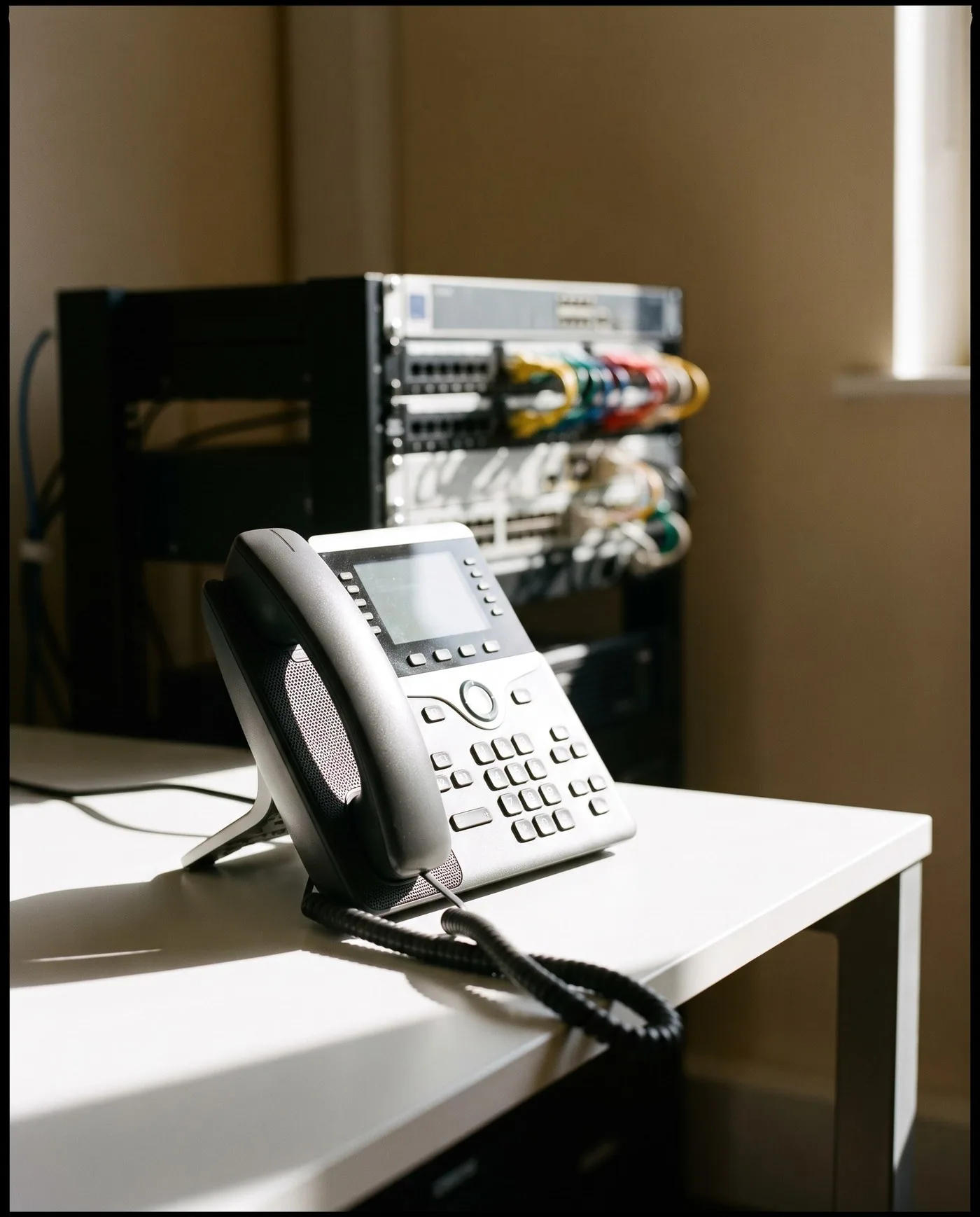
| Factor | Hosted / cloud PBX | On-prem IP-PBX |
|---|---|---|
| Typical fit | Smaller new deployments | Larger estates, or regulated sectors |
| Internet dependency | Needs reliable connectivity | Call continues through an internet outage |
| Data residency | Provider-hosted | Stays on-site where residency rules apply |
Educational comparison — not about any specific installer.
/ The discipline, in detail
How we approach epabx & ip-pbx.
Voice infrastructure is rarely glamorous and never optional. We design extension plans, hunt groups, IVR menus, voicemail-to-email flows and PMS check-in/check-out triggers per the property's actual operating model. SIP trunks are sized to peak concurrent calls, not the brochure number. Hosted UC is offered where it lowers TCO; on-prem stays where data residency or call-volume economics warrant it.
In hospitality and healthcare the phone system is an operations tool, not a utility — check-in, room-status, nurse-call and emergency-line flows all run through it. We map the dial plan, hunt groups and PMS triggers to how the front desk and clinical teams actually work, then size SIP trunks and failover so a single circuit outage does not silence the building. Where a hosted platform lowers total cost we say so; where call volume or data residency favours on-prem we keep it there — and we document the migration path either way so the choice is reversible.
On record
Every epabx & ip-pbx engagement is documented end-to-end — design, programming, commissioning, calibration — and handed over with the files our successors would need if we were never to return.
/ Where we deploy this
Active across 4 sectors.
EPABX & IP-PBX is rarely a standalone brief — it sits inside a wider sector practice with its own codes, expectations and operating rhythm.
/ Sister services
The rest of it.
A serious brief usually crosses two or three of these. Read across the discipline — we deliver them as one contract.
- 02
Enterprise Network Design & Installation
Wires the building's nervous system.
Structured cabling, Wi-Fi 7, switching, SD-WAN and data-centre networking — Cisco, HPE Aruba, Juniper, Netgear, CommScope.0 - 03
Structured Cabling
Backbones rated for the next quarter-century.
Cat6A, OS2 and OM4/OM5 structured cabling — designed to TIA-568, terminated to manufacturer warranty and labelled to a documented patch schedule.1 - 04
Enterprise Wi-Fi
Coverage you can measure, not just claim.
Wi-Fi 7 and Wi-Fi 6E enterprise wireless — Cisco, Aruba, Juniper Mist, Netgear — site-surveyed to the building's actual cell-edge SNR.2 - 05
Network Security
Segmentation. Visibility. Recoverable backups.
Next-generation firewalls, segmentation, NAC, EDR, SIEM and backup — Fortinet, Palo Alto, Sophos, Check Point — designed to how breaches actually unfold, not how vendors describe them.3 - 06
Servers, Storage & Data Centre
On-prem, hybrid and edge — sized for actual workload.
Server and storage architecture — Dell, HPE, Lenovo, Pure, NetApp — for on-prem and hybrid workloads, including precision cooling, rack design and DR.4 - 07
Video Conferencing Infrastructure
Reliability beats features.
Cloud, on-prem and hybrid VC — Microsoft Teams, Zoom, Google Meet, Cisco Webex — with bridges, gateways, recording and transcription infrastructure.5 - 08
Digital Library & RFID Automation
The whole collection, tracked and self-service.
RFID-based library automation — tagging of books and media, self-issue and self-return kiosks, EAS security gates, handheld inventory readers and drop-box automation, integrated with the library-management software.6 - 09
Smart Rack & Precision Cooling
A server room, contained in one cabinet.
Self-contained smart racks — a sealed cabinet with close-coupled precision cooling, in-rack UPS, environmental and access monitoring, and optional integrated fire detection and suppression — for edge and server-room sites without a full data-centre room.7
/ Where this system has been deployed
EPABX & IP-PBX on the ground.
The reference projects below carry a epabx & ip-pbx layer engineered as part of an integrated stack. Each case study walks through the engineering challenges that were solved, the standards the work was held to, and the operational outcome on the day-two team.
- Completed · Handover 2024
Tinsukia Medical College & Hospital
Healthcare · Government · Tinsukia, Assam
- Completed · Handover 2025
Taraghar — State Guest House
Government · State Guest House · Shillong, Meghalaya
- Completed · Handover 2021
Assam State Guest House, Koinadhara
Government · Protocol Residence · Guwahati, Assam
Public project summaries describe systems and outcomes only — BOQ values, quantities, device counts and security layouts are kept off public surfaces.
Request a feasibility review/ Integration with
How epabx & ip-pbx talks to the rest.
A serious deployment of this system rarely operates in isolation. The disciplines below most commonly share its cabling pathways, its controller logic, and its cause-and-effect matrix.
Structured Cabling
Backbones rated for the next quarter-century.
Cat6A, OS2 and OM4/OM5 structured cabling — designed to TIA-568, terminated to manufacturer warranty and labelled to a documented patch schedule.Nurse Calling System
Patient request to nurse response. Documented.
IP-based nurse call systems with bedside, bathroom, code-blue and staff-presence stations, integrated with mobile and PA.Network Security
Segmentation. Visibility. Recoverable backups.
Next-generation firewalls, segmentation, NAC, EDR, SIEM and backup — Fortinet, Palo Alto, Sophos, Check Point — designed to how breaches actually unfold, not how vendors describe them.
/ Read deeper
The engineering, in long form.
Each article below goes deeper than this service page can — a full walk-through of the engineering decisions, written by the team that delivers this work.
Engineering toolkit
Tools to scope this work
Calculators and reference checkers we use ourselves to sense-check the engineering before any drawings change hands.
- Life-safety
NBC Compliance Checker
Building height, type and occupancy in — the life-safety and ELV systems NBC 2016 indicates for that building, citing NBC 2016 and the relevant IS codes.
NBC 2016 · IS codesOpen - Life-safety · 28 states + 8 UTs
NBC Fire-Safety by State
State or union territory, building height and occupancy in — list of sprinkler, voice-evac PA, wet-riser and Fire-NOC triggers out, with explicit source-status tiering across all 28 Indian states and 8 union territories.
NBC 2016 · state ruleOpen - IT · Networking
Network & PoE Calculator
Sized to year-three load — switches, Wi-Fi 7 access points, PoE budget (watts), Cat6A run count, port/AP sizing. Cisco / HPE Aruba / Juniper-class enterprise gear.
Switches · APs · PoE WOpen
/ Engineering concepts
Related engineering concepts
Concept
Hospitality Guest-Room Archetype
Per-room operational unit with PMS-integrated control, scene reset between stays, housekeeping mode, do-not-disturb propagation and multi-language bedside signage.
Concept
Honeywell Building & Security Ecosystem
Honeywell BMS (Niagara framework), Pro-Watch access control and addressable fire-alarm — used as the supervisory and life-safety backbone for premium commercial and hospitality buildings.
Concept
Command-and-Control Facility Archetype
Three-envelope facility: perimeter screening, surveillance + communication, command + briefing. Per-envelope power and earthing strategy; hand-off boundaries between envelopes; operator console correlates events across all three.
Concept
Wi-Fi 7 (IEEE 802.11be)
Current generation of Wi-Fi. Adds 6 GHz band, MLO multi-link operation and 320 MHz channels. Default for new premium deployments where dense-room capacity is the binding constraint.
/ Used alongside
Commonly deployed alongside
Service
Fire Alarm System
Detection that pinpoints. Response that is coordinated.
Sector
Hospitality
Guest experience, engineered.
Service
CCTV & Surveillance
Coverage. Storage. Evidence.
Sector
Commercial & Corporate
Workplaces that begin meetings on time.
Sector
Healthcare
Hospitals where systems serve the patient.
Service
Enterprise Network Design & Installation
Wires the building's nervous system.
/ Plan it right
EPABX & IP-PBX — getting the brief right.
Common mistakes to avoid
- Sizing SIP trunks to the extension count instead of the peak concurrent calls the organisation actually makes.
- Migrating to IP telephony without assessing the network first — voice rides the LAN, and a congested LAN becomes broken calls.
- Designing the dial plan from an organisation chart instead of sitting with the people who actually answer the phones.
- Forgetting the analogue stragglers — lifts, gates, fax lines, alarm diallers — that still need ports after the migration.
- Ignoring power-failure behaviour — the phone system should still be answering when the grid is not, which means UPS coverage for the PBX and its switches.
What to share before a quotation
- Extension count and locations, and the peak concurrent-call estimate.
- The current system — extensions, trunks, what works and what hurts.
- The call workflows that matter — reception routing, hunt groups, IVR, recording.
- PMS or clinical integration scope for hospitality and healthcare properties.
- Network readiness — switching, PoE, VLANs and UPS coverage for voice.
/ Frequently asked
EPABX & IP-PBX — what buyers ask first.
On-prem PBX or cloud PBX in 2026?
Cloud PBX is the default for new deployments under 200 extensions. On-prem stays sensible above 500 extensions, in regulated sectors with data-residency rules, or in properties with intermittent internet (where the call must continue through the outage).
EPABX or IP-PBX — which should we deploy?
IP-PBX is the right answer for any new install in 2026. SIP trunks have replaced ISDN for nearly all enterprises; the cost-per-extension is lower; integration with video conferencing, mobile clients and recording is built-in. We retain EPABX hardware only where existing extensions and analogue lines are too embedded to migrate.
How many extensions can a typical IP-PBX support?
Grandstream UCM630x supports 3,000 extensions and 450 concurrent calls — sufficient for most hospitals and hotels. Alcatel-Lucent OXO Connect scales similarly. Above that scale we deploy distributed clusters; below that scale we deploy a single appliance with redundant power.
Do IP phones need PoE switches?
Yes — modern IP phones (Grandstream, Alcatel, Yealink) all draw power from the network port. We design the network with sufficient PoE budget on day one — a typical 24-port PoE+ switch handles 24 phones plus 8 access points. Sizing for year-three growth is part of the design.
Can the PBX integrate with our CRM?
Yes — modern IP-PBX platforms expose APIs and SIP-based call-event hooks that integrate with Salesforce, HubSpot, Zoho CRM and most internal CRMs. Caller-ID lookup against the customer record, call logging and click-to-dial are standard features we configure on most enterprise deployments.
What's the lifecycle of an IP-PBX deployment?
Hardware lasts 7–10 years; firmware refresh cycle is 2–3 years. We track firmware and configuration baselines offline so a hardware refresh is a same-day cutover rather than a multi-week rebuild. End-of-life on a major version is signalled 18 months in advance through our AMC programme.
Which EPABX and IP-PBX brands does TechnoGuru work with?
We work with Alcatel-Lucent Enterprise (ALE), Syntel, NEOS, Grandstream and Cisco across hospitality and corporate deployments, matched to extension count, trunk plan and integration needs. Hotel EPABX and corporate IP-PBX often call for different families, so the platform is chosen against the operating model rather than fixed in advance. Final make and model stay subject to the extension and SIP plan, PMS or CRM requirement and availability.
Can the phone system integrate with our hotel PMS?
Yes — hospitality PBX platforms integrate with the property-management system so check-in, check-out, wake-up calls, room status and call accounting flow between the two through a documented interface. Which platform fits depends on the PMS in use and the room count, so we scope the integration against the actual property. Share the PMS and extension details through /contact for a written scope.
How do we migrate from analogue extensions to IP without disruption?
Analogue-to-IP migration is usually staged — SIP trunks and an IP-PBX run alongside the existing analogue extensions, and stations move across in planned batches so no floor loses service during the cutover. The sequence depends on the extension count, the trunk or SIP plan and the cabling in place. We design the migration against a survey rather than a walk-through and hand over a documented cutover plan.
· Begin
Begin a
epabx & ip-pbx
brief.
Tell us about the building, the timeline, and what success looks like a year after handover. We will reply within two working days with a written response, not a sales pitch.