
Lighting Scenes — Smart Home Lighting Control Interactive
— Interactive · live scene state
One panel. The whole apartment responds.
Tap a scene. Every circuit, shade, AC zone and AV source shifts at once.
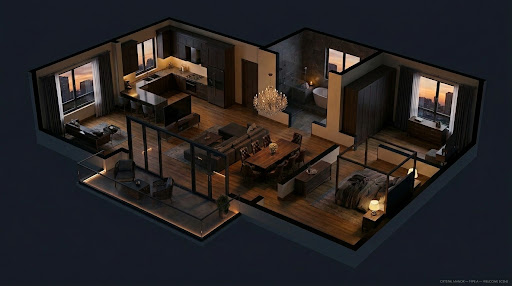
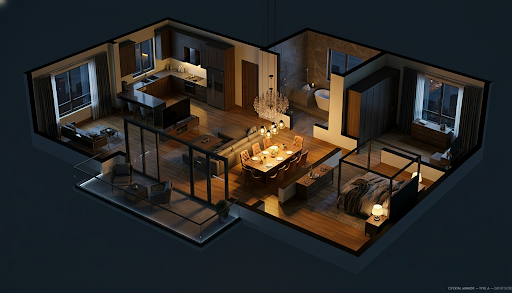
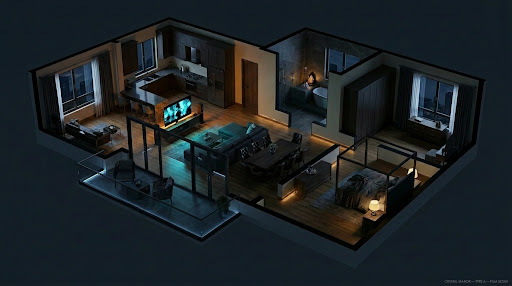
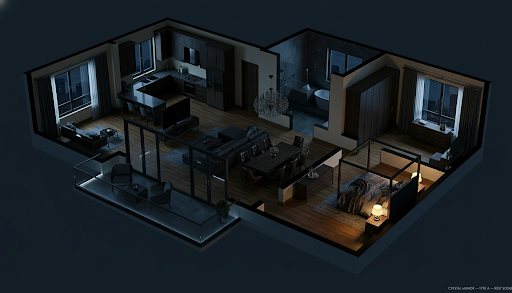
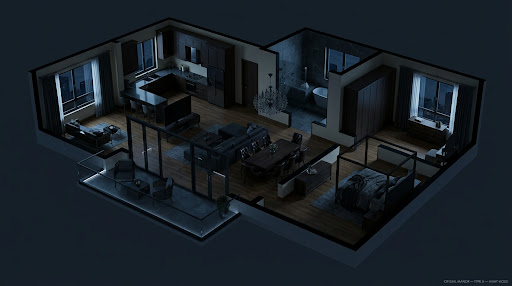
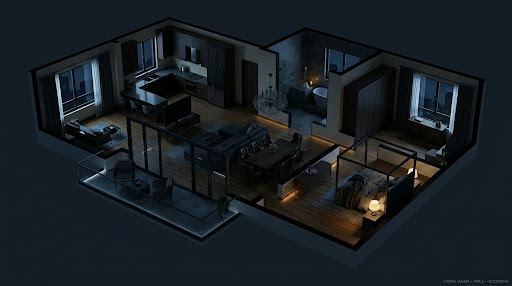
· Engineering advisory · Lighting Scenes
What a scene is, behind the panel.
A scene is the result of 84 control points moving in concert. The hidden engineering — the protocol stack, the failure-mode isolation, the configuration baseline, the in-house programming maturity — is what decides whether the scene works in year three.
01 · Deployment observations
Deployment observations
The observations3 notes — engineering detail behind this section
- Scene state is a discrete, named operation on the KNX bus — Welcome, Dinner, Film, Rest, Away, Goodnight — not an ad-hoc transition. Each scene's per-circuit values, transition time and dependency on other systems (HVAC, AV, security) is engineered explicitly.
- DALI handles the lighting bus; KNX TP1 carries scene state and setpoints; Rako Wireless overlays handle retrofit zones — each layer does what it does best, the failure modes localise per layer, the operator sees one keypad UI.
- Six to eight scenes is the practical pattern for a 4 BHK; the family uses two or three daily and the rest cover defined moments. Tuning happens at commissioning against the family's actual rhythm, not at design.
02 · Commissioning discipline
Commissioning discipline
Read the commissioning discipline2 notes — engineering detail behind this section
- Scene tuning is a multi-evening exercise with the family at home — empty-house scene programming does not predict the lived-in experience. The transition times, the dimmer endpoints and the AC-zone coordination are walked against actual use.
- Configuration baseline (KNX .knxproj, Rako .pro, DALI gateway config) is exported offline at commissioning and after every change — a panel swap or controller fault is a same-day exercise against the saved baseline.
03 · Operational notes
Operational notes
Read the operational notes2 notes — engineering detail behind this section
- Homeowner-app edits cover zone re-allocation and fixture changes without an engineer visit; topology changes route through the practice — the boundary is the rule, not the exception.
- Scene drift after a brand-firmware refresh is a known failure mode — the AMC visit re-validates the scene library against the post-release behaviour and rolls back if the drift is material.
04 · Lifecycle implications
Lifecycle implications
Read the lifecycle implications2 notes — engineering detail behind this section
- KNX as the backbone gives the residence a 20+ year operational horizon and vendor independence — any KNX-certified device can replace any other on the bus, with the configuration recoverable from the .knxproj file.
- Rako and Lutron are proprietary and carry vendor-lock over the same horizon; the building owner inherits the brand's roadmap. Each protocol's lifecycle is named in the contract, not assumed from the catalogue.
05 · Expansion readiness
Expansion readiness
Read the expansion readiness1 note — engineering detail behind this section
- Additional zones, additional scenes and Phase-2 integrations (security, intercom, BMS) sit on the KNX bus's reserved capacity — the backbone is engineered to hold expansion without re-cabling.
Verification status: Decision support — editorial logic, no numeric claim · Methodology, assumptions and sources documented · reviewed 2026-08-30
· Engineering notes
How to read this tool’s output
Stage 1 (brief). Use during the first conversation to align on the level of scene programming an automated home delivers.
The assumptions, limits and reference architectures behind this
What an engineer should know
The assumptions behind the numbers this tool produces.
- Reference 4 BHK plan with six scenes (Welcome, Dinner, Film, Rest, Away, Goodnight). Every circuit, shade, AC zone and AV source shifts in concert on a single keypad press.
When this tool is the right one
The project moments and room types this is built for.
- Premium villa walk-through with architect and homeowner.
- Hospitality suite specification.
What changes the answer in practice
Field conditions that move the result away from the planning figure.
- Scene programming must be designed alongside the architectural plan — retrofit is significantly more constrained.
Defensible starting architectures
Vendor-neutral reference points, not a recommendation to buy — the right answer is the one that survives your site survey.
- Rako + KNX + DALI combined for premium residential where lighting, shade, climate and AV are unified.
Common mistakes
Failure patterns we see on real projects.
- Treating scenes as a software feature — they require the lighting layer to be physically zoned at the panel.
How this lands against adjacent systems
What else has to be agreed before this output is safe to build to.
- Scenes are commissioned, not auto-generated — every scene engraved on a keypad represents a programmed state.
Where this tool fits
The building types this output is calibrated for — and, where we have said so, the ones it is not.
Best suited for
The standards and technologies this touches
Reference pages for the protocols, standards and systems behind this tool’s output.
Compare the options ·
KNX vs wireless smart-home automation — the control backbone· Why it matters
A scene is not a button — it is the result of 84 control points moving in concert. Lights, shades, AC zones, AV sources, security, intercom. The panel hides the engineering; the engineering is the whole point. KNX as the backbone gives a 20–25+ year operational horizon and vendor independence; Rako handles the wireless retrofit overlays; DALI carries the lighting bus. This module shows what the engineering actually delivers.
· Frequently asked
Whole-home automation —
what people ask first.
Is this a real apartment?
The render is a reference 4 BHK — the scene framework, zone count and protocol decisions are the practice's standard for a residence of this class. We deploy variations of this scene framework across most premium projects.
Why KNX as the backbone instead of Rako-only?
KNX is an ISO/IEC 14543-3 open standard — published in 2006, with installed systems running well past two decades — with multi-vendor support. Rako and DALI sit as overlays on KNX where retrofit, wireless or specific lighting-bus advantages apply. For a building that will outlive its first integrator, the KNX decision pays itself back many times in the third decade.
How many scenes does a typical 4 BHK actually use?
Six to eight, in our experience. The owner uses two or three daily; the rest cover defined moments — guests, holidays, away mode, sleep. We tune the scene list during commissioning, not at design — what the family actually does dictates the panel, not what an integrator imagines.
Can the scenes be edited after handover?
Yes — without an engineer visit, through the homeowner app. Anything that does not change the underlying topology (zone re-allocation, fixture changes) is handled by the family. Topology changes route through us.
What does the lighting bus look like physically?
DALI 2 wired bus from each ceiling driver back to a central rack, with KNX TP1 carrying scene state and per-zone setpoints. Wireless retrofit zones (where opening up the ceiling was not on the table) sit on Rako Wireless and bridge to the same scene graph through a gateway.
Engineering toolkit
Next in this sequence
Calculators whose inputs or outputs connect to this one.
- Smart Home
Smart Home Discovery Wizard
For villa and apartment owners — pick your home, the zones that matter and the experiences you want, and map a coordination scope and room checklist. Not a final design, device count or security layout.
Advisory · discoveryOpen - AV · LED
LED Wall Size Calculator
Direct-view LED wall sizing across a source-cited model catalogue including Samsung, LG MAGNIT, Sony, Philips, Leyard, Absen, Unilumin, ROE Visual, AOTO, INFiLED, Daktronics, Planar, Nanolumens and more. Cabinet count, native resolution, brightness adequacy, power and weight — with pitch-vs-distance honesty and camera-refresh flags. Sources cited per model.
50 brands · pitch-awareOpen - AV · Projection
Projector Throw Distance Calculator
Engineering-grade throw distance calculator across a verified multi-brand projector catalogue — Sony, JVC, Epson, BenQ, LG, Optoma, ViewSonic, Panasonic, Barco, Christie, Canon, InFocus, Maxell, Casio, EIKI, Philips, Nebula, JMGO, Dangbei, Boxlight, ASUS, Leica, Xiaomi, WEMAX, Ricoh and more. Searchable picker, throw range, lens-shift envelope, viewing distance, pixel density, feasibility flags and a custom-throw fallback. Sources cited per model.
51 brands · sourcedOpen
· Begin
Building one of these
for your home?
Send the floor plan, the brand intent and the operational profile. We will write back within two working days with a scene framework, a protocol recommendation and a written lifecycle and maintenance summary.