
08 / 22
Case file
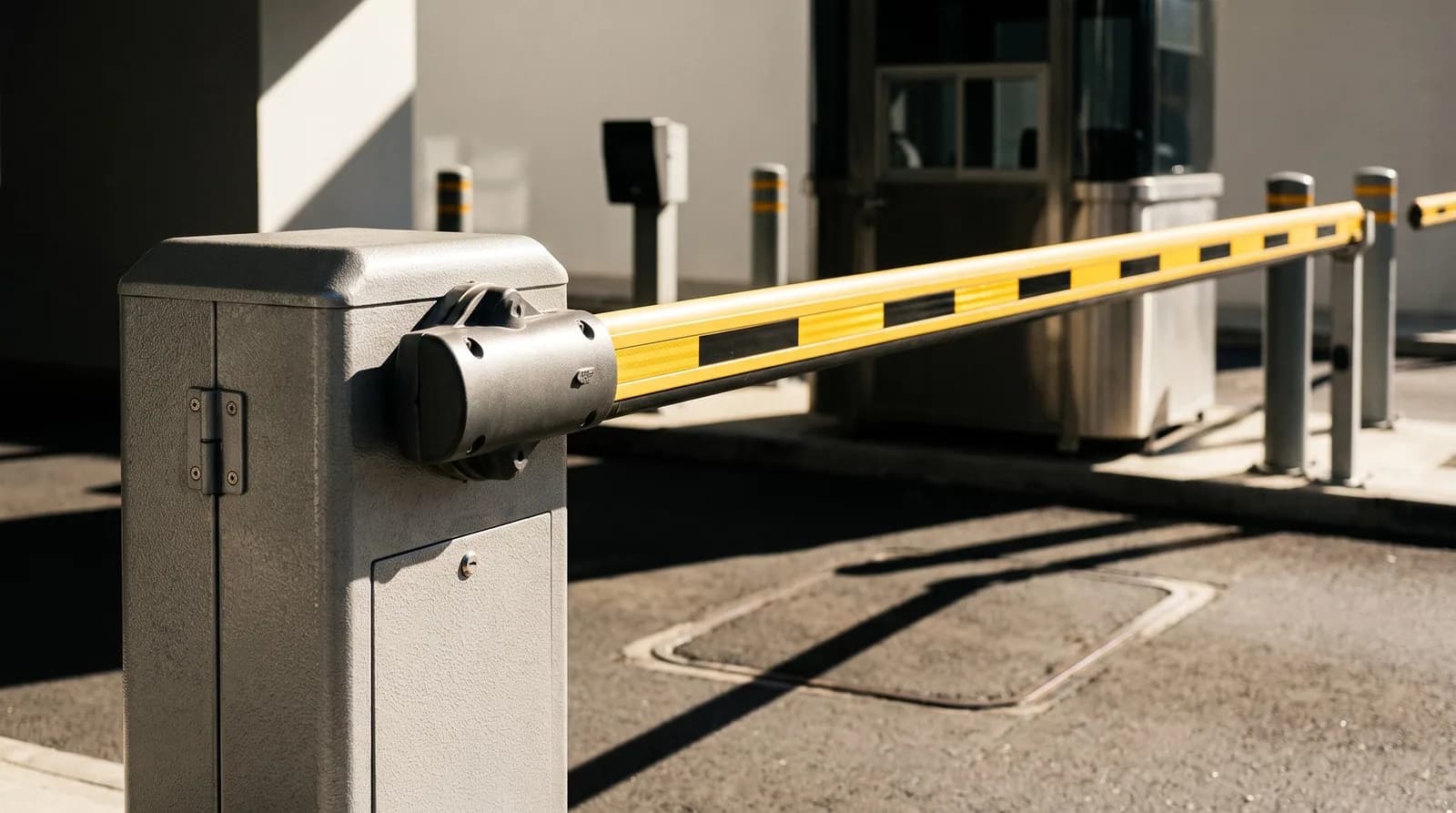
Boom barriers, sliding and swing gates, road blockers, bollards and turnstiles — integrated with ANPR, RFID and access control.
| Requirement | Catalogue-default approach | Engineered approach |
|---|---|---|
| Barrier speed | Chosen from the catalogue spec | Sized to peak vehicles-per-minute so the queue does not back up |
| Duty cycle | Generic | Matched to the cycles per day the gate will really see |
| Crash rating | Applied uniformly or not at all | Specified against a written, per-site threat assessment |
Educational comparison of design rigour — not a statement about any specific installer.
/ The discipline, in detail
How we approach boom barriers & motorised gates.
Vehicle entry is the single highest-throughput interaction at any property. We design barriers and gates to the actual peak flow — opening time, MCBF (mean cycles before failure), safety photocells, loop sensors and obstacle-detection. ANPR or RFID handles the credential read; the barrier handles the physical motion. Crash-rated bollards and road blockers are specified at K4/K8/K12 ratings where the threat profile demands.
Vehicle entry is where security meets traffic flow, and the two are usually in tension. We design the lane sequence — credential read, barrier motion, safety interlock — to the property's peak throughput so a morning rush never backs onto the public road, and we match the barrier's duty cycle and safety sensing to the cycles per day the gate will really see. Crash-rated protection is specified against a written threat assessment per site rather than applied uniformly, and the barrier layer is integrated with access control and ANPR so authorised vehicles flow while everything else is held for a decision — without publishing any of the coverage detail that belongs in the project file.
On record
Every boom barriers & motorised gates engagement is documented end-to-end — design, programming, commissioning, calibration — and handed over with the files our successors would need if we were never to return.
/ Where we deploy this
Active across 5 sectors.
Boom Barriers & Motorised Gates is rarely a standalone brief — it sits inside a wider sector practice with its own codes, expectations and operating rhythm.
/ Sister services
The rest of elv.
A serious brief usually crosses two or three of these. Read across the discipline — we deliver them as one contract.
- 01
CCTV & Surveillance
Coverage. Storage. Evidence.
IP video surveillance — Hikvision, Dahua, Axis, Bosch — designed to coverage, recording-bandwidth and retention specifications, with VMS and AI-analytics overlays.0 - 02
Access Control
Right person. Right door. Right time.
Card, biometric, mobile-credential and visitor-management — Honeywell, HID, Matrix and Suprema — integrated with CCTV, intrusion and HR systems.1 - 03
Fire Alarm System
Detection that pinpoints. Response that is coordinated.
Addressable and conventional fire detection and alarm — one of the three fire families (fire alarm, fire hydrant, fire extinguishers) — Honeywell, Bosch, Notifier and Siemens panels — integrated with PA, BMS, access control and emergency lighting to readiness per NBC, IS 2189 and NFPA 72, for consultant and AHJ review.2 - 04
Fire Hydrant System
High-volume water, precisely where it's needed.
Wet- and dry-riser hydrant systems — one of the three fire families (fire alarm, fire hydrant, fire extinguishers) — jockey-and-main pump rooms, yard hydrants and four-way fire-brigade inlets, engineered to readiness per NBC, IS 13039 and NFPA 14 for consultant and AHJ review.3 - 05
X-Ray Baggage Scanners
Operator confidence, in seconds.
Dual-energy X-ray baggage and parcel scanners for airports, hotels, government buildings, courts, malls and corporate lobbies.4 - 06
Under Vehicle Surveillance (UVSS)
Full-chassis scan, the moment a vehicle arrives.
Embedded high-resolution UVSS with ANPR and driver-occupant cameras — a critical first line of defence at every vehicle entry point.5 - 07
Door-Frame Metal Detectors
Quick, unobtrusive, accurate.
Multi-zone DFMDs with adjustable sensitivity, pinpoint LED indicators and networked logging — for hotels, courts, places of worship, malls and government buildings.6 - 09
Nurse Calling System
Patient request to nurse response. Documented.
IP-based nurse call systems with bedside, bathroom, code-blue and staff-presence stations, integrated with mobile and PA.7 - 10
Gas Suppression System
Fire put out without water touching the equipment.
Clean-agent and inert-gas fire suppression — the clean agent flooding system of consultant schedules — FM-200/HFC-227ea, fluoroketone-class NOVEC 1230, CO2 and inert-gas systems — for server rooms, data centres, archives, electrical and panel rooms and other spaces where water would do as much damage as the fire, engineered to readiness per NBC, relevant IS codes and NFPA 2001/12 for consultant and AHJ review.8 - 11
Fire Sprinkler System
Automatic water, only where the heat is.
Automatic water sprinkler systems — wet, dry, pre-action and deluge — engineered to readiness per NBC, relevant IS codes and NFPA 13, and coordinated with the fire-hydrant and fire-alarm systems for consultant and AHJ review.9 - 12
Emergency Lighting & Egress Signage
A lit, legible path out when the mains go dark.
Emergency and egress lighting with photoluminescent exit and wayfinding signage — self-test luminaires, central-battery systems and IS-compliant signage — designed so occupants can find and follow a marked route to a final exit when normal power fails, engineered to readiness per NBC and relevant IS codes for consultant and AHJ review.10 - 13
Fire Doors & Fire-Rated Shutters
The fire held at the doorway.
Fire-rated doorsets and rolling shutters — passive fire protection at compartment lines, staircases and service openings — with frames, closers, panic hardware and magnetic hold-open release coordinated with the fire alarm and the escape plan, supplied and installed where project-fit.11 - 14
Fire Extinguishers & Fire-Protection Goods
First response, within arm's reach.
Portable fire extinguishers — one of the three fire families (fire alarm, fire hydrant, fire extinguishers) — ABC dry powder, CO2, clean-agent, foam and water classes, with site-assessed placement, mounting, signage, refilling and AMC, along with related fire-protection goods and accessories.12 - 15
Automatic Tube Fire Detection & Suppression
Suppression born inside the cabinet.
Automatic Linear Pneumatic Tube Detection systems — enclosure-level fire detection and suppression for electrical panels, server and network racks, battery enclosures and machine cabinets — operating standalone without external power, in direct- and indirect-discharge configurations.13 - 16
Intrusion Detection & Alarm
Know the moment a boundary is crossed.
Intrusion and perimeter detection — door/window contacts, dual-tech motion sensors, glass-break, vibration and fence sensors, panic and alarm panels with app and central-station-ready monitoring — integrated with CCTV and access control.14 - 17
Intercom & Video Door Phone
See who's there before you open the door.
Intercom and video door phone (VDP) door-entry — audio and video door stations, indoor monitors, IP and 2-wire systems, lift and lobby intercom, apartment and villa door-entry — integrated with access control and mobile answer.15 - 18
Facial Recognition System
Recognised at the door. Logged, with consent.
AI face-recognition for access, attendance and surveillance — face-based entry, watchlist and VIP/denied-entry alerts — integrated with CCTV and access control on a consent-aware, privacy-respecting deployment.16 - 19
ANPR & Number-Plate Recognition
The plate decides the barrier.
Automatic number-plate recognition for gate automation, parking and visitor logging — plate-read cameras with watchlist alerts, integrated with boom barriers and access control.17 - 20
AI Video Analytics
What your cameras can actually carry.
Video analytics is a layer, not a product — it runs on whatever streams the cameras already on site can genuinely deliver.18 - 21
Centralised CCTV Monitoring
Many sites. One monitoring picture. Stated limits.
Head-office monitoring across branch sites commissioned years apart on different recorders — surveyed site by site, then built on what each recorder actually exposes.19 - 22
Fireman Talk-Back & Emergency Communication
Two-way communication that is supervised, not assumed.
Supervised fireman's telephone circuits and talk-back field stations — fixed jack points and handset outlets distributed through the building, calling a master console at the fire command point over dedicated two-wire circuits that are monitored, so a cut or a short shows up as a fault rather than as a surprise during an incident.20
/ Integration with
How boom barriers & motorised gates talks to the rest.
A serious deployment of this system rarely operates in isolation. The disciplines below most commonly share its cabling pathways, its controller logic, and its cause-and-effect matrix.
Access Control
Right person. Right door. Right time.
Card, biometric, mobile-credential and visitor-management — Honeywell, HID, Matrix and Suprema — integrated with CCTV, intrusion and HR systems.CCTV & Surveillance
Coverage. Storage. Evidence.
IP video surveillance — Hikvision, Dahua, Axis, Bosch — designed to coverage, recording-bandwidth and retention specifications, with VMS and AI-analytics overlays.Under Vehicle Surveillance (UVSS)
Full-chassis scan, the moment a vehicle arrives.
Embedded high-resolution UVSS with ANPR and driver-occupant cameras — a critical first line of defence at every vehicle entry point.
/ Read deeper
The engineering, in long form.
Each article below goes deeper than this service page can — a full walk-through of the engineering decisions, written by the team that delivers this work.
Engineering toolkit
Tools to scope this work
Calculators and reference checkers we use ourselves to sense-check the engineering before any drawings change hands.
- Readiness
Access Control Readiness Checker
A readiness self-check before a door-access or attendance conversation — door-survey status, credential considerations, integrations, privacy-policy and operations readiness. No door counts, layouts or reader placement; statuses only.
Advisory · readinessOpen - Site planning
Industrial & Tea-Estate Technology Planner
Site type, zones and what's ready in — which systems to coordinate (CCTV, PA, access, networking, UPS, fire/ELV), what to prepare and a readiness view out. Advisory; no counts, layouts or pricing.
Advisory · readiness · copyableOpen - AV · LED
LED Wall Size Calculator
Direct-view LED wall sizing across a source-cited model catalogue including Samsung, LG MAGNIT, Sony, Philips, Leyard, Absen, Unilumin, ROE Visual, AOTO, INFiLED, Daktronics, Planar, Nanolumens and more. Cabinet count, native resolution, brightness adequacy, power and weight — with pitch-vs-distance honesty and camera-refresh flags. Sources cited per model.
50 brands · pitch-awareOpen
/ Engineering concepts
Related engineering concepts
Concept
High-Security ELV Stack
Coordinated perimeter screening (UVSS, ANPR, X-ray, RFID auto-recognition), control-room CCTV, EPABX-LAN backbone, per-load UPS topology, chemical-earthing strategy and hand-off boundaries to convenience features that run in parallel with screening.
Concept
VVIP Protocol Residence Archetype
Hilltop or guarded protocol residence hosting state guests and visiting dignitaries — perimeter screening (UVSS, ANPR, X-ray), control-room CCTV, EPABX-LAN, AV briefing room, addressable fire alarm, per-load UPS architecture. Uptime under multi-mode failure is the design brief.
Concept
Command-and-Control Facility Archetype
Three-envelope facility: perimeter screening, surveillance + communication, command + briefing. Per-envelope power and earthing strategy; hand-off boundaries between envelopes; operator console correlates events across all three.
Concept
Online (Double-Conversion) UPS
Double-conversion uninterruptible power supply. Rectifies AC to DC and inverts back to clean AC, isolating the load from grid disturbances. Default for mission-critical IT and life-safety equipment.
/ Used alongside
Commonly deployed alongside
Sector
Industrial & Warehousing
Operations that don't take a day off.
Service
CCTV & Surveillance
Coverage. Storage. Evidence.
Service
Fire Alarm System
Detection that pinpoints. Response that is coordinated.
Sector
Government & Public Safety
Mission-grade integration.
Service
Access Control
Right person. Right door. Right time.
Service
Online UPS
Clean power, isolated from grid reality.
/ Plan it right
Boom Barriers & Motorised Gates — getting the brief right.
Common mistakes to avoid
- Buying barrier speed and duty cycle from a catalogue instead of the gate's real peak vehicles-per-hour.
- Skipping safety sensing — loops, photocells, obstacle detection — where the barrier crosses pedestrian movement.
- No credential plan — the barrier is only as smooth as the RFID or ANPR read that precedes it, and visitor handling decides the queue.
- Ignoring power backup and the manual-release plan at the gate, so a grid failure leaves the entrance either stuck open or stuck shut.
- Applying crash-rated protection uniformly — or skipping it — instead of specifying it against a written threat assessment per site.
What to share before a quotation
- The gate positions and lane layout (shared privately).
- Peak traffic — vehicles per hour in and out, and the vehicle mix.
- The credential model — RFID tags, ANPR, and how visitors are handled.
- Pedestrian movement around each gate.
- Power availability at the gate, and the integration scope with access control and CCTV.
Equipment categories
See the equipment behind the solution.
Explore equipment we supply and the services around it. The final specification follows your space, operating needs and agreed scope.
/ Frequently asked
Boom Barriers & Motorised Gates — what buyers ask first.
How fast should a boom barrier open?
A high-speed boom barrier opens in 1.5–1.8 seconds for corporate gates at 200 vehicles/hour peak; 3-second barriers create queuing at that flow. We size barrier speed to peak vehicles-per-minute, not catalogue spec.
How many cycles per day can a premium boom barrier handle?
Premium barriers (Came, Nice, Magnetic Autocontrol) are rated for 3,000–10,000 cycles per day depending on duty class. A typical commercial gate runs 200–800 cycles. We specify duty class against year-3 expected flow, never to launch-day estimates.
How is the barrier interlocked with the rest of the gate sequence?
Through a documented logic in the access-control platform: ANPR confirms plate, UVSS confirms clean, access database confirms authorised, vehicle-detection loop confirms presence — only then does the barrier open. Loops on either side of the barrier prevent it from closing on a vehicle. Every interlock is programmed and tested at commissioning.
Crash-rated barriers — when are they appropriate?
For embassies, military bases and certain government and corporate HQs where vehicle-borne threat is part of the realistic threat model. Crash-rated bollards (M30, M50) and crash-rated barriers (PAS 68 / IWA 14 standards) are engineered to stop a 7,500 kg vehicle at 50 mph. The civil work for proper anchoring is significant; we coordinate with the structural consultant.
What's the AMC scope for a high-traffic gate?
Quarterly inspection (motor health, gearbox lubrication, induction-loop calibration, beacon and barrier-arm condition), annual full overhaul (motor brushes, gearbox seals, electronic-control replacement schedule), and contracted critical-hours support for high-traffic sites. We hold spare motors, controllers and arms for active deployments.
· Begin
Begin a
boom barriers & motorised gates
brief.
Tell us about the building, the timeline, and what success looks like a year after handover. We will reply within two working days with a written response, not a sales pitch.