
04 / 22
Case file
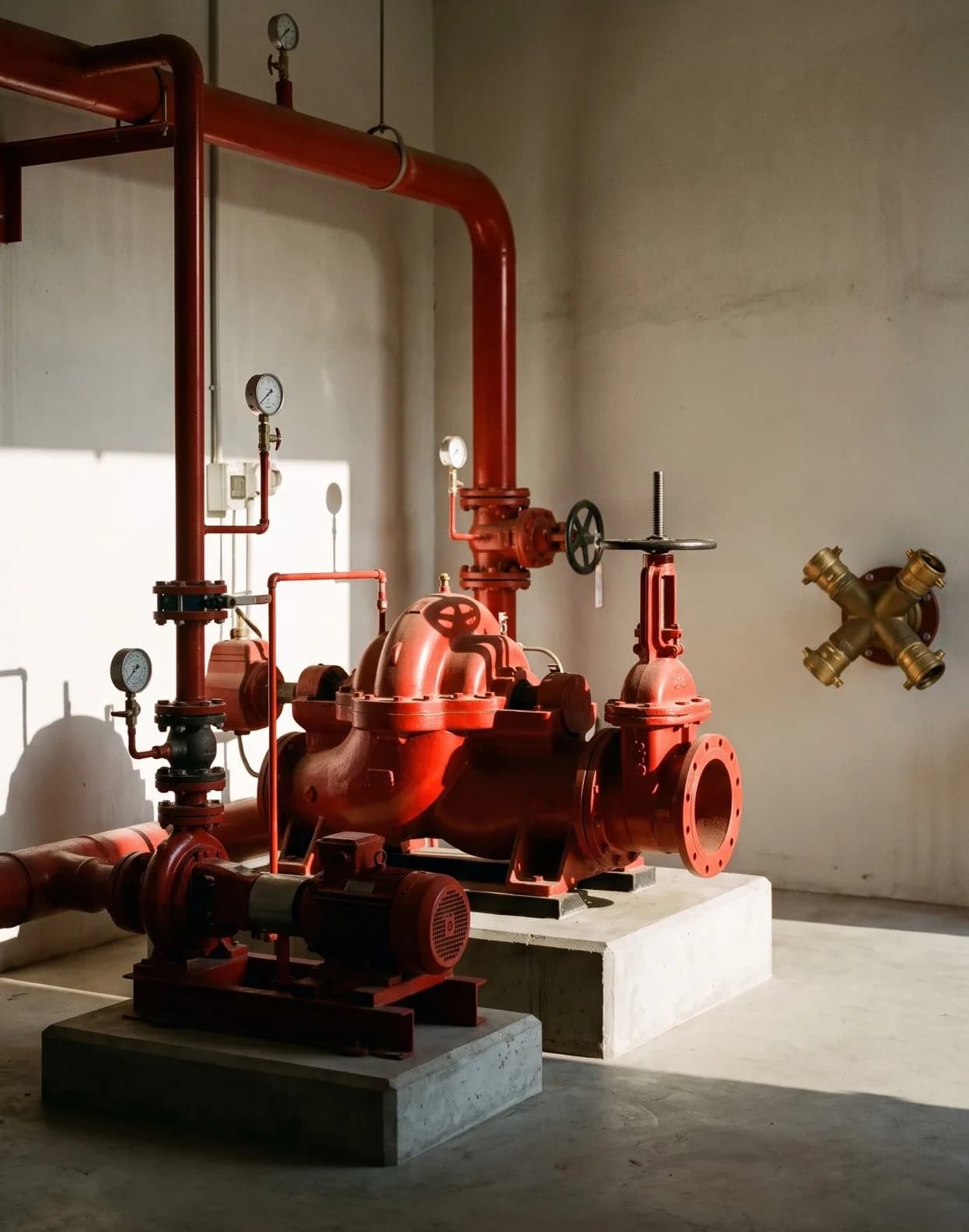
Wet- and dry-riser hydrant systems — one of the three fire families (fire alarm, fire hydrant, fire extinguishers) — jockey-and-main pump rooms, yard hydrants and four-way fire-brigade inlets, engineered to readiness per NBC, IS 13039 and NFPA 14 for consultant and AHJ review.
| Requirement | Rule-of-thumb approach | Engineered approach |
|---|---|---|
| Sizing basis | Pump and reservoir from supplier defaults | Derived from a hydraulic calculation at the worst-case outlet |
| Pump house | Single pump | Main, diesel standby and jockey, with auto-transfer and supervision |
| Network | Branch main | Ring main with sectional valves so one break does not isolate hydrants |
| Handover | Switched on | Witness-tested — every coupling and landing valve checked at design pressure |
Educational comparison of design rigour — not a statement about any specific installer.
How we approach it
Fire hydrant works, planned for readiness
Fire hydrant works are delivered as part of the fire family — alongside fire alarm and fire extinguisher works where applicable to project scope — and always within the limits of the drawings and the authority's review. Our role is readiness and coordination, not the final clearance.
- Part of the fire family
- Fire hydrant, fire alarm and fire extinguisher works are planned together where they fall within project scope, so the fire systems are coordinated rather than piecemeal.
- Scope, not site detail
- We align the scope and BOQ coordination against the consultant's drawings. Routing, zoning and quantities stay with the design set — we do not publish them.
- Readiness for review
- We prepare the works so they can be inspected; final clearance is the authority's decision. Verify with the AHJ / consultant before relying on any fire provision.
- Maintainable after handover
- Fire systems need ongoing attention to stay dependable, so upkeep can be planned as an AMC scope once the works are in service.
/ The discipline, in detail
How we approach fire hydrant system.
A hydrant network is one of the few systems in a building that should never be tested casually — and one of the few that absolutely must work the first time it is used in earnest. It forms part of the fire-safety scope alongside fire alarm and fire extinguisher works where applicable to project scope. We start every design with a hydraulic calculation that backs out from the worst-case outlet: the topmost landing valve at the furthest riser, holding code-mandated nozzle pressure with code-mandated flow. Pump-house sizing, jockey-and-main staging, riser diameter and reservoir capacity all follow from that single calculation — not from supplier rules of thumb.
On site, we treat the install as a witness-test exercise. Every coupling is pressure-checked, every landing valve flow-tested at the design pressure, and the static-and-running curves of the pump set are recorded against the spec. The AMC that follows is structured the same way — pump load tests on a calendar, hose pressure tests every twelve months, mock drills with the local fire-brigade where willing, and NOC paperwork prepared without you having to chase it. We deliver to readiness; final approval rests with the AHJ/consultant, so verify with the AHJ/consultant.
On record
Every fire hydrant system engagement is documented end-to-end — design, programming, commissioning, calibration — and handed over with the files our successors would need if we were never to return.
· Water path
From the stored water to the fire-fighting point
A hydrant network is a pressurised water path with a defined worst case. The design works backwards from the least favourable outlet, not forwards from the pump.
01
Static storage
Dedicated fire water held independently of the domestic supply, so a fire draw cannot be defeated by ordinary consumption.
02
Pump set
Jockey, main and standby pumps staged so small pressure losses are made up without starting the main set, and a main-set failure does not end the supply.
Four-way fire-brigade inlet
Lets an attending appliance pump into the network from ground level, independently of the building's own pump set.
03
Riser and ring main
Distribution sized by hydraulic calculation against the worst-case outlet, not by a rule of thumb.
04
Landing valves and yard hydrants
The outlets the fire service actually uses, positioned with the project's fire consultant.
05
Hose and fire-fighting point
The delivery end — hose reels and hose boxes kept serviceable, because the path is only as good as its last metre.
Indicative water path, not a project drawing. Capacities, sizing and outlet positions are established per building by hydraulic calculation, and final approval rests with the project's fire consultant and the authority having jurisdiction.
/ Three lenses on the same system
Read it the way you actually need it.
Three short readings of fire hydrant system — for a non-engineer who needs the picture, an engineer who needs the spec, and a buyer who needs to see the system in operation.
/ In simple terms
A fire-hydrant system is the building's emergency water grid — reservoir, pumps, risers and hydrants — sized so the firefighter at the worst-case landing valve still gets pressure and flow on the day they need it. Most of the engineering happens months before anyone sees a single hose: the hydraulic calculation, the reservoir sizing, and the pump-room layout. The maintenance discipline is what keeps it from being a museum piece.
/ Technical explanation
A fire-hydrant system designed to NBC, IS 13039 and NFPA 14 comprises a dedicated static-water reservoir sized to design flow × run-time, a triplex pump house (main electric + diesel standby + jockey), wet- and dry-risers terminating in landing valves at every floor, yard hydrants on a ring main at 30 m centres, four-way fire-brigade inlets, and 25 mm hose reels on every floor for first-attack. Hydraulic calculation backs out from the topmost-furthest landing valve at NBC-mandated nozzle pressure and flow. Pump-room is fire-compartmented, generator-priority, ATS-switched and supervised by the fire-alarm panel.
/ Real project usage
Our published fire-hydrant references are the Capital Cultural Hall, Kohima and the Town Hall, Dimapur. Our commissioning method treats the hydrant network as a witness-test exercise — couplings pressure-checked and landing valves flow-tested at design pressure, with the test record handed over in the commissioning pack.
/ System architecture
The layers, named.
Every layer below is engineered as one piece of the integrated stack. Each carries its own commissioning artefact and its own AMC inclusion.
- 01
Static-water reservoir — typically a dedicated underground or overhead tank sized against the design flow rate × required run-time per NBC. For a mid-rise commercial building (Group D2), 75,000–150,000 litres of dedicated firefighting water at 60-minute peak demand is typical; high-rise residential under the 2016 NBC amendment goes to 150,000–200,000 litres.
- 02
Pump house — main pump (electric, sized to deliver 100% of design flow at design head), standby pump (diesel, identical capacity, automatic transfer on main-pump failure), jockey pump (10–15% of main capacity, maintains line pressure between operations). Pump-house ventilation, drainage, and battery health for the diesel engine are explicit design line-items.
- 03
Wet riser — permanently charged from the pump room. Riser diameter sized hydraulically (typically 150 mm for mid-rise, 200 mm for high-rise), with landing valves on every floor at the protected staircase. NBC mandates wet risers above 15 m (low-rise) and 24 m (high-rise) building height.
- 04
Yard hydrants — pillar hydrants placed at 30 m intervals around the building perimeter on a ring main, with hose cabinets adjacent. Four-way fire-brigade inlets at ground level allow the brigade tender to charge the system from outside if the pump room is compromised.
- 05
Hose reels — 25 mm or 19 mm semi-rigid hose reels on every floor for first-attack firefighting before the brigade arrives. Reel length 30 m, nozzle pressure maintained at 2.0–3.5 bar at the worst-case outlet.
/ Design considerations
The decisions we take early.
- The first calculation is hydraulic — back out from the topmost landing valve at the furthest riser, holding NBC-mandated nozzle pressure (typically 3.5 kg/cm² at the most remote outlet for wet risers) with NBC-mandated flow (typically 900 lpm). Pump head and reservoir capacity are derived from that calculation, not from a supplier's rule of thumb.
- Pump room location — physically separated from the building, on a fire-rated floor, with independent ventilation and drainage. Diesel-pump exhaust routed to atmosphere with no risk of CO ingress into the building. Pump-room itself must be addressable on the fire-alarm panel.
- Reservoir compartmentation — fire reservoir is dedicated, not shared with domestic supply. If shared, a fire-only suction with the fire-tank level above the domestic-tank suction is required so domestic use cannot deplete the fire reserve.
- Hydrant network — ring main preferred over branch, so a single break on one segment does not isolate hydrants. Sectional valves at planned intervals so segments can be isolated for maintenance without taking the network out of service.
- Pressure-relief and pump-protection — relief valves on the discharge of every pump to protect against dead-head operation, with relief discharge piped to the suction reservoir or to drain.
/ Integration logic
How it talks to the rest.
- Fire-alarm interlock — sprinkler flow-switch or hydrant valve operation triggers a relay input to the fire-alarm panel, escalating from supervisory state into full alarm if not silenced within the cause-and-effect matrix's grace window.
- BMS supervision — pump-room status (mains health, pump running, pump tripped, reservoir level, line pressure) reported to the BMS as supervisory points. Operations team sees a single dashboard, not three separate panels.
- Generator priority — fire pump connected to the building's emergency power bus, with priority above all non-emergency loads. ATS switches the fire pump to generator within seconds of mains failure.
- Pump-room access control — door to the pump room on a fail-safe lock released by the fire-alarm panel, so brigade access is automatic on confirmed alarm.
/ Failure scenarios
What goes wrong, in practice.
- Jockey pump short-cycling — line leaks or check-valve seepage cause the jockey to start every few minutes, eventually failing on contactor wear. Mitigated by quarterly leak survey, semi-annual check-valve replacement on jockey discharge.
- Diesel standby not starting on main-pump failure — battery degradation or fuel-system air-lock. Mitigated by monthly auto-start test under load, quarterly battery load test, six-monthly fuel polishing.
- Reservoir cross-contamination — fire-only tank used incidentally for domestic supply during maintenance, depleting the fire reserve. Mitigated by physical lock-out of the cross-connection valve, signed log on every operation.
- Landing-valve leakage — packing failure on disused landing valves, slow leak depletes reservoir overnight, mains pump compensates until reservoir runs dry. Mitigated by annual landing-valve service and the BMS reservoir-level low-low alarm.
- Hose-cabinet pilferage — hose, nozzle and key removed for non-emergency use; not discovered until a real event. Mitigated by quarterly hose-cabinet audit and tamper-evident seals.
/ Maintenance expectations
What the AMC actually delivers.
- Monthly main-pump and jockey-pump test run, recording the static-and-running curves against the original spec.
- Quarterly hose pressure test on every wet riser landing valve, recording pressure at the most remote outlet.
- Annual reservoir clean-down and ultrasonic level-sensor calibration.
- Annual full-load mock drill with local fire-brigade where willing, with debrief and matrix updates.
- Five-yearly hydrostatic test of the riser network at 1.5× design pressure, with witness sign-off.
/ Where we deploy this
Active across 7 sectors.
Fire Hydrant System is rarely a standalone brief — it sits inside a wider sector practice with its own codes, expectations and operating rhythm.
Hospitality
Guest experience, engineered.
Commercial & Corporate
Workplaces that begin meetings on time.
Education & Institutions
Schools, colleges and universities.
Healthcare
Hospitals where systems serve the patient.
Government & Public Safety
Mission-grade integration.
Retail & Malls
Footfall, loyalty, footprint.
Industrial & Warehousing
Operations that don't take a day off.
/ Sister services
The rest of elv.
A serious brief usually crosses two or three of these. Read across the discipline — we deliver them as one contract.
- 01
CCTV & Surveillance
Coverage. Storage. Evidence.
IP video surveillance — Hikvision, Dahua, Axis, Bosch — designed to coverage, recording-bandwidth and retention specifications, with VMS and AI-analytics overlays.0 - 02
Access Control
Right person. Right door. Right time.
Card, biometric, mobile-credential and visitor-management — Honeywell, HID, Matrix and Suprema — integrated with CCTV, intrusion and HR systems.1 - 03
Fire Alarm System
Detection that pinpoints. Response that is coordinated.
Addressable and conventional fire detection and alarm — one of the three fire families (fire alarm, fire hydrant, fire extinguishers) — Honeywell, Bosch, Notifier and Siemens panels — integrated with PA, BMS, access control and emergency lighting to readiness per NBC, IS 2189 and NFPA 72, for consultant and AHJ review.2 - 05
X-Ray Baggage Scanners
Operator confidence, in seconds.
Dual-energy X-ray baggage and parcel scanners for airports, hotels, government buildings, courts, malls and corporate lobbies.3 - 06
Under Vehicle Surveillance (UVSS)
Full-chassis scan, the moment a vehicle arrives.
Embedded high-resolution UVSS with ANPR and driver-occupant cameras — a critical first line of defence at every vehicle entry point.4 - 07
Door-Frame Metal Detectors
Quick, unobtrusive, accurate.
Multi-zone DFMDs with adjustable sensitivity, pinpoint LED indicators and networked logging — for hotels, courts, places of worship, malls and government buildings.5 - 08
Boom Barriers & Motorised Gates
Controlled flow, every gate.
Boom barriers, sliding and swing gates, road blockers, bollards and turnstiles — integrated with ANPR, RFID and access control.6 - 09
Nurse Calling System
Patient request to nurse response. Documented.
IP-based nurse call systems with bedside, bathroom, code-blue and staff-presence stations, integrated with mobile and PA.7 - 10
Gas Suppression System
Fire put out without water touching the equipment.
Clean-agent and inert-gas fire suppression — the clean agent flooding system of consultant schedules — FM-200/HFC-227ea, fluoroketone-class NOVEC 1230, CO2 and inert-gas systems — for server rooms, data centres, archives, electrical and panel rooms and other spaces where water would do as much damage as the fire, engineered to readiness per NBC, relevant IS codes and NFPA 2001/12 for consultant and AHJ review.8 - 11
Fire Sprinkler System
Automatic water, only where the heat is.
Automatic water sprinkler systems — wet, dry, pre-action and deluge — engineered to readiness per NBC, relevant IS codes and NFPA 13, and coordinated with the fire-hydrant and fire-alarm systems for consultant and AHJ review.9 - 12
Emergency Lighting & Egress Signage
A lit, legible path out when the mains go dark.
Emergency and egress lighting with photoluminescent exit and wayfinding signage — self-test luminaires, central-battery systems and IS-compliant signage — designed so occupants can find and follow a marked route to a final exit when normal power fails, engineered to readiness per NBC and relevant IS codes for consultant and AHJ review.10 - 13
Fire Doors & Fire-Rated Shutters
The fire held at the doorway.
Fire-rated doorsets and rolling shutters — passive fire protection at compartment lines, staircases and service openings — with frames, closers, panic hardware and magnetic hold-open release coordinated with the fire alarm and the escape plan, supplied and installed where project-fit.11 - 14
Fire Extinguishers & Fire-Protection Goods
First response, within arm's reach.
Portable fire extinguishers — one of the three fire families (fire alarm, fire hydrant, fire extinguishers) — ABC dry powder, CO2, clean-agent, foam and water classes, with site-assessed placement, mounting, signage, refilling and AMC, along with related fire-protection goods and accessories.12 - 15
Automatic Tube Fire Detection & Suppression
Suppression born inside the cabinet.
Automatic Linear Pneumatic Tube Detection systems — enclosure-level fire detection and suppression for electrical panels, server and network racks, battery enclosures and machine cabinets — operating standalone without external power, in direct- and indirect-discharge configurations.13 - 16
Intrusion Detection & Alarm
Know the moment a boundary is crossed.
Intrusion and perimeter detection — door/window contacts, dual-tech motion sensors, glass-break, vibration and fence sensors, panic and alarm panels with app and central-station-ready monitoring — integrated with CCTV and access control.14 - 17
Intercom & Video Door Phone
See who's there before you open the door.
Intercom and video door phone (VDP) door-entry — audio and video door stations, indoor monitors, IP and 2-wire systems, lift and lobby intercom, apartment and villa door-entry — integrated with access control and mobile answer.15 - 18
Facial Recognition System
Recognised at the door. Logged, with consent.
AI face-recognition for access, attendance and surveillance — face-based entry, watchlist and VIP/denied-entry alerts — integrated with CCTV and access control on a consent-aware, privacy-respecting deployment.16 - 19
ANPR & Number-Plate Recognition
The plate decides the barrier.
Automatic number-plate recognition for gate automation, parking and visitor logging — plate-read cameras with watchlist alerts, integrated with boom barriers and access control.17 - 20
AI Video Analytics
What your cameras can actually carry.
Video analytics is a layer, not a product — it runs on whatever streams the cameras already on site can genuinely deliver.18 - 21
Centralised CCTV Monitoring
Many sites. One monitoring picture. Stated limits.
Head-office monitoring across branch sites commissioned years apart on different recorders — surveyed site by site, then built on what each recorder actually exposes.19 - 22
Fireman Talk-Back & Emergency Communication
Two-way communication that is supervised, not assumed.
Supervised fireman's telephone circuits and talk-back field stations — fixed jack points and handset outlets distributed through the building, calling a master console at the fire command point over dedicated two-wire circuits that are monitored, so a cut or a short shows up as a fault rather than as a surprise during an incident.20
/ Where this system has been deployed
Fire Hydrant System on the ground.
The reference projects below carry a fire hydrant system layer engineered as part of an integrated stack. Each case study walks through the engineering challenges that were solved, the standards the work was held to, and the operational outcome on the day-two team.
- Completed · Handover 2022
Capital Cultural Hall, Kohima
Government · Cultural Auditorium · Kohima, Nagaland
- Completed · Handover 2024
Town Hall Auditorium, Dimapur
Government · Civic Auditorium · Dimapur, Nagaland
- Completed · Handover 2021
Assam State Guest House, Koinadhara
Government · Protocol Residence · Guwahati, Assam
Public project summaries describe systems and outcomes only — BOQ values, quantities, device counts and security layouts are kept off public surfaces.
Request a feasibility review/ Selected fire hydrant system experience
Where we have done this work.
Sites where the fire hydrant system scope is confirmed by TechnoGuru’s own delivery record. Where a full case study is published, the entry links to it.
- Installed
Shubham Buildwell residential complex
Guwahati
- Installed
Niathu Resort
Dimapur
- Installed
Capital Cultural Hall
Kohima
- Installed
Town Hall
Dimapur
- Ongoing
Crystal Manor residential complex
Guwahati
Scope shown is the fire hydrant system layer only, and entries marked ongoing are in progress rather than complete. Listing a site records what we delivered there; it is not a statement on behalf of the client. Capacities, quantities and equipment schedules stay off public surfaces.
/ Integration with
How fire hydrant system talks to the rest.
A serious deployment of this system rarely operates in isolation. The disciplines below most commonly share its cabling pathways, its controller logic, and its cause-and-effect matrix.
Fire Alarm System
Detection that pinpoints. Response that is coordinated.
Addressable and conventional fire detection and alarm — one of the three fire families (fire alarm, fire hydrant, fire extinguishers) — Honeywell, Bosch, Notifier and Siemens panels — integrated with PA, BMS, access control and emergency lighting to readiness per NBC, IS 2189 and NFPA 72, for consultant and AHJ review.Fire Sprinkler System
Automatic water, only where the heat is.
Automatic water sprinkler systems — wet, dry, pre-action and deluge — engineered to readiness per NBC, relevant IS codes and NFPA 13, and coordinated with the fire-hydrant and fire-alarm systems for consultant and AHJ review.Fire Extinguishers & Fire-Protection Goods
First response, within arm's reach.
Portable fire extinguishers — one of the three fire families (fire alarm, fire hydrant, fire extinguishers) — ABC dry powder, CO2, clean-agent, foam and water classes, with site-assessed placement, mounting, signage, refilling and AMC, along with related fire-protection goods and accessories.Fireman Talk-Back & Emergency Communication
Two-way communication that is supervised, not assumed.
Supervised fireman's telephone circuits and talk-back field stations — fixed jack points and handset outlets distributed through the building, calling a master console at the fire command point over dedicated two-wire circuits that are monitored, so a cut or a short shows up as a fault rather than as a surprise during an incident.
Engineering toolkit
Tools to scope this work
Calculators and reference checkers we use ourselves to sense-check the engineering before any drawings change hands.
- Life-safety · 28 states + 8 UTs
NBC Fire-Safety by State
State or union territory, building height and occupancy in — list of sprinkler, voice-evac PA, wet-riser and Fire-NOC triggers out, with explicit source-status tiering across all 28 Indian states and 8 union territories.
NBC 2016 · state ruleOpen - Life-safety
NBC Compliance Checker
Building height, type and occupancy in — the life-safety and ELV systems NBC 2016 indicates for that building, citing NBC 2016 and the relevant IS codes.
NBC 2016 · IS codesOpen - Fire · NBC · Zoning
Sprinkler Zoning Planner
Building height, occupancy and hazard class in — recommended sprinkler zone count, riser strategy, valve room count and reference NBC clause out. Brief-stage planning only — not a fire-engineering submission.
zones · risers · clausesOpen
/ Engineering concepts
Related engineering concepts
Concept
National Building Code 2016 (India)
India's umbrella building-services code. Sets fire and life-safety, structural, building-services and accessibility requirements that every ELV, fire, PA and BMS scope must cite line-by-line.
Concept
Fire Cause-and-Effect Matrix
A written specification that documents what each life-safety event triggers across the connected systems — lift recall, magnetic door release, PA announcement, AHU damper close, CCTV pre-record, access evacuation mode.
Concept
IS 2189 — Fire Detection
Indian Standard for the selection, installation and maintenance of automatic fire-detection and alarm systems. Cited line-by-line in every TechnoGuru fire-alarm engineering pack.
Concept
Honeywell Building & Security Ecosystem
Honeywell BMS (Niagara framework), Pro-Watch access control and addressable fire-alarm — used as the supervisory and life-safety backbone for premium commercial and hospitality buildings.
/ Used alongside
Commonly deployed alongside
Service
Fire Alarm System
Detection that pinpoints. Response that is coordinated.
Sector
Hospitality
Guest experience, engineered.
Sector
Healthcare
Hospitals where systems serve the patient.
Sector
Commercial & Corporate
Workplaces that begin meetings on time.
Service
CCTV & Surveillance
Coverage. Storage. Evidence.
Service
Professional Audio & PA Systems
Intelligible, every seat in the house.
/ Plan it right
Fire Hydrant System — getting the brief right.
Common mistakes to avoid
- Sizing pumps and risers from supplier rules of thumb instead of the hydraulic calculation backed out from the worst-case outlet.
- Designing the hydrant network in isolation from the sprinkler system — they usually share the reservoir and pump room and must be engineered together.
- Treating the reservoir as a tank purchase rather than a calculated capacity tied to flow rate and run-time.
- Leaving the pump room to the end of civil planning, so drainage, ventilation and access never fit the pump set.
- No testing calendar after handover — a hydrant system that is never load-tested is an assumption, not a safety system.
What to share before a quotation
- Site and floor plans with building height, floor count and occupancy use.
- Any consultant or fire-authority requirement, or NOC condition, already issued.
- Water infrastructure — existing or planned reservoir, pump-room position, municipal supply.
- Whether sprinklers share the scope, since both draw on the same water infrastructure.
- New-build or retrofit, and any existing hydrant infrastructure to be assessed.
Equipment categories
See the equipment behind the solution.
Explore equipment we supply and the services around it. The final specification follows your space, operating needs and agreed scope.
/ Frequently asked
Fire Hydrant System — what buyers ask first.
Wet riser vs dry riser?
A wet riser is permanently charged from the pump room (first water in 15 seconds) and mandatory above 15 m height under NBC; a dry riser stays empty until a fire-tender pumps into the four-way inlet at ground level.
How is reservoir capacity calculated?
Fire reservoir size is design flow rate × required run-time per NBC, adjusted for the building's hazard category — typically 75,000–150,000 litres of dedicated firefighting water for a mid-rise commercial building at a 60-minute run-time at peak demand.
What is the difference between a fire hydrant system and a fire alarm system?
They do opposite jobs and are separate systems. A fire alarm system detects and warns — detectors, call points, a panel and sounders that tell people something is wrong and drive the building's cause-and-effect. A fire hydrant system fights — stored water, pumps, risers and landing valves that put a working water supply in the hands of whoever attends. One raises the alarm, the other supplies the response, and a building normally needs both. They are engineered as distinct disciplines and are coordinated rather than merged.
What is in a fire hydrant pump room?
Three pumps with three different jobs, plus the controls that stage them. The jockey pump makes up small pressure losses so the network stays charged without starting the main set. The main pump carries the design flow when an outlet is opened. The standby pump — usually on a different power source or a diesel drive — exists so a single failure does not end the water supply. Staging is set so each starts at its own pressure, and the set is tested against the recorded static and running curves rather than assumed to work.
How is a hydrant system tested before handover?
By witness test, not by inspection. Couplings are pressure-checked, landing valves are flow-tested at the design pressure, and the pump set's static and running curves are recorded against the specification — so the handover pack shows measured performance rather than a claim. Afterwards the AMC keeps it honest with scheduled pump load tests, annual hose pressure tests and mock drills with the local fire service where they are willing to attend. We deliver to readiness; final approval rests with the authority having jurisdiction and the project's fire consultant.
What's the difference between hydrant, sprinkler and gas-suppression?
Hydrant systems are manual — fire crews and trained occupants attach hoses to wall hydrant valves. Sprinklers are automatic — heat opens the head, water flows. Gas-suppression (FM-200, NOVEC, Inergen) is automatic and used where water would damage the contents (server rooms, archives, art galleries). Most premium buildings use all three in different zones.
How are fire pumps sized for a building?
Through hydraulic calculation against the worst-case scenario — typically the most-distant hydrant valve at the highest floor at peak design flow. Jockey pump maintains line pressure; main pump kicks in when an outlet opens; standby pump is the redundant fail-over. We use IS 13039 and IS 15301 as the design references.
What about water-tank capacity?
NBC 2016 mandates dedicated fire-water storage sized to provide pump runtime per the building's classification — typically 30–60 minutes of design flow. The tank is usually shared with domestic supply but with a fire-reserve segregation (lower outlet at the fire-reserve level, domestic outlet above). We coordinate with the plumbing consultant on tank sizing.
How do we test fire pumps without flooding the building?
Through a documented annual flow test against a calibrated test header that returns water to the tank — load and pressure are verified without commissioning the actual building distribution. Quarterly we run a churn-test (no-flow) to verify the pump starts. Both are part of our AMC programme.
· Begin
Begin a
fire hydrant system
brief.
Tell us about the building, the timeline, and what success looks like a year after handover. We will reply within two working days with a written response, not a sales pitch.