
/ AV
AV-over-IP deployment realities: network discipline is the binding constraint, not the codec choice
Quick answer
AV-over-IP success depends entirely on the IT-network discipline: managed switches with IGMP snooping (Cisco IOS-XE / Aruba CX class), multicast routing with PIM-SM where appropriate, VLAN segregation between the AV multicast traffic and the general data plane, QoS marking at the encoder source with matching policy across every switch, jumbo-frame support on the AV VLAN, and BFD (Bidirectional Forwarding Detection) for sub-second failover. The codec choice (uncompressed SMPTE ST 2110 / JPEG-XS / NMOS / H.264) decides the latency and bandwidth profile; the network discipline decides whether the deployment works. Mixed-class fabric (premium NVX + entry-level fallback) carries the cost of both decisions but bounds the deployment risk.
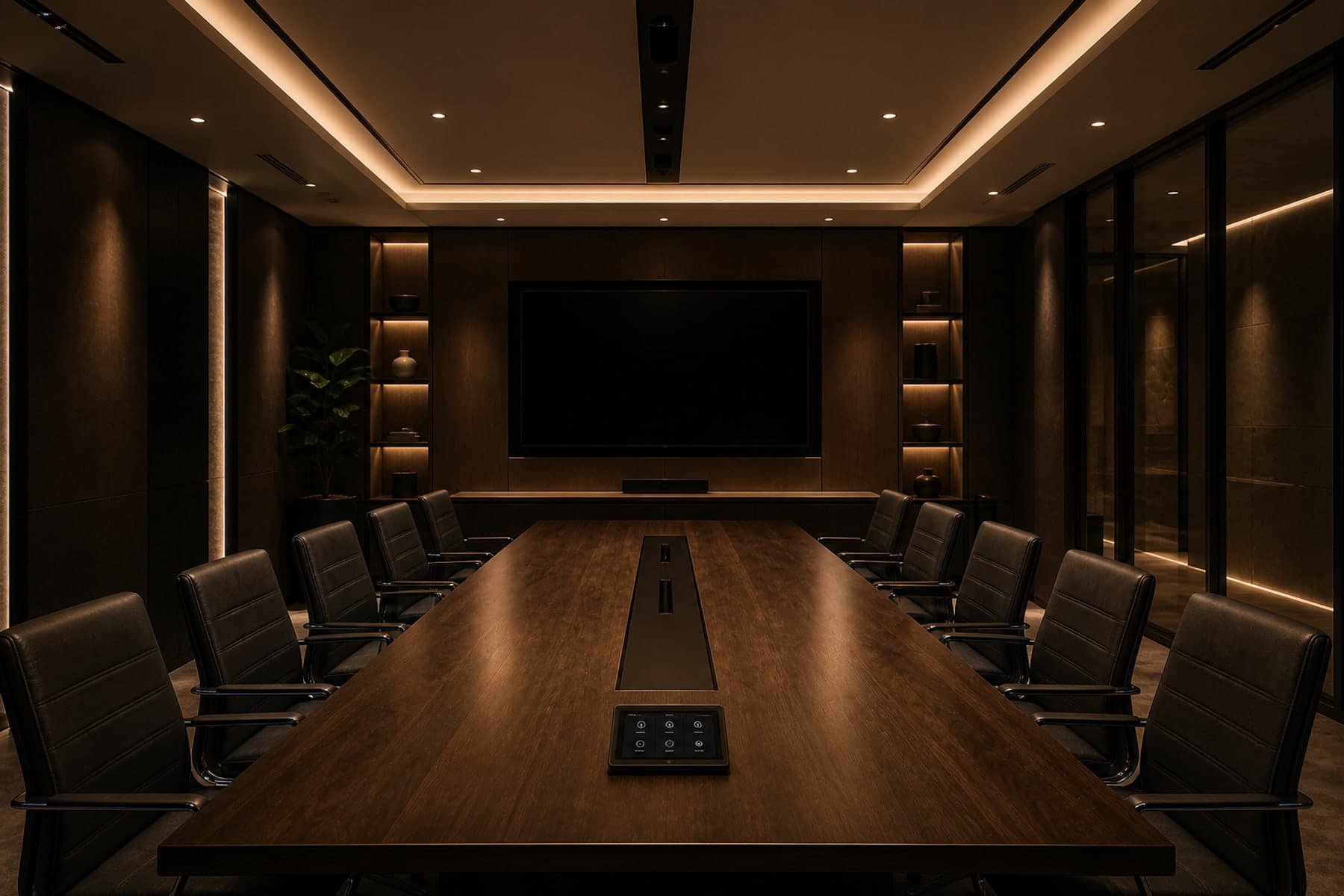
AV-over-IP is the most common AV-distribution architecture for enterprise, government and hospitality deployments above 16 endpoints. The codec choices (SMPTE ST 2110, JPEG-XS, H.264/H.265, Crestron NVX, WyreStorm NetworkHD, AMX SVSI) are well-documented; the network-discipline requirements are less well-documented and are where deployments fail.
Multicast routing and IGMP snooping discipline
AV-over-IP fabrics use multicast for one-to-many distribution — one encoder, many decoders, no per-decoder bandwidth cost. The multicast group membership is managed by IGMP (Internet Group Management Protocol); IGMP snooping at the switch layer ensures multicast traffic is only forwarded to ports with active group members. Without IGMP snooping, multicast traffic floods every port and saturates the switch fabric. The discipline is enabled at the managed-switch layer, verified at commissioning, and is non-negotiable on any AV-over-IP deployment.
PIM-SM for cross-VLAN multicast
When the AV deployment spans multiple VLANs (campus-wide, multi-building, multi-tenant), PIM-SM (Protocol Independent Multicast — Sparse Mode) handles cross-VLAN multicast routing. The PIM-SM rendezvous point is engineered against the deployment topology; without it, cross-VLAN multicast falls back to flood-and-prune which saturates the inter-VLAN links. PIM-SM is a Layer-3 discipline that requires the routing infrastructure to be in scope at design stage, not retrofitted.
VLAN segregation between AV and data
AV-over-IP traffic is segregated onto its own VLAN — protects the general data plane from AV-traffic spikes, isolates the multicast groups from broadcast-domain pollution, and enables QoS policy enforcement at the VLAN boundary. The AV VLAN is engineered with jumbo-frame support (MTU 9000), CoS / DSCP marking enforcement, and per-port multicast-traffic policing. Without VLAN segregation, AV-traffic spikes during high-bandwidth content (uncompressed 4K, multi-stream broadcast) degrade the general data plane.
QoS marking at the source and enforcement across the fabric
AV-over-IP encoders mark their traffic with CoS / DSCP values that signal latency-sensitive AV — typically EF (Expedited Forwarding, DSCP 46) for uncompressed AV, AF41 (DSCP 34) for compressed AV. Every switch in the fabric must enforce the QoS policy (prioritise EF-marked traffic ahead of general data, queue AF41 separately from background traffic). Without end-to-end QoS enforcement, the AV traffic competes with general data on the same queue and the latency floor collapses.
Jumbo-frame support on the AV VLAN
Uncompressed AV streams generate large packets — typically 8000-9000 byte MTU. Default Ethernet MTU is 1500 bytes; without jumbo-frame support on the AV VLAN, the encoder fragments every packet into multiple sub-1500-byte fragments, multiplying the packet-rate and the switch-CPU load. Jumbo-frame support is enabled per-switch on the AV VLAN, verified at commissioning, and is part of the AV network spec.
BFD for sub-second failover
BFD (Bidirectional Forwarding Detection) is the protocol that detects link failure on the order of 100-500 ms — fast enough that an AV-over-IP failover (encoder swap, decoder re-join, multicast group migration) is operationally invisible. Without BFD, link-failure detection relies on routing-protocol timers (typically 30-180 seconds), and the AV deployment experiences multi-second outages on any link event. BFD is enabled at the Layer-3 routing layer, configured per link.
Codec choice decides latency and bandwidth, not deployment success
Uncompressed SMPTE ST 2110 / JPEG-XS class carries sub-frame latency at 1-12 Gbps per endpoint; H.264 / H.265 carries 50-200 ms latency at 10-50 Mbps; NVX / NetworkHD carries 10-30 ms at 250-800 Mbps. The codec choice decides the network bandwidth budget and the latency floor; the deployment success depends on the network discipline above, not on the codec brand.
Mixed-class fabric for risk bounding
On large deployments, mixed-class fabric (premium NVX or NetworkHD at critical endpoints + entry-level H.264 / H.265 fallback at non-critical endpoints) bounds the deployment risk: critical content runs on the premium class at the 10-30 ms this article states for it, non-critical content runs on the entry class at 50-200 ms, and the network discipline serves both. That premium range straddles the duration of a single frame at 60 Hz, so frame-accuracy is a per-model and per-mode question rather than a property of the class. Read it off the encoder's own specification before promising it. The cost penalty is real but the deployment risk is contained.
Callout — what AV-over-IP procurement most miss
The network discipline is the actual engineering — the codec choice is the procurement decision. Specify the IGMP snooping, the PIM-SM rendezvous point, the VLAN segregation, the QoS marking and enforcement, the jumbo-frame support and the BFD failover before specifying the encoder brand. The encoder works only if the network works.
References
1. SMPTE ST 2110 — professional media over IP standard.
2. AES67 — high-performance streaming audio-over-IP.
3. NMOS IS-04 / IS-05 — networked media open specifications.
4. RFC 7761 — Protocol Independent Multicast — Sparse Mode (PIM-SM).
5. RFC 5880 — Bidirectional Forwarding Detection (BFD).
AV-over-IP orchestration
av-over-ip-orchestrationDiagram · described
Enterprise AV-over-IP orchestration
Five horizontal lanes show how sources, encoders, an orchestrated switch fabric, decoders and rooms compose an enterprise AV-over-IP deployment. The fabric carries VLAN segmentation, QoS, time-sync and the control plane; decoders sit per room with display-side downstream.
Key engineering takeaways
- IGMP snooping at the managed-switch layer is non-negotiable on any AV-over-IP deployment.
- PIM-SM rendezvous point is engineered for cross-VLAN multicast; flood-and-prune is operationally unacceptable.
- AV traffic is segregated onto its own VLAN with jumbo-frame support and QoS policy enforcement.
- End-to-end QoS marking at the source and enforcement across every switch in the fabric.
- BFD enables sub-second failover detection; routing-protocol timers (30-180 s) are operationally too slow.
- Codec choice decides latency and bandwidth profile; network discipline decides deployment success.
- Mixed-class fabric bounds the deployment risk on large deployments — premium at critical, entry-class at non-critical.
/ Frequently asked
Quick answers from the practice.
- When is HDBaseT the right answer instead of AV-over-IP?
- For room-bound, scale-bound deployments below ~16 endpoints where the IT-network discipline is the constraint. HDBaseT 2.0 carries 4K60 4:4:4 at 100 m on Cat6A without touching the network — point-to-point cable, no multicast, no VLAN, no QoS. Above 16-32 endpoints or on campus / multi-building deployments, AV-over-IP is the architecturally right answer.
- Does TechnoGuru run the network audit before AV-over-IP deployment?
- Yes. Pre-deployment network audit covers multicast routing, IGMP snooping, QoS marking, jumbo-frame support, PoE budget if applicable, BFD discipline, verified across every switch in the fabric. The audit is a network-engineering deliverable, not an AV-vendor deliverable.
- What is the typical capex split between encoders and network?
- Roughly 60-70% encoders + decoders + control, 30-40% managed switches + cabling + commissioning for typical enterprise AV-over-IP deployments. Premium uncompressed deployments shift toward 50-50 because the switch class (multi-gig, jumbo-frame, IGMP-snooping-capable) is more expensive.
/ What to do next
Three next steps for AV-over-IP scope
- Try the AV-IP vs HDBaseT wizard →Six-question decision flow with platform candidates.
- Read the WyreStorm vs Crestron NVX insight →Codec, latency and scale ceiling for the leading platforms.
- Send the network and room schedule →We return a network-discipline audit and a topology recommendation within three working days.
Engineering toolkit
Tools that go with this read
If this article gave you a question worth pricing, these calculators give a defensible first number.
- AV · Selector
Boardroom Solution Selector
Pick the room, how it is used and the platforms in play, and see a broad meeting-room direction with what to share. A planning aid — not a final design, model list, quantity or budget.
Advisory · directionOpen - IT · Networking
Network & PoE Calculator
Sized to year-three load — switches, Wi-Fi 7 access points, PoE budget (watts), Cat6A run count, port/AP sizing. Cisco / HPE Aruba / Juniper-class enterprise gear.
Switches · APs · PoE WOpen - AV · LED
LED Wall Size Calculator
Direct-view LED wall sizing across a source-cited model catalogue including Samsung, LG MAGNIT, Sony, Philips, Leyard, Absen, Unilumin, ROE Visual, AOTO, INFiLED, Daktronics, Planar, Nanolumens and more. Cabinet count, native resolution, brightness adequacy, power and weight — with pitch-vs-distance honesty and camera-refresh flags. Sources cited per model.
50 brands · pitch-awareOpen
Related engineering decision
The comparison behind this question.
/ Services this article informs
Read the discipline pages.
Video Walls
Pixels at the scale of architecture.
Digital Conferencing & Voting Systems
Sittings, voting, interpretation — one system, every seat.
Enterprise Network Design & Installation
Wires the building's nervous system.
Conference Room AV
Single-touch join. Every meeting.
Network Security
Segmentation. Visibility. Recoverable backups.
Servers, Storage & Data Centre
On-prem, hybrid and edge — sized for actual workload.
Video Conferencing Infrastructure
Reliability beats features.
/ Reference work
Projects where this engineering shows up.
Arunachal Pradesh Legislative Assembly
Government · Legislative Chamber
Itanagar, Arunachal Pradesh · Handover 2017Cabinet Conference Room, Arunachal Pradesh Secretariat
Government · Cabinet Conferencing
Itanagar, Arunachal Pradesh · Handover 2018Conference Room, Chief Minister's Residential Complex, Kohima
Government · Executive Conference Room
Kohima, Nagaland · Handover 2022Agartala Medical College & GBP Hospital
Healthcare · Government
Agartala, Tripura · Handover 2022Town Hall Auditorium, Dimapur
Government · Civic Auditorium
Dimapur, Nagaland · Handover 2024
· Where to go next
The wider authority graph for this topic.
Editorial — about this surface
TechnoGuru AV Systems Practice
The AV systems practice engineers residential reference cinema and commercial audio-visual systems against the AVIXA CTS, CEDIA, HAA Level 1 and K-Array Certified Designer reference frames. Every installation pairs measurable acoustic and visual targets with the field calibration that proves the room actually meets them.
Reviewed against calibrated measurement realities — room performance is verified against reference targets before sign-off.
Last reviewed
17 May 2026
Engineering domains
Residential cinema and reference audio · Commercial audio-visual systems · Acoustic engineering and room treatment · Loudspeaker and line-array design
Operating environments
Residential reference cinema · Hospitality lounges and venues · Corporate AV and boardrooms · Auditoria and assembly halls
/ Discuss your project
If this article matches a brief you are working on, the next step is a short brief — a project lead replies to it directly.
We do not run sales pipelines. The first reply comes from a project lead, within two working days, and it goes straight to the engineering question rather than a brochure.