
/ AV
WyreStorm vs Crestron NVX — the AV-over-IP comparison for installers
Quick answer
WyreStorm NetworkHD is often the leaner fit for standalone deployments where the AV system does not need to share a controller with lighting, HVAC and security; Crestron DM-NVX wins on tight integration with the rest of a Crestron-controlled estate and on programming maturity for boardrooms with strict control discipline. Both are 1 GbE JPEG2000-class platforms that scale to 100+ endpoints over a managed switch fabric, and the actual decision usually breaks on the rest of the integration scope rather than on the AV-over-IP layer alone.
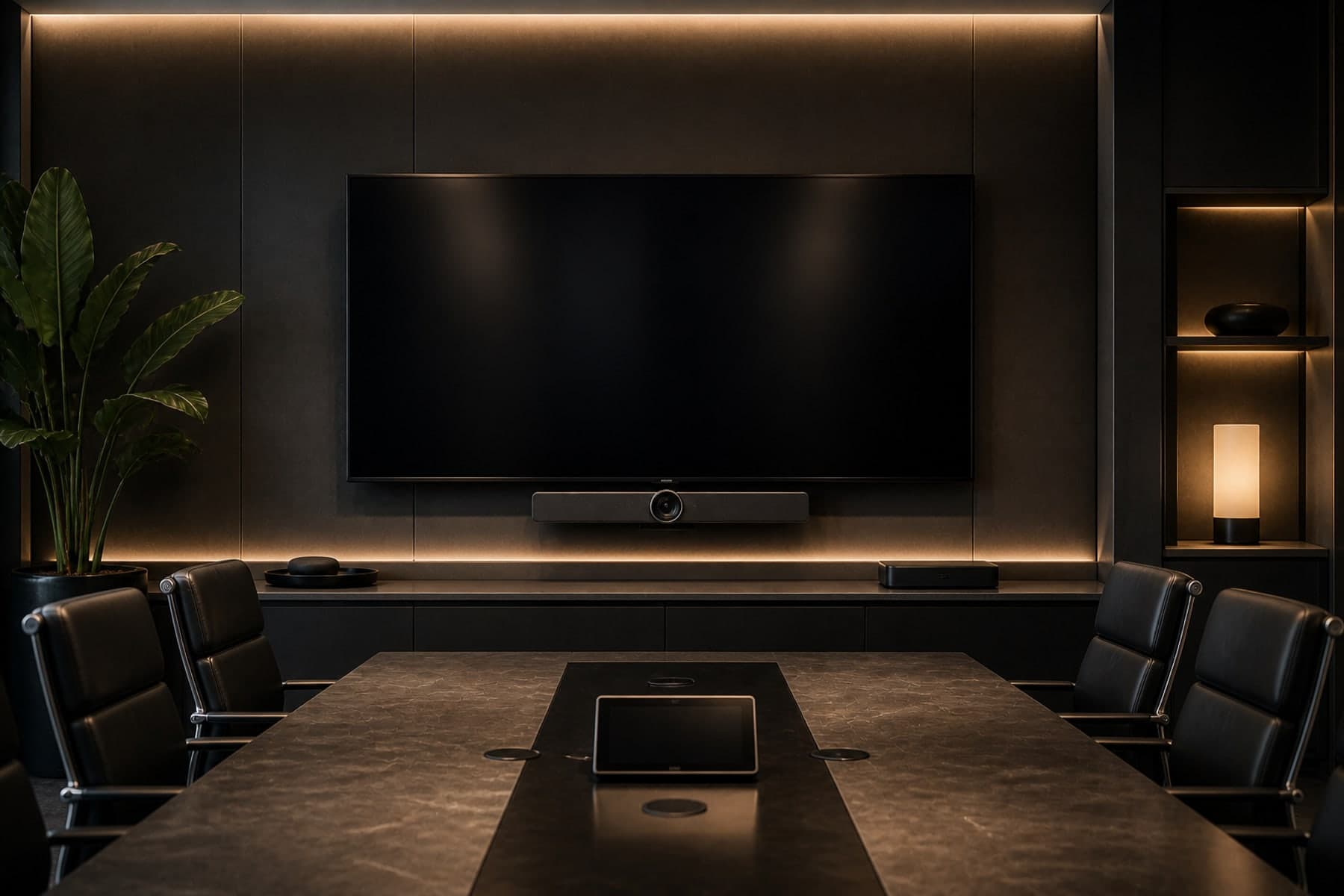
The two AV-over-IP platforms we are asked to compare most often on Indian installations are WyreStorm NetworkHD (the NHD-400, NHD-500 and NHD-600 series) and Crestron DM-NVX. Both are 1 GbE-class platforms, both use JPEG2000 visually-lossless compression, and both scale to 100+ endpoints. The differences are subtle but they decide the right answer for a given brief.
Codec and visual quality
Both platforms use JPEG2000 wavelet compression at variable bitrates up to ~800 Mbps. Visual quality is indistinguishable from uncompressed on any source that is not specifically constructed to expose codec artefacts (high-frequency text patterns, fine moiré, fast-motion sport at the upper edge of the codec's design envelope). On real boardroom and video-wall content — laptop presentations, document cameras, conferencing video, broadcast feeds — both platforms are visually transparent.
Both platforms carry 4K60 4:4:4. WyreStorm publishes it on the exact model — the NHD-500-TX/RX v2 is listed as a "NetworkHD 500 Series 4K60 4:4:4 JPEG2000 Encoder & Decoder", with a supported-resolution row reading "4K60Hz 4:4:4" and a maximum video resolution of "4096x2160p @ 60Hz 8bit 4:4:4 or RGB". Chroma is therefore not a discriminator between these two platforms, and any comparison that treats it as one should be checked against the exact encoder model rather than the series.
Latency and time-alignment
AV-over-IP reference architecture
av-over-ip-orchestrationDiagram · described
Enterprise AV-over-IP orchestration
Five horizontal lanes show how sources, encoders, an orchestrated switch fabric, decoders and rooms compose an enterprise AV-over-IP deployment. The fabric carries VLAN segmentation, QoS, time-sync and the control plane; decoders sit per room with display-side downstream.
Platform-coexistence risk
WyreStorm and Crestron NVX can coexist — but they multiply control-plane complexity.
Mixed estates with WyreStorm + NVX on the same switch fabric work via separate multicast groups and VLANs, but the control-plane integration is more complex than either alone. The practical advice for new builds is to consolidate to one platform; the practical advice for retrofits is to draw the line at the room boundary, not at the rack.
Latency is published per product and the two platforms should be compared on their own figures, not on a shared band. WyreStorm publishes "4ms video latency (pass-through mode)" for the NHD-500-TX/RX v2. We have not verified an equivalent published end-to-end figure for the NVX line against a Crestron document, so no number is stated for it here. Note that a 30-60 ms figure — which this article previously carried for both — cannot be described as sub-frame: one frame at 60 Hz is 16.7 ms, so 30-60 ms is two to four frames. Where time-alignment matters — video walls driven from a single source, lip-sync against an external audio stream — both platforms support frame-accurate sync within the same session.
WyreStorm NHD-600 series and Crestron NVX-D30 both support genlock-level frame alignment across multiple displays; the WyreStorm implementation is slightly easier to configure for installers new to the platform, while the Crestron implementation is more robust under network jitter (a side-effect of the deeper buffering in the NVX silicon).
Network discipline and IGMP
AV-over-IP rides on multicast IP and depends on the network switch handling IGMP querying, snooping and PIM routing correctly. Both platforms publish certified switch lists; the WyreStorm list is broader (including NETGEAR M4250 and M4350, Cisco SG-series and Catalyst 9300, HPE Aruba 6100 and 6300) and the Crestron list is narrower but more strict (the company publishes configuration templates for each certified switch and will not support deployments on un-certified switches).
On a real installation, the network is the deployment risk — far more than the AV endpoints themselves. Both platforms work cleanly on a properly configured managed switch with IGMP snooping and a dedicated AV VLAN; both fail mysteriously on a flat L2 network shared with corporate traffic. Budget proper network engineering on every AV-over-IP install or expect to spend the commissioning week debugging dropped frames.
Control integration
This is where the platforms diverge most. Crestron DM-NVX integrates natively with Crestron's control system (3-Series and 4-Series processors); a single SIMPL or Crestron Home programme controls AV-over-IP routing, room scenes, lighting, shading, HVAC and security through the same control layer. For installations where the rest of the estate is Crestron-controlled, this is the dominant integration advantage.
WyreStorm NetworkHD exposes a more open API: REST endpoints, Telnet/TCP control commands, native drivers for AMX, Q-SYS, Extron, RTI and Control4. For installations where the rest of the estate is not Crestron-controlled — most pro-AV deployments outside the boardroom segment — WyreStorm's openness is a real advantage.
Procurement posture
Procurement fit varies by region, support channel and the control architecture around the AV fabric. On standalone deployments, WyreStorm NetworkHD is usually the leaner procurement posture for an equivalent specification class. In a Crestron-controlled estate, DM-NVX often justifies its place through control integration, programming maturity and support discipline rather than the AV-over-IP layer alone.
Scale ceiling and reference deployments
Both platforms scale to 100+ endpoints on a properly engineered switch fabric. WyreStorm has reference deployments at 250+ endpoints on retail digital-signage and hospitality applications; Crestron NVX has reference deployments at 500+ endpoints on enterprise corporate AV and education campuses. At the very large end (1000+ endpoints) Crestron's enterprise discipline wins; at the small-to-medium end (16-100 endpoints) both platforms deliver well.
Programming reality for the installer
WyreStorm Synergy is the company's drag-and-drop room configuration tool; it covers about 80% of the typical boardroom or video-wall deployment without code. The remaining 20% — custom event automation, scheduled scenes, integration with non-WyreStorm devices — drops to the REST or Telnet API. The platform is approachable for installers new to AV-over-IP, with a moderate ramp-up.
Crestron NVX is programmed through SIMPL Windows, SIMPL+, or Crestron Home (depending on the rest of the estate). The toolchain is mature, well-documented, and the user community is large; the ramp-up is steeper for installers new to Crestron generally, and the Crestron Service Provider certification is effectively required for warranty-eligible commercial deployments.
The installer's verdict
Three rules from our practice. First, if the rest of the building is Crestron-controlled (or will be), Crestron NVX is the right call — the integration overhead is recovered in installation labour and post-handover support discipline. Second, if the AV system is standalone or the rest of the estate is on a different control platform (Q-SYS, AMX, Control4), WyreStorm NetworkHD is often the right call — the API openness avoids the integration tax. Third, on very large enterprise deployments (>500 endpoints), Crestron's enterprise tooling and switch-certification discipline win; on smaller integrations (≤100 endpoints), both platforms are viable and the choice breaks on the surrounding control layer.
/ Reference table
WyreStorm NetworkHD vs Crestron DM-NVX — side-by-side
| Dimension | WyreStorm NetworkHD | Crestron DM-NVX |
|---|---|---|
| Codec / compression | JPEG2000 wavelet · up to ~800 Mbps | JPEG2000 wavelet · up to ~800 Mbps |
| 4K60 chroma | 4:4:4 at 4K60 (NHD-500-TX/RX v2, manufacturer product page) | 4:4:4 at 4K60 on NVX-D30/D80 |
| End-to-end latency | 4 ms, pass-through mode (manufacturer published, NHD-500-TX/RX v2) | Not verified here against a Crestron document |
| Multicast / IGMP support | Broad certified-switch list | Narrow but strictly certified list |
| Control integration | Open API · drivers for AMX/Q-SYS/Extron/RTI/Control4 | Native Crestron only · deepest integration with Crestron estate |
| Per-endpoint cost (16-endpoint reference) | Index 1.0 | Index 1.45-1.7 |
| Scale ceiling (proven) | ~250 endpoints | 500+ endpoints |
| Programming tool | WyreStorm Synergy + REST/Telnet API | SIMPL Windows / Crestron Home |
| Installer certification | WyreStorm Certified Installer | Crestron Service Provider |
| Best fit | Standalone AV or mixed-control estates · digital signage · hospitality | Crestron-controlled corporate / enterprise / education estates |
Pricing index is illustrative at 2026 Indian prices for a 16-endpoint deployment; absolute prices vary by region, channel and procurement structure.
/ Frequently asked
Quick answers from the practice.
- Is Crestron NVX worth the premium for a single boardroom?
- Only if the rest of the building is Crestron-controlled or will be. Both platforms are JPEG2000 1 GbE encoders carrying 4K60 4:4:4, so for a single boardroom in isolation the AV-over-IP layer itself is unlikely to be what separates them. The Crestron premium is paid for integration depth across the estate rather than for the AV-over-IP layer alone. We do not publish comparative pricing — the commercial position depends on channel, region and procurement structure, and we quote it against a room schedule.
- Do these platforms work over a corporate LAN?
- They will work but they should not. AV-over-IP at JPEG2000 bitrates needs a dedicated VLAN with multicast routing properly configured. Riding a corporate LAN shared with users introduces jitter and contention that show up as dropped frames at random intervals. Spec a dedicated AV switch fabric on every install above 8 endpoints.
- What about SDVoE — is it superior to both?
- SDVoE (10 GbE, uncompressed) delivers zero-frame latency and 4:4:4 4K60 native, and it requires a 10 GbE switch fabric at every endpoint where the 1 GbE JPEG2000 platforms do not — that infrastructure step, not the endpoint specification, is what decides the design. For live performance, broadcast feeds and gaming-class deployments SDVoE is the right answer; for boardrooms, corporate AV and digital signage, 1 GbE JPEG2000 (either WyreStorm or NVX) is more than sufficient.
- Can the two platforms coexist on the same network?
- Yes, on the same switch fabric with separate multicast groups and separate VLANs. We have done it on multi-vendor estates where legacy WyreStorm endpoints were retained while new boardrooms were built on Crestron NVX. The control plane integration across the two is more complex than either alone, and the practical advice is to consolidate to one platform if the estate allows.
- Will TechnoGuru install and commission either platform?
- Yes. We work extensively with both WyreStorm and Crestron platforms and have delivered both on real projects. We will recommend the right platform for the project's specific brief — and that recommendation will not be the same on every brief.
/ What to do next
Three next steps for installers and architects
- Run the AV-over-IP vs HDBaseT decision wizard →Six questions, scored verdict, platform candidates per side.
- Read the home cinema and boardroom AV service pages →Where each AV-over-IP platform fits in our service catalogue.
- Send a project brief to the studio →Site dimensions, endpoint counts, control-system intent — we will recommend a platform and a BOQ within two working days.
Engineering toolkit
Tools that go with this read
If this article gave you a question worth pricing, these calculators give a defensible first number.
- AV · Selector
Boardroom Solution Selector
Pick the room, how it is used and the platforms in play, and see a broad meeting-room direction with what to share. A planning aid — not a final design, model list, quantity or budget.
Advisory · directionOpen - AV · LED
LED Wall Size Calculator
Direct-view LED wall sizing across a source-cited model catalogue including Samsung, LG MAGNIT, Sony, Philips, Leyard, Absen, Unilumin, ROE Visual, AOTO, INFiLED, Daktronics, Planar, Nanolumens and more. Cabinet count, native resolution, brightness adequacy, power and weight — with pitch-vs-distance honesty and camera-refresh flags. Sources cited per model.
50 brands · pitch-awareOpen - AV · Projection
Projector Throw Distance Calculator
Engineering-grade throw distance calculator across a verified multi-brand projector catalogue — Sony, JVC, Epson, BenQ, LG, Optoma, ViewSonic, Panasonic, Barco, Christie, Canon, InFocus, Maxell, Casio, EIKI, Philips, Nebula, JMGO, Dangbei, Boxlight, ASUS, Leica, Xiaomi, WEMAX, Ricoh and more. Searchable picker, throw range, lens-shift envelope, viewing distance, pixel density, feasibility flags and a custom-throw fallback. Sources cited per model.
51 brands · sourcedOpen
/ Services this article informs
Read the discipline pages.
· Where to go next
The wider authority graph for this topic.
Engineering pages
Editorial — about this surface
TechnoGuru AV Systems Practice
The AV systems practice engineers residential reference cinema and commercial audio-visual systems against the AVIXA CTS, CEDIA, HAA Level 1 and K-Array Certified Designer reference frames. Every installation pairs measurable acoustic and visual targets with the field calibration that proves the room actually meets them.
Reviewed against calibrated measurement realities — room performance is verified against reference targets before sign-off.
Last reviewed
13 May 2026
Engineering domains
Residential cinema and reference audio · Commercial audio-visual systems · Acoustic engineering and room treatment · Loudspeaker and line-array design
Operating environments
Residential reference cinema · Hospitality lounges and venues · Corporate AV and boardrooms · Auditoria and assembly halls
/ Discuss your project
If this article matches a brief you are working on, the next step is a short brief — a project lead replies to it directly.
We do not run sales pipelines. The first reply comes from a project lead, within two working days, and it goes straight to the engineering question rather than a brochure.