
/ ELV
Addressable vs conventional fire alarm: which one your building actually needs
Quick answer
Neither NBC 2016 nor IS 2189 mandates addressable fire alarm — NBC requires an automatic detection and alarm system by occupancy and height and stays technology-neutral, and IS 2189 sets out how each type is designed rather than which to choose. The engineering case for addressable is zone geometry: IS 2189 caps a conventional detection zone at 2,000 sq m and a 30 m search distance, which large floor plates exhaust quickly. Addressable supervises every detector individually so the panel reports the exact device, not just the floor — and it is what makes cause-and-effect with lifts, access, BMS and PA programmable. Conventional remains acceptable only for small standalone buildings where forensic granularity is not needed.
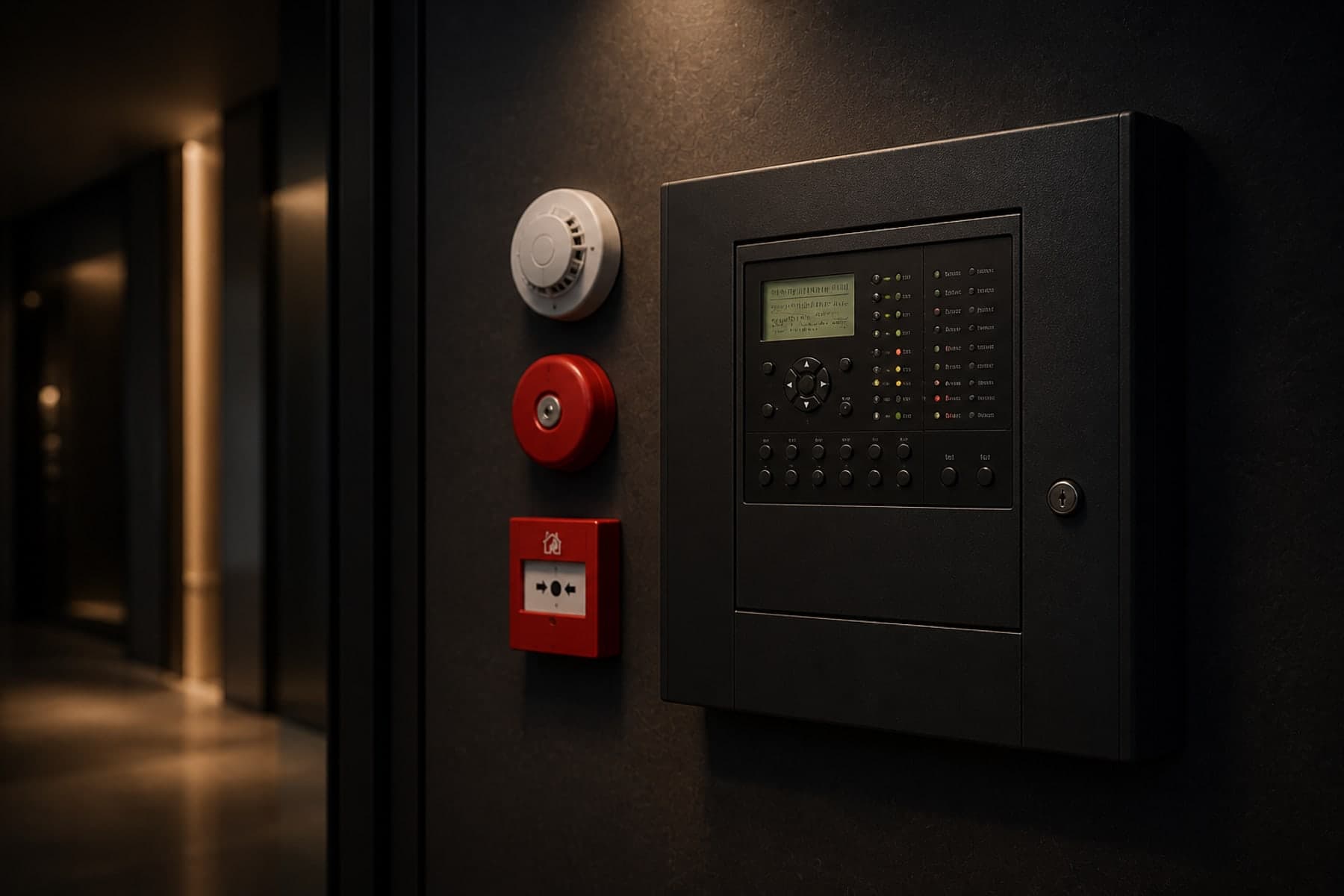
A conventional fire alarm divides the building into electrical zones — typically a few floors per zone — and reports an alarm to the panel as the zone in which the event has occurred. An addressable system instead supervises every detector, manual call-point, sounder and beacon on the loop individually, so the panel reports not only that there is an alarm but exactly which device on which loop has triggered.
Neither the National Building Code of India nor IS 2189 mandates addressable systems — NBC 2016 requires automatic detection by occupancy and height without naming a technology, and IS 2189 describes how each type is designed. The code question is therefore the wrong question; the engineering one is zone geometry, since IS 2189 caps a conventional detection zone at 2,000 square metres and a 30 m search distance. Beyond that, the operational difference is significant: when an event occurs in a 10,000-square-metre property, an addressable system tells the security desk exactly where to look, while a conventional system tells them only the floor.
The case for addressable becomes even stronger once you factor in cause-and-effect logic. A modern building expects the fire alarm to coordinate with the lifts (homing them to ground floor), the access-control system (releasing magnetic door-holders), the BMS (closing AHU dampers), and the public-address system (broadcasting the affected zone to occupants). All of this is straightforward to programme on an addressable platform and effectively impossible on a conventional one.
Life safety
Detection to notification — and what it must talk to
The chain itself is simple. What separates a compliant system from a coordinated one is the interface layer on the right: the systems the panel must drive when it goes into alarm.
01
Detection
Senses the event and identifies where it happened.
- Smoke and heat detectors
- Manual call points
02
Loop / zone
The supervised circuit that carries devices back to the panel.
- Addressable loop
- Conventional zone circuit
03
Control panel
Evaluates the input and executes the cause-and-effect programme.
- Main and repeater panels
- Cause-and-effect matrix
Lifts, access control, BMS and PA
Lift homing, magnetic door-holder release, AHU damper closure and zone announcement are all driven from the panel's cause-and-effect programme — which is why they are coordinated at design stage, not at handover.
04
Notification
Tells occupants what to do — audibly, visibly and intelligibly.
- Sounders and beacons
- Voice evacuation messaging
Illustrative discipline-level chain aligned to NBC and IS 2189 practice. Zone boundaries and device schedules are engineered per building.
Where conventional remains acceptable is in small, standalone buildings such as modest warehouses or single-floor offices, where the simplicity is welcome and the forensic granularity of addressable is not strictly necessary. We will recommend conventional in those cases without hesitation. For everything above that threshold, addressable is the right answer — and we deliver to NBC, IS 2189 and NFPA 72 with full cause-and-effect documentation as standard.
/ Frequently asked
Quick answers from the practice.
- What is the cost premium of addressable over conventional?
- At 2026 prices the addressable premium runs ~20-30% at the panel and loop level for buildings up to ~150 devices; above that, addressable's economics improve because conventional needs more zone runs to deliver the same forensic detail. For any building that will use cause-and-effect, the premium is recovered in commissioning labour alone.
- Does an addressable system need addressable detectors only?
- Yes — every device on the loop (smoke detector, heat detector, manual call-point, sounder, beacon, interface module) must be addressable. Mixing conventional zones into an addressable panel is possible via zone-monitor modules but defeats the forensic-localisation benefit.
- Is wireless addressable acceptable under NBC?
- Wireless addressable systems (Hochiki Firewave, Bosch wireless, Hyfire) are NBC- and IS-acceptable for retrofit projects and listed-building installations where wired cabling is prohibited. They cost ~40% more than wired addressable, and the practice is to specify wireless only where wired is genuinely infeasible.
- How long does an addressable fire alarm system last?
- Panel lifecycle is typically 12-15 years; detectors are typically 8-10 years on a service refresh cycle (per IS 2189 maintenance requirements). Cause-and-effect programming and configuration baselines are retained offline for the system's entire life — a discipline that distinguishes a serious AMC from a billing exercise.
- Will TechnoGuru deliver the Fire NOC submission?
- Yes. We prepare the design-stage and occupancy-stage Fire NOC submission packs — cause-and-effect matrix, hydraulic calculations, equipment certifications, NBC clause-by-clause compliance notes — and coordinate site inspection with the state Fire Authority. Standard inclusion in our fire-alarm and life-safety scope.
/ What to do next
Three next steps for fire-safety scope
- Try the NBC fire-safety state quick-check →State, height and occupancy in, cited scope out across eight Indian states.
- Read the fire-alarm service page →Engineering scope, brand bands, AMC structure.
- Send the project drawings to the studio →We mark up the fire-safety scope with NBC and state-rule citations within two working days.
Engineering toolkit
Tools that go with this read
If this article gave you a question worth pricing, these calculators give a defensible first number.
- Life-safety
NBC Compliance Checker
Building height, type and occupancy in — the life-safety and ELV systems NBC 2016 indicates for that building, citing NBC 2016 and the relevant IS codes.
NBC 2016 · IS codesOpen - Life-safety · 28 states + 8 UTs
NBC Fire-Safety by State
State or union territory, building height and occupancy in — list of sprinkler, voice-evac PA, wet-riser and Fire-NOC triggers out, with explicit source-status tiering across all 28 Indian states and 8 union territories.
NBC 2016 · state ruleOpen - Site planning
Industrial & Tea-Estate Technology Planner
Site type, zones and what's ready in — which systems to coordinate (CCTV, PA, access, networking, UPS, fire/ELV), what to prepare and a readiness view out. Advisory; no counts, layouts or pricing.
Advisory · readiness · copyableOpen
Related engineering decision
The comparison behind this question.
/ Services this article informs
Read the discipline pages.
/ Reference work
Projects where this engineering shows up.
Tinsukia Medical College & Hospital
Healthcare · Government
Tinsukia, Assam · Handover 2024Capital Cultural Hall, Kohima
Government · Cultural Auditorium
Kohima, Nagaland · Handover 2022Town Hall Auditorium, Dimapur
Government · Civic Auditorium
Dimapur, Nagaland · Handover 2024Taraghar — State Guest House
Government · State Guest House
Shillong, Meghalaya · Handover 2025Assam State Guest House, Koinadhara
Government · Protocol Residence
Guwahati, Assam · Handover 2021
Editorial — about this surface
TechnoGuru Fire & Life-Safety Practice
The fire and life-safety practice runs the discipline that the state fire service signs against. Addressable detection design, cause-and-effect logic, PAVE voice-evac and emergency lighting — engineered against the National Building Code, the relevant state amendments and the field realities of how a building actually evacuates.
Reviewed against NBC, IS 2189 and the relevant state fire-service requirements — every recommendation is held to what passes NOC and field cause-and-effect verification.
Last reviewed
18 May 2026
Engineering domains
Addressable fire detection · Cause-and-effect logic engineering · Public-address voice evacuation (PAVE) · Emergency lighting design
Operating environments
Mid-rise and high-rise commercial · Hospitality and healthcare buildings · Government and institutional facilities · Assembly and gathering venues
/ Discuss your project
If this article matches a brief you are working on, the next step is a short brief — a project lead replies to it directly.
We do not run sales pipelines. The first reply comes from a project lead, within two working days, and it goes straight to the engineering question rather than a brochure.