
01 / 03
Case file
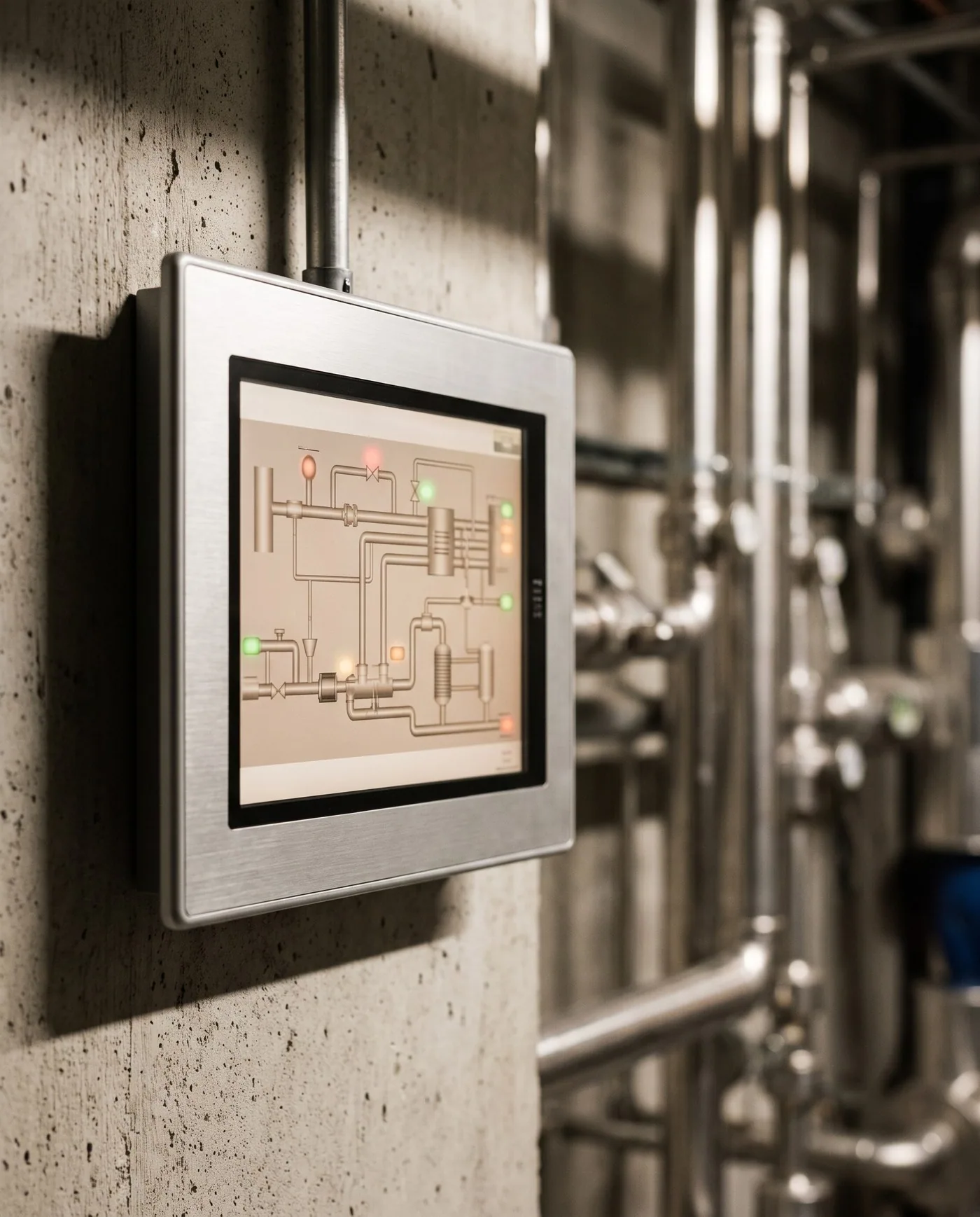
Open-protocol BMS frameworks — HVAC, lighting, fire and access integrated to a single graphical front-end with operator analytics and alarm escalation.
| Requirement | Head-end-first approach | Engineered approach |
|---|---|---|
| Scope | Front-end specified before the points list | Points list agreed first — what is monitored and controlled drives the design |
| Protocols | Plant bought on closed protocols, then bridged | Open-protocol integration over BACnet, Modbus and KNX from the start |
| Operability | Graphics and trends added later | Dashboards, alarms and a runbook built into commissioning |
| Verification | Points connected | Commissioned and verified end-to-end against the cause-and-effect |
Educational comparison of design rigour — not a statement about any specific installer.
Illustrative 24-hour load profile for a reference commercial building: HVAC, lighting, IT and other loads stack hour by hour, the BESS charges off-peak overnight and discharges 55 kW into the 14:00–17:00 peak, and the BMS flags a chiller anomaly at 14:00. The figures are a synthetic demonstration profile, not measured data from a live site. Use the hour slider to inspect each hour's load breakdown, BESS state and any BMS alert.
— 24 hours, on the dashboard
The building, in numbers.
Drag the timeline. Watch HVAC, lighting, IT and other loads stack — plus BESS discharge for peak-shave and the chiller-2 anomaly the BMS catches at 14:00.

Time
13:00
Illustrative profile
Live at 13:00
566kW
- HVAC308
- Lighting80
- IT130
- Other48
BESS
0 kW
Hot-standby
Day total8,587 kWh
Peak demand592 kW @ 14:00
Anomalies caught1
/ The discipline, in detail
How we approach building management system (bms).
A BMS is justified the day it spots a chiller drawing 12% more current than the same chiller drew last month. We design BMS deployments to the building's actual operating priorities — comfort, plant health and compliance — and we specify an analytics layer that turns logs into decisions. Trend graphs, alarm escalation, mobile dashboards and a documented operations runbook are built into the commissioning, not added later.
On record
Every building management system (bms) engagement is documented end-to-end — design, programming, commissioning, calibration — and handed over with the files our successors would need if we were never to return.
/ Integration tiers
Field to front end
The four-tier BMS pattern — field devices, DDC controllers, supervisory network and operator front end — and where HVAC, energy and ELV plug in.
Diagram · described
HVAC × BMS integration topology
Four-column architecture: field sensors and plant feed DDC controllers; controllers translate up to a BACnet/IP supervisor; supervisor feeds the operator dashboard, tenant billing, alarm escalation, energy analytics, and reserves capacity for Phase 2 fire and access integration.
Diagrammatic view — a system planning illustration for design discussion, not a project drawing or live interface.
/ Three lenses on the same system
Read it the way you actually need it.
Three short readings of building management system (bms) — for a non-engineer who needs the picture, an engineer who needs the spec, and a buyer who needs to see the system in operation.
/ In simple terms
A Building Management System (BMS) is the supervisory dashboard that runs a building's mechanical and electrical plant — chillers, air-handling units, lighting, sub-metering — from a single screen. It tells the facilities team what is running, what is alarming, and what is using how much energy. The good systems pay for themselves in 18–36 months on energy savings alone.
/ Technical explanation
A BMS runs on a supervisory cluster (Honeywell EBI, Siemens Desigo, Johnson Controls Metasys), with DDC controllers distributed across the building handling AHU, chiller, lighting and sub-meter logic on BACnet/IP and BACnet/MS-TP. Sequence-of-operations programming, sub-metering granularity and cause-and-effect interlocks (fire-to-AHU, BMS-to-UPS) are the engineering decisions; alarm-management and offline configuration baselines are the operational discipline.
/ Real project usage
On the PM Ekta Mall Guwahati deployment we are programming the chiller sequence against the mall's actual occupancy curve (F&B opens earlier, retail trades a longer envelope, weekend differs from weekday), with sub-metering granular at the lease-clause level for tenant-billing, and an integration pathway already engineered for phase-two fire-alarm and access-control integration. The mall opens with a working dashboard, named alarms in plain English and escalation routing — not a vendor handover that needs three months of stabilisation.
/ System architecture
The layers, named.
Every layer below is engineered as one piece of the integrated stack. Each carries its own commissioning artefact and its own AMC inclusion.
- 01
Supervisory layer — the BMS server cluster running the brand's supervisory software (Honeywell EBI, Siemens Desigo CC, Johnson Controls Metasys). The supervisory layer hosts the dashboard, the alarm-management engine, the trend-data archive, the schedule engine and the reporting engine.
- 02
Field controllers — DDC controllers distributed through the building, one per AHU, chiller, lighting circuit, sub-meter group. Each controller carries its own logic and continues to operate even if the supervisory layer is unavailable.
- 03
Field devices — sensors (temperature, humidity, CO₂, occupancy, lux, pressure), actuators (damper, valve, relay), sub-meters (electrical, water, BTU). Cabling is typically 18 AWG twisted-pair on a Modbus or BACnet bus, with the field device addresses mapped to the controller's I/O.
- 04
Network — BACnet/IP over the building's structured cabling backbone (segregated VLAN), with BACnet/MS-TP or Modbus RTU on field-bus segments where required. Gateways translate between protocols where the field devices are not native BACnet.
- 05
Mobile and remote access — dashboard exposed via secure VPN or HTTPS to authorised mobile clients; alarm escalation routed to nominated facilities-team mobiles via SMS/push.
/ Design considerations
The decisions we take early.
- Sub-metering granularity — the data layer drives demand-charge analysis, tenant cross-charging and fault detection. We typically meter at chiller plant, AHU, lift bank, lighting circuit, tenant-zone level plus any load above 25 kW.
- Sequence-of-operations programming — the chiller and AHU sequences are programmed against the building's actual occupancy curve (mall hours differ weekday from weekend; hospital ICU runs 24/7; office tower has morning ramp-up). The sequence is documented in the as-built and reviewable by the facilities team.
- Alarm management — every alarm has a name in plain English, a priority level (critical / urgent / informational), an escalation path (which mobile, after how long), and an acknowledgement workflow. Alarms without these are noise.
- Cause-and-effect interlocks — fire-alarm to AHU damper, BMS to UPS, BMS to access-control evacuation mode. Each interlock is documented in the matrix and tested on commissioning.
- Future-readiness — the controller capacity, the dashboard real-estate and the network design must accommodate phase-two systems (additional AHUs, sub-meters, fire-alarm integration, access-control integration) without re-cabling.
/ Integration logic
How it talks to the rest.
- Fire-alarm to BMS — on a fire-alarm trigger, the BMS closes AHU dampers per the matrix, with hospital-OT acknowledgement window where applicable. The BMS dashboard surfaces the fire event with the affected zone highlighted.
- BMS to UPS/BESS — the UPS reports its state (online / on-battery / fault) to the BMS via SNMP or Modbus. The BMS dashboard surfaces UPS state and triggers escalation on prolonged on-battery operation.
- BMS to access-control — on access-control evacuation mode, the BMS dashboard surfaces the evacuation event and the BMS may interlock dependent plant (e.g. lift homing).
- BMS to lighting — daylight-harvesting and occupancy-driven dimming through DALI gateways, programmed against the building's actual usage pattern.
- BMS to sub-metering — the BMS aggregates sub-metering data into demand-charge analysis and tenant cross-charging feeds.
/ Failure scenarios
What goes wrong, in practice.
- Controller battery failure — DDC controllers carry a battery to retain configuration on power loss. Battery degradation causes configuration loss on the next power event. Mitigated by quarterly battery-state monitoring and 3-year proactive replacement.
- Schedule drift — the chiller and AHU schedules drift from the building's actual occupancy curve over months and years (occupancy patterns change, the schedule does not). Mitigated by quarterly schedule review against actual occupancy data.
- Sub-meter calibration drift — electrical sub-meters drift in calibration over 3–5 years, producing tenant-billing disputes. Mitigated by annual sub-meter calibration against a reference standard.
- Alarm flood — a single fault produces hundreds of cascading alarms, masking the root cause. Mitigated by alarm-management with priority levels and root-cause grouping.
- Network segmentation breach — the BMS VLAN is bridged to the general office network during a network change, exposing the BMS to lateral attack. Mitigated by network-security audit on every BMS network change.
/ Maintenance expectations
What the AMC actually delivers.
- Monthly chiller-sequence verification, quarterly damper-actuator function test, quarterly alarm-management review, annual sub-metering calibration.
- Annual full sequence-of-operations review with the facilities team, with sequence updates pushed to controllers per the review.
- Configuration baselines stored offline — every controller's configuration captured to versioned storage, recoverable in hours.
- Spares-on-hand — DDC controllers, common sensor types, common actuator types, sub-meters, sized against the manufacturer's MTBF data.
- Quarterly review of alarm patterns and escalation effectiveness; alarms that fire without operations-team action are re-tuned or retired.
/ Where we deploy this
Active across 7 sectors.
Building Management System (BMS) is rarely a standalone brief — it sits inside a wider sector practice with its own codes, expectations and operating rhythm.
Hospitality
Guest experience, engineered.
Commercial & Corporate
Workplaces that begin meetings on time.
Education & Institutions
Schools, colleges and universities.
Healthcare
Hospitals where systems serve the patient.
Retail & Malls
Footfall, loyalty, footprint.
Restaurants, Bars & Clubs
The room. The night. The sound.
Industrial & Warehousing
Operations that don't take a day off.
/ Sister services
The rest of bms.
A serious brief usually crosses two or three of these. Read across the discipline — we deliver them as one contract.
- 02
Online UPS
Clean power, isolated from grid reality.
Double-conversion online UPS — continuous AC-to-DC-to-AC rectification that delivers regulated sine to your load with zero transfer time and complete isolation from grid sag, surge, harmonics and frequency drift.0 - 03
Battery Energy Storage (BESS)
Power as an asset, not a cost.
Lithium-ion Battery Energy Storage Systems — installed alongside online UPS, paired with rooftop solar, or stand-alone — for peak-shave, demand-response, off-peak tariff arbitrage and ride-through.1
/ Where this system has been deployed
Building Management System (BMS) on the ground.
The reference projects below carry a building management system (bms) layer engineered as part of an integrated stack. Each case study walks through the engineering challenges that were solved, the standards the work was held to, and the operational outcome on the day-two team.
Public project summaries describe systems and outcomes only — BOQ values, quantities, device counts and security layouts are kept off public surfaces.
Request a feasibility review/ Integration with
How building management system (bms) talks to the rest.
A serious deployment of this system rarely operates in isolation. The disciplines below most commonly share its cabling pathways, its controller logic, and its cause-and-effect matrix.
Fire Alarm System
Detection that pinpoints. Response that is coordinated.
Addressable and conventional fire detection and alarm — one of the three fire families (fire alarm, fire hydrant, fire extinguishers) — Honeywell, Bosch, Notifier and Siemens panels — integrated with PA, BMS, access control and emergency lighting to readiness per NBC, IS 2189 and NFPA 72, for consultant and AHJ review.Online UPS
Clean power, isolated from grid reality.
Double-conversion online UPS — continuous AC-to-DC-to-AC rectification that delivers regulated sine to your load with zero transfer time and complete isolation from grid sag, surge, harmonics and frequency drift.
/ Read deeper
The engineering, in long form.
Each article below goes deeper than this service page can — a full walk-through of the engineering decisions, written by the team that delivers this work.
- BMS · 13 min
BMS retrofit playbook for occupied hospitals
A BMS retrofit in an occupied hospital is unlike any other commercial BMS retrofit. Patient-care continuity, infection-control zoning and operational requirements shape a project-specific clinical programme. The playbook we have learned across multiple projects, including the Tinsukia Medical College & Hospital delivery for NCC Limited.
Read article - BMS · 10 min
BMS vs smart automation: the bright line nobody draws — and why it matters at year three
Smart automation runs comfort layers on a homeowner's terms; a BMS runs operational and energy layers on a facilities team's terms. The line between them is a discipline boundary, not a marketing one — and crossing it is what produces the residential buildings whose 'BMS' fails on the third year and the commercial buildings whose 'automation' is unmanageable on the first.
Read article - BMS · 9 min
Lithium-ion BESS vs VRLA: the eight-year economics for mission-critical UPS
Cycle life, footprint, depth of discharge, payback windows — why we now specify lithium for almost every new mission-critical install above 20 kVA, and what the migration audit looks like for an existing VRLA bank.
Read article
Engineering toolkit
Tools to scope this work
Calculators and reference checkers we use ourselves to sense-check the engineering before any drawings change hands.
- Drawing readiness
Drawing & BOQ Readiness Checker
Check whether your drawings, schedules, BOQ/spec status, site access and project team are ready for a systems conversation. Advisory; no pricing, quantities or final scope.
Advisory · copyableOpen - Handover
System Handover Readiness Checker
Score a project's handover readiness across as-builts, test records, O&M manuals, warranties, spares, training, credential transfer and the AMC decision — and get the chase list to close the gaps. Statuses only; no credential capture.
Advisory · readinessOpen - BMS · Readiness
BMS Readiness Checker
A readiness self-check before a BMS conversation — which plant systems to supervise, how BMS-ready the existing controls are, and whether the network, operations team and documentation are in place. Statuses only; no points counts, plant capacities or network detail.
Advisory · readinessOpen
/ Engineering concepts
Related engineering concepts
Concept
BACnet Protocol
ISO-standard data-communication protocol for building automation. The default language for modern HVAC, lighting and BMS controllers — enables multi-vendor integration.
Concept
Honeywell Building Management System
Honeywell's BMS framework — chiller, AHU, lighting and energy supervision integrated into a single operating picture for premium commercial and hospitality buildings.
Concept
Honeywell Building & Security Ecosystem
Honeywell BMS (Niagara framework), Pro-Watch access control and addressable fire-alarm — used as the supervisory and life-safety backbone for premium commercial and hospitality buildings.
Concept
Modbus Protocol
Industrial serial and TCP protocol. Lingua franca of energy meters, VFDs and legacy controllers — the integration bridge between BMS, BESS and industrial plant.
/ Used alongside
Commonly deployed alongside
Sector
Hospitality
Guest experience, engineered.
Service
Fire Alarm System
Detection that pinpoints. Response that is coordinated.
Sector
Commercial & Corporate
Workplaces that begin meetings on time.
Service
Enterprise Network Design & Installation
Wires the building's nervous system.
Sector
Healthcare
Hospitals where systems serve the patient.
Service
CCTV & Surveillance
Coverage. Storage. Evidence.
/ Plan it right
Building Management System (BMS) — getting the brief right.
Common mistakes to avoid
- Specifying a head-end before agreeing the points list — what is actually monitored and controlled drives the whole cost and value.
- Buying plant (chillers, AHUs, pumps) on closed protocols, then needing costly gateways to make it talk to the BMS.
- Promising energy savings as a number before any baseline measurement exists to prove them against.
- Leaving graphics, alarms and trends as an afterthought, so the facilities team cannot operate the building from the BMS.
- No commissioning plan, so points are 'connected' but never verified end-to-end against the cause-and-effect.
What to share before a quotation
- Mechanical and electrical schedules — the plant to monitor or control and its protocols (BACnet, Modbus, etc.).
- The operational outcome wanted: comfort, energy visibility, alarm management, or all three.
- Who operates the BMS day to day, and from where.
- Integration scope — fire, CCTV, access, lighting, metering, DG / solar.
- Whether this is new-build or a retrofit onto existing controls.
/ Frequently asked
Building Management System (BMS) — what buyers ask first.
What energy savings does a BMS deliver?
The saving comes from HVAC and lighting, and its size depends almost entirely on the building's existing control maturity — a building already running good schedules has less headroom than one running none. We do not publish a percentage or a payback period for that reason; we model both against your tariff and load profile and share them in a written estimate after review.
What does a good BMS actually do for the building?
It optimises the things that drive the operational bill — chiller schedules against occupancy, AHU dampers against CO₂, lighting against daylight, hot-water against demand, energy against tariff. The right BMS pays back in 18–36 months on energy savings alone, then continues to pay back annually.
Which BMS framework is right for a building?
The right BMS framework follows the building's HVAC vendor, protocol requirements, operating team and reporting goals. For multi-vendor environments we favour open-protocol, agnostic architectures; for campuses with deep HVAC integration, the controls stack must be matched to the equipment and long-term support model.
Can a BMS be retrofitted to an existing building?
Retrofit phasing depends on the existing controls, available cutover windows and operational constraints. We plan zones, parallel running where feasible, controller changes and verification against the agreed scope. Procurement, approvals and site coordination determine the written programme; uninterrupted operation is assessed for that building.
How does the BMS report to the facilities team?
Through a customised dashboard that surfaces only the alarms and KPIs that need action — not the noise from every minor event. Facilities receive weekly summaries, daily exception reports, and real-time critical alerts to mobile. We design the dashboard with the operations lead during commissioning so it reflects how they actually work.
What's the AMC for a BMS?
Quarterly health-check (controller temperature, network latency, alarm-log review, software-licence renewal), annual full re-tune (PID loops, schedules, sensor calibration), firmware patching on schedule, and analytics-driven optimisation reports. AMC is scoped to the system and is priced in writing after review.
· Begin
Begin a
building management system (bms)
brief.
Tell us about the building, the timeline, and what success looks like a year after handover. We will reply within two working days with a written response, not a sales pitch.