
/ BMS
BMS vs smart automation: the bright line nobody draws — and why it matters at year three
Quick answer
Smart automation is for spaces a homeowner or operator interacts with directly — lighting, drapery, climate, AV scenes — running on Rako, Fibaro or KNX. A BMS is for the operational and energy plant a facilities team runs on a dashboard — chillers, AHUs, sub-metering, alarms — running on Honeywell, Siemens or Johnson Controls. They serve different decision-makers, sit on different protocols, and fail differently. Conflating them is what produces residential 'BMS' that nobody can operate after handover and commercial 'automation' that the facilities team disables in week six.
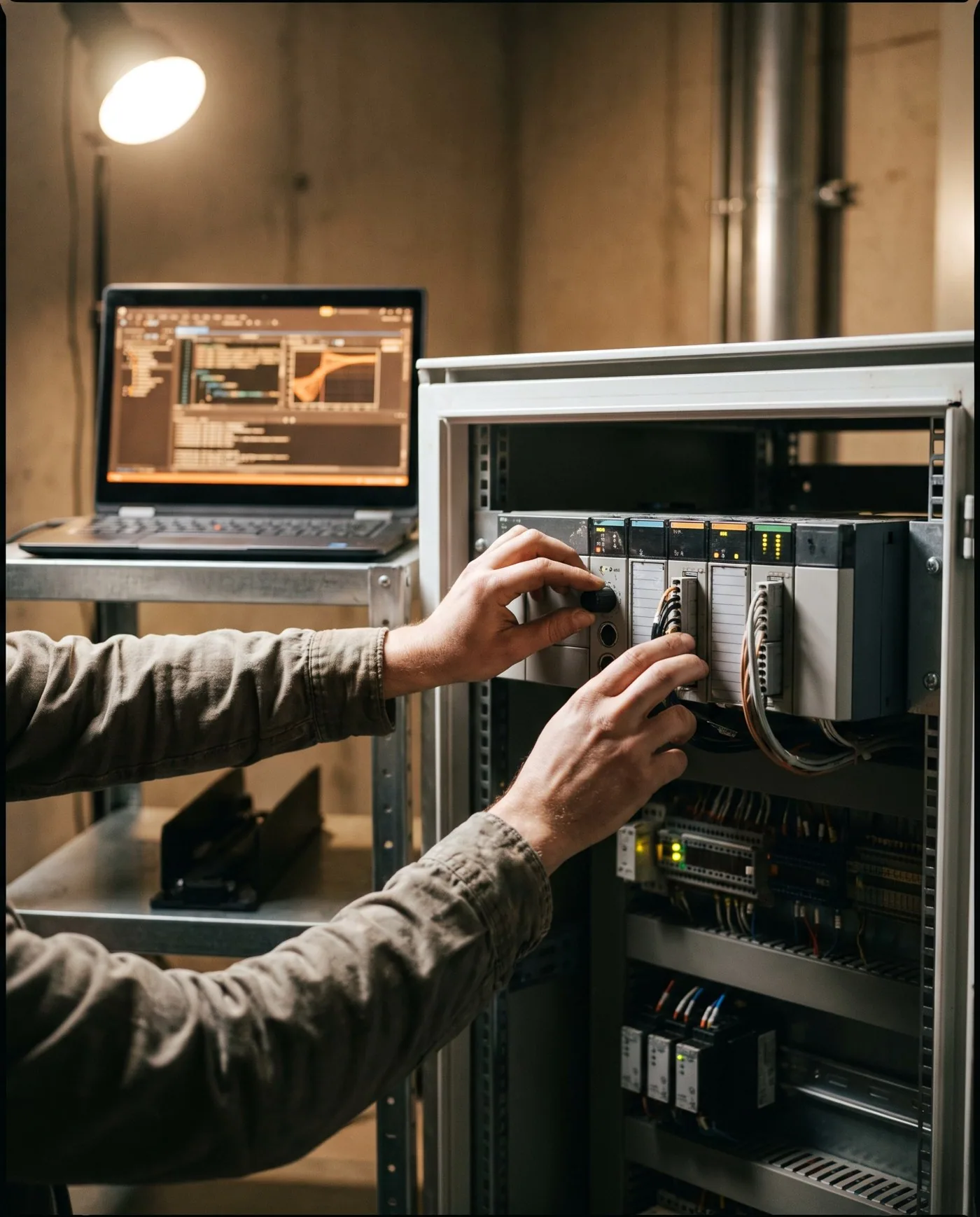
We are asked at least once a month — usually by a residential client whose architect has used the words interchangeably — to deliver 'a BMS for the home' or 'smart automation for the office tower'. The phrasing is harmless; the engineering risk is not. Smart automation and BMS are two different disciplines with two different decision-makers, two different protocol stacks and two different failure modes. Conflating them produces residential buildings whose 'BMS' nobody can operate after handover, and commercial buildings whose 'automation' the facilities team disables in week six.
What smart automation actually is
Smart automation runs the layers a homeowner or end-user interacts with directly: lighting scenes, drapery, climate setpoint, AV routing, security arming. The control surface is a wall-mounted keypad, a touch panel or an app — the homeowner's interface. The protocol stack is typically Rako, Fibaro, KNX, Z-Wave or Zigbee, optimised for room-level integration and a residential interaction model. The failure mode is a scene that misbehaves, a keypad that stops working, a dimmer that won't fade — all small, recoverable, and the homeowner notices immediately.
Smart automation is engineered around the homeowner's actual scenes — Welcome, Dinner, Film, Goodnight — engraved on keypads that read like architecture. The system is programmed in-house, the configuration is versioned, and the homeowner does not need a facilities team to operate it. Six months after handover, when the homeowner asks for a guest-bedroom dimmer, the change is a morning's work because the original programming is recoverable.
What a BMS actually is
A BMS — Building Management System — runs the operational plant a facilities team manages on a supervisory dashboard: chillers, air-handling units, fans, pumps, sub-metering, lighting circuits at the panel level, fire-alarm interfaces, generator status, UPS status, energy. The control surface is a dashboard on a desk or a mobile, with named alarms, escalation routing and audit logs. The protocol stack is BACnet, Modbus, LonWorks or proprietary BMS protocols (Honeywell EBI, Siemens Desigo, Johnson Controls Metasys), optimised for plant-level monitoring and a facilities interaction model.
A BMS is engineered around the priorities a facilities lead actually monitors: plant deviations, alarm rates, audit-grade documentation and tenant-billing sub-metering. The system is configured for a 24/7 operations team, with named alarms in plain English, escalation to mobile devices, and a daily ops report that lands in the facilities manager's inbox. Year-one savings on HVAC energy are typically 4–8%; the operating-discipline value is larger and harder to quantify.
The bright-line test — who runs it after handover?
Reference architecture
hvac-bms-integrationDiagram · described
HVAC × BMS integration topology
Four-column architecture: field sensors and plant feed DDC controllers; controllers translate up to a BACnet/IP supervisor; supervisor feeds the operator dashboard, tenant billing, alarm escalation, energy analytics, and reserves capacity for Phase 2 fire and access integration.
Comparison
Smart automation vs BMS — the discipline boundary
Smart automation
- Operator — homeowner or end-user, direct interaction
- Protocol stack — Rako, KNX, Fibaro, Z-Wave, Zigbee
- Surface — keypad, touch panel, mobile app
- Failure mode — single-scene misbehaviour, recoverable
- Programming — in-house, versioned, recoverable on change
BMS
- Operator — 24/7 facilities team on supervisory dashboard
- Protocol stack — BACnet, Modbus, LonWorks, Honeywell EBI, Siemens Desigo
- Surface — alarm dashboard, mobile escalation, audit log
- Failure mode — plant deviation, energy spike, alarm storm
- Programming — configured for 24/7 ops team, plain-English alarm names
Year-three failure mode
A 'residential BMS' fails silently at year three.
There is no facilities team to monitor the dashboard; chiller and AHU alarms fire to nobody; the homeowner cannot operate a facilities-grade UI. The platform is correct, the operating model is wrong, and the failure surfaces silently — typically when a chiller failure forces a maintenance visit the homeowner did not know was needed.
The clearest way to decide whether a brief is automation or BMS is to ask who runs it after handover. If the answer is the homeowner or the office user, it is automation. If the answer is a 24/7 operations team, it is BMS. The two systems can integrate — a BMS can expose lighting scenes to a meeting-room control system; a smart automation system can expose energy data to a BMS dashboard — but they are designed against different decision-makers and different operational rhythms.
Where the two are conflated, the failure modes show up at year three. A 'BMS for a residence' is typically a smart-automation backbone with HVAC integration shoehorned in — there is no facilities team, the dashboard is the homeowner's app, and on the third year when a chiller alarm fires and nobody is monitoring the dashboard, the alarm is silent. A 'smart automation for an office tower' is typically a BMS with KNX bolted on — the lighting scenes are clunky for users, the room-level interaction model is wrong, and the office staff disables the automation because it gets in the way of their day.
Where they integrate cleanly
On hospitality, healthcare and large commercial projects we routinely deliver both — a BMS running the plant and a smart-automation layer running the room-level interaction — with a defined integration boundary between them. The BMS exposes occupancy and energy data to the automation layer; the automation layer exposes scene-state to the BMS dashboard. The integration is a published API, with the data flowing both ways and the responsibility split per protocol.
On PM Ekta Mall we are delivering the BMS as a phase-one scope and engineering the integration pathway for a future automation layer in the tenant-occupied retail units; on the Tinsukia hospital we delivered the BMS for the plant and a separate ELV layer for the clinical cause-and-effect, with the integration boundary documented in the as-built. Both projects work because the discipline boundary is explicit, not blurred.
Callout — what buyers most miss
Choose the system that matches the operator, not the brochure. The homeowner does not want a BMS; the facilities team does not want smart automation. Specify each system to its actual operator's decision-making model. Where the brief crosses both worlds — a hotel, a hospital, a large commercial complex — engineer the two systems with a defined integration boundary, not as one mongrel platform.
Reference deployment context
PM Ekta Mall (Honeywell BMS, Phase 1) is a pure BMS deployment for an operations team running the plant. The Capital Cultural Hall is a pure AV-and-lighting deployment running on DMX and Art-Net for the venue's operator. The Tinsukia Medical College is a coordinated ELV stack with a future BMS-integration pathway, sized against the hospital's clinical-engineering operating model.
References
1. ASHRAE Standard 135 (BACnet) — Data Communication Protocol for Building Automation and Control Networks.
2. KNX Standard EN 50090 — Open building automation protocol.
3. Honeywell EBI / Siemens Desigo CC / Johnson Controls Metasys — vendor reference architectures.
Key engineering takeaways
- Smart automation serves the homeowner's or end-user's interaction model; BMS serves the facilities team's operational model — they are different disciplines, not different brands.
- The clearest decision test is the post-handover operator question — homeowner or office user = automation; 24/7 ops team = BMS.
- Smart automation runs on Rako, KNX, Fibaro, Z-Wave or Zigbee; BMS runs on BACnet, Modbus, LonWorks or vendor-specific protocols (Honeywell EBI, Siemens Desigo, Johnson Controls Metasys).
- Where the brief crosses both worlds (hospitality, healthcare, large commercial), engineer two coordinated systems with a documented integration boundary — not one mongrel platform.
- Conflating the two surfaces at year three: a 'residential BMS' has nobody to operate it; a 'commercial automation' gets disabled by the facilities team within weeks.
- Integration between the two is a published API at the protocol boundary — data flows both ways, responsibility splits cleanly per protocol.
Common mistakes
What we see go wrong
- Specifying a 'BMS for a residence' because the architect liked the dashboard aesthetic.
- Why it fails — There is no facilities team to monitor it; chiller and AHU alarms fire to nobody; the homeowner cannot operate the facilities-grade UI.
- What we do instead — Specify a residential smart-automation platform (Rako/KNX/Fibaro) and limit BMS to homes with on-site engineering staff (rare).
- Specifying 'smart automation for an office tower' because the keypad aesthetic was sold to the architect.
- Why it fails — Room-level scenes are clunky at floor scale; facilities team disables the automation in week six because it gets in the way of daily operations.
- What we do instead — Specify a BMS for plant and energy; specify smart automation only at executive floors or meeting suites with a defined integration boundary.
- Outsourced programming of a Rako, KNX or BMS deployment.
- Why it fails — Configuration files are held off-site; year-three change requests become forensic exercises; the integrator's lifecycle commitment is fiction.
- What we do instead — Specify in-house programming maturity with named certified engineers; ask for a redacted .pro / .knxproj / vendor config file at integrator selection.
- Treating the BMS-to-automation integration as a software overlay rather than an engineered protocol boundary.
- Why it fails — Silent mis-mappings drift over 24-36 months; the integration appears to work in commissioning and fails at year three with no debug path.
- What we do instead — Engineer the integration as a documented protocol boundary (BACnet, REST API or Modbus gateway) with versioned mapping and semi-annual integration audits.
/ Frequently asked
Quick answers from the practice.
- Can one platform run both BMS and smart automation?
- Theoretically yes — KNX on the residential side or Honeywell EBI on the commercial side both support both layers. In practice, the operating models are different and the dashboards target different decision-makers. A homeowner running Honeywell EBI feels lost in a facilities-grade UI; a facilities team running Rako lacks the alarm management and trend logs they need. We keep them separate by design even when the protocol allows them to merge.
- Which protocol do you specify for BMS?
- BACnet/IP as the integration backbone, with Modbus and KNX for legacy field-device pickup. Vendor-specific protocols (Honeywell's proprietary CARE, Siemens APOGEE) are accepted where the building is single-vendor; mixed-vendor estates run on BACnet to preserve future flexibility.
- Which protocol for residential smart automation?
- Rako for retrofit residential where wireless is the only option; KNX where construction stage allows wired backbone and the building will live for 20+ years; Fibaro for second homes and smaller residential where the polished mobile app is the priority. The rule of thumb: above 30 zones or 15+ years lifecycle, KNX wins on TCO.
- Can a residential cinema or boardroom AV sit on the same controller as the rest of the house?
- Yes for premium residential — Crestron and AMX both span automation + AV + lighting + climate from one controller for a true single-pane UX. For commercial, the AV system is usually a separate control layer (Crestron NVX, Q-SYS) federated with the BMS through a published API. The pattern is per-project.
- Will TechnoGuru deliver both BMS and smart automation across the same building?
- Yes — both as a single-contract turnkey or as two coordinated contracts where the client prefers separation. Reference: PM Ekta Mall Guwahati (Honeywell BMS), Capital Cultural Hall Kohima (AV-and-lighting), Tinsukia Medical College (ELV with future BMS pathway).
/ What to do next
Three next steps for choosing between BMS and smart automation
- Read the BMS service page →Engineering scope for the facilities team's operating model.
- Compare automation platforms →Rako vs Lutron vs KNX vs Crestron side-by-side.
- Send the building brief →We will return a layered recommendation — what sits on the BMS vs what sits on the smart-automation layer.
Engineering toolkit
Tools that go with this read
If this article gave you a question worth pricing, these calculators give a defensible first number.
- BMS · Energy
Energy & Efficiency Estimator
Adjust building variables and see indicative energy and CO₂ savings (kWh) for a BMS-driven energy upgrade plus daylight-harvesting LED retrofit. Conservative; defensible in a first conversation.
kWh · CO₂ savedOpen - BMS · BESS
BESS Sizer
Peak demand + solar + storage strategy in, indicative LFP battery size, inverter rating, daily throughput and cell life out. Vertiv, Delta and Fuji-class deployments.
LFP · kWh · cell lifeOpen - Power · BESS · Solar
DG → Solar+BESS Crossover
DG capacity and monthly run-hours in — the kWp solar + kWh LFP BESS that displaces the genset's run-hours out, plus annual diesel litres displaced and CO₂ avoided.
kWp · kWh · yearsOpen
Related engineering decision
The comparison behind this question.
/ Services this article informs
Read the discipline pages.
/ Reference work
Projects where this engineering shows up.
· Where to go next
The wider authority graph for this topic.
Engineering pages
Projects
Editorial — about this surface
TechnoGuru Smart Automation Practice
The smart automation practice engineers control systems where protocol choice, controller architecture and commissioning discipline decide whether the install ages well. We work in DALI, KNX, Lutron, Crestron, Rako, Control4 and similar ecosystems, with protocol selection grounded in the building rather than the brochure.
Reviewed against protocol-selection realities — the operating ecosystem decides which control architecture survives the second renovation.
Last reviewed
9 May 2026
Engineering domains
Smart home and lighting control · DALI, KNX and protocol architecture · Scene and occupancy logic · Climate, shading and HVAC control
Operating environments
Residential smart homes · Hospitality lighting and scenes · Commercial workplace lighting · Assembly venues with scene control
/ Discuss your project
If this article matches a brief you are working on, the next step is a short brief — a project lead replies to it directly.
We do not run sales pipelines. The first reply comes from a project lead, within two working days, and it goes straight to the engineering question rather than a brochure.