
/ IT
Structured cabling planning: the 25-year decisions you take in week one of design
Quick answer
Structured cabling decisions taken in design week one decide the building's network performance for 25 years: choose Cat6A as the floor (the premium over Cat6 is now under 10% and supports 10 Gbps at 100 m for the cable's full life); design the IDF/MDF placement against the architect's actual floor plan, not the catalogue rule-of-thumb; size pathway capacity for year-three device count, not launch-day; specify TIA-568 channel-test certification on every outlet at handover; and label to a published room-rack-panel-port schedule. Every retrofit cost five years from now is decided by these five choices today.
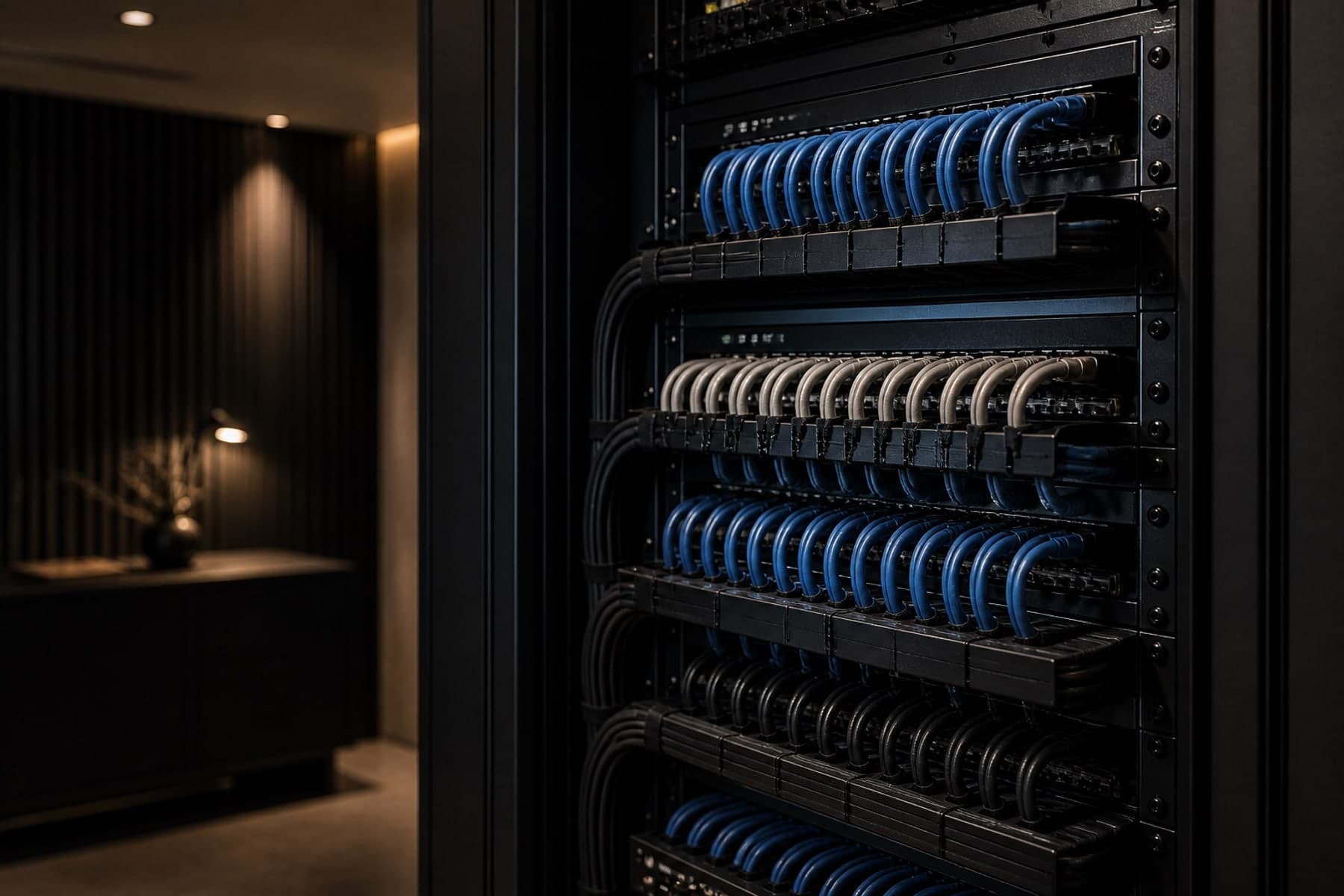
Structured cabling is the most consequential and least glamorous decision in a serious building's IT layer. The cable lasts 25 years; it is buried in walls, ceilings and risers; and almost every decision about it is taken in the first week of design — when the architect's drawings are still fluid, the IT team has not yet assembled, and the procurement focus is on the visible items the client cares about. Five years later, when a new device cannot be added without a retrofit cabling exercise, the cost of those week-one decisions surfaces.
Cat6A is the floor — the premium over Cat6 is no longer the question
The most consistent under-spec we audit is Cat6 cabling on new builds where Cat6A would have cost 8–10% more and lasted a decade longer at the building's network layer. Cat6A supports 10 Gbps over a full 100 m channel, is rated for 25 years of service, and at 2026 cable prices the procurement premium is decisively under the cost of replacing a Cat6 backbone in year ten. We specify Cat6A as the floor on every new build; Cat6 is reserved for retrofit work where pathway constraints force the choice.
Above Cat6A, the next decision is fibre to the desk for 100G+ workloads — typically reserved for media-production floors, AI/ML labs and trading rooms. For mainstream office, hospitality, healthcare and educational deployments, Cat6A is the right answer for the foreseeable network horizon.
IDF/MDF placement against the actual floor plan
The Intermediate Distribution Frame (IDF) and Main Distribution Frame (MDF) placement decides the cable lengths, the riser routing, and the future device-density limits. The catalogue rule-of-thumb is one IDF per floor at the floor's geometric centre; that rule fails on most architecturally interesting buildings, where the floor is not symmetrical and the geometric centre is in a meeting room or a foyer.
We plan IDF/MDF placement against the architect's floor plan, with each IDF placed within 90 m cable-run distance of every outlet it serves (the TIA-568 channel limit is 100 m, and we leave 10 m of margin for patch and mid-span). Where the floor's geometry forces an IDF beyond the 90 m envelope, we add a second IDF rather than push cables to the limit. The two-IDF cost is small at construction; the cable-extension cost five years on is several times higher.
Pathway capacity for year-three device count, not launch-day
Cable trays, conduit and risers are sized at construction. They cannot be expanded gracefully later. The mistake most procurement teams make is to size pathways against the launch-day device count — number of access points, cameras, IP phones, automation devices. The result is pathways at 90% fill on day one, and any device added in year two requires a parallel pathway.
We size pathway capacity against the year-three device count: launch-day plus growth headroom plus IoT plus building-systems plus AV. The headroom is typically 50–80% over launch-day, sized against the building's actual occupancy growth and the technology refresh cycle. Pathways at 50% fill on day one are a cheap insurance against the year-three retrofit.
Channel-test certification on every outlet, at handover
TIA-568 channel-test certification is the standard acceptance test for structured cabling, and it is the deliverable that separates a serious cabling installation from a casual one. Channel-test certifies every outlet against the standard's requirements — insertion loss, return loss, near-end crosstalk, alien crosstalk — across the relevant frequency range. The output is a per-outlet test report, signed by the cabling installer and verifiable by an independent auditor.
We specify channel-test certification on every outlet at handover, with the test reports delivered as part of the as-built documentation pack. Without channel-test, the cabling is unverified — a Cat6A cable that fails alien crosstalk is a Cat5e cable in disguise, and that delta is invisible until the network slows down at the link layer. We have audited buildings where 18% of the outlets failed channel-test against the spec — and where the original contract had not required the test.
Labelling to a published room-rack-panel-port schedule
Every patch, port and outlet must be labelled to a published schedule, agreed with the IT team before deployment. The standard format is room-rack-panel-port (R201-RA02-P03-12 = Room 201, Rack A02, Panel 3, Port 12). The schedule is published before installation, the labels are applied during installation, and the schedule is delivered as part of the as-built.
The discipline is that years from now, when someone needs to find which port serves which desk, the answer is in the documentation rather than in someone's memory. Without the schedule, every cable trace is a forensic exercise; with it, the answer is a 30-second lookup. The labelling cost is trivial; the operational cost of not labelling is many times the cost over the cable's life.
Callout — what buyers most miss
Pathway capacity is the irreversible decision. Cable specs can be upgraded; channel-test can be re-run; labelling can be added. Pathway capacity at construction is the one decision that cannot be retro-fit gracefully. Size pathways against the year-three device count, not the launch-day spreadsheet, and the building's network layer carries the next decade's device additions without retrofit.
Reference deployment context
On the Tinsukia Medical College & Hospital deployment, the Cat6A backbone was sized against the year-three clinical-device count (medical IoT, medication-tracking, RTLS, additional CCTV cameras), with pathways at 55% fill on day one and channel-test certification on every outlet. The Agartala Medical College & GBP Hospital deployment carried the same standard, with three blocks brought online independently and tied back to a central MDF only at final commissioning. Both deployments are working at the cabling layer with no retrofit history.
References
1. TIA-568 (current revision) — Generic Telecommunications Cabling for Customer Premises.
2. TIA-942 — Telecommunications Infrastructure Standard for Data Centres.
3. ISO/IEC 11801 — Information technology — Generic cabling for customer premises.
4. ANSI/TIA-606-C — Administration Standard for Telecommunications Infrastructure.
Campus fibre-backbone reference
multi-building-fiber-backboneDiagram · described
Multi-building fibre backbone topology
A campus-grade single-mode fibre backbone connecting a core MDF to four building IDFs (academic, clinical, admin, hostel) over a redundant ring topology with HDPE under-conduit during civil build-out, draw pits at every IDF entry, LIU termination with 6-port and 24-port panels, OSPF L3 with EIGRP/static fall-back, single-disk failure tolerance per NVR aggregator, and a documented loss-budget test record per fibre core.
Channel-test certification at handover
TIA-568 channel-test on every outlet, signed.
Insertion loss, return loss, near-end and alien crosstalk measured per outlet across the relevant frequency range — independently verifiable, signed by the cabling installer, tied to the as-built room-rack-panel-port schedule.
Effort — 1 day per 200-outlet floor
/ Frequently asked
Quick answers from the practice.
- Cat6 vs Cat6A — what is the right floor in 2026?
- Cat6A on every new build. The procurement premium over Cat6 is under 10% and Cat6A supports 10 Gbps over the full 100 m channel for 25 years. Cat6 is acceptable only for retrofit work where pathway constraints force the choice. Above Cat6A, the next decision is fibre-to-the-desk — reserved for media production, AI/ML labs and trading rooms.
- How do I size IDF placement?
- Against the architectural floor plan, not the catalogue rule-of-thumb. Each IDF must sit within 90 m cable-run of every outlet it serves (TIA-568 channel limit is 100 m; we leave 10 m for patch and mid-span). Where the floor's geometry forces an IDF beyond 90 m, add a second IDF — the construction-stage cost is small; the cable-extension cost five years on is multiples higher.
- What is channel-test certification?
- TIA-568 channel-test certifies every outlet against the standard's electrical requirements — insertion loss, return loss, near-end crosstalk, alien crosstalk — across the relevant frequency range. Without channel-test, the cabling is unverified — a Cat6A cable that fails alien crosstalk is a Cat5e cable in disguise, and the degradation only surfaces years later when the network slows down at the link layer.
- How big should the pathway capacity be?
- Sized against year-three device count, not launch-day. The headroom is typically 50–80% over launch-day, against the building's actual occupancy growth and the technology refresh cycle. Pathways at 50% fill on day one are cheap insurance against the year-three retrofit; pathways at 90% fill on day one trigger that retrofit.
- Will TechnoGuru deliver channel-test on every outlet?
- Yes. Channel-test certification on every outlet is a standard handover deliverable on every structured-cabling scope we deliver — independently verifiable, signed by the cabling installer, and tied to the as-built room-rack-panel-port schedule. Reference: Tinsukia Medical College and Agartala Medical College & GBP Hospital both delivered to this standard.
/ What to do next
Three next steps for structured cabling
- Try the PoE budget calculator →Per-device PoE wattage in, switch tier and SKU band out.
- Read the IT networking service page →Engineering scope, brand bands, channel-test discipline.
- Send the architectural drawings →We mark up IDF/MDF placement and pathway sizing against your actual floor plan.
Engineering toolkit
Tools that go with this read
If this article gave you a question worth pricing, these calculators give a defensible first number.
- IT · Networking
Network & PoE Calculator
Sized to year-three load — switches, Wi-Fi 7 access points, PoE budget (watts), Cat6A run count, port/AP sizing. Cisco / HPE Aruba / Juniper-class enterprise gear.
Switches · APs · PoE WOpen - IT · Cabling
Structured Cabling Estimator
Estimate total structured-cabling length, patch panel count and IDF closet count against floor area and drop count. 50 cable-system brands including Panduit, CommScope, Belden, Legrand, Corning, Furukawa, R&M, Siemon, Nexans, Schneider Electric, STL, Finolex and Polycab. Cat6, Cat6A, Cat7, Cat8 copper plus OM3, OM4, OS2 fibre. TIA-568 compliant.
50 brands · 7 categoriesOpen - IT · Wi-Fi · Coverage
Wi-Fi AP Planner
Floor area, ceiling height, wall material and client density in — AP count, PoE budget, switch ports and channel-plan advice out. Wi-Fi 6 / 6E / 7 with material-derated coverage and hex-packed cell preview.
APs · PoE · channelsOpen
Related engineering decision
The comparison behind this question.
Decision · Networking & IT
Cat6 vs Cat6A — structured cabling grade
You are specifying the horizontal cabling grade for a new fit-out or a re-cable and want to size it for the building's life, not just today's link speed.
Decision · Networking & IT
Single-mode vs multimode fibre backbone
You are specifying the backbone fibre grade for a new build or a re-cable and want it sized for the building's life rather than the current switch generation.
/ Services this article informs
Read the discipline pages.
/ Reference work
Projects where this engineering shows up.
Tinsukia Medical College & Hospital
Healthcare · Government
Tinsukia, Assam · Handover 2024Agartala Medical College & GBP Hospital
Healthcare · Government
Agartala, Tripura · Handover 2022PM Ekta Mall, Guwahati
Commercial · Retail
Guwahati, Assam · In progress · 2026Taraghar — State Guest House
Government · State Guest House
Shillong, Meghalaya · Handover 2025BJP Head Office, Guwahati — Conference Room AV
Government · Conference Room AV
Guwahati, Assam · Completed projectAssam State Guest House, Koinadhara
Government · Protocol Residence
Guwahati, Assam · Handover 2021
Editorial — about this surface
TechnoGuru Network & IT Infrastructure Practice
The network and IT infrastructure practice engineers the backbone that everything else rides on — Cat6A and fibre structured cabling, switching and Wi-Fi, network segmentation, BMS-network integration and the security architecture that keeps the operational network and the corporate network sensibly separated.
Reviewed against enterprise field realities — capacity, segmentation and observability decisions are held to what survives the second campus refresh.
Last reviewed
7 May 2026
Engineering domains
Structured cabling — Cat6A and fibre · Enterprise switching and routing · Wi-Fi 6 / 6E / 7 design · Network segmentation and security
Operating environments
Enterprise office buildings · Institutional and government campuses · Healthcare networks · Hospitality and venue networks
/ Discuss your project
If this article matches a brief you are working on, the next step is a short brief — a project lead replies to it directly.
We do not run sales pipelines. The first reply comes from a project lead, within two working days, and it goes straight to the engineering question rather than a brochure.