
03 / 18
Case file
Acoustic design and treatment for cinemas, auditoriums, recording studios, places of worship and conference halls — engineered absorbers, diffusers, bass traps and ceiling clouds.
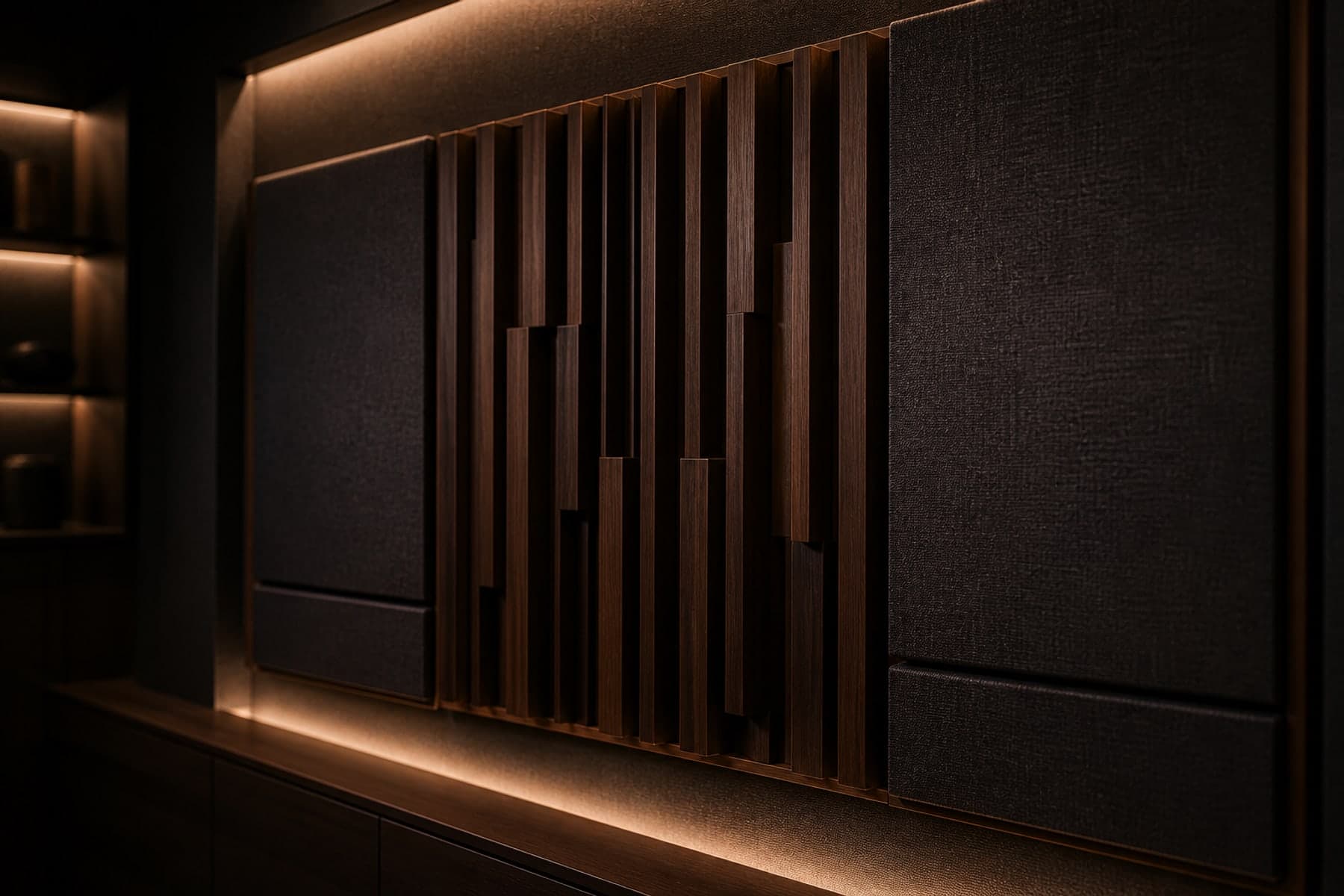
| Requirement | Appearance-led approach | Target-led approach |
|---|---|---|
| Specification basis | Finishes chosen for looks alone | Coverage worked back from RT60, STI and clarity targets |
| Modelling | None | EASE or CATT-Acoustic modelling where the brief warrants |
| Timing | Late add-on after walls and ceiling are built | Integrated during the carcass and ceiling-grid stage |
| Integration | Retrofit applied to the building | Reads as the building — panels as upholstery, joinery or architecture |
Educational comparison of design rigour — not a statement about any specific installer.
/ The discipline, in detail
How we approach acoustic solutions.
Most premium rooms are hostile to their own intent. Polished stone, sheet glass, double-height volumes — every surface a hard reflector — and a brief that asks for both intelligibility and intimacy. Treatment is the quiet engineering that lets the room serve the people in it. Done well, you don't notice it; you only notice that the conversation across the dinner table is no longer a struggle and the espresso machine isn't dominating the morning room.
We work backwards from a measurable target — RT60 by frequency band, STI in every seat, clarity index for music programme — and prescribe the actual coverage of absorbers, diffusers, bass traps and ceiling clouds the target requires. Where the brief warrants, we model the space in EASE or CATT-Acoustic before specifying, so the panel count is engineered rather than guessed.
Material selection is a coordination conversation with the interior designer, not a separate transaction. Fabric-wrapped panels that read as upholstery, slatted timber that reads as joinery, micro-perforated metal that reads as architecture — the treatment reads as the building rather than as a retrofit applied to it.
On record
Every acoustic solutions engagement is documented end-to-end — design, programming, commissioning, calibration — and handed over with the files our successors would need if we were never to return.
/ Ray geometry
First reflections, treated
Why treatment position matters more than treatment quantity — the first-reflection geometry every serious room starts from.
Diagram · described
Acoustic ray geometry
A top-down view of a generic listening room showing the direct path from source to listener (solid line) and four first reflections off the ceiling, floor and the two side walls (dashed). The diagram is purely indicative — it visualises how first-reflection treatment placement is derived, not a project-specific room.
Diagrammatic view — a system planning illustration for design discussion, not a project drawing or live interface.
/ Where we deploy this
Active across 6 sectors.
Acoustic Solutions is rarely a standalone brief — it sits inside a wider sector practice with its own codes, expectations and operating rhythm.
Residential
The premium home, made quiet.
Hospitality
Guest experience, engineered.
Commercial & Corporate
Workplaces that begin meetings on time.
Education & Institutions
Schools, colleges and universities.
Places of Worship
Voice that carries. Light that holds.
Restaurants, Bars & Clubs
The room. The night. The sound.
/ Sister services
The rest of av.
A serious brief usually crosses two or three of these. Read across the discipline — we deliver them as one contract.
- 01
Home Theatre
Reference cinema, in your living room.
Custom-engineered private cinemas — projector, processor, screen, seating and acoustics designed to a single sweet-spot, following THX and Dolby Atmos reference layouts.0 - 02
Multi-Room Audio
One song. Every room. Or six different ones.
Whole-home audio on Yamaha, Sonance and BluOS — invisible in-ceiling speakers, hidden subs, room-corrected and zone-routed.1 - 04
Video Walls
Pixels at the scale of architecture.
Direct-view LED, fine-pitch LCD and rear-projection video walls for command centres, lobbies, broadcast studios, control rooms and event venues.2 - 05
Control Rooms & Command Centres
The room is the instrument.
Operator environments for security, utilities, transport and industrial monitoring — where the display wall, the operator position and the infrastructure behind them are engineered as one system that runs continuously.3 - 06
Smart Classrooms
Every student. Every word. Every time.
Interactive flat-panels, lecture-capture, voice-lift and learning-management integrations — engineered to NCERT, NEP-2020 and university lab specifications.4 - 07
LED Panels & Projectors
The right pixels for the room.
Direct-view LED, OLED, microLED and laser projection — selected to the room's lux, throw, sightline and content.5 - 08
Professional Audio & PA Systems
Intelligible, every seat in the house.
Public address, voice-evacuation and concert-grade audio for auditoriums, places of worship, stadia, transit hubs and event venues.6 - 09
Auditoriums & Boardrooms
Rooms that begin on time.
Turnkey auditorium, boardroom, training-room and conference-room AV — display, audio, control, video-conferencing and lighting integrated to a single touch.7 - 10
Digital Conferencing & Voting Systems
Sittings, voting, interpretation — one system, every seat.
Parliamentary-grade digital conferencing for legislative chambers, council halls and corporate boardrooms — mic management, electronic voting, 8-channel interpretation, camera control and chamber recording, integrated through Bosch DCN, Dicentis and Integrus.8 - 11
Recording Studios & Nightlife
Rooms tuned to the recording.
Recording studio design, post-production suites, broadcast booths and nightlife audio — acoustic isolation, monitoring, console integration and DJ infrastructure.9 - 12
Stage Lighting
Light that performs.
Theatre, concert, event, nightclub and place-of-worship stage lighting — moving heads, washes, profiles, pixel-mapped LED, effect lighting and MADRIX or ProtoPixel show control on DMX / Art-Net / sACN.10 - 13
Conference Room AV
Single-touch join. Every meeting.
Microsoft Teams Rooms, Zoom Rooms and Cisco Webex meeting rooms on platform-certified hardware, with auto-tracking cameras, ceiling-array microphones and one-touch room controllers.11 - 14
Hospitality Venue AV
From the banquet stage to the last bar stool.
Hospitality venue AV — banquet hall, ballroom and conference AV, restaurant and bar zone audio, and club-grade nightlife systems with JBL Professional, K-array and Kgear, engineered for hotels, resorts and standalone venues.12 - 15
Digital Signage & Wayfinding
The right message, in the right place, on schedule.
Commercial indoor and outdoor display panels, signage video walls, menu boards, wayfinding and queue or information screens — driven by content-management software with scheduling and remote management for retail, hospitality, corporate, transport and institutional spaces.13 - 16
IPTV & Hospitality TV
Live channels, your channel, on every screen in the building.
Head-end reception and IP distribution of live television, in-house channels and content to commercial-grade and hotel TVs — with interactive welcome screens, an electronic programme guide, casting and integration into the property's network and guest-room systems.14 - 17
Queue Management System
Take a token, watch the counter, walk up.
Token and queue management — ticket dispensers, counter and main calling displays, audio call-forward, multi-counter routing and wait-time analytics — for healthcare, banks, government and retail counters.15 - 18
IP Paging & Announcement
Page the right zone, over the network.
IP network paging and announcement — zoned paging over the data network, SIP/telephone and desktop paging, scheduled bells and announcements — integrated with the PA and telephony systems for offices, campuses, industrial and transit sites.16
/ Where this system has been deployed
Acoustic Solutions on the ground.
The reference projects below carry a acoustic solutions layer engineered as part of an integrated stack. Each case study walks through the engineering challenges that were solved, the standards the work was held to, and the operational outcome on the day-two team.
- Completed · Handover 2022
Capital Cultural Hall, Kohima
Government · Cultural Auditorium · Kohima, Nagaland
- Completed · Handover 2024
Town Hall Auditorium, Dimapur
Government · Civic Auditorium · Dimapur, Nagaland
- Completed · Handover 2018
Multipurpose Cultural Hall, Namsai
Government · Cultural Auditorium · Namsai, Arunachal Pradesh
- Completed · Handover 2016
Recording Studio, Naharlagun
Media Production · Recording Studio · Naharlagun, Arunachal Pradesh
Public project summaries describe systems and outcomes only — BOQ values, quantities, device counts and security layouts are kept off public surfaces.
Request a feasibility review/ Integration with
How acoustic solutions talks to the rest.
A serious deployment of this system rarely operates in isolation. The disciplines below most commonly share its cabling pathways, its controller logic, and its cause-and-effect matrix.
Auditoriums & Boardrooms
Rooms that begin on time.
Turnkey auditorium, boardroom, training-room and conference-room AV — display, audio, control, video-conferencing and lighting integrated to a single touch.Home Theatre
Reference cinema, in your living room.
Custom-engineered private cinemas — projector, processor, screen, seating and acoustics designed to a single sweet-spot, following THX and Dolby Atmos reference layouts.Professional Audio & PA Systems
Intelligible, every seat in the house.
Public address, voice-evacuation and concert-grade audio for auditoriums, places of worship, stadia, transit hubs and event venues.
/ Read deeper
The engineering, in long form.
Each article below goes deeper than this service page can — a full walk-through of the engineering decisions, written by the team that delivers this work.
- AV · 11 min
Why fluid acoustic treatment beats panel-only above 800 seats
Above 800 seats, panel-only acoustic treatment hits a wall — diffraction, low-frequency build-up and audience absorption variation make the room misbehave. Fluid acoustic treatment — variable-density absorption, tuned bass-traps and adaptive diffusion — delivers measurably better STI and intelligibility scores. The position we take and why.
Read article - AV · 14 min
Spec'ing a residential 9.1.6 cinema in 2026 — the order of operations
A reference 9.1.6 Atmos cinema in 2026 is not a list of components — it is a sequence of decisions. Get the sequence right and the room sounds the way you imagined; get it wrong and the room reads as an expensive living room with surround speakers. The order of operations we follow on every reference cinema we commission.
Read article
Engineering decisions
Compare the options
Decision · AV & Audio
Architectural audio vs conventional loudspeakers — the design approach
You are choosing a loudspeaker approach for a design-sensitive space and weighing concealment and even coverage against conventional flexibility and cost.
Decision · AV & Audio
Home theatre AVR vs separates — processing and amplification
You are specifying the processing and amplification for a home cinema and weighing a single receiver against separates.
Engineering toolkit
Tools to scope this work
Calculators and reference checkers we use ourselves to sense-check the engineering before any drawings change hands.
- AV · Audio · Coverage
Speaker Coverage Planner
Engineering-grade speaker coverage and SPL planner across a source-cited public model catalogue spanning pro touring, commercial audio and architectural speakers. Predicts SPL at listener distance, the horizontal coverage width at that distance on the -6 dB dispersion axis, and the quantity needed for the room.
45 brands · SPL predictionOpen - AV · Cinema
Cinema Sizer
Room dimensions in, recommended screen size, seat layout, Atmos format and projector throw out. Reference / Premium / Media-room tiers.
Screen · seats · AtmosOpen - Auditorium AV · Readiness
Auditorium AV Scope & Readiness Planner
A scope-level self-check for an auditorium, convention or multipurpose hall — the AV signal chain (sources, mixing & DSP, amplification & loudspeaker zones, projection, stage-lighting, assistive listening, recording, control), plus acoustics, infrastructure and operations — with the gap list and who owes what. Statuses and bands only; no seat counts, SPL targets or model choices.
Advisory · readinessOpen
/ Engineering concepts
Related engineering concepts
Concept
Harman Pro Ecosystem (JBL · Crown · BSS · Soundcraft · AKG)
Harman Professional brand family used across our cinema, auditorium and PA deployments — JBL loudspeakers, Crown amplification, BSS DSP, Soundcraft consoles, AKG microphones.
Concept
Trinnov Altitude Processor
French immersive cinema processor. Reference 3D-audio processing with Optimizer room correction. The default specification for reference-grade 9.1.6 and 11.4.6 Dolby Atmos rooms.
Concept
K-array & KGEAR — Premium Italian Architectural Audio
Premium Italian architectural-audio ecosystem — K-array's slim, discreet loudspeakers and the KGEAR everyday professional line — specified for design-led residences, hospitality and premium interiors across North-East India.
Concept
JBL Synthesis Cinema
JBL's reference home-cinema speaker and amplification line. Custom-installed Atmos arrays with Crown amplification — the loudspeaker layer behind the Trinnov + JBL Synthesis reference cinema specification.
/ Used alongside
Commonly deployed alongside
Service
Auditoriums & Boardrooms
Rooms that begin on time.
Service
Professional Audio & PA Systems
Intelligible, every seat in the house.
Sector
Hospitality
Guest experience, engineered.
Service
Multi-Room Audio
One song. Every room. Or six different ones.
Sector
Education & Institutions
Schools, colleges and universities.
Sector
Places of Worship
Voice that carries. Light that holds.
/ Plan it right
Acoustic Solutions — getting the brief right.
Common mistakes to avoid
- Buying loudspeakers to overcome a room the acoustics never addressed.
- Specifying absorption everywhere and deadening the room, instead of balancing absorption, diffusion and reflection.
- Ignoring seasonal reverberation drift in the Northeast, where humidity swings move the room's behaviour across the year.
- Choosing finishes for appearance alone, with no acoustic coefficient behind them.
- Treating acoustics as a late add-on once the ceiling and walls are already built.
What to share before a quotation
- Room drawings with volumes, surfaces and the intended use (speech, music, mixed).
- The target reverberation or intelligibility, or the experience the space must deliver.
- Finish and material constraints from the architect or interior designer.
- Whether the AV / audio design is being done in parallel.
- Any existing acoustic problem being solved in a retrofit.
/ Frequently asked
Acoustic Solutions — what buyers ask first.
When should I bring an acoustician into my project?
Bring an acoustician in before plaster — treatment is dramatically more effective and less visible when integrated during the carcass and ceiling-grid stage. Retrofit is always possible but the acoustic outcome and the visual integration are both compromised.
Is acoustic treatment expensive?
Acoustic isolation and treatment typically costs 8–12% of the total project for a residential cinema and 4–6% for a boardroom — the cost of *not* treating is paid in every meeting, every film and every dinner thereafter.
Do I really need acoustic treatment in my room?
Yes — rooms with stone floors, glass walls or ceiling height above 3.5 m need acoustic treatment; untreated rooms exhaust occupants in 30 minutes regardless of speaker quality. Rooms with stone or marble floors, glass walls, ceiling height above 3.5m, hard parallel surfaces — yes. Untreated rooms exhaust occupants by minute thirty regardless of how good the speakers are. RT60 above 0.8s in a meeting room is a serious productivity tax.
How do you measure RT60, STI and clarity in a room?
Acoustic measurement uses a calibrated microphone, a controlled impulse source and analysis in REW, Smaart or EASE — reporting RT60 by octave band, STI scores and recommended absorber/diffuser layout. A calibrated measurement microphone and a controlled-source impulse — typically a balloon pop, starter pistol or swept-sine through a reference loudspeaker. The room's response is captured at multiple seat positions and analysed in REW, Smaart or EASE. The report includes RT60 by octave band, STI scores and the recommended absorber/diffuser layout.
Will acoustic treatment look like a recording studio?
No — premium acoustic treatment is engineered to disappear. Fabric-wrapped wall absorbers in deep emerald or walnut tones, ceiling clouds finished to match the architectural palette, perforated-wood diffusers integrated into the joinery. Done properly the room reads as architecture, not as engineering.
What's the cost of acoustic treatment for a typical room?
Acoustic-treatment cost is driven by room volume and the treatment depth the brief warrants — a 200 sqft boardroom needs absorbers, diffusers, fabric and installation; a private cinema adds bass traps, ceiling clouds and decoupled walls; an auditorium is typically a measured percentage of total room cost. The spend is significant but decisive of the result. TechnoGuru does not publish tentative prices or budget bands because every project depends on site conditions, drawings, system scope, brands, integration depth, commissioning and support requirements. Please email info@technoguru.in or WhatsApp/call +91 88110 34444 with your drawings, BOQ or project brief for a written estimate after review.
· Begin
Begin a
acoustic solutions
brief.
Tell us about the building, the timeline, and what success looks like a year after handover. We will reply within two working days with a written response, not a sales pitch.