
/ AV
Why fluid acoustic treatment beats panel-only above 800 seats
Quick answer
Above 800 seats, panel-only acoustic treatment fails on three predictable axes: diffraction at panel edges, low-frequency build-up that no surface absorber can solve, and audience-absorption variation between half-house and full-house. Fluid treatment — variable-density absorption tuned per audience zone, calibrated bass-traps in volume corners, and adaptive diffusion at calculated frequency bands — pushes STI from a typical 0.48–0.55 (panel-only) to 0.62–0.68 across the audience plane. The discipline is in the proportion and placement, not the panel area.
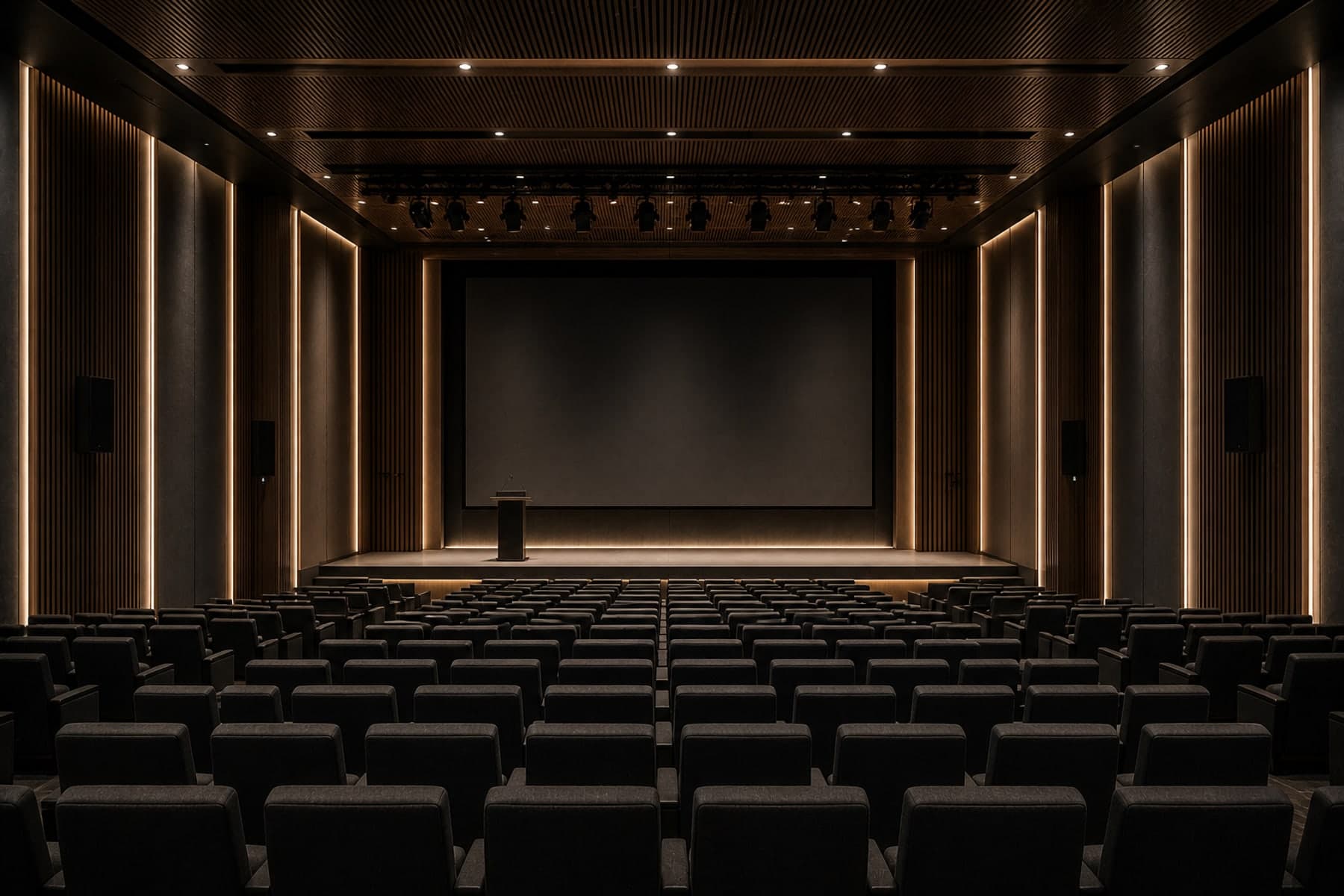
Above roughly 800 seats, the acoustic problem changes character. The room you have engineered for a 400-seat auditorium with conventional panel treatment is not a bigger version of the room you need at 1,200 seats — it is a different problem. We have learned this the hard way across half a dozen civic auditoria, the largest of which was the 1,800-seat Capital Cultural Hall in Kohima. Panel-only treatment above 800 seats produces measurable artefacts that no commissioning routine can quietly tune out.
The first failure mode is diffraction at panel edges. A flat wall absorber sitting in a 400-seat room reads as a roughly continuous absorbing surface to the audience plane; the same panel in a 1,200-seat room is a small object on a very large wall, and the diffraction off its edges becomes audible as a high-frequency smearing of the early reflections. The acoustic model in EASE will tell you this if you let it run — most consultants do not.
The second failure mode is low-frequency build-up. Panel treatment above 200 Hz is straightforward; below it, broadband panels need depth that a 50 mm fabric absorber simply cannot deliver. Above 800 seats the room volume drives mode density into a regime where individual modes are no longer audible as room ringing — they sum into a low-frequency soup that registers in the listener's ear as muddy bass and reduces the clarity score for any spoken-word programme. The treatment that works is targeted bass-trapping at calculated coverage, not generic panels with thicker fabric.
The third failure mode is audience-absorption variation. A 400-seat room with 60% occupancy still behaves close to the design model. A 1,800-seat room at 60% occupancy is acoustically a different room from the same hall at 95% occupancy — the empty seats absorb very differently from the bodies in them. Panel-only treatment cannot adapt; the room either over-damps at full house or rings at half house. Fluid treatment — variable-density absorption with adaptive diffusion elements — narrows that delta to a manageable range.
What fluid acoustic treatment actually means
We use the term 'fluid' in the engineering sense, not the marketing one. Fluid treatment is the combination of three layered choices: variable-density absorption tuned per zone of the audience plane; calibrated bass-traps in the volume corners and along the proscenium; and adaptive diffusion that moves the high-frequency early reflections from coherent specular returns into a controlled scattered field. None of the three is novel; the engineering is in the proportion and placement, and that is what panel-only specifications miss.
Variable-density absorption typically means a mix of 50 mm and 100 mm thicknesses, with denser fabric in the high-energy zones (proscenium, side walls within the first six rows) and lighter fabric in the rear of the hall. The result reads visually as one treatment but performs as several — the front of the room damps the early reflections that would otherwise smear consonants, and the rear preserves enough liveness for the back row to not feel acoustically dead.
Bass-trapping is where most large-hall designs underspend. We typically allocate 18–25% of the absorptive volume of the room to broadband bass treatment below 200 Hz, distributed across volume corners and the proscenium-to-ceiling junction. This is a calculated number per room, not a rule of thumb; for the Capital Cultural Hall we ran a CATT-Acoustic model and arrived at a bass-trap volume that was roughly 30% larger than the panel consultant had specified. The intelligibility result vindicated the calculation.
Adaptive diffusion is the part most acousticians get wrong. The instinct is to specify QRD or BAD diffusers off a catalogue and apply them at uniform density to the rear walls. Above 800 seats this produces an audible ring on transient programme — handclaps, cymbal crashes — because the diffusers are scattering at frequencies they were not designed for. We specify diffusion at calculated frequency bands per zone, with denser scattering near the proscenium and lighter at the rear, and we measure the result with a calibrated impulse test before signing off.
Callout — what buyers most miss
Buyers most often underspend on bass-trap volume and overspend on visible panel area. The visible square-footage of fabric-wrapped panels is what most clients photograph and what most LD-and-AV reviews rate. The work that decides whether a 1,200-seat auditorium reads as elegant or muddy is happening below 200 Hz, in volume corners that nobody photographs. We will publish a bass-trap calculation in every commissioning report from now on so the spend is visible against its function.
Measuring the result
Every fluid-treatment project we deliver is measured against three numbers: STI (speech transmission index) at every seat, RT60 across octave bands, and clarity (C50 or C80) for the room's principal programme. STI ≥ 0.55 in every seat is the threshold for 'good' speech intelligibility; we typically deliver 0.62–0.68 in every seat across a fluid-treated 1,200-seat hall. Panel-only treatment in the same hall typically lands at 0.48–0.55, with a measurable spread between centre seats and side wings.
RT60 is reported per octave band, not as a single number, because that is where the design lives. A flat 1.4-second RT60 across 125 Hz–4 kHz means the room has been over-treated in the high frequencies and under-treated in the low. We design to a slightly rising curve — 1.6 seconds at 125 Hz, 1.4 seconds at 1 kHz, 1.2 seconds at 4 kHz — which reads to the audience as 'warm but clear'. Panel-only treatment cannot produce this curve at scale; the bass-trapping is what allows the high-frequency target to be hit without the low-frequency bloom.
Clarity (C50 for speech, C80 for music) is the third number and the most predictive of audience response. Above C50 = +2 dB the room reads as 'present' for spoken word; below 0 dB it reads as 'reverberant'. For music programme, C80 between -2 and +4 dB is the sweet spot — beyond that the room reads as too dry. Fluid treatment lets us hit different targets in different zones, so the front of the hall is acoustically present for plays and the back is acoustically warm for music. Panel-only specifications cannot do this without compromise.
When panel-only is still the right answer
We are not arguing against panel treatment. Below 800 seats, panel-only — properly specified, with calculated coverage and material discrimination — is often the most cost-efficient and visually integrated answer. The Town Hall Dimapur (374 seats) we delivered in 2024 used a panel-and-cloud specification that met the civic-speech intelligibility the brief required, and the cost per seat was substantially lower than the fluid-treatment specifications we used at scale. The threshold is the room volume and the audience-plane dimensions, not the seat count alone — but seat count is a serviceable proxy in most halls.
Above 800 seats, panel-only is no longer the right answer. The three failure modes — diffraction, low-frequency build-up, audience-absorption variation — are not engineering edge cases; they are the typical regime, and they are what separates a 1,200-seat hall that reads as a working civic asset from one that the operations team quietly retreats from booking serious programme into. Fluid treatment is what closes the gap.
References
1. Capital Cultural Hall, Kohima — 1,800-seat civic auditorium. Fluid treatment specification, 2022 commissioning. STI 0.64 mean, 0.58 minimum across audience plane.
2. Town Hall, Dimapur — 374-seat civic auditorium. Panel-and-cloud specification, 2024 commissioning, signed off to civic-speech intelligibility standard.
3. Beranek, L. L. (2003). Concert Halls and Opera Houses: Music, Acoustics, and Architecture. Springer.
4. ISO 3382-1:2009, Acoustics — Measurement of room acoustic parameters — Part 1: Performance spaces.
5. AES Standard AES-15id-1991, Sound system design — Speech intelligibility.
Auditorium signal architecture · paired with the room
auditorium-signal-architectureDiagram · described
Civic auditorium signal architecture
A civic / cultural auditorium AV signal architecture. Inputs (gooseneck and lavalier microphones, line-in sources, HDMI presentation, livestream feed) route through a digital mixer to a DSP with feedback suppression, EQ and named-preset library (Civic, Cultural, Ceremonial). DSP feeds line-array audio output, stage monitors, LED-cluster video wall, DMX stage lighting and a recording / livestream encoder. Auditorium-staff console recalls a preset and orchestrates all five output classes from a single gesture.
/ Frequently asked
Quick answers from the practice.
- What is the seat-count threshold above which fluid treatment wins?
- Roughly 800 seats, but the real threshold is the room volume and the audience-plane dimensions. A 700-seat hall with a long throw and a deep balcony can hit the fluid-treatment regime; a 900-seat hall with a compact stalls geometry may still respond well to panel-only. Seat count is a serviceable proxy where the room geometry is conventional.
- How do you measure STI in practice?
- Calibrated source (omnidirectional dodecahedron), calibrated measurement microphone (Earthworks M30 or equivalent), source positions matching the design speaker positions, microphone positions at every audience seat in a representative grid. ITU-T P.56 speech-shaped noise; STI computed per IEC 60268-16. We map the result on the audience plane so the operations team sees which seats fall below the target.
- Does adaptive diffusion need motorised surfaces?
- No. Adaptive in this context means frequency-selective by construction — quadratic-residue diffusers tuned to specific frequency bands, placed where the modal analysis says they reduce build-up. Motorised acoustic surfaces exist but are rarely needed for civic auditoria; they belong in multi-purpose halls that toggle between speech and music programmes.
- Will TechnoGuru deliver large-room acoustic treatment as a single contract?
- Yes. We design (in EASE), specify the materials, install the treatment, commission with measurement (STI, RT60, modal sweep) per ISO 3382, and document deviations. End-to-end accountability — including coordination with the architect's interior finishes — under one accountable hand.
/ What to do next
Three next steps for auditoria acoustics
- Try the RT60 calculator →Indicative reverberation time and absorber-area estimate at design stage.
- Read the auditoria-and-boardrooms service page →Engineering scope, brand bands, commissioning discipline.
- Send the architectural drawings →We mark up the acoustic envelope and recommend a treatment specification within two working days.
Engineering toolkit
Tools that go with this read
If this article gave you a question worth pricing, these calculators give a defensible first number.
- Auditorium AV · Readiness
Auditorium AV Scope & Readiness Planner
A scope-level self-check for an auditorium, convention or multipurpose hall — the AV signal chain (sources, mixing & DSP, amplification & loudspeaker zones, projection, stage-lighting, assistive listening, recording, control), plus acoustics, infrastructure and operations — with the gap list and who owes what. Statuses and bands only; no seat counts, SPL targets or model choices.
Advisory · readinessOpen - AV · Audio · Coverage
Speaker Coverage Planner
Engineering-grade speaker coverage and SPL planner across a source-cited public model catalogue spanning pro touring, commercial audio and architectural speakers. Predicts SPL at listener distance, the horizontal coverage width at that distance on the -6 dB dispersion axis, and the quantity needed for the room.
45 brands · SPL predictionOpen - AV · Acoustics
RT60 Acoustic Calculator
Room dimensions and finish materials in, indicative reverberation time and recommended absorber area out. Sabine equation; defensible for early-stage acoustic planning.
Sabine · seconds · m²Open
/ Reference work
Projects where this engineering shows up.
Arunachal Pradesh Legislative Assembly
Government · Legislative Chamber
Itanagar, Arunachal Pradesh · Handover 2017Multi-Purpose Hall, Arunachal Pradesh Assembly Complex
Government · Multi-Purpose Auditorium
Itanagar, Arunachal Pradesh · Handover 2018Cabinet Conference Room, Arunachal Pradesh Secretariat
Government · Cabinet Conferencing
Itanagar, Arunachal Pradesh · Handover 2018Conference Room, Chief Minister's Residential Complex, Kohima
Government · Executive Conference Room
Kohima, Nagaland · Handover 2022Tinsukia Medical College & Hospital
Healthcare · Government
Tinsukia, Assam · Handover 2024Capital Cultural Hall, Kohima
Government · Cultural Auditorium
Kohima, Nagaland · Handover 2022Town Hall Auditorium, Dimapur
Government · Civic Auditorium
Dimapur, Nagaland · Handover 2024Multipurpose Cultural Hall, Namsai
Government · Cultural Auditorium
Namsai, Arunachal Pradesh · Handover 2018Taraghar — State Guest House
Government · State Guest House
Shillong, Meghalaya · Handover 2025BJP Head Office, Guwahati — Conference Room AV
Government · Conference Room AV
Guwahati, Assam · Completed projectAssam State Guest House, Koinadhara
Government · Protocol Residence
Guwahati, Assam · Handover 2021Recording Studio, Naharlagun
Media Production · Recording Studio
Naharlagun, Arunachal Pradesh · Handover 2016
Editorial — about this surface
TechnoGuru AV Systems Practice
The AV systems practice engineers residential reference cinema and commercial audio-visual systems against the AVIXA CTS, CEDIA, HAA Level 1 and K-Array Certified Designer reference frames. Every installation pairs measurable acoustic and visual targets with the field calibration that proves the room actually meets them.
Reviewed against calibrated measurement realities — room performance is verified against reference targets before sign-off.
Last reviewed
15 May 2026
Engineering domains
Residential cinema and reference audio · Commercial audio-visual systems · Acoustic engineering and room treatment · Loudspeaker and line-array design
Operating environments
Residential reference cinema · Hospitality lounges and venues · Corporate AV and boardrooms · Auditoria and assembly halls
/ Discuss your project
If this article matches a brief you are working on, the next step is a short brief — a project lead replies to it directly.
We do not run sales pipelines. The first reply comes from a project lead, within two working days, and it goes straight to the engineering question rather than a brochure.