
01 / 18
Case file
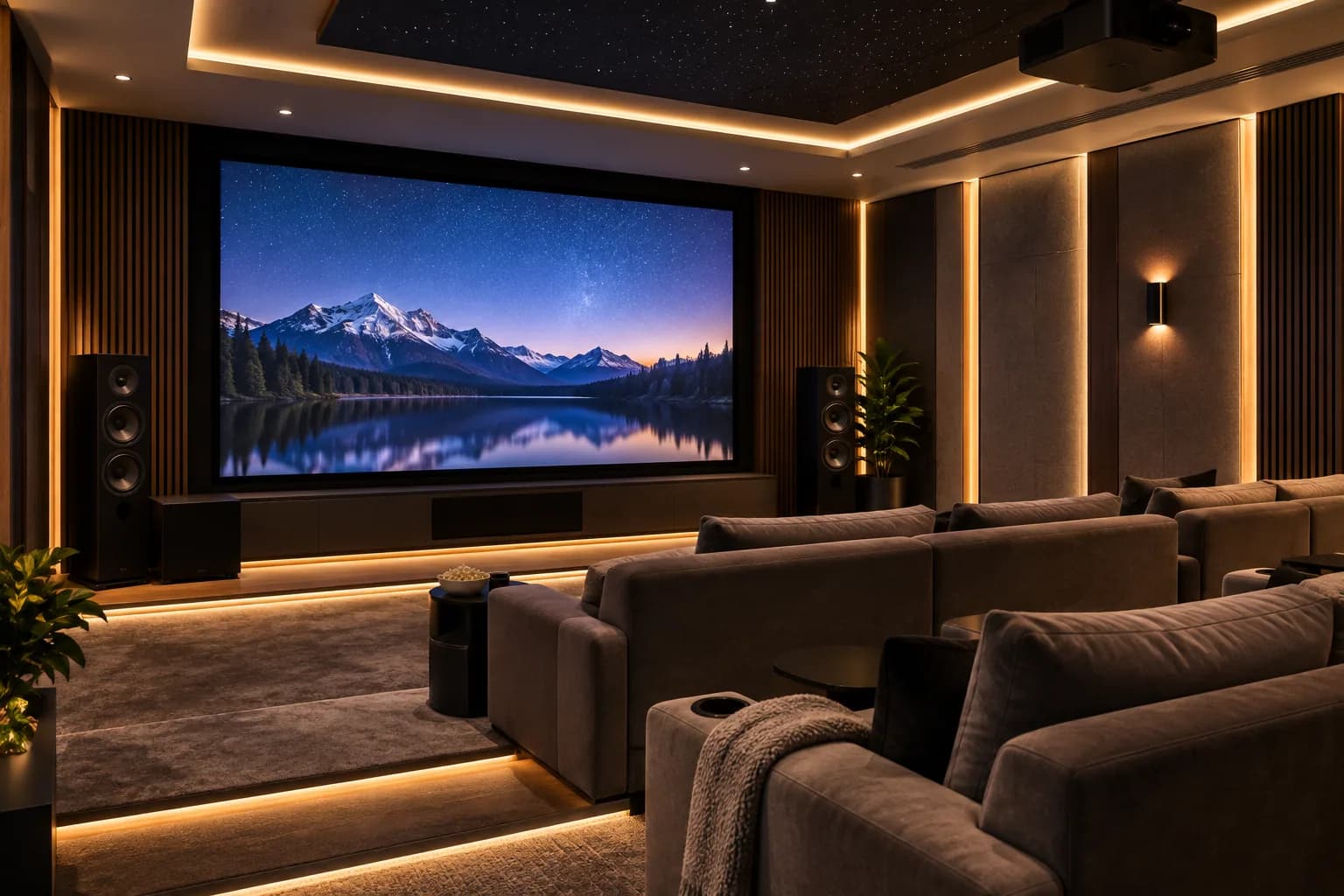
Custom-engineered private cinemas — projector, processor, screen, seating and acoustics designed to a single sweet-spot, following THX and Dolby Atmos reference layouts.
| Aspect | Living room with surround speakers | Engineered cinema |
|---|---|---|
| Design order | Electronics chosen first | Envelope, then treatment, then speakers, then source chain |
| Quality driver | Speaker brand | Acoustic isolation and treatment — the single biggest determinant |
| Layout | Architectural symmetry | Channels dimensioned around the listening position |
| Handover | Plug in and play | Per-seat calibration report: response curves, sub integration, time-alignment, screen colour |
Educational comparison of design rigour — not a statement about any specific installer.
— Interactive · cinema scenes
One panel. The room becomes a cinema.
Tap a scene. Projector source, screen aspect, processor preset, room lighting, climate and seating shift in concert.
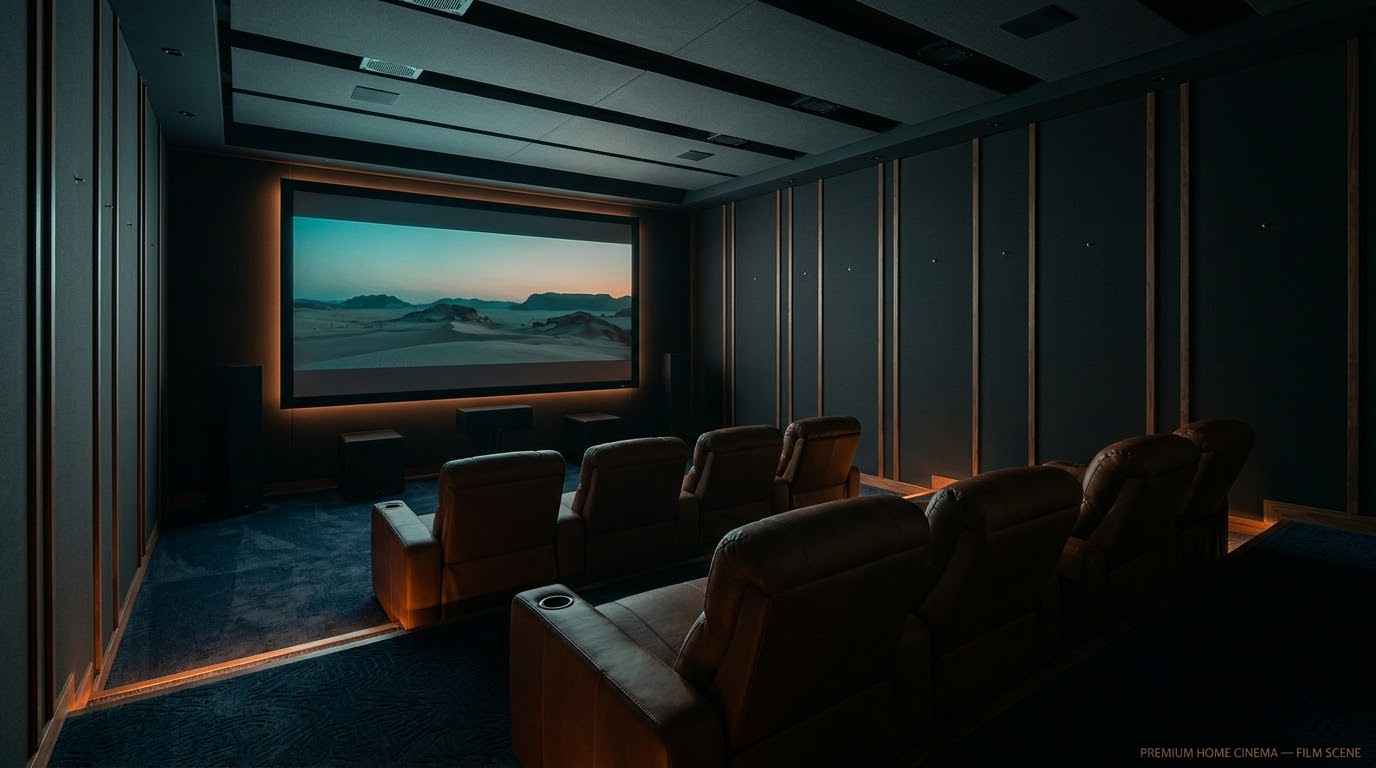
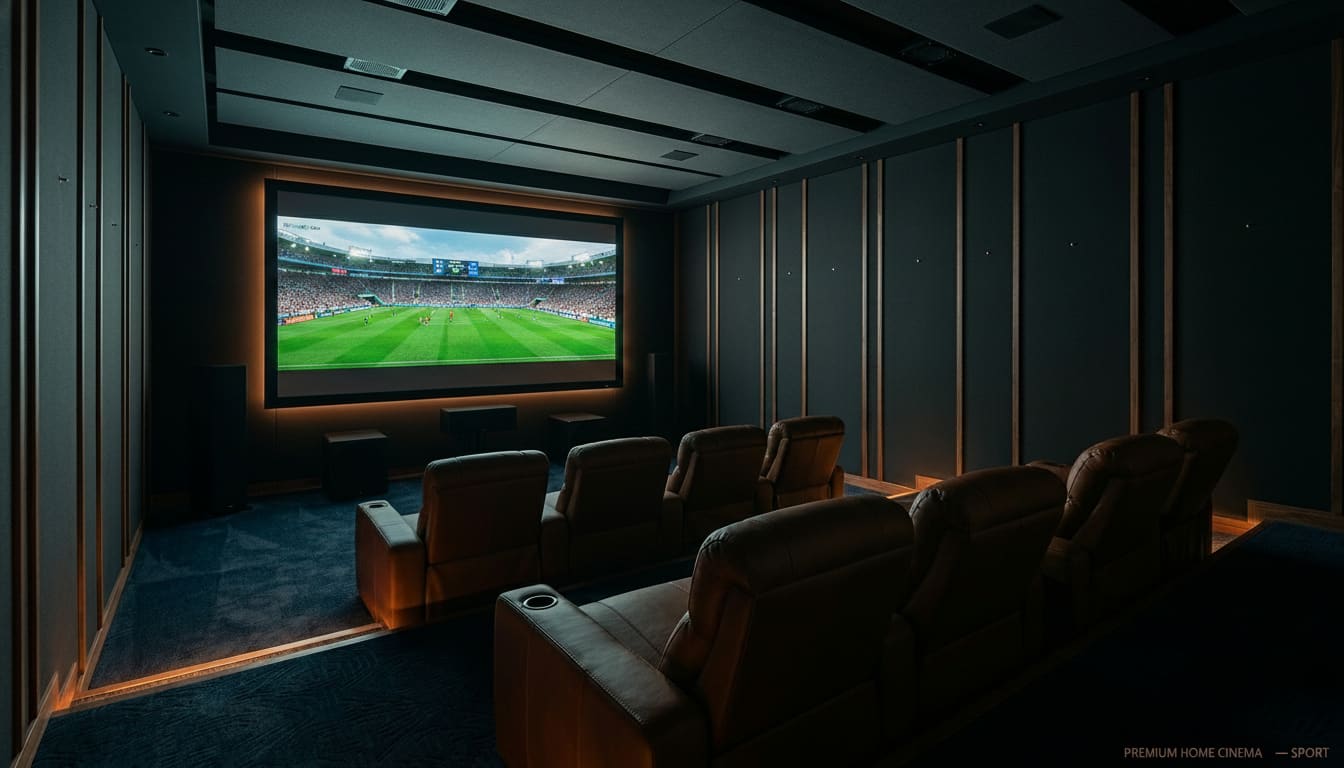
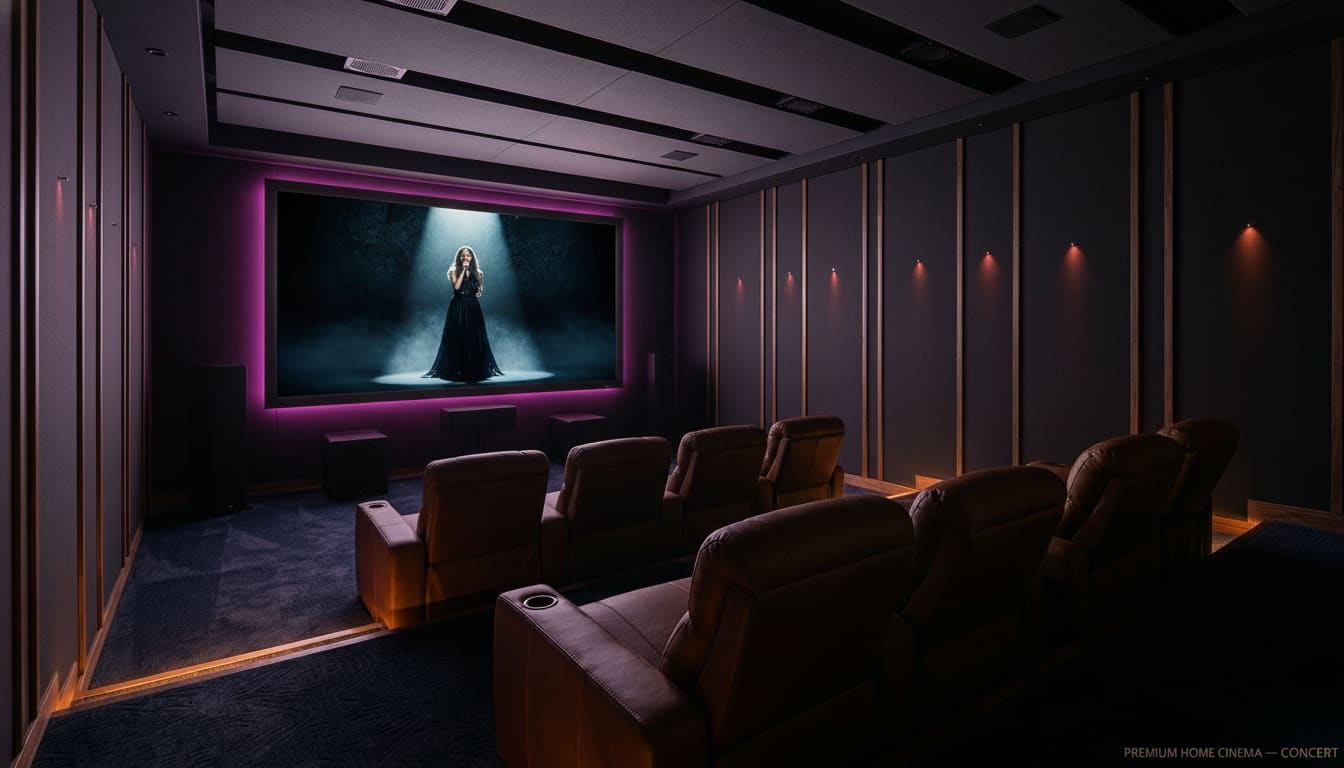
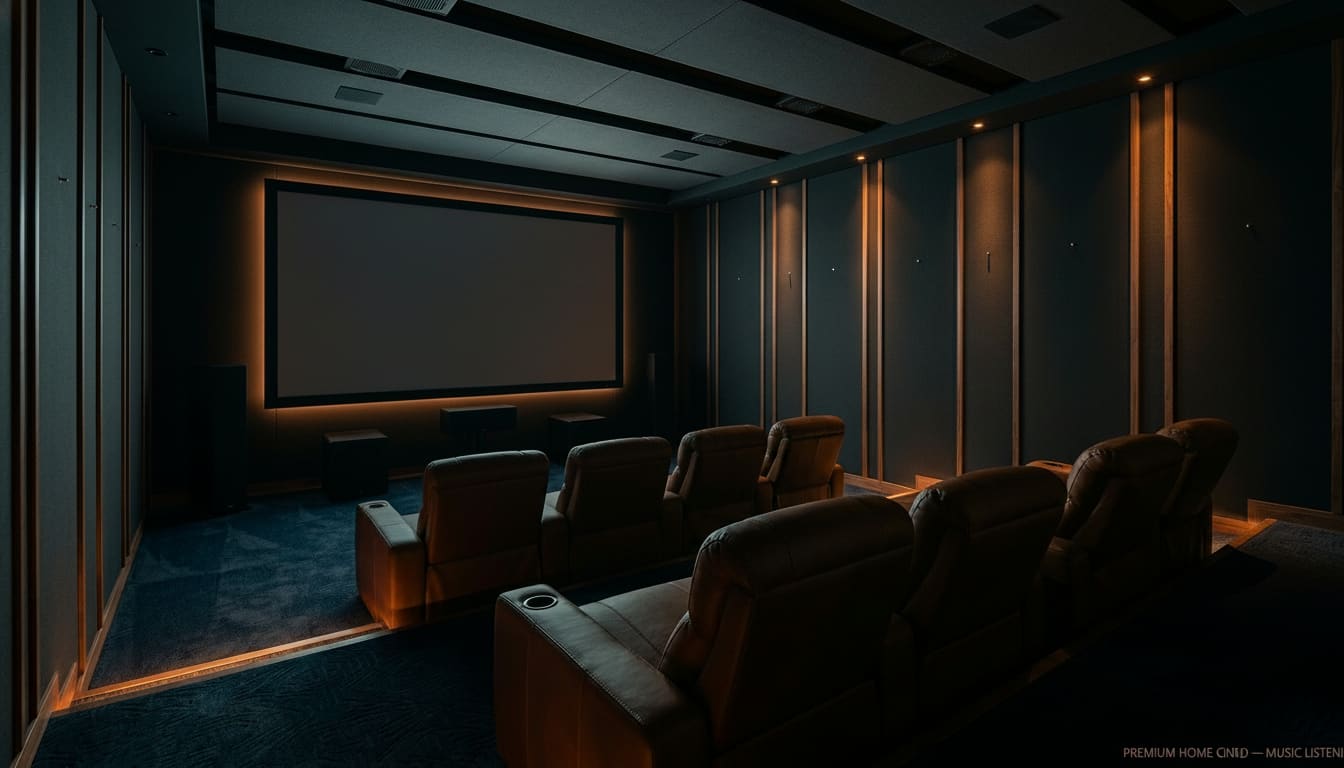
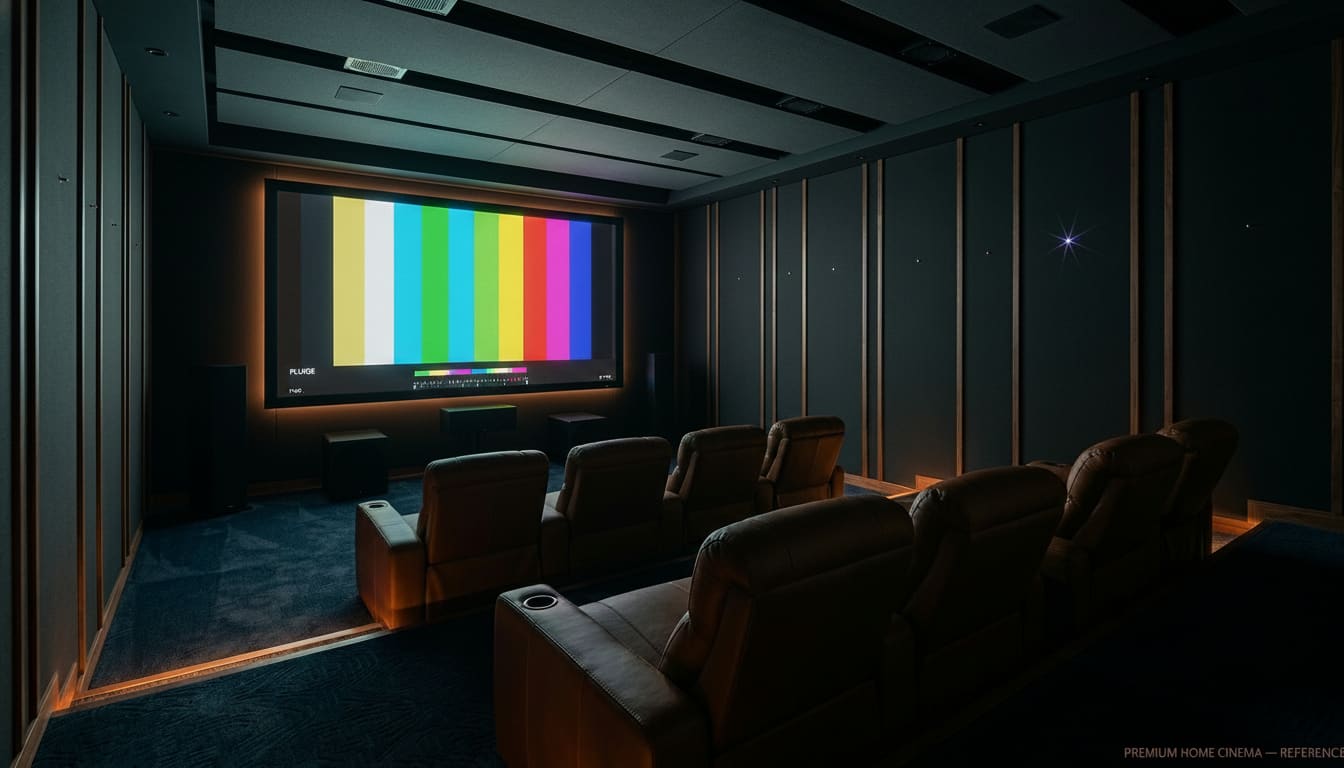
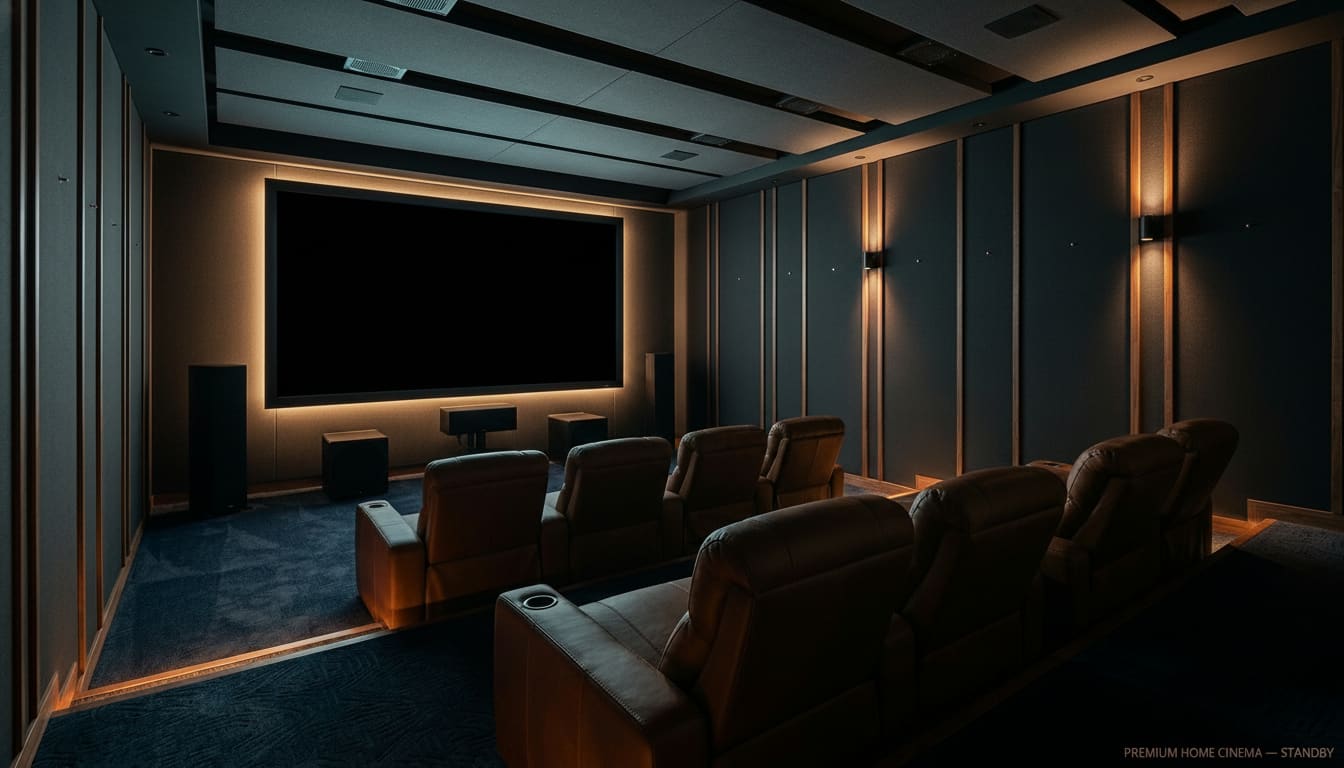
Scene 01 · Film
/ The discipline, in detail
How we approach home theatre.
There is a long, polite version of what separates a real cinema room from a living-room with surround speakers, and there is the short version: the room is the system. Acoustic isolation, treatment, sightlines and seat geometry are decided before a single piece of electronics is specified. We design the envelope first — wall mass, decoupling, HVAC silencer paths — then the treatment, then the loudspeaker layout, then the source chain. In that order.
Atmos and 9.1.6 layouts are dimensioned around the listening position rather than the architectural symmetry, because cinema is a single-listener art form even when there are eight seats in the room. Risers, bass-shakers and seating layouts are coordinated so that conduit runs are invisible at handover. Projection, screen, immersive processor and amplification are specified to the room's actual screen size and aspect — not the headline number on the brochure.
Every cinema we hand over carries a calibration report: response curves per seat, sub-woofer integration, time-alignment, and the colour gamut of the screen as measured in front of you. You see what we measured before you take delivery.
On record
Every home theatre engagement is documented end-to-end — design, programming, commissioning, calibration — and handed over with the files our successors would need if we were never to return.
/ Signal flow
Source through reproduction
The five-stage cinema signal chain — gain structure, processing and calibration verified at every join.
Diagram · described
Signal flow — Cinema · 9.4.6 reference
A generic, non-confidential representation of an AV signal flow with five stages: source (media, microphone or stream), processing (DSP and matrix), amplification (power and limiter), distribution (zone routing) and reproduction (loudspeaker or screen). Indicative pattern only — actual project topologies vary with brand stack and brief.
Diagrammatic view — a system planning illustration for design discussion, not a project drawing or live interface.
/ Where we deploy this
Active across 2 sectors.
Home Theatre is rarely a standalone brief — it sits inside a wider sector practice with its own codes, expectations and operating rhythm.
/ Sister services
The rest of av.
A serious brief usually crosses two or three of these. Read across the discipline — we deliver them as one contract.
- 02
Multi-Room Audio
One song. Every room. Or six different ones.
Whole-home audio on Yamaha, Sonance and BluOS — invisible in-ceiling speakers, hidden subs, room-corrected and zone-routed.0 - 03
Acoustic Solutions
Rooms that sound the way they look.
Acoustic design and treatment for cinemas, auditoriums, recording studios, places of worship and conference halls — engineered absorbers, diffusers, bass traps and ceiling clouds.1 - 04
Video Walls
Pixels at the scale of architecture.
Direct-view LED, fine-pitch LCD and rear-projection video walls for command centres, lobbies, broadcast studios, control rooms and event venues.2 - 05
Control Rooms & Command Centres
The room is the instrument.
Operator environments for security, utilities, transport and industrial monitoring — where the display wall, the operator position and the infrastructure behind them are engineered as one system that runs continuously.3 - 06
Smart Classrooms
Every student. Every word. Every time.
Interactive flat-panels, lecture-capture, voice-lift and learning-management integrations — engineered to NCERT, NEP-2020 and university lab specifications.4 - 07
LED Panels & Projectors
The right pixels for the room.
Direct-view LED, OLED, microLED and laser projection — selected to the room's lux, throw, sightline and content.5 - 08
Professional Audio & PA Systems
Intelligible, every seat in the house.
Public address, voice-evacuation and concert-grade audio for auditoriums, places of worship, stadia, transit hubs and event venues.6 - 09
Auditoriums & Boardrooms
Rooms that begin on time.
Turnkey auditorium, boardroom, training-room and conference-room AV — display, audio, control, video-conferencing and lighting integrated to a single touch.7 - 10
Digital Conferencing & Voting Systems
Sittings, voting, interpretation — one system, every seat.
Parliamentary-grade digital conferencing for legislative chambers, council halls and corporate boardrooms — mic management, electronic voting, 8-channel interpretation, camera control and chamber recording, integrated through Bosch DCN, Dicentis and Integrus.8 - 11
Recording Studios & Nightlife
Rooms tuned to the recording.
Recording studio design, post-production suites, broadcast booths and nightlife audio — acoustic isolation, monitoring, console integration and DJ infrastructure.9 - 12
Stage Lighting
Light that performs.
Theatre, concert, event, nightclub and place-of-worship stage lighting — moving heads, washes, profiles, pixel-mapped LED, effect lighting and MADRIX or ProtoPixel show control on DMX / Art-Net / sACN.10 - 13
Conference Room AV
Single-touch join. Every meeting.
Microsoft Teams Rooms, Zoom Rooms and Cisco Webex meeting rooms on platform-certified hardware, with auto-tracking cameras, ceiling-array microphones and one-touch room controllers.11 - 14
Hospitality Venue AV
From the banquet stage to the last bar stool.
Hospitality venue AV — banquet hall, ballroom and conference AV, restaurant and bar zone audio, and club-grade nightlife systems with JBL Professional, K-array and Kgear, engineered for hotels, resorts and standalone venues.12 - 15
Digital Signage & Wayfinding
The right message, in the right place, on schedule.
Commercial indoor and outdoor display panels, signage video walls, menu boards, wayfinding and queue or information screens — driven by content-management software with scheduling and remote management for retail, hospitality, corporate, transport and institutional spaces.13 - 16
IPTV & Hospitality TV
Live channels, your channel, on every screen in the building.
Head-end reception and IP distribution of live television, in-house channels and content to commercial-grade and hotel TVs — with interactive welcome screens, an electronic programme guide, casting and integration into the property's network and guest-room systems.14 - 17
Queue Management System
Take a token, watch the counter, walk up.
Token and queue management — ticket dispensers, counter and main calling displays, audio call-forward, multi-counter routing and wait-time analytics — for healthcare, banks, government and retail counters.15 - 18
IP Paging & Announcement
Page the right zone, over the network.
IP network paging and announcement — zoned paging over the data network, SIP/telephone and desktop paging, scheduled bells and announcements — integrated with the PA and telephony systems for offices, campuses, industrial and transit sites.16
/ Integration with
How home theatre talks to the rest.
A serious deployment of this system rarely operates in isolation. The disciplines below most commonly share its cabling pathways, its controller logic, and its cause-and-effect matrix.
Acoustic Solutions
Rooms that sound the way they look.
Acoustic design and treatment for cinemas, auditoriums, recording studios, places of worship and conference halls — engineered absorbers, diffusers, bass traps and ceiling clouds.Multi-Room Audio
One song. Every room. Or six different ones.
Whole-home audio on Yamaha, Sonance and BluOS — invisible in-ceiling speakers, hidden subs, room-corrected and zone-routed.Home & Office Automation
One press. The whole space responds.
Lights, climate, blinds, audio, cinema and security — orchestrated by a single Rako, Fibaro or KNX backbone and controlled from a touch panel, voice or a discreet keypad on the wall.
/ Read deeper
The engineering, in long form.
Each article below goes deeper than this service page can — a full walk-through of the engineering decisions, written by the team that delivers this work.
Product intelligence
What we specify for this system, and what we hold published figures for
A receiver is chosen for the layout it has to drive — amplified channels and processing channels are different counts, and only the first drives passive loudspeakers.
Audio — home theatre electronics
38 products · 3 brands · 38 manufacturer-verified
Including Denon AVR-A1H, Marantz CINEMA 30, Yamaha RX-A8A, Denon AVR-A10H, Marantz CINEMA 40 and Yamaha RX-A6A.
No TechnoGuru calculator consumes this category yet. The published figures are held and used in design; they are not yet behind a self-serve tool.
Audio — loudspeakers
2543 products · 58 brands · 2278 manufacturer-verified
Including 1 SOUND C4, AUDAC ALTI4, Adamson VGd, Alcons Audio CCS6, AtlasIED FAP33T-W and Biamp Community R.5-94Z.
- Speaker Coverage Planner — the horizontal coverage width this loudspeaker's published dispersion gives at a listening distance.
Audio-visual — projection
390 products · 51 brands · 187 manufacturer-verified
Including AWOL Vision LTV-3000 Pro (UST), Anker Nebula Capsule 3 Laser, Barco DP4K-30L, BenQ W5850, Canon LV-X420 and Casio XJ-V1.
- Projector Throw Distance Calculator — the placement distance this projector's published throw ratio allows for a given image width.
Figures come from manufacturer documents, each recorded with its source and the date it was read. Holding published data for a product means we specify and integrate it. It does not make TechnoGuru that manufacturer’s dealer, distributor, reseller or appointed representative, and no such relationship should be inferred from a product appearing here.
Engineering decisions
Compare the options
Decision · AV & Audio
Architectural audio vs conventional loudspeakers — the design approach
You are choosing a loudspeaker approach for a design-sensitive space and weighing concealment and even coverage against conventional flexibility and cost.
Decision · AV & Audio
Home theatre AVR vs separates — processing and amplification
You are specifying the processing and amplification for a home cinema and weighing a single receiver against separates.
Engineering toolkit
Tools to scope this work
Calculators and reference checkers we use ourselves to sense-check the engineering before any drawings change hands.
- AV · Projection
Projector Throw Distance Calculator
Engineering-grade throw distance calculator across a verified multi-brand projector catalogue — Sony, JVC, Epson, BenQ, LG, Optoma, ViewSonic, Panasonic, Barco, Christie, Canon, InFocus, Maxell, Casio, EIKI, Philips, Nebula, JMGO, Dangbei, Boxlight, ASUS, Leica, Xiaomi, WEMAX, Ricoh and more. Searchable picker, throw range, lens-shift envelope, viewing distance, pixel density, feasibility flags and a custom-throw fallback. Sources cited per model.
51 brands · sourcedOpen - AV · Cinema
Cinema Sizer
Room dimensions in, recommended screen size, seat layout, Atmos format and projector throw out. Reference / Premium / Media-room tiers.
Screen · seats · AtmosOpen - Smart Home
Smart Home Discovery Wizard
For villa and apartment owners — pick your home, the zones that matter and the experiences you want, and map a coordination scope and room checklist. Not a final design, device count or security layout.
Advisory · discoveryOpen
/ Engineering concepts
Related engineering concepts
Concept
JBL Synthesis Cinema
JBL's reference home-cinema speaker and amplification line. Custom-installed Atmos arrays with Crown amplification — the loudspeaker layer behind the Trinnov + JBL Synthesis reference cinema specification.
Concept
Trinnov Altitude Processor
French immersive cinema processor. Reference 3D-audio processing with Optimizer room correction. The default specification for reference-grade 9.1.6 and 11.4.6 Dolby Atmos rooms.
Concept
Harman Pro Ecosystem (JBL · Crown · BSS · Soundcraft · AKG)
Harman Professional brand family used across our cinema, auditorium and PA deployments — JBL loudspeakers, Crown amplification, BSS DSP, Soundcraft consoles, AKG microphones.
Concept
Premium Residence Archetype
Private villa or premium apartment, architect-led, multi-system: Rako or KNX lighting, multi-room audio, reference cinema, climate, surveillance and IT — engineered as one integrated layer from the drawing stage.
/ Used alongside
Commonly deployed alongside
Sector
Residential
The premium home, made quiet.
Sector
Hospitality
Guest experience, engineered.
Service
Multi-Room Audio
One song. Every room. Or six different ones.
Service
Acoustic Solutions
Rooms that sound the way they look.
Service
Home & Office Automation
One press. The whole space responds.
Service
Auditoriums & Boardrooms
Rooms that begin on time.
/ Plan it right
Home Theatre — getting the brief right.
Common mistakes to avoid
- Buying the electronics first and treating the room as an afterthought — isolation, treatment and geometry decide more of the result than the equipment does.
- Locking seating and riser positions before the loudspeaker layout, so the main listening position lands in a bass null.
- Choosing screen size from a brochure instead of the actual seating distances and sightlines.
- Ignoring HVAC noise — a silent room is the foundation the whole system stands on, and a hissing duct wastes the projector.
- Skipping calibration and documentation at handover, so the room never performs to what was actually installed.
What to share before a quotation
- Room dimensions — or the plans, if the room is still on paper; earlier is always better.
- Seat count and how the family will really use the room — films only, sport, gaming, music.
- The isolation context — what sits above, below and beside the cinema.
- Whether acoustic treatment and interiors are in scope or with another designer.
- Source preferences and any equipment being carried over.
/ Frequently asked
Home Theatre — what buyers ask first.
What's the minimum room size for a private cinema?
A dedicated 7.1.4 Atmos room performs well from about 16' × 12'; below that we recommend a 5.1 layout in a media-room configuration. The single biggest determinant of cinema quality is not room size — it is acoustic isolation and treatment.
Projector or large TV?
In a dedicated, light-controlled room above ~120 inches, 4K laser projection wins on image scale, eye comfort and dynamic range. For a media room with ambient light, a 95–98 inch microLED or OLED is the better answer.
How much does a private home cinema cost in India?
Cost is driven by channel count, the speaker and amplification stack, projection class, acoustic treatment and seating. An entry reference room — 7.1.4, 4K projector, custom seating, acoustic treatment — sits at one scale; a reference Atmos room with Yamaha DSP, BenQ projection and Crown amplification sits well above it. We scope every room to your music and film priorities first. TechnoGuru does not publish tentative prices or budget bands because every project depends on site conditions, drawings, system scope, brands, integration depth, commissioning and support requirements. Please email info@technoguru.in or WhatsApp/call +91 88110 34444 with your drawings, BOQ or project brief for a written estimate after review.
Atmos, Auro-3D or DTS:X — which immersive format do we calibrate to?
Calibrate to Dolby Atmos as the default for private cinemas in 2026; the room and seating geometry are optimised for Atmos with Auro-3D and DTS:X playback decoded as fallbacks. Dolby Atmos is the dominant format and the right default for a private cinema today; the available content library is the largest. We calibrate to all three on JBL Professional-grade processors so the room can decode whatever the source emits, but the room and seating geometry are optimised for Atmos.
Should the cinema be a dedicated room or a media room?
Choose a dedicated cinema for the absolute reference experience; choose a media room for everyday family use with motorised drapery for blackout. Both are engineered honestly with documented trade-offs. Black-painted, isolated walls, treated to a target RT60 of 0.30–0.40s, screen on a riser — give the absolute reference. Media rooms — with daylight, motorised drapery, integration into the living area — are an excellent compromise for families that want a usable everyday space. We engineer both, and we explain the audio and visual trade-offs in writing.
What's the right screen size for a given room?
Cinema screen size is 1.0–1.5× screen height for the front row and 2.0–2.5× for the back, modelled in CAD against the actual seating before specifying. 1.0–1.5× screen height for the front row, 2.0–2.5× for the back. We model the room in CAD before specifying — too-large a screen forces the front row uncomfortably close, too-small wastes the resolution of a 4K projector. BenQ sizes are spec'd to the actual room, never to a brochure recommendation.
Which speaker and AVR brands does TechnoGuru work with for a private cinema?
Loudspeakers are specified from families such as Sonance, Pure Acoustics, K-array and KGEAR, with the AVR or processor typically from Denon and control accessories from Xantech, Russound or VSSL where a multi-source layer is involved. We match the speaker family to the room and the seating rather than fixing it in advance. Final make and model follow the room acoustics, the seating layout and the client's approval.
Can the cinema have ambient, bias or star-ceiling lighting that reacts to the film?
Yes — screen-bias lighting behind the projection, cove washes and a fibre or RGBW star-ceiling can all be part of the room, and they integrate with the cinema's scene layer so a single 'Film' press dims the room, closes the drapery and drops the bias to a calibrated level. Where the effect earns it, the RGBW and pixel layers run on a ProtoPixel or MADRIX engine so colour can follow the content or a chosen mood, bridged into the Rako or KNX scene graph rather than living on a separate remote. We decide the pixel-media layer after the room layout and drivers are reviewed — bias done wrong lifts the black floor of the image, so it is engineered, not bolted on.
In-wall, in-ceiling or free-standing speakers — how is that decided?
Where the design wants the speakers to disappear, in-wall and in-ceiling architectural models (Sonance, Pure Acoustics) are the route; where performance leads and the room allows it, free-standing models earn their place. Subwoofer count and placement are modelled against the room's low-frequency behaviour rather than dropped in a corner. The layout is selected after the room drawings and acoustic conditions are reviewed.
How does the home theatre integrate with lighting and control?
A single 'Film' state can dim the lighting, close the drapery, drop the screen and power the audio chain together, with the cinema sitting inside the home's wider control layer rather than as an island. The control accessories (Xantech, Russound, VSSL) are chosen to match that integration. The final scheme is designed against the room and the home's control platform; share the drawings through /contact or the brief wizard for a written scope.
· Begin
Begin a
home theatre
brief.
Tell us about the building, the timeline, and what success looks like a year after handover. We will reply within two working days with a written response, not a sales pitch.