
/ AV
CEDIA/CTA-RP22 — immersive audio design for private cinemas
Quick answer
CEDIA/CTA-RP22 is the Immersive Audio Design Recommended Practice. It concerns audio design for private entertainment spaces, with four performance levels that help an owner and designer agree the intended result. Calibration is a later activity in delivering a room; RP22 should not be presented as a cinema-calibration certificate or a video-performance standard.
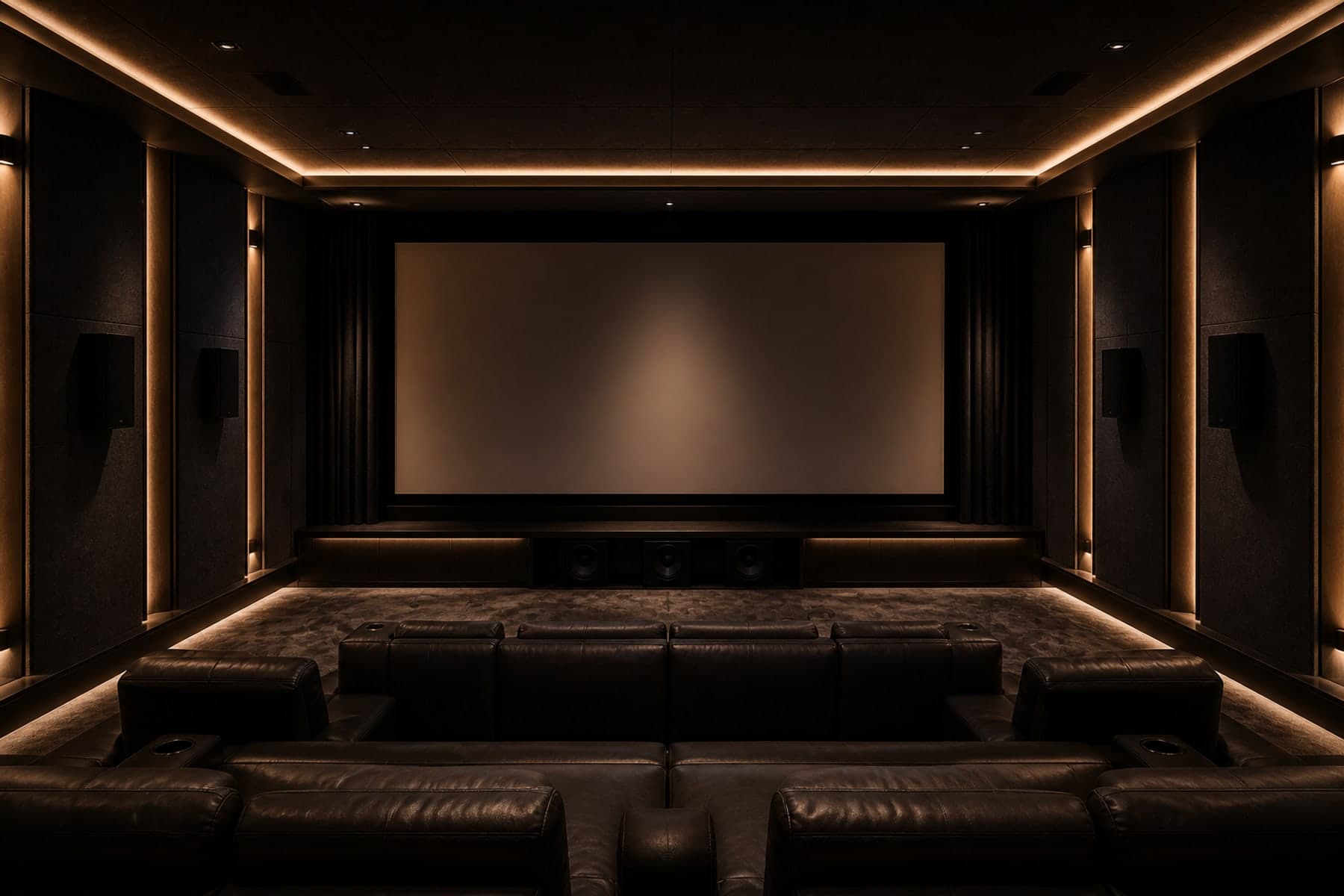
CEDIA and the Consumer Technology Association identify RP22 as an immersive audio design recommended practice. CTA lists the document as published in September 2023 and describes its subject as audio design for private listening experiences. CEDIA explains that its four performance levels provide a framework for discussing the experience a system should deliver. Source records: https://www.cta.tech/standards/cediacta-rp22/ and https://cedia.org/en-us/smart-home-professionals/advocacy/standards-best-practices/immersive-audio-design-excellence/.
Begin with the listening brief
For a private cinema, the useful starting question is which seats must share the intended experience. A room used by one listener and a room used by a family across several seats create different design constraints. Give the designer the room dimensions, proposed seating, intended uses and architectural restrictions before selecting the equipment. Ask which decisions remain open and which would be expensive to change once the room is finished.
Agree a performance level and its evidence
The four RP22 performance levels let a designer describe an audio ambition in a more structured way than a list of expensive products. Naming a level in a proposal is only the beginning of a project discussion. Ask the designer to identify the applicable requirements, the assumptions behind the design and how the completed system will be assessed. A generic label such as premium room does not establish that a particular level has been achieved.
Coordinate the room and the system
Our practical planning advice is to review the seating layout, loudspeaker positions, available equipment space and acoustic treatment together. Share ceiling limitations, concealed-installation requirements and the finishes proposed by the architect. If an architectural decision changes, return it to the audio designer before procurement. A documented change is easier to assess than a late substitution whose effects nobody has reviewed.
Keep design, commissioning and calibration distinct
An audio design defines the intended system and its assumptions. Installation delivers that design on site. Commissioning checks the completed work, while calibration adjusts the system within its capabilities. The commissioning scope should identify the checks, measurement methods, listening positions, records and acceptance criteria agreed for the project. Neither an equipment list nor a reference to RP22 alone is a measurement report.
RP22 should not be used as the attribution for projector brightness, screen luminance or ambient-light targets. Those belong to a separately specified video and room-lighting scope. Likewise, this article does not publish a substitute numerical table for the recommended practice. Technical requirements should be checked against the source document and the agreed project design by the responsible specialist.
What an owner can request before signing off
Request a short design brief that states the intended listening experience, the seats covered, the room constraints and the outstanding decisions. Ask for an equipment proposal that explains how it serves that brief, and a written commissioning plan that identifies what evidence will be supplied. Keep approved changes alongside those records so a future service engineer can understand why the installed system differs from an earlier drawing.
Where an existing cinema is being reviewed, begin with its available drawings, equipment records and the symptoms the owner wants resolved. The specialist can then determine an appropriate investigation and calibration scope. Access, room condition, system complexity and the required evidence determine the programme; this article makes no fixed-duration promise or claim that a particular room has achieved an RP22 level.
/ Reference table
Questions to settle in an immersive audio brief
| Decision | Useful record | Who coordinates it |
|---|---|---|
| Listening seats and intended use | Agreed room and seating brief | Owner and designer |
| Performance ambition | Applicable design requirements and assumptions | Audio designer |
| Architectural constraints | Coordinated drawings and approved changes | Architect and integration team |
| Commissioning evidence | Test plan, records and acceptance criteria | Responsible project specialists |
An owner-planning checklist, not a table of RP22 numerical requirements or a certification claim.
/ Frequently asked
Quick answers from the practice.
- What does CEDIA/CTA-RP22 cover?
- Its title is Immersive Audio Design Recommended Practice. It concerns audio design for private entertainment spaces. The official CTA record and CEDIA overview linked above describe its purpose and performance framework.
- Does RP22 mean cinema calibration?
- No. RP22 is an audio design recommended practice. Commissioning and calibration are related delivery activities whose scope, methods and evidence must be agreed for the actual system.
- Does naming an RP22 level prove that a room achieves it?
- No. A design ambition must be supported by the applicable requirements and appropriate project evidence. Ask the responsible designer what the proposed level means for the room and how the completed work will be assessed.
- Are screen luminance and projector settings RP22 audio targets?
- No. Video performance and room lighting require their own technical scope and supporting references. They should not be attributed to this immersive audio design document.
/ What to do next
Three next steps for a private cinema brief
- Read our home cinema service page →Discuss the room, audio, video and commissioning scope.
- Try the Cinema Sizer tool →Explore room geometry as an early planning aid.
- Share your cinema brief →Send the room drawings, proposed seats and intended uses for review.
Engineering toolkit
Tools that go with this read
If this article gave you a question worth pricing, these calculators give a defensible first number.
- Lead intake
Project Brief Wizard
Six structured questions, a written response within two working days. The fastest path to engaging the practice on a real project.
6 questions · 2-day replyOpen - BMS · Energy
Energy & Efficiency Estimator
Adjust building variables and see indicative energy and CO₂ savings (kWh) for a BMS-driven energy upgrade plus daylight-harvesting LED retrofit. Conservative; defensible in a first conversation.
kWh · CO₂ savedOpen - BMS · BESS
BESS Sizer
Peak demand + solar + storage strategy in, indicative LFP battery size, inverter rating, daily throughput and cell life out. Vertiv, Delta and Fuji-class deployments.
LFP · kWh · cell lifeOpen
Related engineering decision
The comparison behind this question.
Editorial — about this surface
TechnoGuru AV Systems Practice
The AV systems practice engineers residential reference cinema and commercial audio-visual systems against the AVIXA CTS, CEDIA, HAA Level 1 and K-Array Certified Designer reference frames. Every installation pairs measurable acoustic and visual targets with the field calibration that proves the room actually meets them.
Reviewed against calibrated measurement realities — room performance is verified against reference targets before sign-off.
Last reviewed
15 September 2026
Engineering domains
Residential cinema and reference audio · Commercial audio-visual systems · Acoustic engineering and room treatment · Loudspeaker and line-array design
Operating environments
Residential reference cinema · Hospitality lounges and venues · Corporate AV and boardrooms · Auditoria and assembly halls
/ Discuss your project
If this article matches a brief you are working on, the next step is a short brief — a project lead replies to it directly.
We do not run sales pipelines. The first reply comes from a project lead, within two working days, and it goes straight to the engineering question rather than a brochure.