/ Smart Living
Lighting control protocols: DALI vs 0-10V vs KNX vs Rako vs Lutron — the engineering decision matrix
Quick answer
0-10V is right for ≤20-fixture single-room scope where dimming-only is the brief. DALI wins for commercial buildings above 50 fixtures where addressable group control, emergency-light test logs and BMS handshake matter. KNX is the 20-year residential and large-commercial standard where vendor independence is the priority. Rako wins for retrofit residential where wireless is the only option. Lutron is the right answer for ultra-premium residential where the keypad-aesthetic and lifecycle support are decisive. The matrix is below.
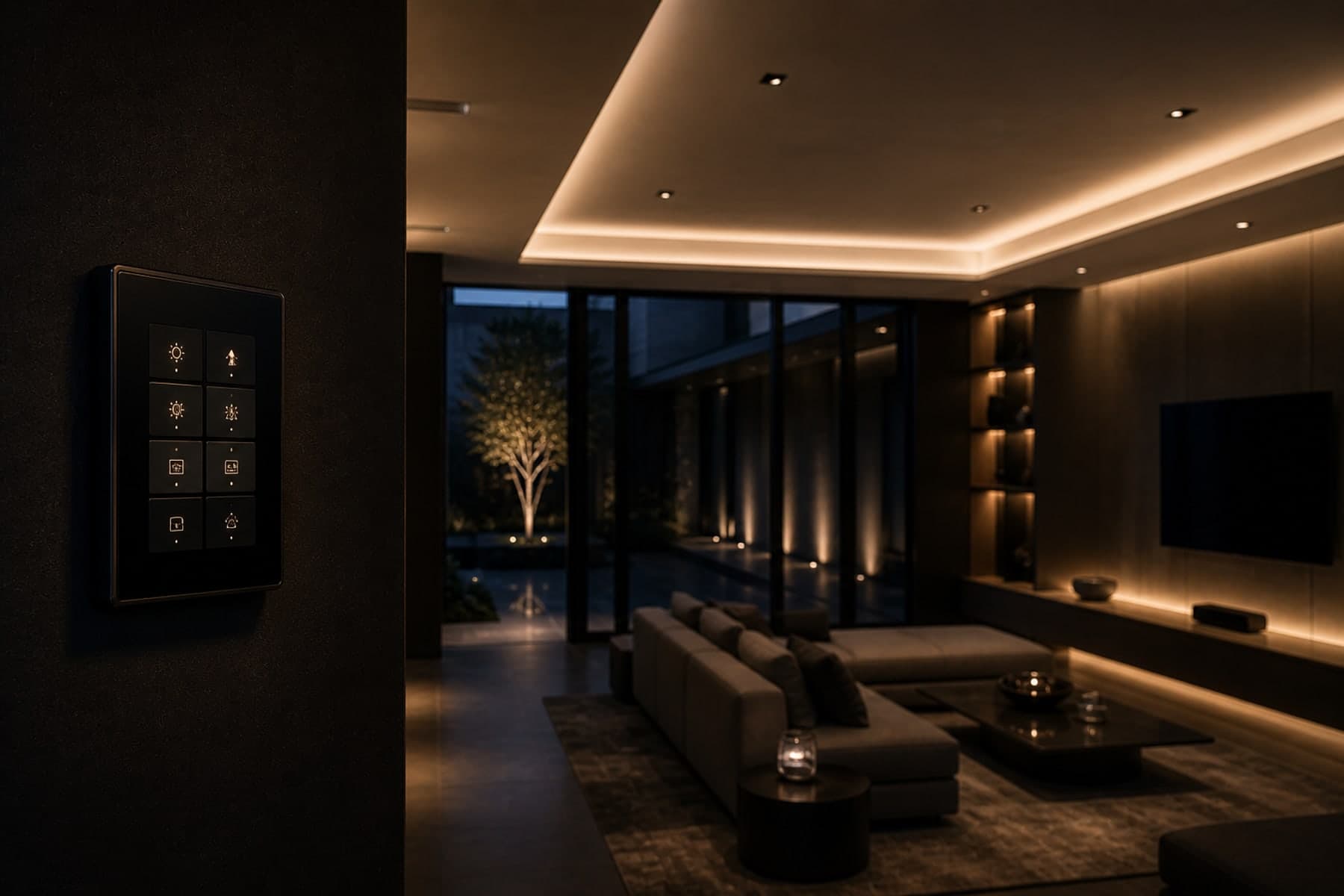
Lighting control protocol selection is decided early in the design and almost never re-opened, which is what makes the wrong choice expensive. The five mainstream protocols in the Indian and international market — 0-10V, DALI (DALI-2 in current practice), KNX, Rako and Lutron HomeWorks/RadioRA 3 — each occupy a different point on the scalability / interoperability / retrofit / lifecycle plane. The misuse pattern is consistent: 0-10V specified for a 200-fixture commercial fit-out (and discovered to be unmanageable at year two), KNX specified for a 9-zone home where the entry cost cannot pay back, or Lutron specified for a project where the long-tail support inevitability becomes the issue.
0-10V is the simplest and oldest of the five. A single 0-10V analogue control line dims a driver from 0% to 100%; one control line per fixture, or one per group if wired in parallel. The protocol does not address fixtures individually — it dims a wire, not a luminaire — and offers no telemetry back to the controller. For a residential bathroom with two dimmable downlights, or a single-zone hospitality bar with eight matching pendants, 0-10V is the right answer because the simpler protocol is the more maintainable one. Above ~20 fixtures or where group reconfiguration after installation is expected, 0-10V becomes a re-wiring exercise every time, which is what disqualifies it from commercial scope.
DALI-2 is the addressable broadcast-control standard for commercial lighting in 2026 — every fixture on a 2-wire DALI loop has an individual short-address, can be queried for status, supports emergency-lighting self-test (DALI-2 part 202), and reports back to the controller. The protocol handles up to 64 fixtures per loop (more with extender bridges) and supports group, scene and zone constructs natively. For commercial buildings above 50 fixtures with a BMS handshake requirement, DALI-2 is the default specification — the addressable model is what makes a Honeywell EBI or Siemens Desigo BMS able to expose lighting state to the facilities dashboard cleanly. The lifecycle cost is dominated by the DALI bus engineering discipline; misengineered loops produce the symptom of 'one fixture drops the whole zone'.
KNX (EN 50090) is the open European protocol for residential and large-commercial automation — a twisted-pair bus carrying control telegrams between any KNX-certified device from any manufacturer. The case for KNX is vendor independence: a KNX-certified ABB switch can talk to a KNX-certified Schneider dimmer to a KNX-certified Gira keypad to a KNX-certified Theben presence detector, all on the same bus, programmed in ETS (the open KNX engineering tool). The vendor-independence is the case at the 20-year horizon — a building owner running KNX today can replace any device with any KNX-certified alternative in 2046, because the protocol is open and the engineering files (ETS .knxproj) are portable. The cost of admission is the entry cost (typically 2× of a proprietary alternative at the device layer) and the requirement for an ETS-certified engineer to programme; KNX rewards size, complexity and the long-term horizon, not small scope.
Rako is the British wireless-and-wired residential automation protocol that has become the default for Indian residential automation above 6-8 zones — a balance of polished mobile app, engraved-keypad aesthetic, and a wireless option that supports retrofit installation without re-running cables. Rako is proprietary, which is the trade-off: the building owner is on the Rako roadmap, the .pro file is editable only in Rako's RASOFT tool, and the vendor-lock is real over a 20-year horizon. The case for Rako is the retrofit scope (where KNX wired is infeasible), the residential aesthetic and the practice's in-house programming maturity. We specify Rako on roughly half of our residential automation work above 6 zones, switching to KNX where the construction stage allows the wired backbone and the 20-year horizon is the priority.
Lutron HomeWorks QSX (the current premium platform; the older HomeWorks QS has been superseded) and Lutron RadioRA 3 are the American ultra-premium residential platforms — keypad aesthetics that read as architecture, scene programming depth, and a service tail that the Lutron India network supports directly. The price point is materially above Rako and KNX at the device layer, and the case is straightforward: the homeowner has been specified Lutron by the architect, the keypad finish is part of the interior design conversation, and the lifecycle support inevitability is decisive. We specify Lutron where the architect or homeowner has named it; we do not displace a Lutron specification into Rako or KNX because the keypad-aesthetic and Lutron's direct support are typically the actual brief.
Lighting protocol stack
lighting-protocol-stackDiagram · described
Lighting protocol stack
A three-layer canonical lighting control architecture: BMS supervisor layer at the top, scene/keypad layer in the middle (Rako and Lutron control systems or the open KNX standard), an addressable bus layer connecting the scene controls to fittings (DALI-2 typically), and fittings at the bottom with addressable drivers and emergency self-test. The arrows show the direction of control telegrams; the gateway bridges scene-control systems to DALI-2 at the fitting layer.
Comparison
Centralised vs distributed control
Centralised (wired-to-controller cupboard)
- Programmability — one place to read every scene, every dimmer
- Serviceability — one rack carries the entire deployment
- Failure containment — a controller fault affects the whole estate
- Cabling cost — higher, every fixture pulls back to centre
- Best fit — Lutron HomeWorks QSX, large KNX backbones, DALI-2 estates
Distributed (controllers per room)
- Programmability — per-room edits, decentralised authority
- Serviceability — room-level swap-and-load
- Failure containment — one room's fault stays in one room
- Cabling cost — lower, room-to-room signalling only
- Best fit — Rako, Lutron RadioRA 3, distributed DALI
DALI is also residential-acceptable, particularly for the lighting-control sub-layer beneath a Rako or KNX scene-control layer — a hybrid architecture where the room-level scenes are managed by Rako/KNX keypads and the underlying fixtures are DALI-addressed. This is the workhorse pattern for residential and hospitality above 100 fixtures: DALI on the fixture loop, Rako or KNX at the keypad and scene layer, a BMS integration layer above for energy reporting. The pattern works because each layer is doing what it does best, the failure modes are localised, and the operator sees one keypad UI regardless of the underlying complexity.
0-10V remains acceptable as a fixture-level dimming protocol beneath a higher-layer scene system in residential — a Rako wired dimmer module commanding a 0-10V driver — but the higher-layer system is the addressable layer. Pure 0-10V architectures above 20 fixtures are the failure pattern we are most often called to remediate.
Two cross-cutting decisions sit above the protocol question. First, wired vs wireless: wired wins on reliability, latency, lifecycle (the cable is good for 30 years), and BMS-integration cleanliness; wireless wins on retrofit feasibility and on residential aesthetics where chasing the wall is impossible. Second, centralised vs distributed control: centralised (every fixture wired back to a controller cupboard) wins on programmability and serviceability, distributed (controllers at each room) wins on fault containment and cabling cost. KNX and DALI scale both ways; Rako is primarily distributed; Lutron is primarily centralised; 0-10V is implicitly distributed at room scope.
The protocol decision flows from the scope and the operator, not the brand. For a 9-zone home where the homeowner is the operator and retrofit is in scope, Rako is the right answer. For a 200-zone commercial fit-out where a facilities team is the operator and BMS integration is the priority, DALI-2 on a Honeywell or Siemens controller is the right answer. For a 50-zone home where the architect has specified Lutron and the 20-year lifecycle support is the priority, Lutron is the right answer. The mistake is to read these as competing brands; they are competing architectures, each correct in their own scope.
Key engineering takeaways
- Protocol selection follows scope and operator, not brand preference — the same protocol is correct or wrong depending on whether a homeowner or a facilities team will run it.
- 0-10V is right only below ~20 fixtures or as a sub-layer beneath an addressable scene controller; pure 0-10V at commercial scale is a remediation contract waiting to happen.
- DALI-2 is the default specification for commercial lighting above 50 fixtures with BMS integration in scope — the addressable model and emergency-light self-test are decisive.
- KNX rewards complexity, scale and the 20-year horizon — vendor independence is the case; entry cost is the trade.
- Rako is the right answer for residential retrofit and 6–60 zone scopes where wireless and in-house programming are the priority.
- Lutron is the right answer where the architect or homeowner has named it — the keypad aesthetic and direct service tail are the brief.
- Hybrid architectures — DALI fixtures beneath Rako/KNX keypads — are the workhorse pattern for residential and hospitality above 100 fixtures, not a compromise.
/ Reference table
Lighting control protocol — engineering fit by scope
| Protocol | Sweet-spot scope | Addressable | BMS handshake | Retrofit posture | Vendor independence | Lifecycle horizon |
|---|---|---|---|---|---|---|
| 0-10V | ≤20 fixtures, single-room dimming | No (wire-level) | No | Strong (analogue, simple) | Open analogue | 10–15 years |
| DALI-2 | Commercial 50–10,000+ fixtures | Yes (per fixture) | Yes (BACnet bridge) | Moderate (loop wiring needed) | Open, multi-vendor | 15–20 years |
| KNX | Residential/commercial >100 devices, 20-year horizon | Yes (per device) | Yes (native or BACnet bridge) | Wired preferred; wireless possible | Open (EN 50090), multi-vendor | 20+ years |
| Rako | Residential 6–60 zones, retrofit-friendly | Yes (per device) | Limited (RS-485 bridge) | Strong (wireless option) | Proprietary | 12–18 years |
| Lutron HomeWorks QSX | Ultra-premium residential, 8–80 zones | Yes (per device) | Yes (Lutron integration toolkit) | Wired-preferred | Proprietary | 15–20 years (with Lutron service tail) |
Numbers reflect 2026 mainstream Indian and international practice. Lifecycle horizons assume disciplined AMC and configuration baseline retention.
Common mistakes
What we see go wrong
- Specifying 0-10V for a 200-fixture commercial fit-out because the entry cost is lowest.
- Why it fails — 0-10V is not addressable; reconfiguring zones requires re-wiring; emergency-lighting self-test is impossible; BMS integration is a non-starter. The savings at install evaporate at year two.
- What we do instead — Move to DALI-2 above ~50 fixtures or where group reconfiguration and BMS integration are anticipated.
- Specifying KNX for a 9-zone home because 'KNX is the standard'.
- Why it fails — KNX carries a higher entry commitment than Rako at 9 zones — more bus devices, a bus power supply and ETS programming; the vendor-independence benefit pays back at the 20-year horizon, not at year three; the programming overhead is significant.
- What we do instead — Rako above 6 zones, KNX above 30 zones or where the construction stage allows wired backbone and the 20-year horizon is decisive.
- Displacing a Lutron architect-specification into Rako or KNX to save cost.
- Why it fails — The keypad aesthetic is typically the actual brief; the homeowner sees the keypads daily; the cost saving is not the gap the client cares about.
- What we do instead — Specify Lutron where the architect or homeowner has named it; offer Rako or KNX where the architect is open and the budget is the constraint.
- Pure-wireless lighting protocol for a 100-zone hospitality estate.
- Why it fails — Wireless mesh latency, RF congestion in 2.4 GHz environments and operational debug cost all scale poorly above ~40 zones; the failure mode is intermittent keypad lag that nobody can reproduce.
- What we do instead — Wired KNX or DALI backbone above ~40 zones; wireless for retrofit pockets only, integrated via a wired-to-wireless bridge.
- Outsourced programming for a Rako, KNX or Lutron deployment.
- Why it fails — The .pro / .knxproj / .hwd file is held by the sub-contractor; year-three change requests become forensic exercises; the integrator's contract does not actually deliver lifecycle ownership.
- What we do instead — Specify in-house programming maturity at integrator selection — ask for ETS / RASOFT / HomeWorks-IT certifications and a redacted .pro file from a comparable project.
- Treating DALI loop wiring as 'just two-wire' without engineering the topology.
- Why it fails — DALI bus discipline (length, capacitance, termination, segment isolation) is what decides whether the loop is reliable; misengineered loops drop a whole zone for a single bad fixture.
- What we do instead — Engineer the DALI topology per DALI Alliance guidance; budget for a daisy-chain or hub topology with isolators per 32 fixtures; commission with a DALI bus analyser.
Deployment realities
What the drawings never show
The .pro / .knxproj file is the building's IP
Whoever holds the editable configuration file controls the lifecycle. AMC contracts that do not include configuration-file portability are AMC contracts that tether the client.
Wireless mesh ages worse than wired bus
RF congestion in 2.4/5 GHz IoT-saturated environments degrades over 5+ years; a wired KNX or DALI bus does not. For 20-year horizons, wired discipline wins.
Hybrid architectures are not a compromise
DALI fixtures under a Rako or KNX scene layer is the canonical pattern above 100 fixtures — each layer optimises for what it does best.
BMS handshake is a network discipline question
DALI-to-BACnet bridges, KNX-to-BACnet bridges and Modbus gateways are mature, but the BMS team owns the IP-network conversation. Specify the gateway, the VLAN and the addressing scheme at design stage.
Emergency lighting changes the protocol calculus
DALI-2 part 202 supports automated emergency-light self-test and log retention — a code-required discipline in commercial buildings. 0-10V cannot deliver this; KNX needs vendor-specific overlays; DALI-2 is the cleanest answer.
Keypad engraving is the homeowner's interface contract
On Rako and Lutron, the engraved keypad labels (Welcome, Dinner, Goodnight) read as architecture; getting this wrong reads daily to the homeowner. Specify keypad layout and engraving with the architect's typography team, not the integrator alone.
When this architecture fails
Failure modes worth knowing in advance
Each protocol has a known failure envelope. Specifying outside the envelope produces predictable problems.
Pure 0-10V deployment in a 150+ fixture commercial fit-out.
Zone reconfiguration becomes a re-wiring exercise; emergency-lighting test compliance is impossible; BMS integration is a non-starter; the year-two facilities team is operating a system they cannot reconfigure.
KNX with no in-house programming maturity, outsourced to a sub-contractor.
The .knxproj file is held off-site; year-three changes require finding the original engineer; the practice's lifecycle commitment is a fiction. We have seen this in re-tender situations more times than is comfortable.
Lutron displaced into Rako or KNX to save cost on a project where the architect specified Lutron.
The keypad aesthetic mismatch is visible daily; the homeowner regrets the substitution; and reverting to Lutron is a change-order rather than a swap — the keypads, the dimmer modules and the programming are all re-specified and re-commissioned.
Rako wireless for a 100+ zone hospitality estate with RF-dense environments.
Keypad latency and intermittent drop-outs at the higher-density zones; debug cost is significant; the operator perceives a 'flaky' system. Move to wired KNX or DALI backbone with wireless for retrofit pockets only.
DALI loop engineered without topology discipline (length, capacitance, isolators).
One bad fixture drops the whole zone; the debug is forensic; the operator perceives 'random lighting failures' that are actually a bus-discipline issue.
What ages poorly
Lifecycle weak points to plan around
Wireless mesh density (2.4 GHz)
Performance degradation visible at 5–7 years in IoT-saturated environments; wired bus does not have this problem.
Proprietary keypad engravings
Replacement engraved keypads require manufacturer turnaround (4–8 weeks) and matched lot numbers for finish; AMC spares discipline is mandatory.
Smartphone-app dependencies
Vendor app deprecations on iOS / Android every 3–5 years; specify systems with web-based fallback UIs, not app-only platforms.
DALI emergency-light batteries
4-year self-test cycle is the design assumption; battery replacement is a code-required discipline, not an optional AMC line.
0-10V driver lifetime
10–12 years typical; LED driver replacement at year 10 is part of any honest lifecycle TCO for a 0-10V architecture.
Lutron HomeWorks QS configurations
Superseded by QSX in 2024; legacy QS systems are still serviced but new-feature parity is on the QSX platform — plan migration windows for major retrofits.
/ Frequently asked
Quick answers from the practice.
- Can DALI-2 talk to a Honeywell or Siemens BMS?
- Yes — via a DALI-to-BACnet/IP gateway. Honeywell EBI and Siemens Desigo CC both have mature integration paths to DALI-2 lighting; the gateway is a deliberate hardware line item, not a software overlay. Specify the gateway model, IP addressing and BACnet object discipline at design stage.
- Is KNX still relevant in 2026 given DALI-2 has matured?
- Yes — KNX and DALI-2 are complementary, not competing. KNX is the scene/keypad/cross-system bus (lighting + shading + HVAC + AV scenes); DALI-2 is the fixture-level lighting bus. The canonical large-commercial architecture has KNX at the room/scene layer and DALI-2 at the fixture layer. KNX-only without DALI works at residential scale; KNX-plus-DALI scales to enterprise.
- What does 'in-house programming' mean and why does it matter?
- It means the integrator's own engineers — named individuals with ETS / RASOFT / HomeWorks-IT certifications — programme the system in their office, version the configuration files, and own the lifecycle. Outsourced programming routes the .knxproj / .pro / .hwd file through a sub-contractor whose continued availability is not guaranteed at year three. Ask for the certifications and a redacted file from a comparable project at integrator selection.
- Wireless or wired KNX?
- Wired (TP) for new construction and for any deployment above ~40 devices — the lifecycle, latency and BMS-integration cleanliness all favour wired. KNX RF for retrofit pockets only, bridged into the wired bus via a media-coupler. Pure-wireless KNX at scale is uncommon in good practice.
- Lutron RadioRA 3 or HomeWorks QSX?
- RadioRA 3 is the right answer below ~30 zones and where wireless is acceptable — the lower entry price, the faster commissioning and the proven retrofit posture are decisive. HomeWorks QSX is the right answer above ~30 zones or where wired backbone, deeper scene programming and the QSX integration toolkit are in scope. The crossover in our practice is roughly the 8–12 zone band, depending on construction stage.
- Will TechnoGuru programme the system in-house?
- Yes — Rako, KNX, Lutron and DALI-2 are all programmed in-house by named engineers, with the configuration files versioned and retained for the system's life. The lifecycle commitment is in the AMC; the programming maturity is named in the contract.
/ What to do next
Three next steps for lighting protocol scope
- Compare automation platforms →Rako vs Lutron vs KNX vs Crestron side-by-side.
- Read the BMS vs smart-automation insight →The discipline line between the homeowner's interface and the facilities team's dashboard.
- Send the lighting drawings to the studio →We mark up the protocol architecture, scene topology and BMS handshake against your scope within two working days.
Engineering toolkit
Tools that go with this read
If this article gave you a question worth pricing, these calculators give a defensible first number.
- Automation · Lighting
Lighting Scenes Interactive
Tap a scene — Welcome, Dinner, Film, Rest, Away, Goodnight — and watch every circuit, shade, AC zone and AV source shift at once across a reference 4 BHK plan. KNX + Rako + DALI.
6 scenes · photorealOpen - Lead intake
Project Brief Wizard
Six structured questions, a written response within two working days. The fastest path to engaging the practice on a real project.
6 questions · 2-day replyOpen - BMS · Energy
Energy & Efficiency Estimator
Adjust building variables and see indicative energy and CO₂ savings (kWh) for a BMS-driven energy upgrade plus daylight-harvesting LED retrofit. Conservative; defensible in a first conversation.
kWh · CO₂ savedOpen
Related engineering decision
The comparison behind this question.
/ Services this article informs
Read the discipline pages.
/ Reference work
Projects where this engineering shows up.
· Where to go next
The wider authority graph for this topic.
Engineering pages
Editorial — about this surface
TechnoGuru Smart Automation Practice
The smart automation practice engineers control systems where protocol choice, controller architecture and commissioning discipline decide whether the install ages well. We work in DALI, KNX, Lutron, Crestron, Rako, Control4 and similar ecosystems, with protocol selection grounded in the building rather than the brochure.
Reviewed against protocol-selection realities — the operating ecosystem decides which control architecture survives the second renovation.
Last reviewed
14 May 2026
Engineering domains
Smart home and lighting control · DALI, KNX and protocol architecture · Scene and occupancy logic · Climate, shading and HVAC control
Operating environments
Residential smart homes · Hospitality lighting and scenes · Commercial workplace lighting · Assembly venues with scene control
/ Discuss your project
If this article matches a brief you are working on, the next step is a short brief — a project lead replies to it directly.
We do not run sales pipelines. The first reply comes from a project lead, within two working days, and it goes straight to the engineering question rather than a brochure.