
/ AV
Public-address system design: STI targets, zoning, and the line-array hang nobody calculates
Quick answer
A PA system is graded by speech intelligibility (STI) at every seat — STI ≥ 0.55 is the floor for 'good', STI ≥ 0.62 is reference. We engineer line-array hangs to deliver flat coverage from row A to row Z (DSP shading, calibrated splay angles), zone amplifiers so an emergency announcement can pre-empt routine paging without manual intervention, and overlay voice-alarm to IEC 60849 / EN 54-16 where the building requires it. The brief is intelligibility per seat, not wattage per zone.
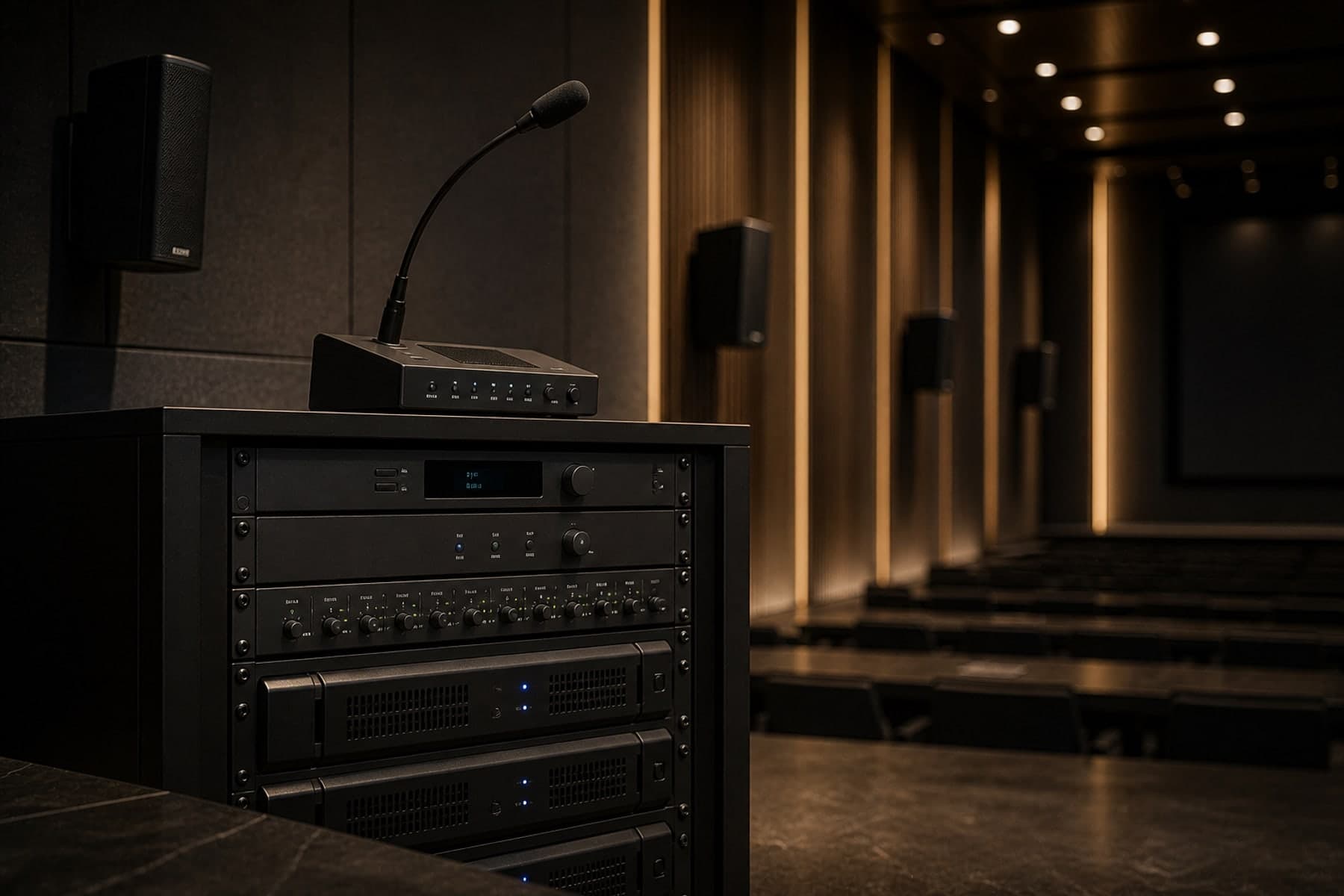
A public-address system is one of the most consistently mis-specified ELV layers in commercial and civic buildings. The brief usually arrives as a wattage figure ('we need 1500 watts of PA') or a brand preference ('JBL or Yamaha'), neither of which decides the actual outcome. The deliverable is speech intelligibility at every seat — measured as STI (Speech Transmission Index) — and the wattage and brand are downstream consequences of designing for that target.
STI is the design target; everything else is implementation
STI is a single number between 0 and 1 that captures how well a listener can understand spoken words at a given location. STI < 0.45 is poor; 0.45–0.55 is fair; 0.55–0.65 is good; > 0.65 is excellent. We design every PA project to STI ≥ 0.55 at every seat and we typically deliver STI 0.62–0.68 across audience planes when the brief is performance.
STI is degraded by three things: reverberation (room reflections that smear consonants), noise (HVAC, audience, external), and direct-to-reverberant ratio (the amount of direct sound versus room-reflected sound at the listener). The design loop is to model the room's acoustic behaviour, place the speakers to deliver high direct-to-reverberant ratio at the listening plane, treat the room to control reverberation, and check the noise floor at the worst-case use condition. We model in EASE for any audience plane above 200 seats; below that, calibrated experience and a measured impulse test are usually sufficient.
Line-array hang geometry — the part nobody calculates
Above 400 seats, the standard answer is a line-array hang. The mistake most integrators make is to specify the line-array off the manufacturer's catalogue without engineering the hang geometry to the room. A line-array's coverage pattern is set by the splay angles between elements, the J-curve at the bottom of the array, and the DSP shading that compensates for distance differences between the front and back rows.
We model every line-array hang in the manufacturer's design tool (K-array K-Framework3, JBL Line Array Calculator, d&b ArrayCalc) before procurement. The output is a per-element splay angle, a per-element DSP shading filter, and a measured SPL coverage map across the audience plane that should fall within ±2 dB front-to-back and ±3 dB seat-to-seat. We commission against the model and we publish the measured coverage map in the commissioning report.
Most line-arrays we audit have been hung off the catalogue specification with uniform splay angles and no DSP shading, producing the characteristic 'hot front rows, dead back rows' pattern that audiences experience as 'the PA is too loud at the front and too quiet at the back'. That is not a wattage problem. It is a geometry problem, and the fix is a half-day re-hang with calculated splay angles and DSP shading.
Zoning and emergency over-ride
Routine paging — meeting calls, lunch announcements, lost-child broadcasts at a mall — runs on the PA's primary zone configuration. Emergency announcements — fire-alarm voice-evacuation, controlled lockdown — must pre-empt routine paging without manual operator intervention, and the routing has to be hardware-enforced rather than software-only.
We zone amplifiers so each zone has a hardware priority input that can override the routine paging from a higher-priority source. The fire-alarm panel's voice-evac module is wired into the highest-priority input on every zone amplifier; on a fire-alarm trigger, the zone amplifiers switch to the voice-evac source regardless of what the routine PA is broadcasting. This is the IEC 60849 architecture for voice-alarm systems, and it is what separates a building's PA from its life-safety system.
Voice-alarm overlay where the building requires it
For occupancies where NBC 2016 Part 4 and the local AHJ require it — typically large auditoria, hospitals, larger hotels and malls — the PA system is designed as a voice-alarm system, specified against IEC 60849 / EN 54-16 as the equipment benchmarks, not as instruments Indian code puts in force. That benchmark adds scope the routine-paging brief does not carry: supervised cabling, redundant amplifiers, battery-backed power for 30 minutes minimum, signal monitoring, and per-zone fault reporting. The voice-alarm overlay is engineered as one with the routine PA, not as a separate system, because the same speakers, amplifiers and zone topology serve both.
Callout — what buyers most miss
STI per seat is the deliverable. Wattage per zone is the cost line. Most PA tenders spec wattage and brand and leave the STI question to commissioning. By that point, the geometry is fixed and the only lever left is more wattage — which does not improve STI in a reverberant room. Tender for STI per seat as the acceptance criterion; the wattage will be whatever it needs to be.
Reference deployment context
The Capital Cultural Hall PA was designed with JBL VLA-series line-array hangs at the proscenium on Crown DCI amplification and a BSS BLU100 DSP profile, with calibrated splay angles and per-element shading published in the commissioning report. STI was measured at 0.64 mean across the 1,800-seat audience plane with a 0.58 minimum at the rear corners. The Town Hall Dimapur PA, on a smaller compact line-array hang, was commissioned to civic-speech intelligibility standard across the 374-seat hall.
References
1. IEC 60849 (now ISO 7240-19) — Sound systems for emergency purposes.
2. AES-15id-1991 — Sound system design — Speech intelligibility.
3. ISO 3382-1:2009 — Acoustics — Measurement of room acoustic parameters.
4. EN 54-16:2008 — Voice alarm control and indicating equipment.
Civic auditorium signal architecture
auditorium-signal-architectureDiagram · described
Civic auditorium signal architecture
A civic / cultural auditorium AV signal architecture. Inputs (gooseneck and lavalier microphones, line-in sources, HDMI presentation, livestream feed) route through a digital mixer to a DSP with feedback suppression, EQ and named-preset library (Civic, Cultural, Ceremonial). DSP feeds line-array audio output, stage monitors, LED-cluster video wall, DMX stage lighting and a recording / livestream encoder. Auditorium-staff console recalls a preset and orchestrates all five output classes from a single gesture.
/ Frequently asked
Quick answers from the practice.
- What STI should we target?
- STI ≥ 0.55 is the floor for 'good' speech intelligibility; STI ≥ 0.62 is reference. On voice-evacuation work the mandating instrument is NBC 2016 Part 4's voice-evacuation provisions; IEC 60849 / EN 54-16 are the equipment benchmarks the specification is written against, and we hold no instrument fixing a numeric STI acceptance band, so we do not publish one. The acceptance criterion is speech intelligibility across the evacuation zone, established by measurement at commissioning. We design and commission to STI ≥ 0.62 at every seat as standard; the budget delta over a bare intelligibility pass is rarely material.
- Line-array, point-source or distributed ceiling?
- Depends on room geometry. Line-array wins on auditoria, ballrooms and worship halls above 800 seats with seated audience over a defined plane. Point-source clusters win on smaller theatres and lecture halls under 400 seats. Distributed ceiling is for low-ceiling spaces (open offices, retail, airports) where coverage uniformity beats SPL.
- Is voice-evacuation mandatory under NBC?
- For most commercial, hospitality, healthcare and educational occupancies above defined thresholds, yes. EN 54-16-benchmarked voice-alarm equipment under NBC 2016 Part 4's voice-evacuation provisions is the technical floor; the building's Fire NOC depends on it. Voice-evacuation overlays must hardware-pre-empt routine paging — that pre-emption is the spec line most retrofits miss.
- Why do you specify Bose, JBL Pro and K-array?
- Bose for distributed ceiling and hospitality F&B (cardioid sub-arrays for boundary control), JBL Professional for line-array auditoria and ballrooms (engineering depth, India support), K-array for premium venues where the form factor needs to disappear into the architecture. The three between them cover the brief on every project we see.
- Will TechnoGuru deliver the IEC 60849 / EN 54-16 voice-alarm compliance pack?
- Yes — measurement report (STI per seat, SPL per seat, calibrated source), zone-and-amplifier discipline, pre-emption test record, signed compliance against the standard. Standard inclusion in our PA scope on any building requiring a Fire NOC.
/ What to do next
Three next steps for PA / voice-alarm scope
- Read the PA service page →Engineering scope, brand bands, voice-alarm discipline.
- Try the RT60 calculator →RT60 is the upstream driver of STI — model the room before specifying the PA.
- Send the architectural drawings →We model the room in EASE, propose a line-array hang or distributed array, and quote against IEC 60849 / EN 54-16 voice-alarm compliance.
Engineering toolkit
Tools that go with this read
If this article gave you a question worth pricing, these calculators give a defensible first number.
- AV · Audio · Coverage
Speaker Coverage Planner
Engineering-grade speaker coverage and SPL planner across a source-cited public model catalogue spanning pro touring, commercial audio and architectural speakers. Predicts SPL at listener distance, the horizontal coverage width at that distance on the -6 dB dispersion axis, and the quantity needed for the room.
45 brands · SPL predictionOpen - Hospitality · Systems
Hotel Technology Planner
Pick the property archetype — boutique, 4-star, 5-star, resort — and the planner maps each space (guest floor, lobby, banquet, F&B, spa, BoH) to systems, AP density, AV grade and lifecycle cost.
property × space × systemsOpen - Life-safety · 28 states + 8 UTs
NBC Fire-Safety by State
State or union territory, building height and occupancy in — list of sprinkler, voice-evac PA, wet-riser and Fire-NOC triggers out, with explicit source-status tiering across all 28 Indian states and 8 union territories.
NBC 2016 · state ruleOpen
Related engineering decision
The comparison behind this question.
/ Services this article informs
Read the discipline pages.
/ Reference work
Projects where this engineering shows up.
Arunachal Pradesh Legislative Assembly
Government · Legislative Chamber
Itanagar, Arunachal Pradesh · Handover 2017Multi-Purpose Hall, Arunachal Pradesh Assembly Complex
Government · Multi-Purpose Auditorium
Itanagar, Arunachal Pradesh · Handover 2018Cabinet Conference Room, Arunachal Pradesh Secretariat
Government · Cabinet Conferencing
Itanagar, Arunachal Pradesh · Handover 2018Conference Room, Chief Minister's Residential Complex, Kohima
Government · Executive Conference Room
Kohima, Nagaland · Handover 2022Tinsukia Medical College & Hospital
Healthcare · Government
Tinsukia, Assam · Handover 2024Capital Cultural Hall, Kohima
Government · Cultural Auditorium
Kohima, Nagaland · Handover 2022Town Hall Auditorium, Dimapur
Government · Civic Auditorium
Dimapur, Nagaland · Handover 2024Multipurpose Cultural Hall, Namsai
Government · Cultural Auditorium
Namsai, Arunachal Pradesh · Handover 2018Taraghar — State Guest House
Government · State Guest House
Shillong, Meghalaya · Handover 2025BJP Head Office, Guwahati — Conference Room AV
Government · Conference Room AV
Guwahati, Assam · Completed project
Editorial — about this surface
TechnoGuru Fire & Life-Safety Practice
The fire and life-safety practice runs the discipline that the state fire service signs against. Addressable detection design, cause-and-effect logic, PAVE voice-evac and emergency lighting — engineered against the National Building Code, the relevant state amendments and the field realities of how a building actually evacuates.
Reviewed against NBC, IS 2189 and the relevant state fire-service requirements — every recommendation is held to what passes NOC and field cause-and-effect verification.
Last reviewed
14 May 2026
Engineering domains
Addressable fire detection · Cause-and-effect logic engineering · Public-address voice evacuation (PAVE) · Emergency lighting design
Operating environments
Mid-rise and high-rise commercial · Hospitality and healthcare buildings · Government and institutional facilities · Assembly and gathering venues
/ Discuss your project
If this article matches a brief you are working on, the next step is a short brief — a project lead replies to it directly.
We do not run sales pipelines. The first reply comes from a project lead, within two working days, and it goes straight to the engineering question rather than a brochure.