
/ Smart Living
Anatomy of a premium villa automation scope — an anonymised discipline breakdown
Quick answer
A premium 2,800 sq-ft villa fit-out, in our practice, typically contains: Rako-led wired lighting automation across 9 zones, motorised shading on 14 openings, distributed multi-room audio in 5 zones, a 7.1 family-cinema with mid-tier electronics, 8 IP-camera CCTV with a 30-day NVR, bio-metric access at three doors, full Cat6A structured cabling with 28 outlets, Wi-Fi 7 across three APs, an online 6 kVA UPS, and a Silver-tier 36-month AMC. The scope below is what we delivered; pricing is project-specific and prepared in writing after a technical review.
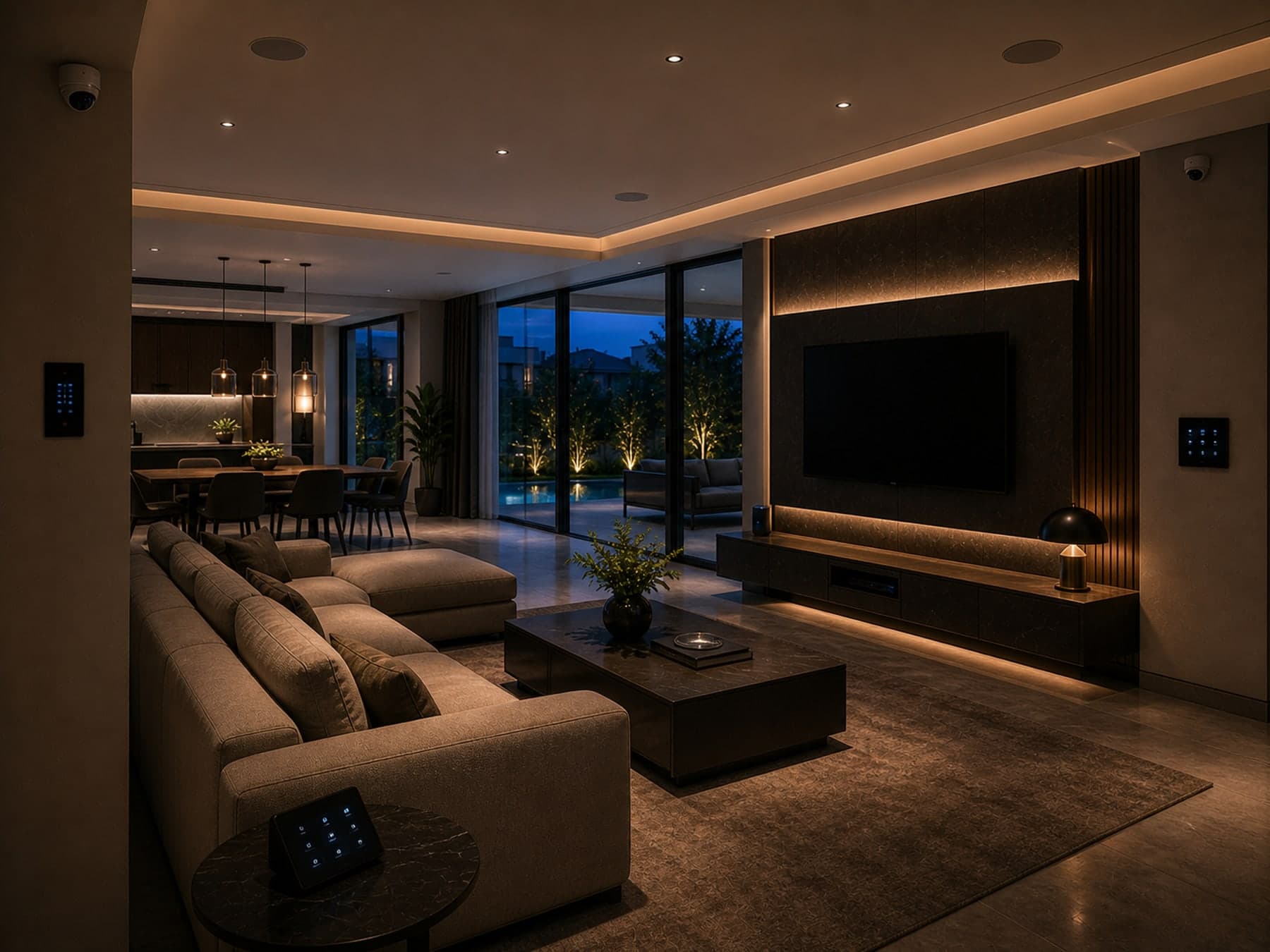
We are asked the same question almost every week: what is actually in a real premium automation fit-out? The honest answer is a discipline-by-discipline scope, anonymised against a real villa we have delivered, with the brand bands and the trade-offs that explain where the engineering effort goes. The villa is 2,800 sq ft, two storeys, North-East India; the owner is a self-described ‘premium but not maximalist’ buyer; the brief is reference-quality engineering without ostentation. We do not publish a price for it — pricing depends on drawings, site conditions, brand selection, cabling stage, integration depth and commissioning, and is prepared in writing after review.
What the scope contains
The scope below is what we delivered, organised by discipline. What the project actually costs shifts with brand selection, with site logistics (lift availability, working-hour windows, civil readiness), and with whether the integration is taken on as turnkey or as point-supply — which is exactly why we quote per project after a technical review rather than publishing a band here.
Trade-offs we made and would make again
Three deliberate trade-offs shape this scope. First, Rako rather than KNX — at 9 zones, KNX's vendor independence and 20-year horizon are real but the entry overhead is higher and the programming effort does not pay back at this scale. Second, mid-tier AV electronics (Marantz Cinema 50, Polk Reserve speakers) rather than a reference 9.4 system — the room geometry does not justify the reference uplift, and that effort is better spent on acoustics where it matters more. Third, Hikvision IP CCTV rather than Axis at this stage — Hikvision delivers 4 MP IP cameras with H.265 and 30-day retention, and the difference at the camera layer is not visible to the owner when the lens, mount and lighting are correct.
What we deliberately kept out of this scope
A reference home cinema (a project in its own right), KNX with a full BMS layer, Crestron control across all AV, motorised opening windows beyond the shade scope, EV charging integration, or a backup-power tier above ride-through UPS. Each of these is a separate conversation; folding them all into one scope would mean compromising every line item. We would rather deliver one tier at full reference quality than five at the floor.
How the scope scales up
A richer brief moves the spec: KNX in place of Rako (vendor independence and a longer horizon), reference-grade acoustics in the cinema, an Axis camera stack, Crestron AV control across the home rather than just the cinema, and a structured 5-year preventive AMC. Higher still, the audio tier lifts to JBL Synthesis or Bowers & Wilkins, the 7.1 cinema becomes a properly engineered 9.4.6 Atmos room, and either solar+BESS or a redundant power tier is added depending on the load profile. Each step is a scope decision, scoped and priced per project after review.
Anonymisation discipline
The breakdown below is anonymised: room counts and zone counts are real, brand selections are real. Customer-identifying particulars (locality, household composition, security details) are excluded. We publish this as a practice-norm reference for architects and owners trying to scope work — not as a marketing claim about a specific project, and not as a price list.
What this means for an owner reading from cold
Three readings to take from this breakdown. First, automation is a discipline scope, not a brand-shopping list — the engineering is in pathways, panels, programming and AMC discipline more than in marquee badges on individual devices. Second, civil readiness shapes the project invisibly; ask your integrator what assumptions are baked in and what changes if civil is not ready on schedule. Third, AMC is a programme, not an invoice — ask which line items an unusually thin AMC has quietly excluded.
/ Reference table
Anonymised scope — 2,800 sq-ft North-East villa
| Discipline | Scope | Brand band |
|---|---|---|
| Lighting automation | 9 zones · 64 circuits · 11 keypads | Rako Wireless + Wired |
| Motorised shading | 14 openings · roller + sheer + blackout | Somfy / Vestamatic |
| Multi-room audio | 5 zones · in-ceiling Sonance + amp rack | Sonance + WiiM Pro |
| Family cinema | 7.1 channel · 110″ screen · projector + AVR | Marantz Cinema 50 + Polk Reserve |
| CCTV surveillance | 8 IP cameras · 30-day NVR · 4 MP H.265 | Hikvision i-series |
| Access control | 3 doors · fingerprint + RFID + door magnet | Hikvision DS-K1T series |
| Structured cabling | 28 outlets · Cat6A · channel-tested | CommScope / Schneider |
| Wi-Fi 7 wireless | 3 APs · seamless roaming · VLAN | Aruba Instant On / TP-Link Omada |
| Online UPS | 6 kVA double-conversion + LFP | Vertiv / Delta |
| AMC (36-month Silver) | Quarterly visits · 24h response · spares pool | TechnoGuru programme |
| Engineering + commissioning | Design + project mgmt + handover docs | Bundled scope |
Civil and electrical pre-works are owner-scope. Brand choices are illustrative — every project is engineered against the architectural reality, not the catalogue. Pricing is project-specific and prepared in writing after a technical review.
/ Frequently asked
Quick answers from the practice.
- Why publish a scope breakdown rather than a price?
- Because a price depends on civil readiness, working-hour windows, lift access, brand availability on the day, customs lead-times on import-stock and the structure of the contract (turnkey vs. supply-only). Publishing a number anchors owners on the wrong figure and invites comparison against incomparable scopes. A discipline-by-discipline scope is the genuinely useful reference; pricing is prepared in writing after a technical review. Share your drawings, BOQ or project brief on WhatsApp/call +91 88110 34444 or email info@technoguru.in for a written estimate after review.
- How does the scope scale up or down?
- Down, it sheds the wired-lighting future-proofing (wireless in place of wired Rako), trims CCTV retention and Cat6A run count, and drops the UPS and AMC — a viable entry point, but a compromise on several axes. Up, it adds KNX, reference cinema acoustics, an Axis camera stack and a longer preventive AMC. Each step is a scope decision, scoped and priced per project after review.
- How much of this can a homeowner self-procure?
- Hardware can be self-procured, but what looks like a saving is usually consumed by the engineering and commissioning overhead an integrator would otherwise absorb (BOQ resolution, brand-version compatibility, warranty claims, commissioning labour). For automation specifically — Rako, Fibaro, KNX — self-procurement also voids the in-house programming continuity that an integrator-owned project provides.
- Does the AMC tier really matter?
- Yes. The single most consequential post-handover decision is the AMC. A Silver-tier programme buys quarterly preventive visits, response targets documented in the AMC scope, configuration-baseline retention and a documented spares pool. Without that programme, the system gradually drifts from the commissioning baseline — and recovery five years on is far more disruptive than the programme itself.
- How do I get a price for a scope like this?
- We quote against your brief, not against a published band. Share your drawings, BOQ, site photos or project brief on WhatsApp/call +91 88110 34444 or email info@technoguru.in — our team will review the requirement and prepare a written estimate after a technical review, with the engineering rationale documented.
/ What to do next
Three next steps for owners and architects
- Send a project brief to the studio →Share drawings, BOQ or a project brief; written response within two working days.
- Compare automation platforms side-by-side →Rako vs Lutron vs KNX vs Crestron — honest comparison across scale, fit and longevity.
- Read our procurement and process method →How we engineer a turnkey integration from brief through 36-month AMC.
Engineering toolkit
Tools that go with this read
If this article gave you a question worth pricing, these calculators give a defensible first number.
- Lead intake
Project Brief Wizard
Six structured questions, a written response within two working days. The fastest path to engaging the practice on a real project.
6 questions · 2-day replyOpen - BMS · Energy
Energy & Efficiency Estimator
Adjust building variables and see indicative energy and CO₂ savings (kWh) for a BMS-driven energy upgrade plus daylight-harvesting LED retrofit. Conservative; defensible in a first conversation.
kWh · CO₂ savedOpen - BMS · BESS
BESS Sizer
Peak demand + solar + storage strategy in, indicative LFP battery size, inverter rating, daily throughput and cell life out. Vertiv, Delta and Fuji-class deployments.
LFP · kWh · cell lifeOpen
Related engineering decision
The comparison behind this question.
Editorial — about this surface
TechnoGuru Smart Automation Practice
The smart automation practice engineers control systems where protocol choice, controller architecture and commissioning discipline decide whether the install ages well. We work in DALI, KNX, Lutron, Crestron, Rako, Control4 and similar ecosystems, with protocol selection grounded in the building rather than the brochure.
Reviewed against protocol-selection realities — the operating ecosystem decides which control architecture survives the second renovation.
Last reviewed
10 May 2026
Engineering domains
Smart home and lighting control · DALI, KNX and protocol architecture · Scene and occupancy logic · Climate, shading and HVAC control
Operating environments
Residential smart homes · Hospitality lighting and scenes · Commercial workplace lighting · Assembly venues with scene control
/ Discuss your project
If this article matches a brief you are working on, the next step is a short brief — a project lead replies to it directly.
We do not run sales pipelines. The first reply comes from a project lead, within two working days, and it goes straight to the engineering question rather than a brochure.