/ Smart Living
Hospitality room control: PMS integration is the contract; KNX/DALI is the implementation
Quick answer
Hospitality room control connects guest touch surfaces (bedside panel, wall keypad, TV remote, mobile app, voice assistant, RFID door-tag) through a room controller (KNX or DALI bus, sometimes Crestron / Lutron / Rako) to physical outputs (lighting scenes, drape automation, HVAC setpoint, IPTV, multi-room audio, bath features) and is gated by the property management system (PMS) integration that handles check-in/out, do-not-disturb, make-up-room and guest-mode hand-off. The scene library (Welcome / Sleep / Wake / Read / Movie / Housekeeping / Maintenance) is the operational contract — guest touch always works; engineering complexity hides behind the bus. The protocol choice (KNX vs DALI vs proprietary) decides the cost line; the PMS integration decides whether the system serves the operator.
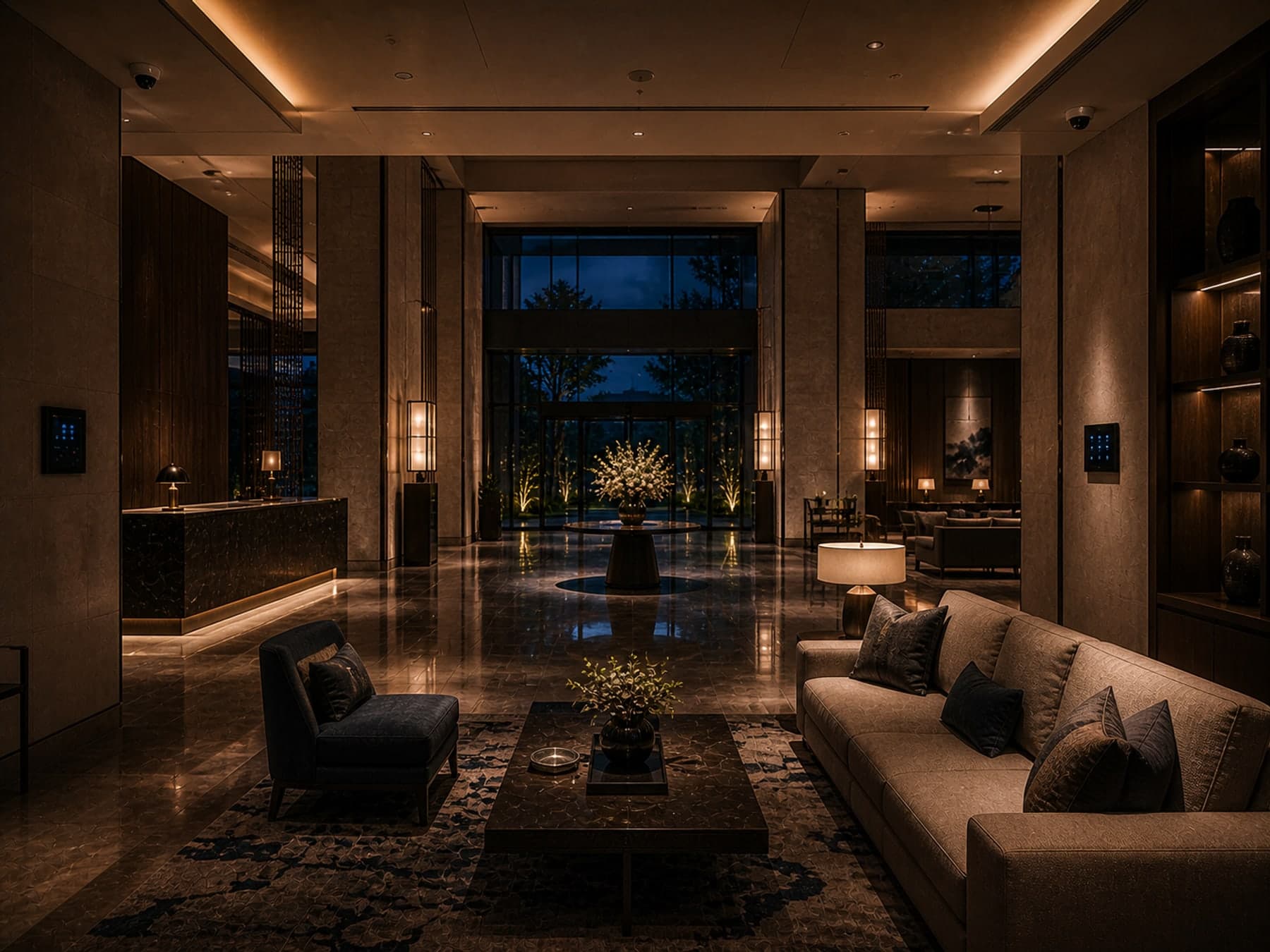
Hospitality room control is the most operationally-misunderstood category of building automation. The procurement default is the protocol question (KNX vs DALI vs Crestron vs Rako vs Lutron); the operational reality is the PMS integration question (Opera vs IDS Next vs WinHMS vs custom) and the scene-library question (what scenes, what touch surfaces, what hand-off discipline).
The scene library is the operational contract
Welcome, Sleep, Wake, Read, Movie, Housekeeping, Maintenance — the scene library is what the guest, the housekeeping staff and the engineering team operate against. The library is engineered against the actual workflow: Welcome on check-in (soft cove lighting + drape open + HVAC pre-cool + IPTV welcome screen); Sleep on bedside touch (full down + drape close + HVAC night setpoint + do-not-disturb door pictogram); Housekeeping on RFID door-tag (bright wash + drape open + maintenance-only HVAC override). The protocol carries the scene; the scene library is what matters.
PMS integration is the contract with the operator
Check-in event from the PMS triggers the Welcome scene at the assigned room; check-out triggers the room state to housekeeping-mode (occupancy clear, HVAC setback, do-not-disturb cleared); a make-up-room request from the guest's mobile app triggers a PMS escalation to the housekeeping queue. Without the PMS integration, the room control is a guest-touch system without an operator-facing surface — the housekeeping staff cannot see room state, the front desk cannot pre-condition the room before arrival, and the engineering team cannot lock the room into a maintenance state.
Bus protocol decides the cost line, not the operational discipline
KNX is the open-standard, multi-vendor protocol that holds a 20+ year service envelope and supports the widest device ecosystem; the spec-and-commissioning discipline is mature. DALI is the lighting-only protocol that integrates lighting tightly with daylight harvesting and emergency lighting; the room controller bridges DALI to the rest of the scene library. Crestron / Lutron / Rako are proprietary protocols with tighter integration to their own ecosystem and shorter generational refresh cycles. Pick the protocol against the deployment scale and the partner ecosystem; the scene library and PMS integration sit above the protocol.
Guest-touch always works is the engineering discipline
The single most consequential operational rule for hospitality room control: guest-touch always works. A failed BMS server, a failed PMS connection, a failed Wi-Fi captive portal — none of these can prevent the guest's bedside panel from triggering the Sleep scene. The room controller carries the scene library locally; PMS integration enriches the experience but cannot be the failure mode. This is engineered at the room controller layer, with PMS as an upstream signal rather than a downstream gate.
Do-not-disturb is a door-state and a PMS-state and a scene-state
Do-not-disturb is one event with three integration points: the door pictogram (LED indicator on the corridor face of the door), the PMS state (visible to front desk and housekeeping queue), and the scene library (Sleep scene typically engages DnD automatically; manual DnD overrides Sleep scene timeout). The three-layer discipline is engineered at the room controller, with the PMS integration handling the operator-facing surface.
Generational refresh and protocol evolution
KNX 1.0 (TP1) and KNX over IP carry generational refresh cycles measured in decades; DALI 1 to DALI-2 is a generational refresh measured in 8-12 years; proprietary protocols carry shorter cycles tied to the vendor's product roadmap. The protocol choice is a 15-20 year decision for any premium-hospitality deployment; the scene library evolves faster (typically every 3-5 years against guest-experience trends).
Callout — what hospitality procurement most miss
The scene library and the PMS integration are the operational contract; the bus protocol is the implementation detail. Specify the scene library against the actual workflow, the PMS integration against the operator-facing surface, and the protocol against the deployment scale and the partner ecosystem. Pick KNX for open multi-vendor, DALI for lighting-tight, Crestron / Lutron / Rako for proprietary-tight — all three deliver the same scene library if the engineering is right.
References
1. KNX standard EN 50090 — open-standard building automation.
2. DALI-2 standard IEC 62386 — digital addressable lighting interface.
3. Crestron, Lutron, Rako proprietary protocol documentation.
4. Oracle Opera / IDS Next / WinHMS PMS integration guides.
Hospitality room control orchestration
hospitality-room-controlDiagram · described
Hospitality room-control orchestration
A hospitality guest-room control system. Guest touch surfaces (bedside panel, wall keypad, TV remote, mobile app, voice assistant) feed a KNX or DALI bus through a room controller. The controller drives lighting scenes (welcome / sleep / wake), drape automation, HVAC setpoint, IPTV / smart-TV, multi-room audio and is gated by a property management system (PMS) check-in/out integration. Scene library is the operational contract — guest-touch always works; engineering complexity hides behind the bus.
Key engineering takeaways
- Scene library (Welcome / Sleep / Wake / Read / Movie / Housekeeping / Maintenance) is the operational contract — engineered against the actual workflow.
- PMS integration handles check-in/out, do-not-disturb state, make-up-room queue and guest-mode hand-off — without it, the room control is guest-facing only.
- Guest-touch always works — failed PMS, failed Wi-Fi or failed BMS cannot prevent the bedside panel from triggering the scene library locally.
- KNX (open, multi-vendor, 20+ year) vs DALI (lighting-tight, 8-12 year refresh) vs proprietary (Crestron / Lutron / Rako, vendor-tied) — pick against scale and ecosystem.
- Do-not-disturb is a three-layer integration: door pictogram + PMS state + scene state.
- Generational refresh: protocol is a 15-20 year decision; scene library evolves every 3-5 years against guest-experience trends.
/ Frequently asked
Quick answers from the practice.
- KNX vs DALI vs Crestron — which is right?
- KNX for open multi-vendor deployments above 50 rooms with a 20-year horizon; DALI when lighting is the dominant scope and daylight-harvesting / emergency-lighting integration matters; Crestron / Lutron / Rako when the operator already has the partner ecosystem and the deployment is single-vendor by design. All three deliver the same scene library.
- Why does PMS integration matter so much?
- Without PMS integration, housekeeping cannot see room state, front desk cannot pre-condition the room before arrival, engineering cannot lock the room into maintenance mode, and the do-not-disturb state lives only on the door pictogram. PMS integration turns guest-touch into an operator-facing system.
- How does the system fail gracefully?
- Guest-touch always works — the room controller carries the scene library locally and a bedside Sleep press triggers the scene without PMS or Wi-Fi connectivity. PMS integration enriches but cannot block the guest experience.
/ What to do next
Three next steps for hospitality room-control scope
- Read the BMS vs smart-automation insight →Where the operator handoff sits.
- Read the lighting-control protocol insight →KNX vs DALI vs Rako vs Crestron decision matrix.
- Send the room-type schedule and PMS class →We return a scene library and PMS-integration brief within three working days.
Engineering toolkit
Tools that go with this read
If this article gave you a question worth pricing, these calculators give a defensible first number.
- AV · Audio · Coverage
Speaker Coverage Planner
Engineering-grade speaker coverage and SPL planner across a source-cited public model catalogue spanning pro touring, commercial audio and architectural speakers. Predicts SPL at listener distance, the horizontal coverage width at that distance on the -6 dB dispersion axis, and the quantity needed for the room.
45 brands · SPL predictionOpen - Hospitality · Systems
Hotel Technology Planner
Pick the property archetype — boutique, 4-star, 5-star, resort — and the planner maps each space (guest floor, lobby, banquet, F&B, spa, BoH) to systems, AP density, AV grade and lifecycle cost.
property × space × systemsOpen - Lead intake
Project Brief Wizard
Six structured questions, a written response within two working days. The fastest path to engaging the practice on a real project.
6 questions · 2-day replyOpen
/ Services this article informs
Read the discipline pages.
· Where to go next
The wider authority graph for this topic.
Engineering pages
Read further
Editorial — about this surface
TechnoGuru Smart Automation Practice
The smart automation practice engineers control systems where protocol choice, controller architecture and commissioning discipline decide whether the install ages well. We work in DALI, KNX, Lutron, Crestron, Rako, Control4 and similar ecosystems, with protocol selection grounded in the building rather than the brochure.
Reviewed against protocol-selection realities — the operating ecosystem decides which control architecture survives the second renovation.
Last reviewed
15 May 2026
Engineering domains
Smart home and lighting control · DALI, KNX and protocol architecture · Scene and occupancy logic · Climate, shading and HVAC control
Operating environments
Residential smart homes · Hospitality lighting and scenes · Commercial workplace lighting · Assembly venues with scene control
/ Discuss your project
If this article matches a brief you are working on, the next step is a short brief — a project lead replies to it directly.
We do not run sales pipelines. The first reply comes from a project lead, within two working days, and it goes straight to the engineering question rather than a brochure.