
/ ELV
Government ELV procurement: GeM, EMD, BG, BOQ and the paperwork that decides who wins
Quick answer
A government ELV tender in India typically requires: GeM-empanelment for Direct-Purchase-Mode (below the GeM direct-purchase limit) or eligibility for Bid-Mode (above it); an Earnest Money Deposit (EMD) of 2-3% of the bid value as Bank Guarantee or Demand Draft; a Performance Bank Guarantee (PBG) of 5-10% upon award; a BOQ format published by the procuring department (typically item-rate or percentage-rate); and technical specifications that often cite OEM make-and-model. The technical bid is opened first and screened against eligibility before the commercial bid is opened — most bids that fail, fail at technical screening, not on price.
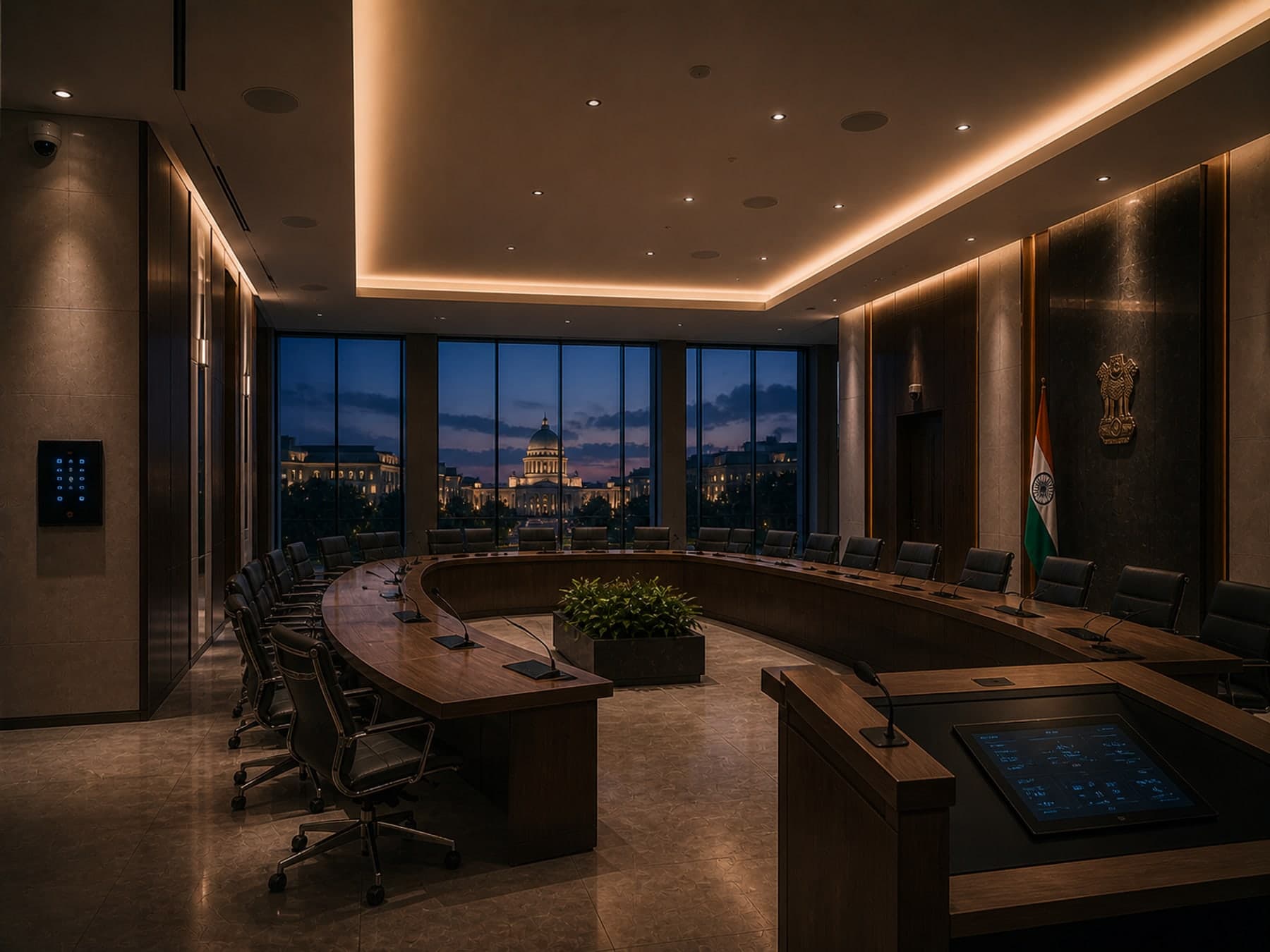
Government procurement in India for ELV systems — CCTV, fire alarm, public-address, access control, structured cabling, BMS, IT — has matured significantly over the past decade with the introduction of the Government e-Marketplace (GeM), the Central Public Procurement Portal (CPPP) and the move to two-cover (technical + commercial) bidding on most tenders above the bid-mode threshold. The procurement discipline is now genuinely two-stage, with technical screening that decides the bidder pool before commercial opens.
This article walks through the moving parts: GeM empanelment, EMD and BG instruments, BOQ formats, technical specification interpretation, the order of operations on bid day, and the paperwork discipline that decides a contract long before the commercial envelope is opened.
GeM and the Direct Purchase / Bid threshold
The Government e-Marketplace (GeM) is the Government of India's online procurement platform, mandatory for most Central Government and increasingly for State Government purchases. GeM empanelment is the bidder's basic eligibility — without it, the bidder cannot be considered on most tenders. Empanelment requires PAN, GST, MSME / Udyam certificate (or equivalent), bank account verification, and product-or-service category registration against the GeM catalogue. The empanelment process takes 4-6 weeks for a new vendor; renewals are annual.
On the buyer side, the procurement mode depends on value: the smallest purchases use Direct Purchase from any GeM-empanelled vendor; mid-value purchases use three-quote comparison; above the bid-mode threshold, full bid mode with technical-commercial cover. ELV tenders typically sit in bid mode — EMD, technical screening, the full discipline.
Earnest Money Deposit (EMD) and Performance Bank Guarantee (PBG)
EMD is the bidder's serious-intent deposit, lodged with the bid. Typical EMD is 2% of the estimated bid value (some departments require 3%), payable as Demand Draft drawn on a scheduled commercial bank, or as a Bank Guarantee from a nationalised or approved bank with a validity covering the bid validity period plus 30 days. EMD is returned to unsuccessful bidders within 30 days of contract award; it is forfeited if the bidder withdraws after technical opening or fails to lodge PBG on award.
PBG (Performance Bank Guarantee) is the post-award security deposit, lodged within 14-21 days of the Letter of Award. Typical PBG is 5-10% of contract value, held as Bank Guarantee for the contract duration plus the defect-liability period (usually 12 months). PBG is released against the final completion certificate plus the defect-liability anniversary, less any retention against defect remediation.
The financial discipline matters: a large tender with 3% EMD and 10% PBG can lock well over a tenth of the bid value in the bidder's working capital across the bid-and-execution cycle. For systems integrators operating on tight cash cycles, this is a real procurement overhead that has to be carried through the bid.
BOQ formats and the rate vs lump-sum choice
The BOQ (Bill of Quantities) is the heart of the technical scope. Government tenders use two BOQ formats: item-rate (each line item carries a quantity and the bidder quotes a unit rate) and lump-sum-rate (each line item is a deliverable and the bidder quotes a single price). Item-rate is more common for ELV scope where quantities are auditable post-installation; lump-sum-rate is used for integrated AMC, design-build packages, and any scope where the deliverable is the building's function rather than a counted unit.
Bidders often miss that BOQ items can be classified — 'mandatory' (cannot be omitted) and 'optional' (may be included at department discretion). An optional item with a high unit rate can lift the L1 ranking if the department exercises the option; an optional item priced low can win the technical bid and then be exercised, raising the integrator's actual delivered value. Reading the optional schedule is part of the bid discipline.
Technical specifications and the OEM make-model trap
Most government ELV tenders carry technical specifications that cite OEM make and model — 'Hikvision iDS-2CD7A26G0/P-IZS or equivalent' rather than a functional spec. The 'or equivalent' clause is the bidder's room to offer a different brand at the same specification class; but 'equivalent' is interpreted by the department's technical committee, and the burden of proof sits with the bidder.
Two patterns to know. First, technical committees often interpret 'equivalent' against the cited OEM's full spec sheet — every parameter must match or exceed. A brand that meets eight of nine parameters is not equivalent, even if the missing parameter is irrelevant to the deployment. Second, some departments publish technical specs that effectively name a single OEM (e.g. a specification that cites a proprietary connector or chassis) — a bid offering a different brand is rejected on technical grounds. The fix on a department's side is to write functional specs; on a bidder's side, it is to either match the cited OEM or to file a clarification before bid opening.
Order of operations on bid day
Bid day on a two-cover tender follows a standard sequence. Technical cover is opened first, in the presence of bidders' representatives. Each bid is screened against the published eligibility criteria — turnover, registrations, past similar work, technical specification compliance. Bids that fail screening are recorded but the commercial cover stays sealed. Commercial cover is then opened only for the technically-eligible bidders, with rates read out and recorded.
Most bids fail at technical screening, not on price. A bidder who has not lodged a valid EMD, whose Udyam certificate has expired, whose financial turnover does not meet the three-year average, or whose past similar work documentation is incomplete is screened out before the commercial envelope is opened. The lesson for new bidders is that the technical bid is the dominant artefact; commercial is the second-round contest.
What we tell new department buyers
If you are a department writing your first ELV tender, three pieces of advice from our practice. First, write functional specifications rather than make-model citations — you will get more bidders and better technical depth. Second, publish a clarifications round and respond in writing; the answers prevent disputes during execution. Third, weight the technical bid heavily (60-70% of the L1 decision) — the lowest-cost bid is rarely the right one for a 10-year ELV deployment.
What we tell new bidders
If you are bidding your first government ELV tender, three pieces of advice. First, get GeM-empanelled and Udyam-registered before you read the tender — these take weeks, not days. Second, pay for legal review of the bid documents before submission — a missing notary stamp or an outdated turnover certificate disqualifies the bid as effectively as a missing EMD. Third, carry the EMD and PBG overhead through the bid; a large bid that ties up a meaningful slice of working capital for 18 months is a real overhead, not an accounting footnote.
TechnoGuru's government practice
We are GeM-empanelled, Udyam-registered, hold an active Import Export Code for the cross-border procurement that some specifications require, and have delivered government ELV scope to PWDs across Arunachal Pradesh, Nagaland, Tripura and Assam — most notably the AP Legislative Assembly Cabinet Conference Room, the Town Hall Dimapur, the Tinsukia Medical College ELV scope (via NCC Limited as principal contractor), and the Taraghar State Guest House. We bid on functional specifications where the department allows it, on make-model where required, and we hold a clean defect-liability record across the government work delivered.
/ Reference table
Government ELV procurement instruments — at-a-glance
| Instrument | When | Typical % | Format | Returned / released |
|---|---|---|---|---|
| EMD | Lodged with bid | 2-3% of bid value | DD or BG (validity = bid validity + 30d) | 30 days after award (unsuccessful) / on PBG submission (successful) |
| PBG | On Letter of Award | 5-10% of contract | BG (validity = contract + defect-liability) | Against final completion certificate |
| Retention | Each running bill | 5-10% of bill | Withheld from bill payment | On defect-liability anniversary |
| Liquidated damages | Schedule slip | 0.5% / week of slip, cap ~10% | Recovered from bills | Not applicable |
| MSME exemption | Application stage | EMD waiver + 15% price preference | Udyam certificate | Continuous benefit |
Percentages are typical; specific tenders set their own thresholds and formats. Always read the tender's General Conditions of Contract for the binding numbers.
/ Frequently asked
Quick answers from the practice.
- Is GeM mandatory for State Government ELV tenders?
- Increasingly yes, but state-by-state. Most Central Government tenders are mandatory GeM; State Governments have varying adoption — some require GeM for all procurement above the direct-purchase limit, others allow GeM as one option alongside the state's own procurement portal. The tender notice will specify.
- What turnover and past-work criteria do most ELV tenders set?
- Three-year average turnover of 2-3× the tender value; at least one similar-scope completed contract of 70-80% of the tender value within the past 5-7 years; on larger tenders, two similar-scope contracts at 50% each. Defining 'similar' is where bidders' eligibility is most often contested — read the eligibility clause carefully and prepare past-work documentation in advance.
- Can a small integrator bid against L&T, NCC and Voltas on a government ELV tender?
- Yes, and we do — typically as a sub-contractor under a principal contractor (the AP Legislative Assembly project ran through NCC Limited), or as a direct bidder on tenders within our turnover band. The MSME 15% price preference is a real advantage on tenders where the small integrator's commercial bid is within 15% of L1; the technical bid still has to clear screening on its own merits.
- How important is the technical clarification round?
- Very. The clarification round is where ambiguities in the specification get resolved in writing, on the record. Bidders who skip the clarifications round and discover an ambiguity at execution stage have no procedural ground to renegotiate. Departments that run a serious clarification round get cleaner bids and fewer disputes during execution.
- Will TechnoGuru help us write the technical specification for our tender?
- We will engage as a pre-bid technical advisor where the department has explicitly engaged us in that capacity and where doing so does not create a conflict at bid stage. The standard practice is that an integrator who advises on technical specifications cannot bid on the same tender — the conflict-of-interest discipline is what protects the procurement's integrity. Where the engagement is structured correctly, the advisory work is a legitimate service in its own right.
/ What to do next
Next steps for departments and bidders
- View our credentials and statutory registrations →GeM empanelment, Udyam, ISO 9001:2015 + 10002:2018, CEDIA, AVIXA, IEC.
- Read about our government project history →PWD work across Arunachal Pradesh, Nagaland, Tripura, Assam.
- Send a tender brief to the studio →Pre-bid clarification, BOQ resolution, technical pre-submission audit available.
Engineering toolkit
Tools that go with this read
If this article gave you a question worth pricing, these calculators give a defensible first number.
- Lead intake
Project Brief Wizard
Six structured questions, a written response within two working days. The fastest path to engaging the practice on a real project.
6 questions · 2-day replyOpen - Process · Timeline
Project Phase Visualiser
Pick a project profile and see the realistic week-by-week Gantt across our seven delivery stages — brief through handover.
7 stages · GanttOpen - Planning · Tiers
Specification Tiers
We don't publish per-square-foot rates. We do publish what changes between basic, premium and enterprise across design, brand stack, redundancy and documentation — for five disciplines.
5 disciplines · 3 tiersOpen
/ Services this article informs
Read the discipline pages.
/ Reference work
Projects where this engineering shows up.
Editorial — about this surface
TechnoGuru Infrastructure Engineering Group
The infrastructure engineering group runs the turnkey delivery layer — bill-of-materials engineering, services-cross-coordination with civil and MEP, commissioning to NBC and IS reference standards. The work moves from concept and BOQ through commissioning hand-over, with the same engineering bench that signed the drawings closing the punchlist.
Reviewed against deployment realities and code-compliance considerations across the practice's institutional and enterprise corpus.
Last reviewed
8 May 2026
Engineering domains
Turnkey systems integration · ELV bill-of-materials engineering · Services cross-coordination · Commissioning programme design
Operating environments
Government and institutional buildings · Hospitality and lifestyle venues · Healthcare facilities · Enterprise office and tech parks
/ Discuss your project
If this article matches a brief you are working on, the next step is a short brief — a project lead replies to it directly.
We do not run sales pipelines. The first reply comes from a project lead, within two working days, and it goes straight to the engineering question rather than a brochure.