
/ AV
Digital signage architecture: pixel pitch, content orchestration and the part of the brief nobody writes
Quick answer
A digital signage system is decided by four numbers most briefs ignore: minimum viewing distance in metres (sets pixel pitch), peak ambient lux at the screen plane (sets brightness), content frame-rate (sets the distribution architecture) and operational duty cycle in hours per day (sets the panel-grade and thermal envelope). Get those four right at design stage and the system runs for eight years; get them wrong and you replace the wall at year two.
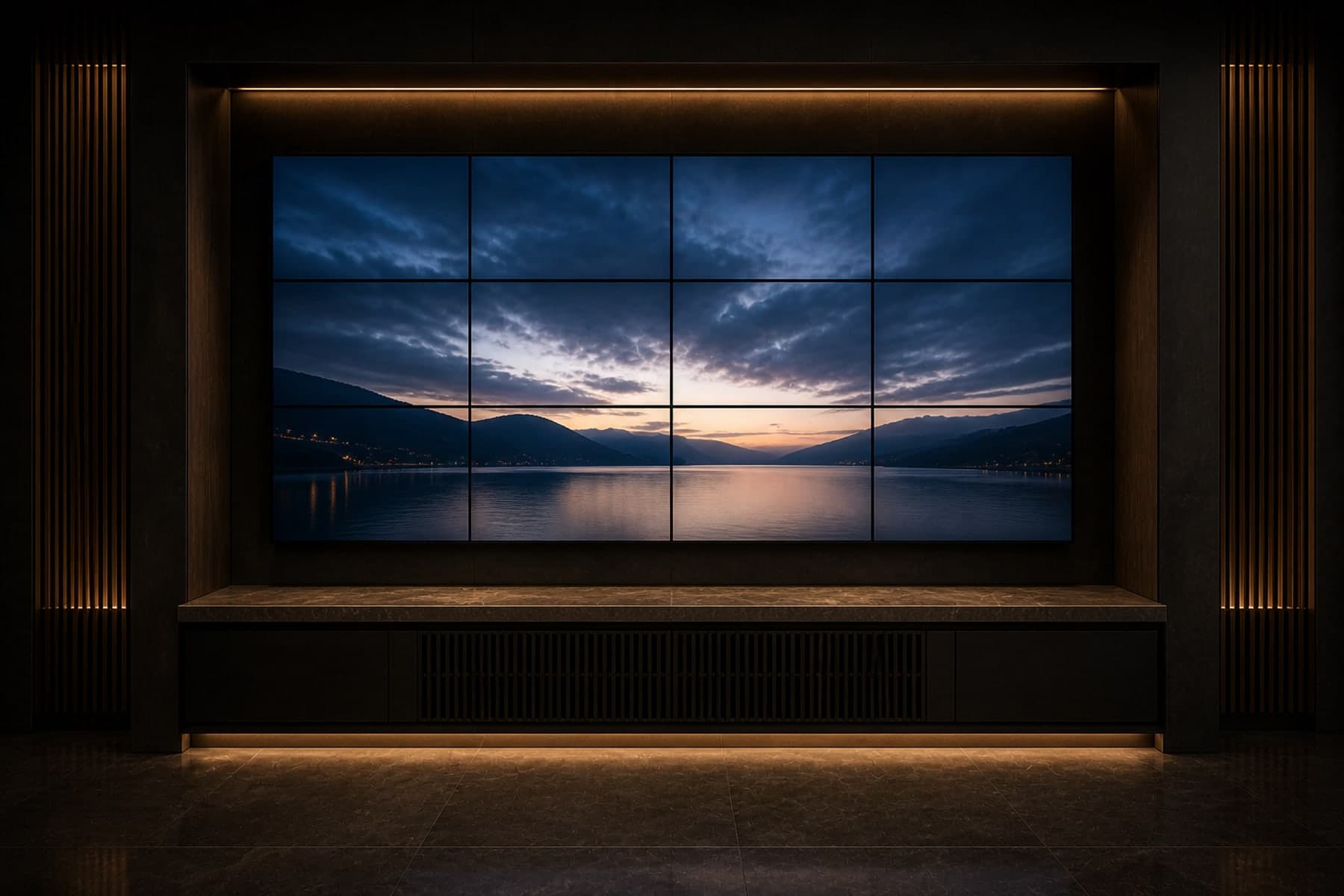
Digital signage in 2026 is less a display problem and more an infrastructure problem. The visible layer — direct-view LED panels, fine-pitch LCDs, projection canvases — is the part the client sees and signs off on. The invisible layer — the content distribution architecture, the signal redundancy, the thermal load on the host structure, the power conditioning, the network discipline, the maintenance access — is where the eight-year reliability is actually engineered. A brief that specifies only the visible layer produces a wall that looks correct on commissioning day and falls apart by year two.
The pixel-pitch decision is the easiest to get wrong because the heuristic is simple but the room is rarely surveyed. The rule of thumb — minimum viewing distance in metres roughly equals pixel pitch in millimetres — works when the closest viewer is the actual closest viewer. In retail and hospitality, the closest viewer is often a passerby standing two metres from the wall while waiting for an elevator, not the architect's intended sightline at four metres. Surveying the actual sightlines, not just the design intent, is what separates a P1.5 wall that reads cleanly from a P2.5 wall that looks pixellated at the cashier counter.
Brightness is the second number nobody calibrates against the room. A 600-nit indoor LED panel reads beautifully in a lobby with 200 lux of ambient light; the same panel becomes unreadable in a south-facing atrium where the floor-plane lux at noon reaches 4,000. The right specification flows from the ambient measurement, not the catalogue: roughly 3× the peak ambient lux at the screen plane for a panel that needs to compete with daylight, and 1.5× for a panel in controlled artificial light. Outdoor signage in tropical climates routinely needs 5,000-7,000 nits with anti-reflective coatings; quoting a 2,500-nit panel for a hotel porte-cochère is how systems get rebuilt within twelve months.
Content distribution is the architecture decision that decides whether the system is operable in year three. The choice is between four broad models. Standalone playback (USB stick or SD card in each display) is cheap, brittle, and impossible to manage above three screens. Networked players with local cache (BrightSign, Magicinfo Player) are the workhorse for retail and hospitality at 4-40 screens — robust, low-bandwidth, scriptable. Centralised AV-over-IP distribution (WyreStorm NetworkHD, Crestron NVX, SDVoE for the very high end) is the right answer for control rooms, command centres and any deployment where multiple synchronised displays draw from a shared source pool. Cloud-managed CMS-only architectures (Yodeck, NoviSign, BrightAuthor:connected) are the right answer where the content is web-based and the operational team is non-technical — but they put the system's availability on the public internet's uptime, which is a deliberate trade.
Signal redundancy is the architecture decision most often skipped and most consequential at year three. A control-room signage deployment running on a single uncached AV-over-IP encoder fails completely if the encoder fails — and replacement is a four-week procurement window. The right pattern is dual encoders with primary/secondary switchover at the decoder level, or a cached player architecture where each panel can fall back to a local content loop if the network drops. For hospitality and retail, a 90-second content cache at each player buys the network team a margin to fix transient drops without anyone noticing.
The thermal and load realities are the part of the brief that lives in mechanical-services drawings and rarely in the signage spec. A 4×3 m direct-view LED wall at P2.5 draws roughly 8-12 kW of continuous power and emits 6-9 kW of heat into the room. The HVAC load calculation should include this; the structural calculation should include the panel weight (typically 40-55 kg per square metre) plus the maintenance access loads; the electrical single-line should reserve a dedicated circuit per video-wall sub-bank with redundant feed. Getting any of these wrong at design stage produces the year-two failures that look like 'the wall went dark' but are actually 'the HVAC tripped because the room temperature exceeded the panel's operating window'.
Operational duty cycle decides the panel-grade. A retail signage panel running 12 hours a day, 7 days a week is operating at roughly 4,400 hours per year — every commercial display will survive that. A 24/7 control-room or transport-hub deployment runs at 8,760 hours per year and demands a 24/7-rated panel (Samsung QM-R series, LG SH7DC, Sony Bravia BZ Professional) — consumer-grade or even commercial-light panels fail their backlight or IPS layer at the 18-month mark under that duty. Specifying the wrong panel-grade is the single most common 'the screens died' incident we are called to remediate.
Content orchestration is the layer that decides whether the system is editable by the operator in year three. A signage deployment whose content can only be changed by the original integrator is failing the operator. The discipline is to provide the operations team with a documented CMS pathway, a versioned content library, and a recovery procedure for a hung player — all written and handed over, not held in the integrator's head. AMC contracts that include 'content updates' without specifying the change-request SLA, the operator's self-service rights, and the content library's portability are AMC contracts that quietly tether the client to one supplier.
Where the practice routinely engineers signage is the hospitality and retail estate brief: a 4-12 screen distributed deployment with a mix of indoor LED, LCD signage and outdoor weatherproof panels, running on a networked-player architecture with cloud CMS and local cache. For these deployments the brand stack we anchor on is Samsung Smart Signage / LG Commercial / Sony Bravia at the LCD layer; Absen, Unilumin, Leyard or LianTronics at the direct-view LED layer; BrightSign or Magicinfo at the player layer; Yodeck or Magicinfo at the cloud-CMS layer. For command-centre and broadcast-grade deployments we move to Crestron NVX or WyreStorm NetworkHD for the distribution layer and to mission-critical 24/7 panels.
The brief that ages well specifies the four numbers — viewing distance, ambient lux, content frame-rate, duty cycle — and lets the engineering follow. The brief that specifies only the panel model and screen size produces a wall that the operations team disowns within the first year. The visible layer is the cheap part of a signage system; the invisible architecture is what the budget should actually defend.
Signage orchestration architecture
signage-orchestrationDiagram · described
Signage orchestration architecture
Networked-player signage architecture for retail and hospitality. Cloud CMS publishes to local players (BrightSign, Magicinfo Player) that hold a 90-second local cache for graceful degradation if the network drops. Each player drives one or more displays in a mix of indoor LCD, indoor LED, outdoor LED and touch kiosk.
Key engineering takeaways
- Pixel pitch is decided by the actual closest viewer, not the design-intent viewer — survey the sightlines before quoting.
- Brightness specification flows from the measured ambient lux at the screen plane (≈3× peak ambient for daylight-competing canvases), not the catalogue heuristic.
- Content distribution architecture decides operability in year three — networked players with local cache is the workhorse pattern for 4–40 screen retail/hospitality deployments.
- Signal redundancy at the encoder or player layer is what separates a system that survives a transient network drop from one that goes dark.
- Thermal and structural loads belong in the mechanical and structural drawings — an 8–12 kW LED wall is an HVAC line-item, not just an electrical one.
- Operational duty cycle decides the panel grade — 24/7 deployments demand mission-critical-rated displays, not commercial-light models running double their design hours.
- CMS portability and operator-side change-request rights are AMC clauses worth writing in week one — they decide whether the client is tethered or autonomous in year three.
/ Reference table
Signage panel-grade vs deployment fit
| Deployment | Daily run-hours | Right panel grade | Reference brands | What fails if you under-spec |
|---|---|---|---|---|
| Retail / hospitality lobby | 10–14 h | Commercial 16/7 LCD or P2.5–P3 indoor LED | Samsung QM-R · LG UH5J · Absen A-series | Backlight uniformity drift by month 18; image retention on static logos |
| Control room / command centre | 24/7 | 24/7 mission-critical LCD or P1.5–P2 indoor LED | Samsung VM-T · LG VL5G-V · Leyard TWA-series | Panel-uniformity loss inside 12 months; bad pixel rate above acceptable |
| Hotel porte-cochère / outdoor canopy | 12–24 h | IP55+ outdoor LED 5,000–7,000 nit | Absen XV-series · Unilumin Uslim outdoor · Leyard Verse | Wash-out in daylight; moisture ingress; tropical-climate ribbon failure |
| Transport hub / airport | 24/7 | 24/7 mission-critical LCD 700-nit minimum | Samsung QH-B · LG SH7DC · Sony BZ Pro | Daylight wash-out at concourse glazing; image retention from departure-board content |
| Auditorium / event venue | Event-driven | Fine-pitch P1.5–P2 indoor LED or fine-pitch LCD | Absen AX · Leyard CarbonLight · Christie Velvet | Mullion visibility at fine-pitch sightline; brightness mismatch with stage lighting |
Numbers reflect 2026 mainstream specifications; bespoke deployments above 50 sq m of LED canvas qualify for direct-from-manufacturer engineering review.
Common mistakes
What we see go wrong
- Specifying pixel pitch from the architect's sightline rather than the actual closest viewer.
- Why it fails — Passersby, queue-formers and people waiting for elevators typically stand 30–50% closer than the design-intent viewer, and at that distance a P2.5 wall reads as pixellated.
- What we do instead — Survey the sightlines on site — measure the closest pedestrian path and specify pixel pitch against that, not the rendering.
- Quoting a 2,500-nit indoor panel for a daylight-flooded lobby or porte-cochère.
- Why it fails — Peak ambient lux in tropical atria and outdoor canopies routinely reaches 4,000–8,000 — a 2,500-nit panel washes out and reads as a grey square for half the day.
- What we do instead — Measure the peak ambient lux at the screen plane; specify roughly 3× peak ambient for daylight-competing canvases (5,000–7,000 nit for outdoor in India).
- Running a 24/7 transport-hub or command-centre deployment on commercial-light panels.
- Why it fails — Commercial-light panels are rated for 16/7 — at 8,760 run-hours per year the backlight or IPS layer fails inside 18 months, the warranty does not cover the failure mode.
- What we do instead — Specify 24/7 mission-critical-rated panels (Samsung QM/VM-T, LG SH7DC, Sony BZ Pro) for any deployment running above 16 hours per day.
- Designing the AV-over-IP signal path with a single encoder and no redundancy.
- Why it fails — Encoder failure takes the entire deployment dark; replacement is a four-week procurement window; the operations team has no recovery path.
- What we do instead — Dual-encoder architecture with primary/secondary switchover at the decoder, or networked-player architecture with local cache so each panel can ride out a network drop.
- Treating thermal and structural load as an installation-day discussion rather than a design-stage line item.
- Why it fails — An 8–12 kW LED canvas is a real HVAC load; the panel weight plus maintenance access exceeds many architectural ceiling-capacity assumptions.
- What we do instead — Issue the signage thermal and structural loads to the MEP and structural team at concept stage, not at installation — most year-two failures trace to this discipline gap.
- Closing AMC scope without operator-side change-request rights and CMS portability.
- Why it fails — Year-three the client cannot update content without the original integrator, and the content library is held hostage to the contract — a quiet vendor-lock.
- What we do instead — Write self-service content rights, named change-request SLAs and CMS export portability into the AMC at handover, not after the first dispute.
Deployment realities
What the drawings never show
Pixel pitch math meets queue formation
The minimum-viewing-distance rule assumes the design-intent viewer; in retail and transit, the closest viewer is often 40% closer because queues form against the wall. Survey before specifying.
Brightness loses to glazing every time
South-facing or west-facing glazing in tropical light puts 4,000+ lux on the screen plane. The catalogue's 600-nit indoor panel cannot compete; specify against the measured envelope, not the brochure.
Maintenance access decides the maintenance contract cost
An LED wall with no rear access requires front-service modules at a 15–20% cost premium; a wall with full rear access can use cheaper rear-service modules. The architectural decision shapes the AMC for the next decade.
Network discipline is what AV-over-IP actually needs
AV-over-IP fails on switches that were not engineered for the multicast load — IGMP snooping, querier discipline and jumbo-frame discipline are mandatory, not optional. The switch fabric is part of the signage spec.
Outdoor LED in monsoon climates ages by ribbon, not pixel
In tropical monsoon climates the failure mode is not pixel death but ribbon-cable moisture ingress at panel seams. IP65+ rating is necessary but not sufficient; deployment orientation and drainage geometry matter as much.
Static logos are the silent killer
Static brand logos or weather-bug overlays running 12+ hours a day on LCD signage produce image retention inside 18 months. Either rotate the overlay position, fade the logo's opacity periodically, or specify panels with pixel-shifting compensation.
When this architecture fails
Failure modes worth knowing in advance
Even well-engineered signage deployments have known failure modes — calling them out at design stage saves the year-two remediation contract.
Fine-pitch (P0.9–P1.2) LED wall in a public space with no protective glazing.
Module damage from accidental contact at chest height inside the first 6 months; replacement modules cost 8–12% of the install per incident. Specify protective glazing or move the deployment to a controlled-access zone.
Single-encoder AV-over-IP distribution for a control room or broadcast deployment.
Encoder failure produces a hard outage of the entire wall with a multi-week recovery; the operations team has no fallback path. Always specify dual encoders with frame-accurate switchover.
Outdoor LED with no shading or anti-reflective coating in tropical climates.
Direct solar at the screen plane drives panel surface temperatures above the operating envelope; auto-dimming kicks in and the content reads as washed-out for several hours a day, every day.
Cloud-CMS-only architecture without local cache, deployed in a building with marginal internet.
Every ISP outage takes the signage offline. For lobby and hospitality where availability is part of the brand impression, this is unacceptable; specify networked players with local cache.
What ages poorly
Lifecycle weak points to plan around
Backlight uniformity (LCD)
Visible drift at 18–24 months on commercial panels; 36–48 months on mission-critical panels. Plan a calibration visit at 12-month intervals.
Module-to-module brightness match (LED)
Begins to diverge at 12 months; calibration to spec at 24 months requires a re-baseline pass. Annual brightness re-cal is an AMC line item, not an optional extra.
Cable runs (HDBaseT > 50 m)
Connector degradation and EMI ingress at the 5–7 year mark; AV-over-IP CAT6A runs age better than long HDBaseT runs in high-EMI environments.
Touch overlays on interactive signage
Capacitive overlays lose responsiveness at the edges after 18–24 months of public use; specify replaceable overlays, not bonded glass.
Outdoor ribbon-cable seals
IP65 seam degradation in tropical monsoon at 36–48 months; specify modular outdoor LED with replaceable seal kits and a seal-inspection AMC line item.
Cloud-CMS contracts
Vendor pricing, feature gating and API stability shift every 24–36 months. Specify CMS export-portability and renewal-pricing caps at procurement, not after the first renewal.
/ Frequently asked
Quick answers from the practice.
- What pixel pitch for a hotel lobby wall at 3 m closest viewer?
- P2.5 indoor LED is the comfortable specification — P2.0 if the lobby curates a sponsor-grade canvas or fine-text content is anticipated. Below 2 m closest viewer move to P1.5 or finer; above 4 m closest viewer P3.0 is defensible and 30% cheaper per square metre.
- Direct-view LED or LCD video wall for a 16 m² command-centre canvas?
- Below ~12 m² the LCD video-wall (Samsung VM-T, LG VL5G-V) at ultra-narrow bezel is competitive on price and brightness; above ~16 m² direct-view LED at P1.5 is the cleaner answer because it eliminates mullions entirely. Between 12–16 m² the choice depends on the content (text-heavy → LED; full-frame video → either).
- Do we need AV-over-IP or networked players for a 12-screen hospitality estate?
- Networked players (BrightSign, Magicinfo Player) is the right answer at this scale — distributed content, local cache, low bandwidth, and any operator can manage it. AV-over-IP is the right answer only when multiple displays must draw from a shared source pool in synchronised frame-accuracy (control rooms, multi-display gaming, broadcast feeds).
- How is the LED-wall HVAC load calculated?
- Approximate thermal output is 65–75% of the rated continuous electrical draw. A 4×3 m P2.5 wall at ~10 kW continuous emits ~6.5–7.5 kW into the room. Issue the load to the MEP team as part of the signage line item at concept stage.
- What CMS do you recommend for a multi-site hospitality estate?
- Magicinfo at the Samsung-anchored estates and Yodeck for mixed-vendor estates — both have proven scale at 50+ screens across multiple sites, both support local cache, both export the content library cleanly. We avoid CMS-only-cloud platforms for hospitality because internet availability becomes a brand-availability risk.
- Is TechnoGuru a signage reseller or an integrator?
- Integrator. We engineer the architecture (panels, distribution, signal redundancy, thermal, structural, content CMS, AMC), procure across multiple manufacturers as the project demands, commission and document the deployment, and AMC the lifecycle. Brand selection is per-project, not per-portfolio.
/ What to do next
Three next steps for signage scope
- Compare AV-over-IP platforms →WyreStorm NHD vs Crestron NVX — codec, latency, scale ceiling.
- Read the video walls service page →Engineering scope, brand bands, AMC structure for command-centre and lobby walls.
- Send the signage drawings to the studio →We mark up the panel-grade, distribution architecture and thermal load against your room within two working days.
Engineering toolkit
Tools that go with this read
If this article gave you a question worth pricing, these calculators give a defensible first number.
- AV · LED
LED Wall Size Calculator
Direct-view LED wall sizing across a source-cited model catalogue including Samsung, LG MAGNIT, Sony, Philips, Leyard, Absen, Unilumin, ROE Visual, AOTO, INFiLED, Daktronics, Planar, Nanolumens and more. Cabinet count, native resolution, brightness adequacy, power and weight — with pitch-vs-distance honesty and camera-refresh flags. Sources cited per model.
50 brands · pitch-awareOpen - AV · Projection
Projector Throw Distance Calculator
Engineering-grade throw distance calculator across a verified multi-brand projector catalogue — Sony, JVC, Epson, BenQ, LG, Optoma, ViewSonic, Panasonic, Barco, Christie, Canon, InFocus, Maxell, Casio, EIKI, Philips, Nebula, JMGO, Dangbei, Boxlight, ASUS, Leica, Xiaomi, WEMAX, Ricoh and more. Searchable picker, throw range, lens-shift envelope, viewing distance, pixel density, feasibility flags and a custom-throw fallback. Sources cited per model.
51 brands · sourcedOpen - AV · Distribution
AV-over-IP vs HDBaseT
Six questions about endpoints, distance, growth, network, control and budget — and a scored recommendation between AV-over-IP and HDBaseT, with platform candidates.
6 questions · scoredOpen
Related engineering decision
The comparison behind this question.
Decision · Display & Collaboration
LED wall vs projector — the right large display
You are choosing the large-format display for a room and want it matched to the ambient light, viewing distance and how the room is used.
Decision · Display & Collaboration
Interactive panel vs projector — classrooms and meeting rooms
You are equipping a classroom or meeting room with an interactive surface and want it matched to the light, the room size and how it is used.
/ Services this article informs
Read the discipline pages.
/ Reference work
Projects where this engineering shows up.
Cabinet Conference Room, Arunachal Pradesh Secretariat
Government · Cabinet Conferencing
Itanagar, Arunachal Pradesh · Handover 2018Conference Room, Chief Minister's Residential Complex, Kohima
Government · Executive Conference Room
Kohima, Nagaland · Handover 2022Town Hall Auditorium, Dimapur
Government · Civic Auditorium
Dimapur, Nagaland · Handover 2024
Editorial — about this surface
TechnoGuru AV Systems Practice
The AV systems practice engineers residential reference cinema and commercial audio-visual systems against the AVIXA CTS, CEDIA, HAA Level 1 and K-Array Certified Designer reference frames. Every installation pairs measurable acoustic and visual targets with the field calibration that proves the room actually meets them.
Reviewed against calibrated measurement realities — room performance is verified against reference targets before sign-off.
Last reviewed
14 May 2026
Engineering domains
Residential cinema and reference audio · Commercial audio-visual systems · Acoustic engineering and room treatment · Loudspeaker and line-array design
Operating environments
Residential reference cinema · Hospitality lounges and venues · Corporate AV and boardrooms · Auditoria and assembly halls
/ Discuss your project
If this article matches a brief you are working on, the next step is a short brief — a project lead replies to it directly.
We do not run sales pipelines. The first reply comes from a project lead, within two working days, and it goes straight to the engineering question rather than a brochure.