
/ ELV
Voice-evacuation intelligibility: STI per seat in a real evacuation, not a clean room
Quick answer
Voice-evacuation PA is cited to NBC 2016 Part 4's voice-evacuation provisions, with IEC 60849 / EN 54-16 as the equipment benchmarks the specification is written against. The acceptance criterion is speech intelligibility at every seat during an actual evacuation — not just at commissioning — and it is established by measurement, not asserted from the equipment schedule. The gap between the empty-room measurement and the real evacuation event is closed by zone-loudness margin against measured ambient noise (≥ 10 dB above evac-event ambient, not standing ambient), multi-language message ordering, message timing against the alarm-sounder discipline, hardware-enforced priority over routine paging, supervised cabling with per-zone fault reporting, battery-backed amplification for 30 minutes minimum, and re-measurement after any room-acoustic change (carpet refresh, ceiling re-treatment, layout reconfiguration).
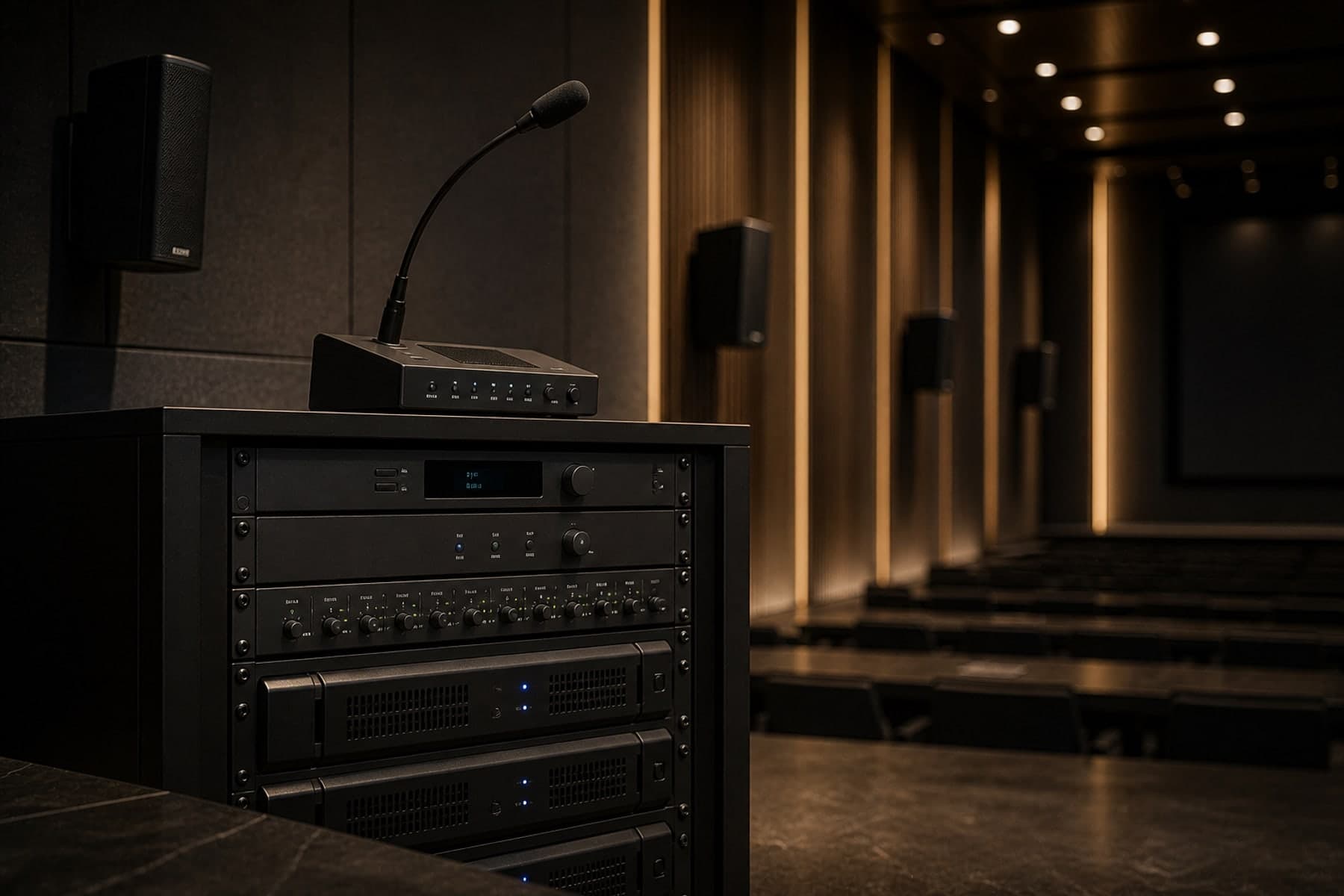
Voice-evacuation is the most consequence-bound PA system in any building. The acceptance criterion is intelligibility during an evacuation event — when the alarm is sounding, the doors are opening, the population is in motion, and the announcement has to compete against everything else for cognitive bandwidth. Measured intelligibility at every seat in the empty room is the starting point; holding that intelligibility during the actual evacuation is the engineering target. We commission against our own per-seat target of STI ≥ 0.55 rather than a published acceptance band, because no instrument this practice holds fixes one.
Zone-loudness margin against evacuation-event ambient
The catalogue zone-loudness specification is typically ≥ 10 dB above standing ambient (the room's background noise floor in normal use). The evacuation-event ambient is much higher — alarm sounders at 80-90 dBA, audience movement noise at 65-70 dBA, door operation noise at 60-65 dBA. The voice-evacuation PA must deliver ≥ 10 dB above the evacuation-event ambient, which means 95-105 dBA at every seat under evacuation conditions. Specifying against standing ambient and discovering the gap during the event is operationally late.
Multi-language message ordering
Public-occupancy buildings in India routinely require evacuation announcements in 2-4 languages (English, Hindi, regional language, sometimes additional for transit hubs and airports). The ordering and timing of the languages is part of the engineering: each language takes 12-18 seconds for a complete evacuation message; the message library must be sequenced so the most-comprehended language plays first, followed by additional languages on a rotating cycle, with sufficient pause for the population to act on the message rather than waiting for the next language. Generic preset libraries miss this.
Hardware-enforced priority over routine paging
PA voice-evacuation priority must be hardware-enforced, not software-configured. The fire-alarm panel's voice-evac module wires into the highest-priority input on every zone amplifier; on a fire-alarm trigger, the zone amplifiers switch to the voice-evac source regardless of what the routine PA is broadcasting. A software-configured priority that a routine paging operation can over-ride is a procedural failure waiting to happen — and we test the hardware priority on every commissioning by triggering a fire-alarm event during a routine page.
Supervised cabling with per-zone fault reporting
Voice-evacuation specified against IEC 60849 / EN 54-16 carries supervised cabling — the system monitors every cable run between the panel and the amplifier, between the amplifier and every speaker, with per-zone fault reporting on cable open, cable short or amplifier failure. Supervision is engineered at the cable layer with end-of-line resistors or active line-monitoring; without it, a single cable fault collapses a whole zone silently and the operator discovers the fault during the evacuation event.
Battery-backed amplification for 30 minutes minimum
Voice-evacuation amplification must continue through power failure — voice-evacuation specifications are written to 30 minutes minimum battery autonomy under full-load discharge. The battery bank is sized against the full-discharge load profile, not the standing-charge load; sealed maintenance-free batteries on a 3-year refresh cycle for the 30-minute guarantee.
Re-measurement after any room-acoustic change
STI is a function of the room's acoustic envelope — carpet, ceiling treatment, audience-chair upholstery, layout reconfiguration all shift the RT60 and therefore the achievable STI. Any room-acoustic change triggers an STI re-measurement on the AMC schedule; the original commissioning STI is the starting baseline, not the lifetime guarantee.
Callout — what evacuation-PA procurement most miss
STI per seat at commissioning is the starting point, not the operational guarantee. The evacuation-event STI is what decides whether the population evacuates safely; engineer the zone-loudness margin, the multi-language sequencing, the hardware priority, the supervised cabling, the battery backup and the AMC re-measurement discipline against the event, not the clean-room test.
References
1. IEC 60849 — Sound systems for emergency purposes.
2. EN 54-16 — Fire detection and fire alarm systems — Voice alarm control and indicating equipment.
3. NBC 2016 Part 4 — fire and life-safety provisions for assembly occupancy.
Auditorium signal architecture with voice-evacuation overlay
auditorium-signal-architectureDiagram · described
Civic auditorium signal architecture
A civic / cultural auditorium AV signal architecture. Inputs (gooseneck and lavalier microphones, line-in sources, HDMI presentation, livestream feed) route through a digital mixer to a DSP with feedback suppression, EQ and named-preset library (Civic, Cultural, Ceremonial). DSP feeds line-array audio output, stage monitors, LED-cluster video wall, DMX stage lighting and a recording / livestream encoder. Auditorium-staff console recalls a preset and orchestrates all five output classes from a single gesture.
Key engineering takeaways
- Voice-evacuation STI must hold at every seat during the actual evacuation event — not just at commissioning.
- Zone-loudness margin is engineered against evacuation-event ambient (alarms + movement + doors), not standing ambient.
- Multi-language message ordering and timing is part of the engineering — generic preset libraries miss this.
- Hardware-enforced priority over routine paging — software-configured priority is a procedural failure waiting to happen.
- Supervised cabling with per-zone fault reporting, benchmarked to IEC 60849 / EN 54-16 — a single cable fault otherwise collapses a whole zone silently.
- Battery-backed amplification for 30 minutes minimum at full-load voice-evacuation discharge — 3-year sealed-MF battery refresh cycle.
- STI re-measurement after any room-acoustic change — carpet refresh, ceiling re-treatment, layout reconfiguration all shift the achievable STI.
/ Frequently asked
Quick answers from the practice.
- What STI target do you design voice-evacuation to?
- The mandating instrument is NBC 2016 Part 4's voice-evacuation provisions; IEC 60849 / EN 54-16 are the equipment benchmarks the specification is written against. Neither gives us a verified numeric acceptance band, so we do not publish a figure as though code fixed it — the acceptance criterion is measured speech intelligibility at every position in the served area. We design and commission against our own target of STI ≥ 0.55 to preserve margin against room-acoustic drift over the AMC lifecycle.
- How is multi-language sequencing engineered?
- Message library sequenced so the most-comprehended language plays first, followed by additional languages on a rotating cycle, with sufficient pause (typically 4-6 seconds) for population to act on the message before the next language begins. Sequencing is part of the commissioning deliverable, signed off by the building operator.
- Will TechnoGuru deliver the IEC 60849 / EN 54-16 compliance pack?
- Yes — measurement report (STI per seat, SPL per seat, calibrated source), zone-and-amplifier discipline, pre-emption test record, signed compliance against the standard. Standard inclusion on any building requiring a Fire NOC.
/ What to do next
Three next steps for voice-evacuation scope
- Read the PA system design insight →Line-array geometry, DSP shading, IEC 60849 / EN 54-16 compliance.
- Read the fire-alarm matrix insight →How voice-evac integrates into the cause-and-effect register.
- Try the RT60 calculator →Room acoustic envelope and its effect on STI.
Engineering toolkit
Tools that go with this read
If this article gave you a question worth pricing, these calculators give a defensible first number.
- Life-safety
NBC Compliance Checker
Building height, type and occupancy in — the life-safety and ELV systems NBC 2016 indicates for that building, citing NBC 2016 and the relevant IS codes.
NBC 2016 · IS codesOpen - Lead intake
Project Brief Wizard
Six structured questions, a written response within two working days. The fastest path to engaging the practice on a real project.
6 questions · 2-day replyOpen - BMS · Energy
Energy & Efficiency Estimator
Adjust building variables and see indicative energy and CO₂ savings (kWh) for a BMS-driven energy upgrade plus daylight-harvesting LED retrofit. Conservative; defensible in a first conversation.
kWh · CO₂ savedOpen
Related engineering decision
The comparison behind this question.
· Where to go next
The wider authority graph for this topic.
Engineering pages
Read further
Editorial — about this surface
TechnoGuru Fire & Life-Safety Practice
The fire and life-safety practice runs the discipline that the state fire service signs against. Addressable detection design, cause-and-effect logic, PAVE voice-evac and emergency lighting — engineered against the National Building Code, the relevant state amendments and the field realities of how a building actually evacuates.
Reviewed against NBC, IS 2189 and the relevant state fire-service requirements — every recommendation is held to what passes NOC and field cause-and-effect verification.
Last reviewed
15 May 2026
Engineering domains
Addressable fire detection · Cause-and-effect logic engineering · Public-address voice evacuation (PAVE) · Emergency lighting design
Operating environments
Mid-rise and high-rise commercial · Hospitality and healthcare buildings · Government and institutional facilities · Assembly and gathering venues
/ Discuss your project
If this article matches a brief you are working on, the next step is a short brief — a project lead replies to it directly.
We do not run sales pipelines. The first reply comes from a project lead, within two working days, and it goes straight to the engineering question rather than a brochure.