
/ ELV
CCTV design for hospitals: privacy zoning, retention windows and the camera count nobody calculates
Quick answer
Hospital CCTV is engineered around four constraints commercial sites do not face: patient privacy zoning (cameras off in wards, on in corridors), NABH-aligned retention (90 days minimum for clinical zones), infection-control cabling that respects pressure boundaries, and clinical-engineering veto over every analytics rule. Camera count typically lands at 12–18 per 1,500 sq m clinical floor (lower than commercial because privacy zones are excluded), with retention sized at 90 days for clinical, 30 days for admin and 180 days for pharmacy and drug stores.
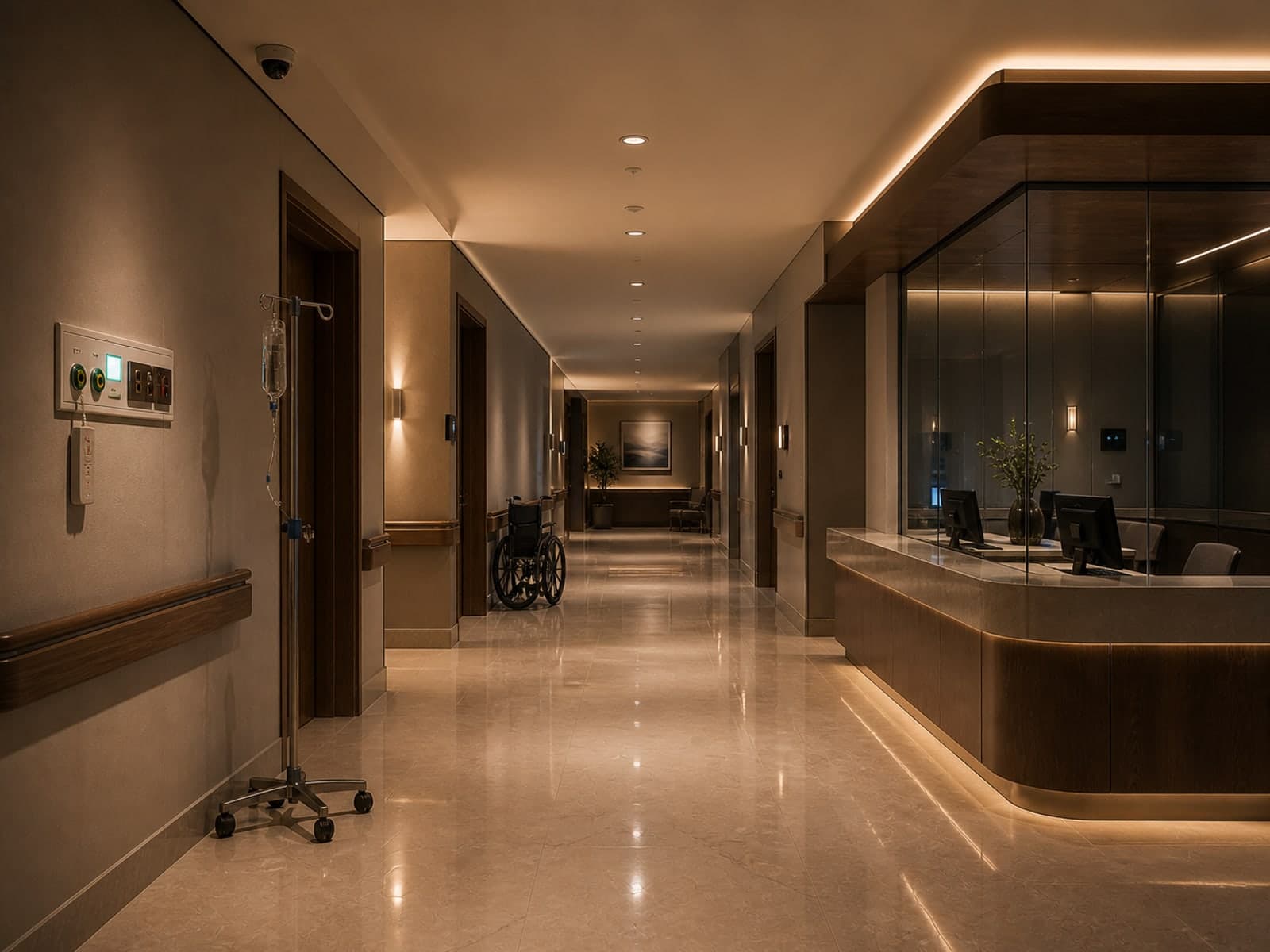
Hospital surveillance is one of the briefs new ELV integrators most consistently misread. The instinct is to apply the commercial CCTV playbook — high camera density, broad coverage, generic analytics, 30-day retention — and stick a hospital sticker on the design. The result is a system that the clinical-engineering lead refuses to commission, and an integrator who has burned a relationship in week three.
The right starting point is the four constraints a hospital imposes that a commercial site does not: patient privacy zoning, infection-control cabling pathways, NABH-aligned retention windows, and clinical-engineering veto rights over every analytics rule. Once the design respects all four, the camera count, the storage sizing, the analytics schedule and the cabling pathway all fall into place. Get any one wrong and the whole plan is non-starter.
Patient privacy zoning is the design floor, not a software setting
Cameras inside patient wards, treatment rooms and consultation rooms are not acceptable in almost every Indian hospital we engineer. The privacy expectation is part of the doctor-patient relationship and is enforced by the medical council's ethical framework as much as by any data-protection law. We design with cameras explicitly excluded from these zones — physical exclusion at the camera-placement drawing, not software masking — and we cover the surrounding corridors, lift lobbies, nurse stations, drug stores, pharmacy, OT entry/exit, OPD waiting halls and perimeter at the densities the operational brief justifies.
Where coverage of a ward is required for patient-safety reasons (high-dependency units, infectious-disease wards under quarantine), the brief is captured in writing, signed by the clinical-engineering lead and the medical superintendent, and the camera is specified with a hardware shutter that can be physically verified — not a firmware-only privacy mask that a future firmware update can disable. The discipline is to make the privacy promise visible to the patient and verifiable to the auditor.
Camera count is lower than commercial, not higher
Most commercial integrators arrive at hospital briefs with a high-density camera plan and find themselves cutting cameras through the entire design phase. The right starting point is the opposite: 12–18 cameras per 1,500 sq m of clinical floor (against 18–28 for an equivalent commercial floor), with the headcount allocated to the corridors, lobbies and high-value zones (drug stores, pharmacy, OT corridors, records rooms, blood-bank entry) rather than spread thinly across the entire footprint.
The economics of a serious analytics layer also push toward fewer, better cameras: 4MP minimum at the corridor heads, varifocal at the lobby junctions, panoramic at the OT corridors, fixed at the drug-store entry. We specify per-zone, against the architect's drawings, with a coverage map the clinical-engineering team can review against their actual workflow. The result is a CCTV layer that surfaces the events the hospital actually needs to forensically reconstruct, not a wallpaper of low-resolution evidence that nobody has the storage to keep at usable quality.
Retention windows are zone-specific, not building-wide
Commercial CCTV retention is typically a single number: 30 days, sometimes 60. Hospital retention is zone-specific because the audit and incident-investigation timelines vary by clinical context. We typically specify 90 days for clinical zones (NABH-aligned for incident-investigation timelines), 180 days for pharmacy and drug stores (controlled-substance audit windows), 30 days for admin and outpatient billing zones, and 365 days for records-room entry and blood-bank cold-chain.
Storage is sized by the formula retention × bitrate × camera count, summed across zones, with redundancy headroom on top. On the teaching-hospital deployments we have handed over, the clinical-engineering lead saw that calculation before procurement and the storage was specified to it rather than back-fitted to a budget; the resulting capacity stays in the project record. We do not let storage become the silent compromise that turns a 4MP camera plan into a 1080p commissioning result.
Cabling routes respect infection-control zoning, not just architectural drawings
The cabling pathway between every camera and the recording infrastructure has to respect the hospital's pressure-zoning, the cleaning protocols and the fire-and-smoke compartmentation. Routing CCTV cabling from a camera in a positive-pressure OT corridor through a negative-pressure isolation room is not a cabling decision — it is a clinical-compliance decision that can void NABH accreditation. We document the infection-control zoning before the cabling design begins, and where a cable crosses a compartmentation boundary, the penetration is sealed to NABH-and-NBC standard with a written penetration register.
This is the part of the brief that takes the most time and surprises the most integrators. The cabling drawing for a hospital CCTV deployment routinely runs 1.5–2× the page count of an equivalent commercial deployment, because the routes are constrained at every compartmentation boundary. We staff the design phase accordingly; the hospital is not a commercial tower with extra labels.
Analytics rules are reviewed by clinical engineering, not configured by IT
The clinical-engineering team has a veto over every analytics rule we propose, and we hand the configuration over for review before commissioning. Loitering analytics in OT corridors are usually rejected (medical staff stand and confer there for legitimate clinical reasons); intrusion analytics on the drug-store door are usually accepted; line-crossing on the pharmacy entry is usually configured with a window-of-acceptance for inventory deliveries.
We script the analytics rules, walk them through with clinical engineering, modify them per the meeting, and only then push them to the VMS. The discipline is that the clinical-engineering team owns the operational picture, not the IT vendor. Hospitals that skip this review end up with analytics that misfire so often the operations team disables them — at which point the analytics tier was a wasted spend.
Callout — what buyers most miss
The clinical-engineering lead has a veto over CCTV that the facilities lead does not. Hospital procurement typically routes CCTV through facilities and IT, who handle the contract and the network. The clinical-engineering lead — the person responsible for medical-device safety, infection control and patient-care continuity — is brought in for sign-off in week ten, often after specifications are locked. That is the wrong sequence: bring clinical engineering into the room from week one, or expect to discover their objections in week ten when they are also irreversible.
Reference deployment context
The Tinsukia Medical College & Hospital deployment we handed over for NCC Limited in 2024 carried a coordinated IP CCTV layer engineered to all four of these constraints — privacy zoning enforced at the camera-placement drawing, retention sized per clinical zone, cabling routed against the infection-control annotation, and analytics reviewed by clinical engineering before commissioning. The system has been operating at the hospital for over a year under our active AMC, and the clinical-engineering team operates the VMS independently of our intervention. That is the test the design was built to pass.
References
1. NABH 5th Edition Accreditation Standards for Hospitals — clauses on facility management, patient rights and infection control.
2. National Building Code of India 2016, Volume 2 — fire and life-safety provisions for hospital occupancy.
3. Tinsukia Medical College & Hospital — 200-bed teaching hospital, integrated ELV stack delivered for NCC Limited, 2024 commissioning.
4. Medical Council of India ethical framework — patient confidentiality and consent provisions.
Camera coverage geometry · FOV cones vs PPM bands
cctv-coverage-geometryDiagram · described
CCTV coverage geometry — FOV cones vs PPM bands
A top-down view of camera coverage geometry. Three camera classes (dome at 2.8 mm, bullet at 6 mm, PTZ at variable) are shown at representative mounting heights with their FOV cones projected onto a gridded floor plan. Identification-grade coverage (250 PPM), recognition (125 PPM) and observation (62 PPM) bands are marked. Real coverage tapers with distance; lens choice and mounting height set the actual coverage envelope.
Hospital ELV coordination matrix
hospital-elv-coordinationDiagram · described
Hospital ELV coordination matrix
A clinical ELV coordination lattice. Six input event sources (addressable fire-alarm, nurse-call / code-blue, medical-gas alarm, access-control event, IP-CCTV analytics, BMS supervisory alarm) converge on a cause-and-effect supervisory matrix. The matrix gates physical responses across seven output classes including PA paging zone, AHU damper response, lift homing, magnetic door-holder release, IP-CCTV bookmark, BMS audit log and on-call mobile escalation. Acknowledgement delays per output preserve surgical-anaesthesia workflow.
/ Frequently asked
Quick answers from the practice.
- Why is patient privacy zoning the constraint other CCTV designs don't face?
- Because cameras in ward areas violate patient confidentiality under both Indian law (DPDPA 2023) and NABH accreditation. Every camera placement must be defensible against a privacy audit — and the placement decision sits with clinical engineering, not with the security designer. Most hospital CCTV failures we audit are placement disputes that surface at NABH inspection, not technical failures.
- Why are camera counts lower than commercial sites?
- Because privacy zones (wards, consultation rooms, treatment bays, toilets) are excluded entirely. Only corridors, lobbies, lifts, pharmacy, drug stores, entrances, parking and external perimeter get coverage. Typical density: 12–18 cameras per 1,500 sq m clinical floor against 40+ for an equivalent commercial floor.
- Is 90-day retention enough?
- For clinical zones, 90 days is the NABH-aligned floor. Drug stores and pharmacy retention is 180 days under Drugs and Cosmetics Act provisions. Admin can run at 30. We size storage and retention per-zone rather than per-property — the cost-saving is significant and the compliance is per-zone anyway.
- Do clinical engineering teams veto analytics?
- Often, and they should. False positives on analytics rules in clinical settings (motion alerts in ICU, loitering detection in admissions) generate noise that disrupts patient care. The right discipline is to engage clinical engineering at rule-design stage and let them veto rules that don't survive their workflow. The end result is fewer rules running well, not more rules running poorly.
- Will TechnoGuru deliver the privacy-zoning documentation?
- Yes. We hand over a privacy-zoning register annotated against the hospital's NABH framework, a camera-by-camera placement justification, and the retention-tier mapping per zone. Standard inclusion in our hospital CCTV scope.
/ What to do next
Three next steps for hospital CCTV
- Try the CCTV coverage calculator →Building dimensions in, camera count + retention storage + bandwidth out.
- Read the CCTV service page →Engineering scope, brand bands, AMC structure.
- Read the healthcare sector page →How we engineer integrated ELV for hospitals.
Engineering toolkit
Tools that go with this read
If this article gave you a question worth pricing, these calculators give a defensible first number.
- Healthcare · Readiness
Healthcare ELV Readiness Checker
A readiness self-check for a hospital, diagnostic centre or clinic coordinating nurse call, CCTV, access, fire alarm + PA, network, patient TV and BMS for critical HVAC — with the gap list and who owes what. Statuses and bands only; no bed counts, layouts or camera specifics.
Advisory · readinessOpen - Life-safety
NBC Compliance Checker
Building height, type and occupancy in — the life-safety and ELV systems NBC 2016 indicates for that building, citing NBC 2016 and the relevant IS codes.
NBC 2016 · IS codesOpen - ELV · Reference
ELV / Life-Safety Building Map
Interactive cross-section of a building. Toggle between CCTV, access control, fire, PA, IP-PBX, server room and BMS — see device locations and where each cabling backbone lands.
7 layers · cross-sectionOpen
Related engineering decision
The comparison behind this question.
Decision · Security & Surveillance
DVR vs NVR — which CCTV recorder architecture to specify
You are choosing the recording architecture for a CCTV system and want it matched to the cabling that exists, the resolution required and how the system will grow.
Decision · Security & Surveillance
IP vs analogue camera — which surveillance camera type to specify
You are setting the camera and transmission technology for a surveillance system and want it matched to existing cabling, resolution requirements and the site's network policy.
/ Services this article informs
Read the discipline pages.
/ Reference work
Projects where this engineering shows up.
Tinsukia Medical College & Hospital
Healthcare · Government
Tinsukia, Assam · Handover 2024Agartala Medical College & GBP Hospital
Healthcare · Government
Agartala, Tripura · Handover 2022Town Hall Auditorium, Dimapur
Government · Civic Auditorium
Dimapur, Nagaland · Handover 2024Taraghar — State Guest House
Government · State Guest House
Shillong, Meghalaya · Handover 2025
Editorial — about this surface
TechnoGuru Infrastructure Engineering Group
The infrastructure engineering group runs the turnkey delivery layer — bill-of-materials engineering, services-cross-coordination with civil and MEP, commissioning to NBC and IS reference standards. The work moves from concept and BOQ through commissioning hand-over, with the same engineering bench that signed the drawings closing the punchlist.
Reviewed against deployment realities and code-compliance considerations across the practice's institutional and enterprise corpus.
Last reviewed
6 May 2026
Engineering domains
Turnkey systems integration · ELV bill-of-materials engineering · Services cross-coordination · Commissioning programme design
Operating environments
Government and institutional buildings · Hospitality and lifestyle venues · Healthcare facilities · Enterprise office and tech parks
/ Discuss your project
If this article matches a brief you are working on, the next step is a short brief — a project lead replies to it directly.
We do not run sales pipelines. The first reply comes from a project lead, within two working days, and it goes straight to the engineering question rather than a brochure.