
01 / 10
Case file
Public address, voice-evacuation and concert-grade audio for auditoriums, places of worship, stadia, transit hubs and event venues.
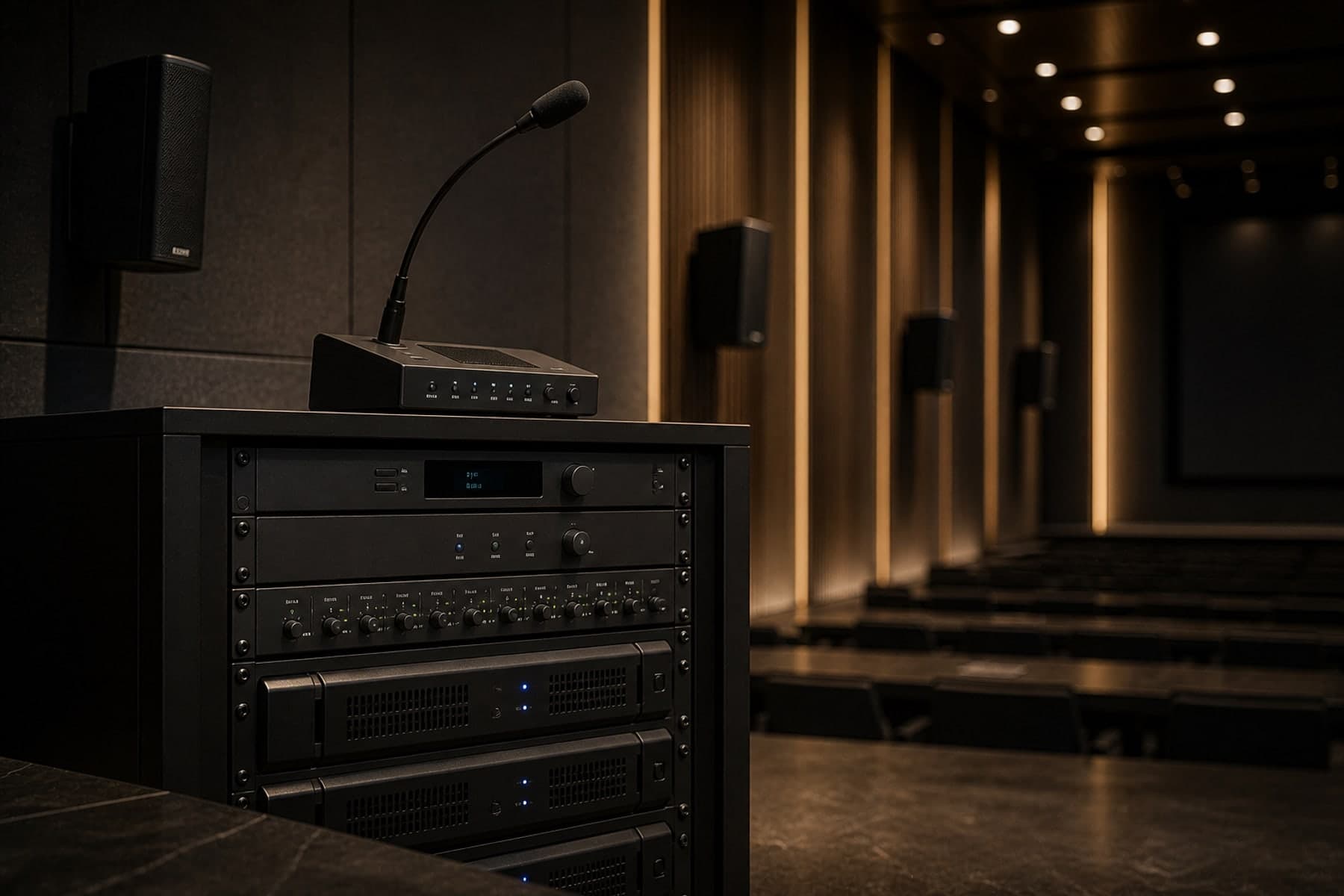
/ Pro Audio · Corporate Auditorium
The room first. The rig second. The brand always last.
K-array's Kgear pro-install line — speech-first column arrays for premium corporate rooms.
Wood-slat acoustic walls, CEO at the lectern, KG-K12 columns flanking the proscenium.
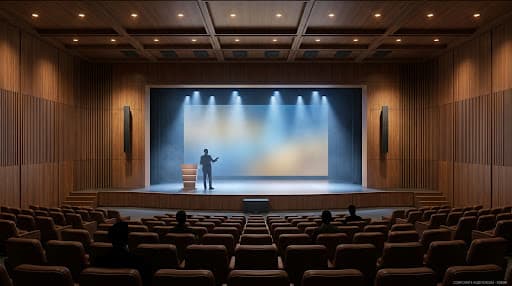

SPL target
94 dB(A) at FOH · STI ≥ 0.62
Coverage
± 2 dB across audience zone, 6 m to 24 m
DSP
BSS BLU-806 · presidium / Q&A / presentation presets
Venue rig demonstrator · spec rebuilds on selector
Specify the venue. The rig follows.
K-array, Kgear, JBL Professional, Bose and BSS engineered into the room — not retrofitted at commissioning.
K-ARRAY · KGEAR · JBL PROFESSIONAL · BOSE · BSS
/ Venue
/ Rig Stack
- › Kgear KG-K12 dual-12" column · L/R primary
- › Kgear KG-S15 single-15" sub · centre stage front
- › Kgear KG-M6 ceiling under-balcony infill · 6× rear
- › BSS BLU-806 DSP · feedback-suppressed speech matrix
- › Crown DCi-N amp stack · networked monitoring
Indicative spec.
Rebuilds per actual brief.
Professional Audio — Venue Rig Selector
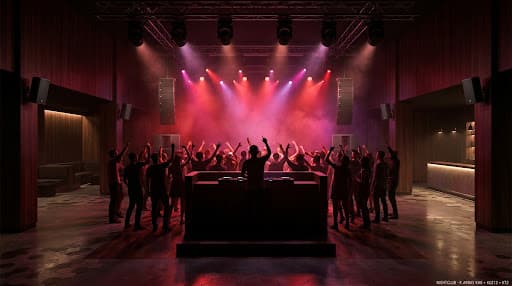
- Nightclub / Lounge: K-array. 800 capacity · 4-zone dancefloor + lounge. SPL 112 dB(A) avg · 118 dB(A) peak.
- Corporate Auditorium: Kgear. 450-seat hybrid hall · speech + presentation. SPL 94 dB(A) at FOH · STI ≥ 0.62.
- Stadium / Arena: JBL Professional. 12,000 capacity · open-air concert + sports PA. SPL 108 dB(A) at FOH · 95 dB(A) at upper deck.
/ The discipline, in detail
How we approach professional audio & pa systems.
We design PA systems to a measurable standard — STI ≥ 0.55 in every audience seat, SPL coverage within ±2 dB across the listening plane, and feedback margin sufficient for live performance. Voice-evacuation (EN 54-16 / IS 16102-2) is engineered as a life-safety layer, not an afterthought, with redundant amplifier zones and battery-backed monitoring.
On record
Every professional audio & pa systems engagement is documented end-to-end — design, programming, commissioning, calibration — and handed over with the files our successors would need if we were never to return.
/ Three lenses on the same system
Read it the way you actually need it.
Three short readings of professional audio & pa systems — for a non-engineer who needs the picture, an engineer who needs the spec, and a buyer who needs to see the system in operation.
/ In simple terms
A professional public-address system delivers clear speech to every seat — whether the room is a 400-seat town hall or an 1,800-seat civic auditorium. The trick is not the speaker brand; it is the engineering of how the speakers are hung, how the room is treated to control echo, and how the system over-rides routine paging when a fire alarm fires.
/ Technical explanation
A pro-audio PA system delivers measured STI ≥ 0.55 (voice-alarm threshold) to STI ≥ 0.62 (reference) at every audience seat through a Dante/AES67 source layer, a digital DSP core with feedback-suppression and room-EQ, line-array hangs engineered per-room with calibrated splay and DSP shading, and zone amplifiers with hardware-enforced voice-alarm priority. Voice-alarm overlay to IS 16102 / IEC 60849 / EN 54-16 where the occupancy threshold applies.
/ Real project usage
Capital Cultural Hall Kohima delivers STI 0.64 mean across the 1,800-seat audience plane on a JBL VLA-series line-array hang with Crown amplification, BSS BLU100 DSP and calibrated per-element splay shading. Town Hall Dimapur delivers STI 0.61 at every seat on a compact line-array hang for the 400-seat civic auditorium. Both halls' amplifier zones carry hardware-enforced voice-alarm priority over routine paging, tested on every quarterly AMC visit.
/ System architecture
The layers, named.
Every layer below is engineered as one piece of the integrated stack. Each carries its own commissioning artefact and its own AMC inclusion.
- 01
Microphone and source layer — handheld and lapel wireless mics, lectern mics, source players, broadcast feeds — connected to a digital DSP via Dante or AES67 audio-over-IP.
- 02
DSP core — feedback suppression, mix-matrix routing, EQ, compression, room-EQ. Programmed in-house against the room's measured RT60 and the source-and-zone matrix.
- 03
Amplifier zones — power amplifiers per audience zone, with hardware priority inputs for fire-alarm voice-evacuation pre-emption.
- 04
Speaker layer — line-array hangs at the proscenium, distributed ceiling speakers in foyers, fill speakers under balconies, in-ceiling for hospitality zones. Hang geometry modelled in the manufacturer's design tool (K-Framework3, Line Array Calculator, ArrayCalc) before procurement.
- 05
Voice-alarm overlay — for occupancies above the IS 16102 threshold, the PA system is engineered as a voice-alarm system to IS 16102 / IEC 60849 / EN 54-16 with supervised cabling, redundant amplifiers, battery-backed power for 30 minutes minimum, and per-zone fault reporting.
/ Design considerations
The decisions we take early.
- STI per seat is the design target — STI ≥ 0.55 is the floor (IS 16102 voice-alarm threshold), STI ≥ 0.62 is the performance target.
- Room RT60 is modelled in EASE for any audience plane above 200 seats, with the speaker-coverage map and the acoustic-treatment design developed against the model before procurement.
- Line-array hang geometry — splay angles, J-curve at the bottom of the array, DSP shading for distance compensation — engineered per-room, not catalogue-default. The output is a measured SPL coverage map across the audience plane that should fall within ±2 dB front-to-back.
- Zone topology — routine paging on primary zones, voice-evacuation on hardware-priority inputs over-riding routine. Zone count and zone partition driven by the building's emergency-evacuation plan.
- Ambient-noise envelope — HVAC, audience, external — measured at design stage, with the speaker SPL and EQ tuned against the worst-case ambient noise.
/ Integration logic
How it talks to the rest.
- Fire-alarm voice-evacuation — the fire-alarm panel's voice-evac module is wired to the highest-priority hardware input on every zone amplifier; on a fire-alarm trigger, every zone broadcasts the affected-zone evacuation message regardless of routine PA state.
- BGM and routine paging — multi-source mixing through the DSP, with operator-pressed presets for the building's actual operating modes (auditorium, civic-meeting, banquet, wedding).
- Mode presets — for multi-mode halls, operator-pressed presets reconfigure the DSP for the venue's actual use case without DSP knowledge.
- AV integration — programme audio from the venue's AV system routed into the PA's source matrix.
/ Failure scenarios
What goes wrong, in practice.
- Line-array catalogue-default hang — uniform splay angles, no DSP shading, hot front rows, dead back rows. Mitigated by hang-geometry modelling per-room, calibrated splay angles and DSP shading published in the commissioning report.
- Software-only voice-evacuation priority — a routine paging operation can over-ride the voice-evac. Mitigated by hardware-enforced priority on every zone amplifier.
- Feedback during live council meetings — multiple lavalier mics with generic DSP feedback-suppression preset. Mitigated by DSP feedback-suppression tuned against the actual lectern and presidium mic count.
- RT60 drift after architectural change — a renovation that adds reflective surfaces shifts the room's acoustic behaviour, degrading STI. Mitigated by post-change RT60 measurement and DSP re-tune.
/ Maintenance expectations
What the AMC actually delivers.
- Quarterly cause-and-effect verification — voice-evacuation pre-emption tested on every zone, with signed test record.
- Annual STI re-measurement at every audience plane — the room is verified to still hit its commissioning STI.
- Bi-annual DSP firmware update calendar with offline configuration baseline.
- Wireless mic spectrum management — annual scan to identify clean RF spectrum and re-tune wireless mics where the local broadcast spectrum has shifted.
- Spares — wireless mics, mic capsules, amplifier modules, line-array elements, sized against the manufacturer's MTBF data.
/ Where we deploy this
Active across 6 sectors.
Professional Audio & PA Systems is rarely a standalone brief — it sits inside a wider sector practice with its own codes, expectations and operating rhythm.
Hospitality
Guest experience, engineered.
Commercial & Corporate
Workplaces that begin meetings on time.
Education & Institutions
Schools, colleges and universities.
Government & Public Safety
Mission-grade integration.
Places of Worship
Voice that carries. Light that holds.
Industrial & Warehousing
Operations that don't take a day off.
/ Sister services
The rest of elv.
A serious brief usually crosses two or three of these. Read across the discipline — we deliver them as one contract.
- 02
CCTV & Surveillance
Coverage. Storage. Evidence.
IP video surveillance — Hikvision, Dahua, Axis, Bosch — designed to coverage, recording-bandwidth and retention specifications, with VMS and AI-analytics overlays.0 - 03
Access Control
Right person. Right door. Right time.
Card, biometric, mobile-credential and visitor-management — Honeywell, HID, Matrix and Suprema — integrated with CCTV, intrusion and HR systems.1 - 04
Fire Alarm System
Detection that pinpoints. Response that is coordinated.
Addressable fire detection and alarm — Honeywell, Bosch, Notifier and Siemens panels — integrated with PA, BMS, access control and emergency lighting per NBC, IS 2189 and NFPA 72.2 - 05
Fire Hydrant System
High-volume water, precisely where it's needed.
Wet- and dry-riser hydrant systems, jockey-and-main pump rooms, yard hydrants and four-way fire-brigade inlets — designed to NBC, IS 13039 and NFPA 14.3 - 06
X-Ray Baggage Scanners
Operator confidence, in seconds.
Dual-energy X-ray baggage and parcel scanners for airports, hotels, government buildings, courts, malls and corporate lobbies.4 - 07
Under Vehicle Surveillance (UVSS)
Full-chassis scan, the moment a vehicle arrives.
Embedded high-resolution UVSS with ANPR and driver-occupant cameras — a critical first line of defence at every vehicle entry point.5 - 08
Door-Frame Metal Detectors
Quick, unobtrusive, accurate.
Multi-zone DFMDs with adjustable sensitivity, pinpoint LED indicators and networked logging — for hotels, courts, places of worship, malls and government buildings.6 - 09
Boom Barriers & Motorised Gates
Controlled flow, every gate.
Boom barriers, sliding and swing gates, road blockers, bollards and turnstiles — integrated with ANPR, RFID and access control.7 - 10
Nurse Calling System
Patient request to nurse response. Documented.
IP-based nurse call systems with bedside, bathroom, code-blue and staff-presence stations, integrated with mobile and PA.8
/ Where this system has been deployed
Professional Audio & PA Systems on the ground.
The reference projects below carry a professional audio & pa systems layer engineered as part of an integrated stack. Each case study walks through the engineering challenges that were solved, the standards the work was held to, and the operational outcome on the day-two team.
- Completed · Handover 2017
Arunachal Pradesh Legislative Assembly
Government · Legislative Chamber · Itanagar, Arunachal Pradesh
- Completed · Handover 2018
Cabinet Conference Room, Arunachal Pradesh Secretariat
Government · Cabinet Conferencing · Itanagar, Arunachal Pradesh
- Completed · Handover 2024
Tinsukia Medical College & Hospital
Healthcare · Government · Tinsukia, Assam
- Completed · Handover 2022
Capital Cultural Hall, Kohima
Government · Cultural Auditorium · Kohima, Nagaland
- Completed · Handover 2024
Town Hall Auditorium, Dimapur
Government · Civic Auditorium · Dimapur, Nagaland
- Completed · Handover 2025
Taraghar — State Guest House
Government · State Guest House · Shillong, Meghalaya
/ Integration with
How professional audio & pa systems talks to the rest.
A serious deployment of this system rarely operates in isolation. The disciplines below most commonly share its cabling pathways, its controller logic, and its cause-and-effect matrix.
Fire Alarm System
Detection that pinpoints. Response that is coordinated.
Addressable fire detection and alarm — Honeywell, Bosch, Notifier and Siemens panels — integrated with PA, BMS, access control and emergency lighting per NBC, IS 2189 and NFPA 72.Auditoriums & Boardrooms
Rooms that begin on time.
Turnkey auditorium, boardroom, training-room and conference-room AV — display, audio, control, video-conferencing and lighting integrated to a single touch.Acoustic Solutions
Rooms that sound the way they look.
Acoustic design and treatment for cinemas, auditoriums, recording studios, places of worship and conference halls — engineered absorbers, diffusers, bass traps and ceiling clouds.
/ Read deeper
The engineering, in long form.
Each article below goes deeper than this service page can — a full walk-through of the engineering decisions, written by the team that delivers this work.
- AV · 11 min
Public-address system design: STI targets, zoning, and the line-array hang nobody calculates
A public-address system is graded by speech intelligibility (STI) at every seat, not by the headline wattage. The discipline of designing for STI ≥ 0.55 across an 800-seat hall, the zoning that lets emergency announcements over-ride routine paging, and the line-array hang geometry that delivers flat coverage from row A to row Z.
Read article - AV · 11 min
Why fluid acoustic treatment beats panel-only above 800 seats
Above 800 seats, panel-only acoustic treatment hits a wall — diffraction, low-frequency build-up and audience absorption variation make the room misbehave. Fluid acoustic treatment — variable-density absorption, tuned bass-traps and adaptive diffusion — delivers measurably better STI and intelligibility scores. The position we take and why.
Read article
/ Frequently asked
Professional Audio & PA Systems — what buyers ask first.
What is voice-evacuation and is it mandatory?
Voice-evacuation is a code-compliant EN 54-16 / IS 16102-2 PA system that broadcasts pre-recorded evacuation messages on fire-alarm trigger — mandatory in many high-occupancy buildings under NBC. A code-compliant PA system that, on fire-alarm trigger, broadcasts pre-recorded evacuation messages to specific zones. It is mandatory in many high-occupancy buildings under NBC and the local fire NOC. Generic background-music systems do not qualify.
What's the difference between a PA and a voice-evacuation PA (PAVA)?
A standard PA delivers paging and music. A voice-evacuation PA is fire-rated equipment certified to EN 54-16 / IS 14735 with redundancy, supervision, fire-survival cabling and integration into the building's fire-alarm cause-and-effect matrix. PAVA is mandatory under NBC 2016 in most commercial, hospitality, healthcare and educational occupancies above defined thresholds.
Line-array, point-source or distributed ceiling speakers?
Line-array for any auditorium or large-volume space (concert hall, conference centre, large lobby). Point-source for medium rooms with focused listening positions. Distributed ceiling speakers for offices, hotels, classrooms, retail — anywhere uniform background-paging coverage is the goal. We model SPL coverage in EASE before specifying.
JBL VTX, K-array or d&b audiotechnik — which line-array?
JBL VTX-series is the broad-spectrum standard for large auditoria and our default for most civic and convocation venues — proven, serviceable, cost-effective at scale. K-array is the specialist choice for nightlife, rooftop bars and architectural-discreet hangs where compact form-factor and bass impact both matter. d&b audiotechnik is the audiophile reference for concert halls and acoustically demanding rooms. We specify by venue acoustics and operating context, not by partnership.
How is the PA tuned to a room?
Through pink-noise measurement at multiple seat positions with a calibration microphone and EQ software (Smaart, REW). The DSP (BSS, Q-SYS, Yamaha) is then programmed with PEQ, dynamics and routing per zone. We deliver a written tuning report on every install.
Do PA systems need backup power?
Voice-evacuation PA does, mandatorily — under NBC 2016 the system must operate for at least 30 minutes after mains failure on internal batteries. Standard non-evacuation PA is typically backed by the building's UPS or generator. We engineer both in coordination with the building's overall power strategy.
· Begin
Begin a
professional audio & pa systems
brief.
Tell us about the building, the timeline, and what success looks like a year after handover. We will reply within two working days with a written response, not a sales pitch.