
/ BMS
UPS runtime: the misconceptions that turn a 30-minute spec into a 12-minute reality
Quick answer
UPS runtime is the most over-specified and under-engineered number in the building's power layer. The catalogue figure assumes nameplate kVA at unity power-factor, fresh batteries at 25°C, and the published Peukert exponent for the battery chemistry. Real holdover at 30 months is typically 60-70% of catalogue for VRLA banks, 80-90% for LFP — driven by battery degradation curve, actual operating temperature (every 10°C above 25°C halves VRLA life), actual load power-factor (PoE switches and Wi-Fi 6 APs run at 0.9-0.95 PF, not 1.0), and the Peukert effect on high-discharge events. Per-load UPS sizing is uptime engineering; shared-bus UPS is power-quality engineering. The brief decides which is right.
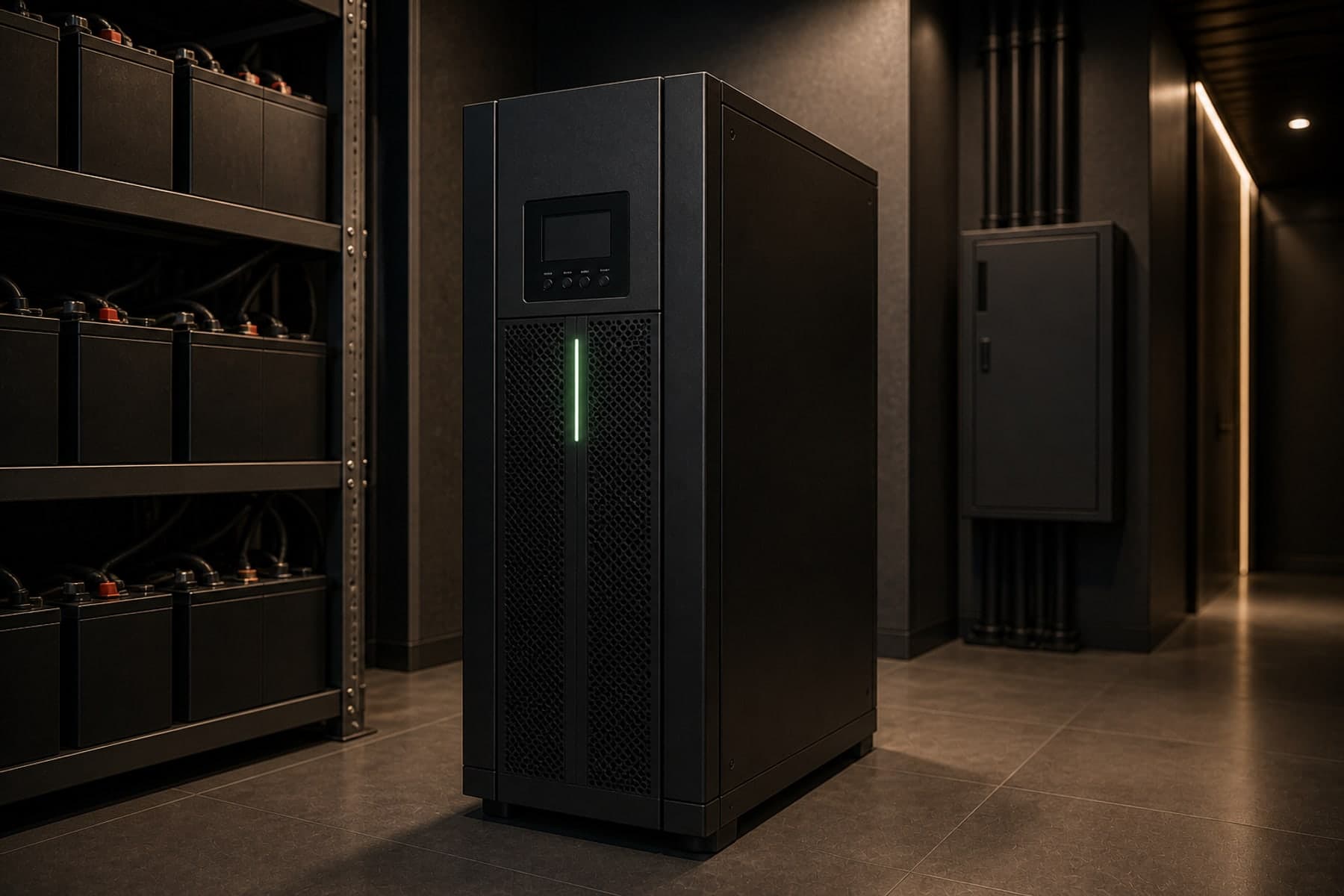
UPS runtime is the spec that survives in the building's nameplate but rarely survives in the building's operation. The catalogue figure is a clean-room test result; the building's holdover at month 30 is what the operator actually has when the mains fails. The gap is engineered, not bridged after the fact.
Battery chemistry decides the degradation curve
VRLA (sealed lead-acid) is the workhorse of mid-tier UPS deployments — cheap, well-understood, predictable. The degradation curve is also well-understood: 5-8% capacity loss per year under nominal conditions, accelerating to 12-15% per year above 30°C ambient. A 30-minute autonomy bank at year one is a 22-minute bank at year three and a 14-minute bank at year six. The AMC schedule treats VRLA banks as a 3-year refresh cycle for any holdover-critical load.
LFP (lithium iron phosphate) carries a much shallower degradation curve — 2-3% capacity loss per year under nominal conditions, 5,000-7,000 cycle service envelope at 80% DoD. A 30-minute LFP autonomy at year one is 27-28 minutes at year five and 24-25 minutes at year ten. The capex penalty is real (2.5-3× VRLA at parity capacity), but the lifecycle economics favour LFP for any deployment with 15+ year planning horizon.
Temperature is the silent runtime killer
Battery cabinet temperature is the leading silent factor in runtime collapse. Every 10°C above 25°C halves VRLA service life; LFP is less sensitive but still de-rates above 35°C. UPS battery cabinets in tropical-climate buildings without dedicated cooling routinely operate at 35-40°C, which compresses the published 5-year VRLA life to 2-2.5 years. Battery-room HVAC is sized against the full-discharge thermal envelope, not the standing-charge load.
Power-factor reality vs catalogue assumption
UPS nameplate kVA is published at unity power-factor (1.0). Real loads have lower power-factor: modern PoE switches and Wi-Fi 6 APs run at 0.9-0.95 PF, AV-over-IP encoders at 0.85-0.92 PF, server-class loads at 0.85-0.95 PF. A 10 kVA UPS at unity PF delivers 10 kW; the same UPS at 0.9 PF delivers 9 kW. The runtime calculation must use the actual load wattage at the actual PF, not the nameplate kVA.
Peukert effect on high-discharge events
The Peukert exponent describes how battery capacity degrades non-linearly with discharge rate. A 100 Ah battery discharged at the 20-hour rate delivers 100 Ah; the same battery discharged at the 1-hour rate delivers 50-60 Ah depending on chemistry. High-discharge events (full-load UPS discharge during a sustained outage) consume more battery capacity than the nominal calculation suggests. The Peukert correction is built into proper UPS runtime calculators; the spec-sheet runtime is the nominal-rate figure, not the high-discharge corrected figure.
Per-load UPS vs shared-bus UPS
Per-load UPS architecture puts every critical load class on its own dedicated online UPS — a fault on one load cannot cascade across the stack. Shared-bus UPS routes everything through one mainline UPS, cheaper capex and a single point of failure. The brief decides which is right: when uptime is the brief (perimeter security, command-and-control, medical-imaging), per-load is correct; when power-quality is the brief (data centre, broadcast), shared-bus with full redundancy is correct.
AMC discipline is what preserves the runtime spec
VRLA battery autonomy tests at quarterly intervals — battery bank discharged under measured load, runtime measured against the spec, replacement triggered at 80% of spec. LFP autonomy tests at semi-annual intervals with the cell-level capacity baseline preserved. The test is the operational deliverable; without it, the runtime spec is theoretical and the first sustained outage is also the first discovery.
Configuration baselines are part of the spec
UPS configuration (inverter mode, ECO mode, battery-test schedule, alarm escalation thresholds) is exported offline at handover and re-exported after every firmware refresh. A clean-slate UPS recovery within the same business day is the operational guarantee; without the configuration baseline, the recovery is hours of vendor-mode reconfiguration.
Callout — what UPS procurement most miss
Runtime spec is not runtime delivered. The catalogue figure is the starting point; the AMC discipline, the battery-cabinet thermal envelope, the actual load power-factor and the Peukert correction together decide what the building actually has when the mains fails. Engineer against the delivered runtime, not the nameplate.
References
1. IEC 62040-1 — uninterruptible power systems (UPS).
2. IEEE 1184 — guide for batteries for uninterruptible power supplies.
3. NFPA 110 — emergency and standby power systems (international cross-reference).
4. Peukert's Law — battery discharge-rate to capacity relationship.
Per-load UPS vs shared-bus topology
ups-ats-redundancyDiagram · described
Per-load UPS vs shared-bus UPS topology
Per-load UPS architecture (left): each critical support load sits on its own dedicated online double-conversion UPS so a fault on one load cannot cascade across the stack. Shared-bus architecture (right): one mainline UPS feeds every load, so a fault or maintenance event takes the entire stack offline. The per-load architecture costs more capex but enforces fault containment at the power layer rather than the application layer.
Key engineering takeaways
- Catalogue UPS runtime assumes nameplate kVA at unity PF, fresh batteries at 25°C — real holdover at month 30 is typically 60-70% of catalogue for VRLA, 80-90% for LFP.
- Battery cabinet temperature is the leading silent runtime killer — every 10°C above 25°C halves VRLA life.
- Modern PoE / Wi-Fi 6 / AV loads run at 0.85-0.95 PF, not 1.0 — the runtime calculation uses actual load wattage at actual PF.
- Peukert effect compresses delivered capacity on high-discharge events — proper sizing applies the chemistry-specific correction.
- Per-load UPS is uptime engineering; shared-bus UPS is power-quality engineering — the brief decides, not the catalogue.
- Quarterly VRLA autonomy tests and semi-annual LFP cell-baseline tests are the AMC discipline that preserves the runtime spec.
- UPS configuration baseline export at handover and after every firmware refresh enables same-business-day clean-slate recovery.
/ Frequently asked
Quick answers from the practice.
- How often should VRLA banks be replaced?
- Every 3 years for any holdover-critical load on the AMC schedule, regardless of measured capacity at the 3-year point. The cost of replacement is decisively lower than the cost of a sustained outage on a degraded bank.
- Is LFP worth the capex penalty?
- For any deployment with 15+ year planning horizon, yes — the lifecycle economics favour LFP decisively. For shorter-horizon scope, VRLA on a 3-year refresh remains the right answer.
- How is the actual load wattage measured?
- Per-circuit measurement at handover under a representative load envelope — the measurement informs the runtime calculation and the per-load UPS sizing. The catalogue nameplate is a starting point, not the operational figure.
- Does TechnoGuru run quarterly UPS autonomy tests?
- Yes, from Silver upward — the governed cadence is a quarterly load-bank test at Silver and Gold, a monthly load-bank test with a quarterly cell-resistance survey at Mission-Critical, and semi-annual at Bronze. Battery bank discharged under measured load, runtime measured against the spec, replacement triggered at 80% of spec. The test record is in the AMC log.
/ What to do next
Three next steps for UPS scope
- Try the UPS runtime estimator →Peukert-corrected ride-through against chemistry, ambient and load PF.
- Read the lithium-vs-VRLA insight →Battery chemistry economics and lifecycle horizons.
- Read the infrastructure redundancy insight →N+1, 2N and the failover-test discipline.
Engineering toolkit
Tools that go with this read
If this article gave you a question worth pricing, these calculators give a defensible first number.
- BMS · Energy
Energy & Efficiency Estimator
Adjust building variables and see indicative energy and CO₂ savings (kWh) for a BMS-driven energy upgrade plus daylight-harvesting LED retrofit. Conservative; defensible in a first conversation.
kWh · CO₂ savedOpen - Multi-category
Brand Comparison Tool
Thirteen-category catalogue — automation, home & pro audio, projector, networking, surveillance, BMS, fire, lighting control, UPS & power, conferencing, EPABX and active-LED display. Pick a discipline, pick up to four brands, compare on the fields that matter. Honest about strengths, gaps and where each is decisively right.
13 disciplines · 4-upOpen - Lead intake
Project Brief Wizard
Six structured questions, a written response within two working days. The fastest path to engaging the practice on a real project.
6 questions · 2-day replyOpen
Related engineering decision
The comparison behind this question.
Decision · Power & UPS
Online UPS vs BESS-backed backup — the right ride-through
You are deciding how to protect a critical load and are weighing instantaneous ride-through against longer-duration backup or an energy strategy.
Decision · Power & UPS
Online UPS vs line-interactive UPS — the topology decision
You are choosing UPS topology for a specific load group and need to know whether a transfer event is acceptable to the equipment behind it.
· Where to go next
The wider authority graph for this topic.
Engineering pages
Read further
Editorial — about this surface
TechnoGuru Operational Continuity Practice
The operational continuity practice engineers for environments where the system simply cannot drop. UPS sizing, battery and BESS engineering, redundancy architecture, fail-over discipline and the operational drills that make sure continuity holds when the grid does not.
Reviewed against operational-continuity field realities — every recommendation is held to what survives a drilled fail-over.
Last reviewed
18 May 2026
Engineering domains
UPS and BESS sizing · Power-redundancy architecture · Fail-over and load-shedding design · Mission-critical observability
Operating environments
Healthcare and clinical environments · Datacenter-adjacent facilities · Broadcast and live-event venues · Mission-critical institutional sites
/ Discuss your project
If this article matches a brief you are working on, the next step is a short brief — a project lead replies to it directly.
We do not run sales pipelines. The first reply comes from a project lead, within two working days, and it goes straight to the engineering question rather than a brochure.